The Ethics of Swallowing

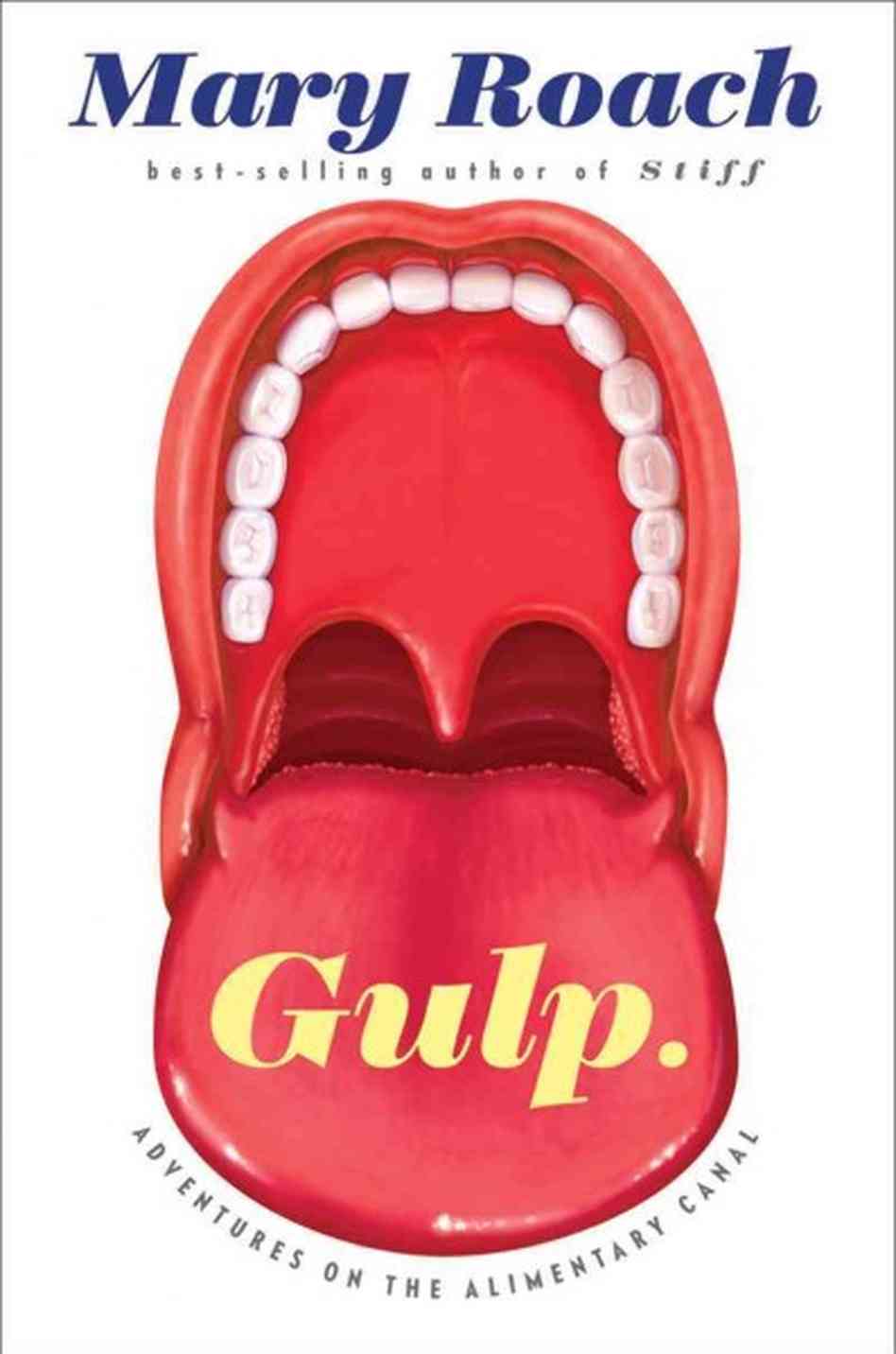
GulpMary Roach never fails to please. I first discovered her during a jaunt to my local, lamented Borders (not a weekend passes when I don’t mourn the chain’s closing anew) on an autumn evening when Spook leaped out at me (metaphorically) from the science section. I have read layperson-digestible science since I was in junior high school, having been a charter subscriber to Discover magazine. I was, therefore, amazed when I realized an author with some scientific credibility would take on the topic of ghosts. This was followed by Stiff, Bonk, Packing for Mars, and now, Gulp. The subtitle of Gulp, Adventures on the Alimentary Canal, captures the flavor of this book about eating. While some live to eat, we all eat to live, and it makes perfect sense that religion could come to shine a little light in this facet of human existence. Actually, although Roach doesn’t emphasize it, the ethics of eating has become a major interest in embodiment theology over the past few years. Food and faith, it turns out, are closely connected.

In Gulp, the one instance where religion comes into major play regards, ironically, rectal feeding. Roach points out that the question of its effectiveness had been part of discussions of fasting in the contexts of convents. Some traditions in various religions advocate denying oneself food as an act of penance or contrition. The question of whether nourishment taken without the satisfaction of eating counted, however, is one that the church took up. Characteristically not making a definitive answer, the practice mutely continues. Roach notes that clergy have been among the avowed supporters of colonic irrigation as well, making one wonder why the upper half of the alimentary canal has typically caused religions so much trouble. Of course, Roach is not writing about religion, but about eating. But still…

Religion, broken out abstractly from everything a person does, is a modern phenomenon. In fact, it is questionable whether religion can even be considered as a phenomenon of ancient societies at all since it was so thoroughly integrated into everything a person did. When priests separated themselves from laity, at least as early as ancient Sumer, the idea that one class of people could handle the requirements of the gods while the rest of us got along with the secular business of living life took hold. But religious specialists still maintained control over morals. Food, in a world of unfair distribution, will forever be an ethical issue. Instead, most religions have brought the focus down to the individual. What you eat may very well reflect your religious beliefs. Whether we feed the world or not we have, unwisely, left to politicians. As I ponder this indigestible topic, I recommend reading Gulp for a bit of relief from the serious business of the ethics of eating.


Invoking Imbolc

As the year continues her eternal circle, we find ourselves once again at Imbolc, the cross-quarter day between the winter solstice and the vernal equinox. Imbolc is an ancient fire festival, and given how chilly our apartment has been these last few weeks, I think I could be downright pagan about it. Dividing the year into eighths, the pre-Christian calendar emphasizes the seasonal aspect of nature. The festival was originally dedicated to the goddess Brighid who became, in her later years, St. Brighid. Naturally, when the Celtic lands were converted, Imbolc was supplanted, somewhat, by the following day—not yet Groundhog Day—Candlemas, or the feast of Mary of the Candles. Diametrically apposed to Samhain, or Halloween, Imbolc celebrates the rekindling of light in a dark time of year. Some have suggested that the festival has roots as early as the Neolithic Period.

One feature of the old religions that was lost with the more transcendent interests of monotheism is the dedication to the earth. Religion, in its earliest forms, grew out of a profound awareness of human connections to the planet that was their home. Without our planet we do not thrive. Even though we’ve learned to catapult ourselves into space, our bodies don’t work so efficiently in zero gravity. (Read Mary Roach’s Packing for Mars for the gory details.) We evolved on and are part of the earth. Early peoples knew that instinctively. Their religion reflects that implicitly. Kindling a fire in winter is a small way of encouraging the light and warmth to return.

Stbrigid

Brighid, a goddess who represents the return to fertility with the earliest beginnings of spring, may also represent the earth. It will be at least another month or two before many of us will begin to see the hints of crocuses breaking through the wan grass, but Imbolc is all about turning that corner. The earth that seems to have forsaken us in the desolate winter is now about to welcome us back into the growing time. It is no wonder that, despite efforts of the missionaries, elements of the old religion remained. Whether with candles or bonfires, the pagan goddess Brighid, or the Christian Saint Brighid, ushers in February, our last full month of winter. And tomorrow, the groundhog will remind us once again that we are merely part of the earth.


Prayers in Space

Science with heart. That’s one way to characterize Mary Roach’s writing. Uninhibited is another. I began reading her books when I saw Spook on the science shelf at Borders some years back. The nexus between what science teaches us and the magisterium of religion (ghosts certainly, by definition, fall into the “spiritual” category) has intrigued me all my life. I posted on both Spook and Stiff earlier in this blog. Her current work that my wife and I have just finished reading is Packing for Mars: The Curious Science of Life in the Void. The message that has rung loudly in my ears throughout the reading is that humans are evolved for this planet—space is not our native environment (well, at least not in a non-metaphysical sense). So many of the troubles she documents stem directly from the fact that we are biologically programmed to keep our feet pretty firmly on the ground. Weightlessness atrophies our bodies, cosmic radiation destroys our tissues, and there is always the difficulty of finding fast food in space.

One of the most telling points Ms. Roach makes, as is frequently the case, comes in a footnote. The note could, with some imagination, have been expanded into an entire chapter. “Religious observations are even tougher in a real spacecraft,” she begins. She points out specifically the difficulties of taking communion on a moon trip or praying five times a day aboard the International Space Station that renders a day a mere 90 minutes in length and staying Mecca-oriented is difficult when moving so far so fast. Religious leaders have to make special dispensations for those who take their religion beyond the bounds of earth-evolved faiths.

All of this raises a question that religions are reluctant to ask directly—what are we to make of petty observances that our belief systems demand when they are clearly based on outdated information? Judaism, Christianity, and Islam all developed in a flat world in a geocentric universe with a dome-like sky above them. The regulations were drawn up for just such a fictional world. When the religious become astronauts they leave that world behind them in a way that must stretch the credibility of a doctrine developed without the input of an astrophysicist. How does an astronaut hope to go to Heaven when some missions take her or him far beyond the realm of the gods into the cold reality of outer space? Looking down on Heaven must be disorienting indeed. If Mary Roach had an equal in the world of religion writing, I would hope that she would ask that very question. In any case, we are fortunate enough to have the one and only Mary Roach to raise the question for us and to keep us oriented toward our true home.