Price Drop

Here’s a public service announcement for your Friday.  If you’ve been wanting to read Holy Horror but found the price too high, McFarland has now lowered the cover price to under $30.  Here’s the link: Holy Horror.  Of my non-academic books, this has been my “best seller.”  Since I’m currently shopping around another book, and since agents aren’t interested (at least not any more), I wondered whether McFarland might look at it.  The editor who handled Holy Horror had left, and the new editor responded to my concern about pricing by telling me that they lower prices after a couple of years.  She noticed, however, that Holy Horror had been overlooked in the price lowering process, so voila!  It’s now affordable.

This model, while not the same as trade publishing’s efforts to get primarily front-list sales, seems to make sense.  Too many publishers raise prices year after year, so if you don’t buy immediately you’ll pay more.  McFarland tends toward a paperback first model.  The first couple of years are aimed at library sales—and they do well at those—then they lower for individual purchase.  All I had to do was ask.  Two years ago I asked Lexington/Fortress Academic if they’d do a paperback of Nightmares with the Bible.  That poor book never had a chance.  The editor said they were considering it.  Instead they did the trick that publishers seem to like: decoupling the ebook price from the hardcover.  So you can buy some expensive electrons instead of holding a real book.  So it goes.  I’ve written a museum piece.

It’s a little too soon to say about The Wicker Man.  My experience has been that university presses, particularly British ones, like to raise prices rather than chasing sales.  If you’re reading this blog you know that I’ll market my books.  I even printed bookmarks for Holy Horror at my own expense.  Maybe it’s time to start distributing them again.  What a difference ten dollars can make!  I’m a book booster.  (You might not have noticed.)  I’m glad that McFarland understands that individuals will buy books, even if they’ve been out for a while.  The standard wisdom among academic publishers is “three years and then you’re done.”  If you’re inclined to help prove that business model wrong, you can now get Holy Horror without having to take out a second mortgage.  That’s cause for hope—any writer has the dream that her or his book will keep on selling.  Sharing this information will, it seems, make it wider known. Please pass it on.

Paperback Nightmares

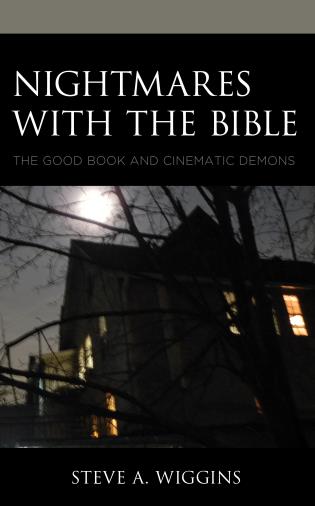
I’m not assertive.  My voice is not loud and even when I have strong opinions I like to let others have their say.  Those of us who’ve been beaten down too many times can be like that.  So it took a lot of courage to ask.  “Is it possible that Nightmares with the Bible might be issued in paperback?”  You see, I know that “academic” books almost always sell the copies they’re going to sell in the first year.  Some follow-up sales continue into years two and three, but beyond that it’s about done.  And I also know that when authors ask for a paperback it almost never sells as well (or even more poorly) than the hardcover.  I’m hoping the paperback of Nightmares will buck this trend because it published into the pandemic.  That was a game-changer.

When you’re worried about staying alive you might not feel like reading about demons.  Of course, what better time to do so is there?  Paperbacks are often produced, in academic settings, to appease authors.  I have long believed—and this flies counter to the orthodoxy of the publishing world—that if books were initially published in paperback and priced affordably they would sell better.  The fear is that the higher priced hardcovers wouldn’t be purchased by libraries.  Librarians would, oh tremble, purchase the reasonably priced paperbacks and rebind them for less expense than the stratospheric price put on a 208-page monograph.  Publishers are often afraid to try anything different.  Assured sales are a blessing that can be bankrolled.

I’m hoping, once the paperback comes out, to do some more promotional work on it.  This blog was started long before I had books to flog.  It’s free content for those who like the less sweet kinds of treats in the bowl.  I do appreciate the occasional free advertising I can do.  It’s my hope that there’s always something to learn offered with it.  Successful content providers can make a living doing it.  Others pay for the privilege.  I often ponder what will happen to this blog when I run up against the size limits of my WordPress account.  The next level up, commercial, is beyond my price range.  Perhaps, like a phoenix, it will be time to start all over again when that moment comes.  In the meantime I’ll reuse images as often as I can, because each new one takes a byte out of my account.  And when it’s all said and done, Nightmares will still be available in print. Hopefully in paperback next year.


Paper not Paper

I’m sure other people have this problem.  I read hardback books with the dust jacket off.  Lest anyone accuse me of being consistent, my wife reminds me that I debated the opposite side early in our marriage.  I guess I’m complex.  In any case, the problem I face is with things pretending to be what they’re not.  This particular book is “cloth-bound.”  I own quite a few cloth-bound volumes, but this one is so slick that I keep dropping it.  It slips right through my fingers.  The reason this happens is because “cloth-bound” seldom means “cloth”-bound.  Modern binderies offer a textured paper covering that looks like cloth but it’s not.  In other words, although this book is not a paperback, it has, in fact, a paper back.  This is more than just semantics.

When looking for a house one of my non-negotiables was that it couldn’t have vinyl siding.  Vinyl siding pretends to be wooden cladding, and I require authenticity.  I don’t want a substance saying it’s something that it’s not.  You see, I grew up in a plain-speaking, blue-collar environment.  The last time I visited my mother’s trailer to get something from her former neighbor who’d moved in, it was summer.  I stepped out of the car and although I’d said maybe less than two sentences to this man in our meetings over the years his first words to me were “What are you all dressed up for?”  A bespectacled, white-bearded veteran, he was wearing a tank-top tee-shirt.  I had on a button-down that had been recently laundered.  I loved his authentic approach.  It was hot out, so why was I “dressed up”?

Book-binding actually has a fascinating history.  Books were originally sold as sheaves of paper in a “book block.”  In the early days booksellers often did the binding themselves, or customers would buy a book block and take it to a bindery of their choice.  That’s why there’s no uniformity in old book covers.  Eventually, however, mechanization allowed for books to be bound before being shipped to book sellers.  Early binding tended to be leather, which is why many Bibles are still sold that way.  I found all of this out from reading various books.  Which ones they were have slipped my mind.  Probably they were bound in paper, pretending to be cloth.  Cloth binding is more expensive than paper-pretending-to-be-cloth binding.  That’s why publishers use it.  The same applies to vinyl siding, I suspect.  Only with human beings does pretend authenticity become more expensive.