Consistency

Consistency.  Back in Wisconsin I belonged to a group of Hebrew Bible professors who read a book and got together to critique it.  We came from different schools—Marquette, Sacred Heart, Carroll College, and Nashotah House (me).  We took turns on different campuses and spent a pleasant Saturday afternoon discussing our selected title.  Soon one of our members, an Auxiliary Bishop for the Diocese of Milwaukee, began to look at me right off and ask if the author had been consistent—my most frequent criticism was inconsistency.  It’s the way I think.  If is an argument is being made, or a story is being told, it has to be consistent in order to be convincing.  Recently I realized that this has carried over into my writing on horror.

The dream of many authors and auteurs is to establish a successful series.  Publishers and studios like them too.  Follow one success with another just like it, so the thinking goes.  People like to see how the story ends.  The longer a series goes, however, the more difficult it is to maintain consistency.  I’ve been noticing this in the articles I’ve been writing lately.  I follow the stories closely and inconsistencies creep in.  I noted this in a recent post about Dark Shadows and I wrote about it when looking at The Conjuring and Paranormal Activity franchises in Nightmares with the Bible.  I realize, just as my Bishop friend pointed out, that consistency is my problem.  Sometimes it gets in the way of enjoying the tale.  Deft authors and auteurs will tease you with it.  It’s part of the literalist mindset.

Being raised as a literalist, from my youngest days I learned that the story goes only one way.  The world, however, is much more ambiguous than that.  Stories have multiple points of view and endless iterations.  Not only that, but not even the author or auteur has the final say in what “really happened.” When I first learned of reader-response theory I was suspicious of it.  Even with a doctorate and teaching experience I was still looking for consistency.  Get the story straight!  But stories are crooked and queer and untamed.  They follow the imagination and defy literary convention.  Those that succeed best are remembered as classics.  The rest are nevertheless expressions of fertile minds with tales to tell.  I doubt I’ll ever get over my watching out for consistency.  I should, however, pay attention to that gentle teasing my erstwhile colleagues gave.  Relax and enjoy learning how it goes this time.

Scary Movies About Scary Movies

Hi all, here’s a guest post to enjoy:

In a meta-twist on the horror movie genre comes the horror film about horror films. Here are some of the most popular and well-executed (see what we did there?) navel-gazing scary films, ie. scary movies about scary movies.

Paranormal Activity (2007)

Rated R

Director: Oren Peli

Starring: Katie Featherston, Micah Sloat, Mark Fredrichs

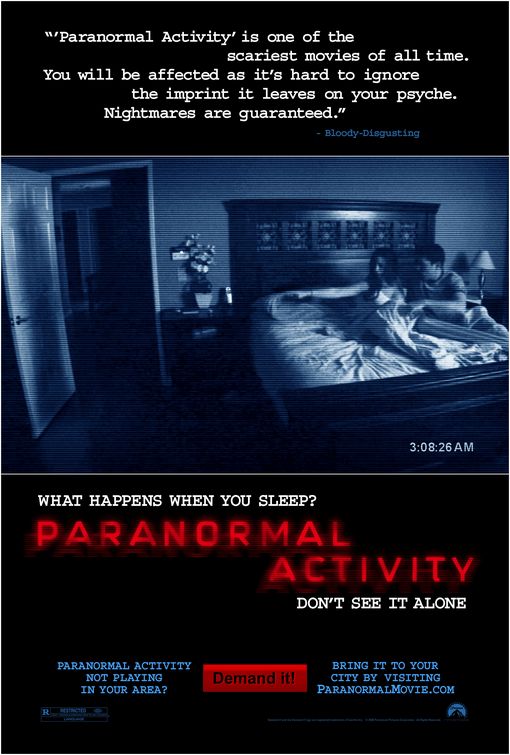
This film has a relatively standard horror plot: a family is stalked by a murderous demon. What makes this film unique, however, is how it’s told. Much of the film is seen through the vantage of security cameras and other devices used to make it appear they were all culled together to thread together the story. This movie spawned a whole series of eight films.

Stream Paranormal Activity on Paramount+, Pluto TV and Netflix.

The Blair Witch Project (1999)

Rated R

Director: Daniel Myrick and Eduardo Sánchez

Starring: Heather Donahue, Michael C. Williams, Joshua Leonard

When this film – likely the progenitor of the entire found-footage horror sub-genre, first released, its uniquely modern (for the time) style of storytelling scared viewers in a whole new and unfamiliar way. Told through a video camera held by an increasingly panicked teen, this poorly lit, blurry, grainy, unsteady, hyper-realistic video-as-film follows friends investigating the myth of a witch and ending up getting lost in the woods.

Stream The Blair Witch Project on Apple TV and Vudu.

Scary Movie (2000)

Rated R

Director: Keenan Ivory Wayans

Starring: Anna Faris, Shawn Wayans, Marlon Wayans, Regina Hall, Shannon Elizabeth

Warning: This film is as much a comedy as it is a horror film. This parody of slasher flicks satirizes popular ones of the day and their classic tropes. Don’t let the comedy fool you though; it’s still got its fair share of scares! The movie spawned four sequels applying the same formula to formulaic haunted house, mysterious object, alien invasion and demon-possessed children movies.

Stream Scary Movie on Apple TV and Vudu.

Midnight Movie (2008)

Rated R

Director: Jack Messitt

Starring: Rebekah Brandes, Daniel Bonjour, Greg Cirulnick, Mandell Maughan

The polar opposite of the Wayan brothers’ franchise, this horror film takes its horror seriously. Replete with classic blood and gore with a little sex and nudity thrown in (thank you, Mr. Hitchcock,) it involves a rare midnight screening at a dilapidated old theater of a slasher film whose maker apparently went insane from it. That doesn’t dissuade the audience, however, all of whom are unaware that when the lights go down, this bloodbath features audience participation.

The Final Girls (2015)

Rated PG-13

Director: Todd Strauss-Schulson

Starring: Taissa Farmiga, Malin Akerman, Adam Devine

An orphan and several other high-school teens watch a B-movie slasher flick made by the orphan’s mother – an 80s scream queen, before she allegedly died. Suddenly, the friends all find themselves trapped inside the movie and face-to-face with some startling truths. To live to tell the tale however, they must adapt to the classic tropes of the genre.

Stream The Final Girls on Apple TV and Vudu.

Recap

After watching these scary movies about scary movies, you’ll never look at another horror movie the same way again!


Unwished Inheritance

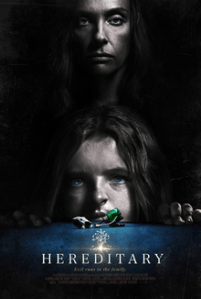
When I mentioned my book Holy Horror to someone recently, she asked “Have you seen Hereditary?”  I had to allow as I hadn’t.  I have to struggle to find time to watch movies, and I’m generally a couple of years behind.  Surprisingly, Hereditary was available for free on Amazon Prime, and I finally had the chance to terrify myself with it.  Perhaps it didn’t help that I’d been reading a book on schizophrenia at the time (as will be explained in due course).  Hereditary is one of those movies that is impossibly scary, up until the final moments when it suddenly seems unlikely.  In this respect it reminded me of Lovely Molly and Insidious.  All three also feature demons.  Using a child to accommodate the coming of a demon king brought in Rosemary’s Baby and the Paranormal Activity franchise.  (The genre is notoriously intertextual.)

While demons can make movies scary, what really worked in Hereditary was the sense of mental instability and the lack of a reliable character to believe.  The Graham family is deeply dysfunctional.  Mix in elements of the occult and dream sequences and you’re never certain what, or whom, to believe.  As with many of the films I examine in Holy Horror, the realms of religion and fear are interbred.   While the Bible plays no part in Hereditary, the matriarch’s “rituals” pervade the family following her death.  In a family of females, where a male demon seeks expression through possession, an obviously challenging dynamic is set up.  It works out through a series of disturbing images and manipulations.

Watching the family disintegrate becomes the basis of the horror.  Then possession comes into play.  As in most films concerning possession, deception and misdirection are used.  A demon named Paimon is seeking to take over the one male heir.  This ties the movie to The Last Exorcism, where the same demon under a different name seeks to propagate through Nell Sweetzer.  Unlike many possession movies, the suggestion that possession is actually involved comes late in the script.  This revelation underscores the the misdirection of attention that focuses on Annie Graham’s struggle to cope with reality.  Her sleepwalking and threats to her own children as well as the suggestion that they are but miniatures being manipulated by a larger, more powerful entity, keep the viewer off balance throughout the story.  Intelligent and provocative, Hereditary assures me that tying to analyze such films, while perhaps a fool’s errand, is an enterprise unlikely to be soon exhausted.


The Problem with Demons

One of the perks to life among a university community is the special programs that come to campus. As an adjunct instructor with a schedule so confusing that even Escher would get lost, however, I do not often have the opportunity to take advantage of such programs. More’s the pity since next week Montclair State University is hosting an event called “The Real Exorcist.” One of the very few authorized exorcists of the Catholic Church will be speaking on campus. The event overlaps with a previously scheduled class at Rutgers.

A little disappointed, last night I sat down to watch Paranormal Activity, the indie movie that made such a splash last year. Assuming it was a ghost story, I wasn’t too concerned about watching it alone on an October night. When I discovered it was a demon story, however, I wasn’t sure watching it alone was such a good idea. You see, in the hands of paranormal investigators the demon has undergone a transformation. Ancient Mesopotamians believed in a set of lesser gods who caused misfortune, although they don’t seem to have been pure evil and they didn’t call them demons. By the time we reach nascent Christianity, demons are cohorts of the Devil and are utterly malign and capable of possessing a person making them do the bidding of their dark lord. That’s where they remained on the divinity scale until modern day investigators using scientific equipment found them. I confess to having watched Ghost Hunters a time or two. Here the demon has morphed into a non-human disembodied entity – the very antagonist of Paranormal Activity.

Being aware of the origin of concepts is often a comforting place to be. When I realize that no special revelation has suddenly validated the existence of a baleful creature set to do me serious harm, a relief encompasses me. The problem with demons is that they don’t evaporate so easily. “Invented” by the Mesopotamians to explain misfortune, by the change of the era they had evolved into (largely) an explanation for epilepsy and mental illness. Now today they are back as haunting entities that have no human sympathy since they were never human. Paranormal investigators take them very seriously, despite their checkered theological pedigree. I guess I side with Shakespeare on this one: “there are more things in heaven and earth, Horatio…” After all, it is October and the nights are growing noticeably long.


Moral Monsters

trees

Everyone likes to feel vindicated. From my childhood I have felt marginalized because of my interests in monsters, and now a book has just been released from Oxford University Press that vindicates my interest! Stephen Asma, a philosophy professor at Columbia College, Chicago, has written a monograph entitled On Monsters: An Unnatural History of Our Worst Fears. Further vindicating my idiosyncratic interest is the fact that the Chronicle of Higher Education even has an electronic front-page article on the book this week. I am overcome with credulity! I haven’t been able to lay my hands on the book yet, but I hungrily read the article and look forward to the whole product.

Readers of this blog know my assertion that monsters originate in a mental space shared by religion. Both are responses to the unknown. Asma writes in his Chronicle article, “The monster concept is still extremely useful, and it’s a permanent player in the moral imagination because human vulnerability is permanent.” Indeed, his article is entitled “Monsters and the Moral Imagination.” The thesis he promotes is that our morality (again tied to religion for many people) benefits from its struggle with monsters. We imagine our moral responses to being faced with the truly horrific, and the monsters themselves are less frightening than our imaginary responses. The top box-office winner this past weekend was Paranormal Activity, a movie noted for not showing the menace, but implying it. There is an evolutionary advantage here; we learn about coping with real danger by imagining danger.

So as I look out the window on yet another cold, gray, rainy October morning, and see the trees swaying in the wind, my imagination takes flight. Those Saturday afternoons and late nights filled with cinematographic visions of even worse things that could happen are cast in a new light. Instead of scaring myself, I was building moral character! As my friend K. Marvin Bruce likes to say, “monsters are only mirrors.” Sometimes the mirror reflects a truly untamed world, and Dr. Asma informs us “inhuman threats are great reminders of our own humanity.” I would simply add, “and of our religions.”