Reformation Blues

Welcome to Reformation Year! Well, not actually. It’s more like an anniversary. Five centuries ago this Halloween, Martin Luther grabbed his silver hammer and history forever changed. In 1517 nobody could guess that that obscure strip of land across the Atlantic (nobody knew how far west it went except maybe those who already had lived here for millennia) would one day identify itself so strongly as Protestant that other religions would be merely tolerated. Even when it established itself as a land of religious freedom, it mainly would have Protestants in mind. Indeed, Martin Luther unlikely ever met a Hindu or Buddhist. His concern was the Catholic Church which, in all fairness, had already split into two major branches a few centuries before he was born.
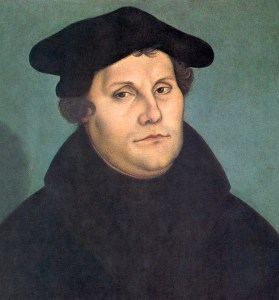
lossy-page1-558px-Martin_Luther_by_Cranach-restoration

Thinking about the Reformation makes me uncomfortable. As my regular readers know, I’m concerned about ultimates. In a universe where “you only live once,” and eternity is so very long, you need to make the right choices when selecting a means of salvation. Really, an eternity in constant torment makes a Trump administration look like a day in the kiddie zoo. This is a very important choice. Heaven and Hell are a non-zero-sum game. You pick the wrong one and you suffer for ever and ever and ever. And ever. With one united church at least you could know that everyone else believed the same. Now you have to shop around for salvation. Which brand really does whiten best? Which is the most flame retardant? Things got pretty complicated as soon as that nail entered that Wittenberg wood.

The truly sad thing is that all this splintering represents those of the same “religion.” It’s bad enough that Christian versus “infidel” was already a thing, but from 1517 onward it was Christ versus Christie, as it were. You may have been lucky enough to have been born into the right family, but if you descended from the wrong scion you were still going to end up in Hell. Catholicism may have been corrupt—selling indulgences is pretty shady business when you can get them for free—but once that break is made we can’t all be right. Somebody’s going to end up eternally in torment and it’s not even going to be the heathens. Reformation suggests something’s wrong in Rome. You can’t hide behind being born Baptist, Methodist, Presbyterian, or Lutheran. No, you’ve got to do your homework and learn which is actually correct. Where is Pascal when you need to make a bet?
Godly Violence

Just a full-term human pregnancy ago, a disturbed young man murdered two grocery store employees in Old Bridge, New Jersey. He then shot himself dead. Of course, such events will never sway those who staunchly defend our right to bear arms. The ratio isn’t too severe after all. Just two to one. We’ve had worse. But that was nine months ago. Earlier this week a police report revealed that Terence Tyler, the perpetrator, had a tattoo on his chest that read, “If there is a God he loves violence. It is his gift to mankind. It is truly magnificent and for this I am thankful.” The newspaper used the understated adjective “disturbing” to describe it. As an erstwhile biblical scholar, my first inclination is to exegete this strange scripture a little bit.

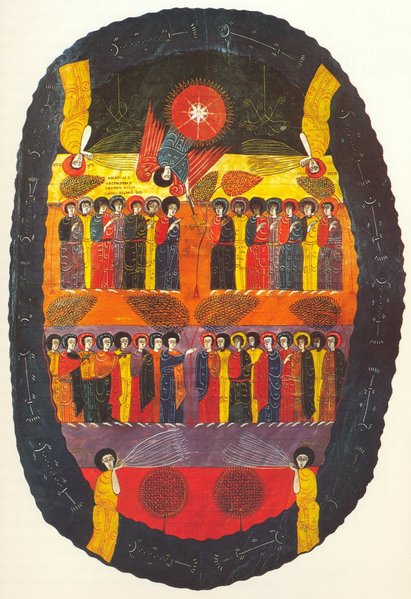
411px-B_Facundus_145“If there is a God.” The mind of the shooter is one for hedging bets. God is an unscientific proposition, and, we are told even by theologians, unknowable. Long ago Pascal urged a wager: God may not be real, but the safer bet is on the divine—you can’t really lose by believing. “He loves violence.” I’m sure many believers disagree, but those who read the Bible will have to admit that Tyler had a point there. There is an ancient kind of bloodlust that hangs heavily over demands for genocide and animal sacrifices. Even, according to mainstream Christianity, the death of an only son will serve divine ends. “It is his gift to mankind.” This may seem counterintuitive, but again, the Bible would seem to back this up, at least in part. Without violence the 144,000 martyrs wouldn’t have much to sing about. “It is truly magnificent and for this I am thankful.” Were this a biblical passage we would probably have to posit a redactor here, or at least an interpolation. Such editorializing doesn’t fit the spirit of the previous three verses.

Religions, while generally abhorring violence, too often condone it. This mostly comes through literal readings of ancient texts whose contexts have changed so much that the originals are unrecognizable by today’s standards. Bibles and Qurans must be understood by those who’ve managed to outlive them. They become the basis for, the excuse for violence that, as a whole, they condemn. In the United States, however, we trust cordite over creed, and guns over gods. We have moved on from the Old Bridge shootings, already for those outside the families of the victims and the local community, the headlines took a minute to jangle the bells of distant recollection. Not much has changed; the NRA still claims, even more vehemently than ever, that guns are our best friends. And, one can almost hear as a subtext, in good eisegetical style, “if there is a god he loves violence.”


Honor Thy Mother

Earth Day should be an international holiday. Perhaps the most disturbing attribute of some varieties of Evangelicalism is their tendency to read the “Be fruitful, and multiply, and replenish the earth, and subdue it” of Genesis 1 to be a mandate not tempered by a literal reading of Genesis 4. As I noticed when tweeting the text yesterday, Genesis 4.11 has God say to Cain, literally, “And now art thou cursed from the earth, which hath opened her mouth to receive thy brother’s blood from thy hand.” Her mouth? What is this if not a biblical affirmation of Gaia? The earth, according to Genesis 2, is literally the mother of Adam. Yahweh is the male element, the fingers molding the dirt (those who have ears, let them hear), while the womb of this bizarre conception is the earth itself. She has a mouth to receive the blood of Abel. The planet beneath our feet, according to the Bible, has not only a mouth, but also hands (Psalm 89, for those who doubt). It is our duty to grasp these hands and save our mother from ourselves.

In the spirit of the day, I decided to fix that pesky leak in the bathroom sink yesterday. We rent, of course, and our landlord—the nicest I’ve ever known—can be a bit slow when it comes to non-emergencies. I fixed the kitchen sink a year or two back, so I stuck my head under the cast-iron monster, baptized by the drips that continued to appear above my head from pipes far older than Methuselah, to see what I could do. After trips to every hardware store in the area, watching bemused DIY experts scratch their heads at photos on my phone of the Byzantine arrangement under my sink, I finally had to admit defeat and reassemble the old faucets again. The drips that fall are Gaia’s tears.

When I was in college I learned of Pascal’s wager. A philosopher who liked to hedge his bets, Pascal deduced that if God exists then our eternal fate relies on our obeying him (always him). If God does not exist, we have lost nothing by behaving ourselves, Pascal concluded. While many Evangelicals find that reasoning attractive, they do not apply it to their mother planet. If God is not coming back any day now, we’d better take care of the planet that sustains us. If God does show up, against all odds, what have we lost? Watching the plants burst back into life after a gray and dank winter, who can help but wonder at it all? Literal or not, the earth is so maternal that we should all pay her the reverence she is owed. Even if it means being a literalist for a day.

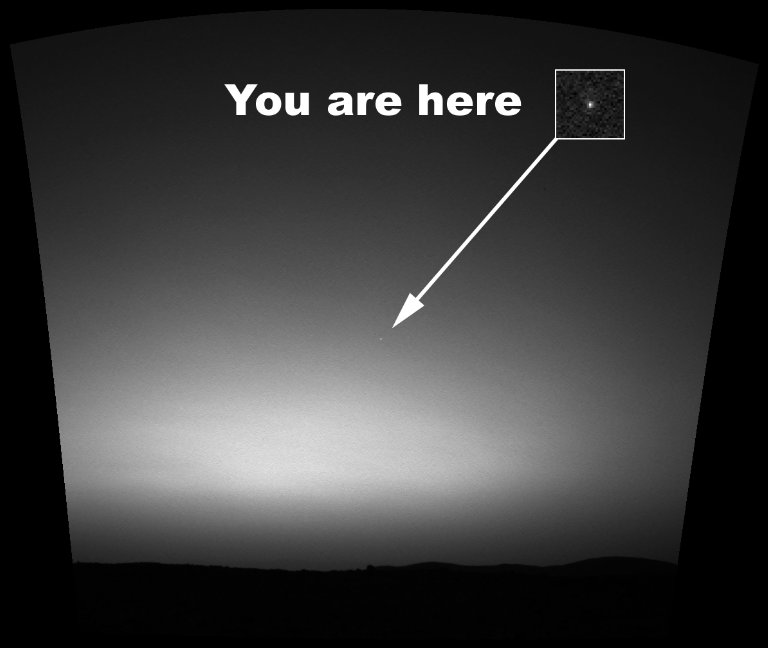
NASA's picture of our mother.