Book or Movie?

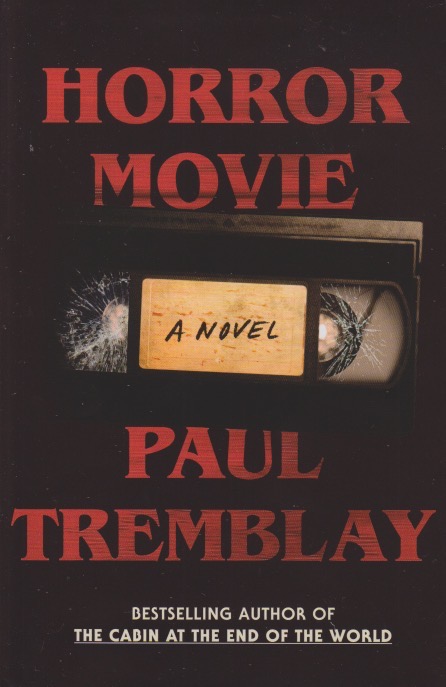
I’ve read a few of Paul Tremblay’s novels.  He’s a horror writer with literary style—often a tough sell (at least in my experience.)  Horror Movie is a compelling read.  The conceit is that a group of young people decide to film, well, a horror movie.  Things go awry, but not in a funny way.  The story unfolds interlaced with the screenplay and with the overlay of the modern remake in the works.  It’s easy to get lost between the narrative account of what happened in the original shoot and what’s happening in the script.  Tremblay uses this technique very well, blurring the reality and movie aspects in a way that’s got to be intentional.  I particularly like his asides about the redeeming value of monsters.  I won’t say too much about the plot since you may want to read it yourself. It does riff on the “cursed movie” trope.

The truly remarkable thing to my regular readers will be that I finished a new book within a month of publication.  Normally I run a couple to several years behind.  And this novel contains several winks and nods to other horror movies.  It pays to know the canon.  In that sense, it reminds me of the movie Scream, one of the more self-aware horror classics.  (I have had Scream out for watching again for several weeks now, but time has a way of slipping away.)  Tremblay, like Stephen King, taught before becoming established as a horror writer.  Maybe there’s hope for some of yet!  I started writing novels in middle school—perhaps there’s still time.  That seems to be one of the themes of Horror Movie, by the way.  It has many elements of a parable.

I found Tremblay’s first horror novel, A Head Full of Ghosts, about four years after it was published.  Indeed, I was working on Nightmares with the Bible at the time, so a book about possession was appropriate.  Horror Movie is more a monster tale but it’s also about movies and reality.  This is territory I often traverse since, it seems to me, movies are more than mere entertainment.  Good ones are, anyway.  And like some other books I’ve read lately, this one is also a reflection on fame (something I wouldn’t know about).  How it’s not what it’s made out to be.  In other words, if you’re willing, Horror Movie is the kind of novel that will make you think.  I appreciate that Tremblay is giving us thoughtful horror and I’m looking forward to trying to keep up.
Cabin Stories

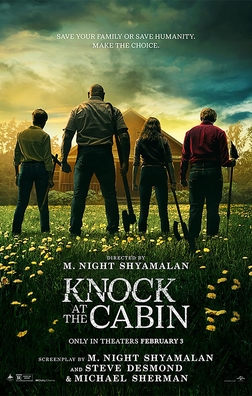
Almost always I come out on the same side of the debate.  The book is better than the movie.  The book allows things to be explained more fully and is the way the story is “supposed to go.”  Maybe it’s because I found the novel open-ended and I like closure, but M. Night Shyamalan’s Knock at the Cabin, in my humble opinion, is better than The Cabin at the End of the World by Paul Tremblay.  Now, the author’s title is better, but Shyamalan’s explanation is clearer.  In short, I think the movie works better.  If you’re not familiar with the story, four apocalypticists, responding to visions they’ve had, break into an isolated cabin occupied by a vacationing family of two daddies and an adopted daughter.  Shyamalan characteristically shifts the cabin’s location to Pennsylvania and, yes, before you think it’s all Philadelphia, there are some very isolated places in my home state.

These weaponized apocalypticists subdue the family and inform them that unless they decide which one will be sacrificed, and then carry out the deed, the world will end the next day.  The adult couple tries to explain rationally how crazy this all is.  How could four people be given this hidden knowledge and be tasked with saving the entire world?  It seems more likely that they’ve targeted a gay couple and are trying to break up their family.  One of the things the movie makes explicit that the book doesn’t is that the intruders are correct.  This is the end of the world.  In order to achieve this, Shyamalan had to rewrite the ending to remove the ambiguity.  For some of us, that really helps.

The movie, in a way that a brief blog post can’t replicate, includes quite a bit of dialogue about religion.  Religion and horror are often bedfellows, and this is one of those movies that relies on religion to fuel the fear.  Interestingly, the cabin invaders aren’t stereotypical conservative Christians.  In fact, they appear to be mostly secular everyday people who have come together around a vision that they all had in common.  In the novel there’s always some question whether this is an elaborate hoax whereas the movie makes it clear that the death of each individual apocalypticist unleashes a plague.  Indeed, they are, as the couple finally realizes, the four horsemen of the apocalypse.  Since I’m still here to tell you about it, the end of the world has obviously been avoided.  This movie is worth seeing, even if the novel has a better title.


World’s End?

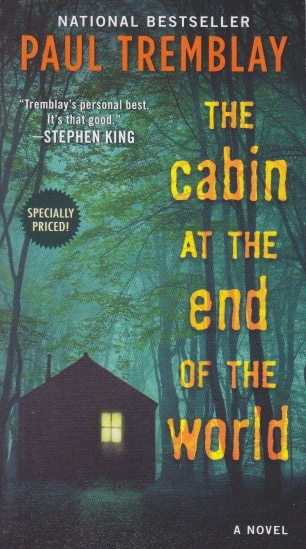
I’ve been writing on religion and horror for quite a few years now.  Sometimes you come across a horror movie, or novel, which addresses this directly.  Paul Tremblay’s The Cabin at the End of the World is one such novel.  A friend strongly recommended this, and indeed, the first half went impossibly fast.  This despite my dislike of home invasion stories.  It nevertheless kept me on the edge of my seat.  I should probably say there will be spoilers here (there will), in case you haven’t read this but intend to.  I’ll hold off on them until the next paragraph, though, so if you’re a faster reader than I am a writer you won’t accidentally run upon them.  So, a family consisting of two fathers and an adopted daughter find the cabin, where they’re vacationing, invaded by four people who believe the world is going to end.  Spoilers follow!

The world is going to end unless the family agree to sacrifice one of themselves to stop the apocalypse.  The strangers are armed while the vacationers are not.  And, as usually happens when those with weapons confront the innocent, the armed prevail.  But.  But the family refuses to sacrifice anyone.  Then the brainwashed four do something unexpected—they kill one of their own.  They continue to do this, attempting to convince the men that if the invaders all die, and neither of the men is sacrificed, the world will end.  Quite a bit of the novel then becomes a theological discussion regarding what kind of god would make such a demand.  Of course, if you read Genesis you’ll already know the answer, right Isaac?

Tremblay knows not to tip his authorial hand as to what’s really happening.  As the cabin becomes a mess of blood and gore, the television seems to be showing predicted apocalyptic events.  The invaders can’t reveal their source of secret knowledge because they receive visions telling them what to do.  The whole thing raises that most troubling of questions: who is really in charge?  Is there a bloodthirsty deity who requires a willing death or are the invaders simply good at acting out their paranoia and interpreting events to meet their expectations?  So it is that Cabin becomes a disturbing story—nearly a theodicy—asking age-old questions of what happens when religious belief conflicts with rational materialism.  There are enough hints of supernatural happenings to make the reader wonder.  And when it ends it affirms something many of us are exploring these days—religion and horror have much in common but neither is clearly understood.


Ghostly Thoughts

Ghosts tend to be on my mind in the autumn.  Paul Tremblay’s A Head Full of Ghosts, however, has been on my reading list for quite some time.  As a novel about possession, it has some scary moments, but it’s difficult to compete against The Exorcist in that regard.  Tremblay handles the topic with an ambiguity worthy of Shirley Jackson, however, and there are a few clear nods to her work here.  At the risk of giving out spoilers (you have been warned!) although it’s pretty clear by the end that much of the demonic was a cry for attention, the family member behind the tragedy is clearly left obscure.  We find out whodunit, but we’re left unsure as to the real reason behind it.

For fear of giving away too much (although my Goodreads assessment might be guilty of this), I’d like to consider something that I address in Nightmares with the Bible.  Demonic possession is largely coded as a feminine phenomenon.  The reasons for this are likely complex, but they are clearly related to the idea behind witch hunts and fear of women’s power in “a man’s world.”  Possession narratives, while they predated William Peter Blatty, became an essential part of the revived interest in demons brought on by The Exorcist.  Tremblay’s story is clearly aware of this, as he has his characters citing both fiction and non-fictional treatments of the topic.  Since researching the subject on my own, I’ve been wondering if anyone else has been able to handle it as deftly as Blatty did, and although Tremblay has two girls under threat, the question of whether it’s real or not tends to outweigh the pathos of believing Marjorie really has a demon.

In the end, it seems as if her father might be the real source of the family’s haunting.  An unemployed man looking for a way to support his family, he turns to religion.  This scenario is all-too-real to life.  And religion gives us not only a rationale for demons, but also a solution in the form of procedures and proper responses.  There are priests here—the males who alone can deliver the females—but whereas Blatty clearly made them the target of a demon that was pretty obviously real, Tremblay doesn’t play that card.  The priests come and go, and deliverance takes a form not expected for such a narrative.  A Head Full of Ghosts raises lots of questions and, like all good fiction, leaves us pondering at the end.  There’s still time to read it this coming fall.