Peace

Mother’s Day should be a time for peace.  In these days when misogyny is in style, it’s an especially important holiday.  The one holiday to explicitly honor women, it’s always been an occasion for reflection for me.  We have 364 days of warring and hatred, and one dedicated to the givers of unconditional love.  I can imagine a different world.  One in which women don’t have to become alt-right to gain positions of authority.  Where compassion and humane treatment would be world priorities.  I can imagine.  Although fathers are necessary too, we have no shortage of men pushing forward their personal agendas.  None of them would be where they are without mothers.  And women are the ones who give us care.  I can imagine a world where Mother’s Day wouldn’t have to feel so politicized, almost polemical.

With all eyes on Pope Leo, I can’t help but think how many treat Mother’s Day like an indulgence.  You know you want to get back to your vices, so why not pay for them in advance?  Celebrate mothers today so we can get back to business as usual tomorrow.  I don’t believe that we’ve lost the ability for transformation.  We can make the world a better place.  Think what it would be like if, before undertaking some cruel action, a person stopped to imagine their mother watching them do it.  Would not the world start to improve?  It is a world where we seem to prefer guns to roses, but it’s also a world with an unwritten future.  Pay attention to your mother.  Maybe things will start to get better.

I believe in the transformative potential of holidays.  We have to take their lessons seriously.  I’m sure I’m not the only working stiff who lives life anticipating the next holiday when things might change for the better.  We have to remember, however, what the holidays teach us.  Not treat them as simply facile days of obligation.  Think of Mom and then get back to the grind.  It doesn’t need to be a grind.  We can learn to cooperate and get along, just like Mom told us to.  Instead of isolating such thoughts to a single day, we could repeat them like a mantra.  I don’t know about you, but looking at the headlines, I could do with a bit of peace and love.  And I still believe that things can, and likely will get better.  And I give the credit to our mothers.


Christmas Silence

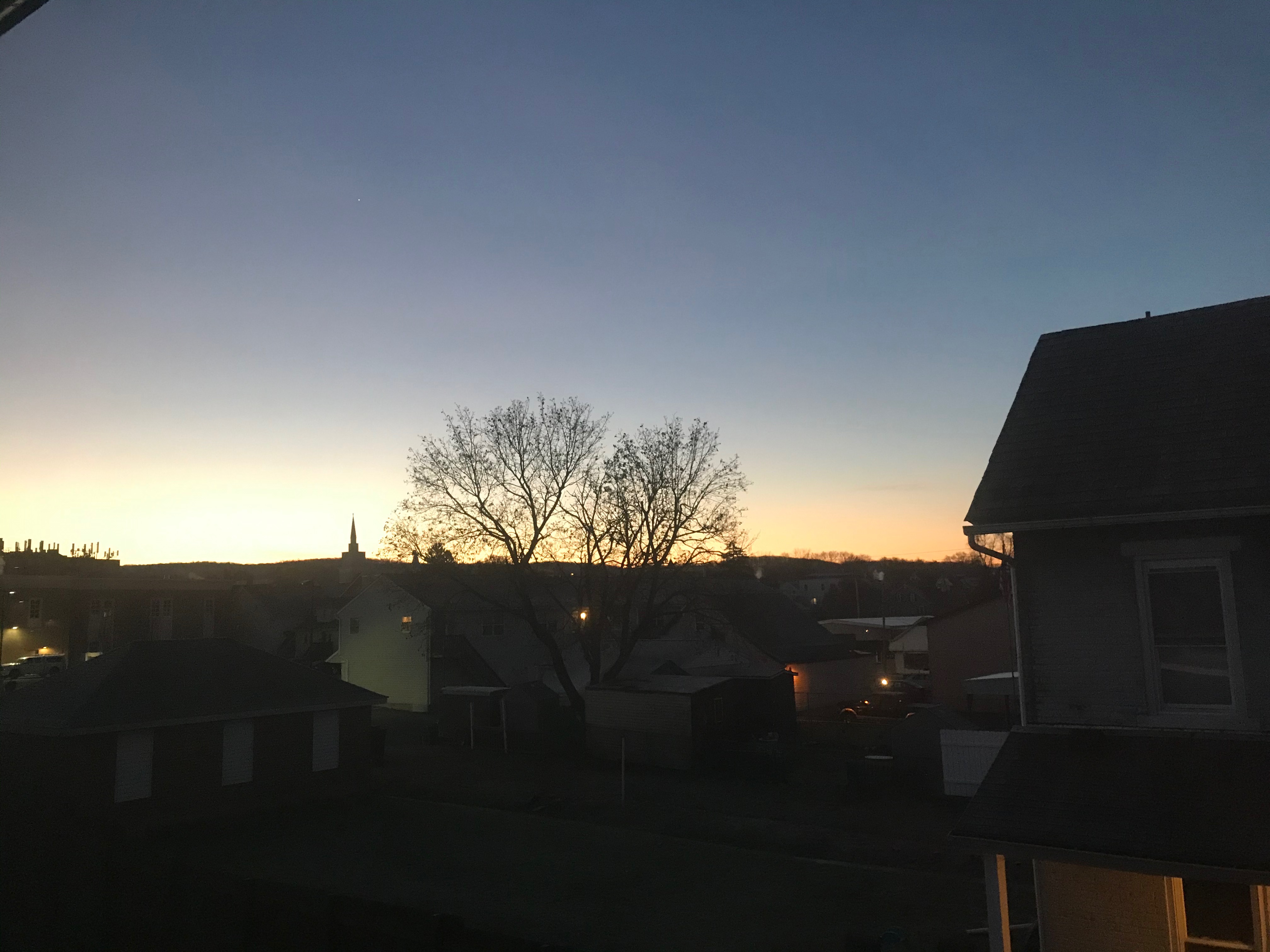
Christmas seems to have come too fast and not fast enough this year.  Like Halloween, it’s one of those long anticipation holidays.  The older I get, the more I appreciate the silence about it.  Not in a Grinch-like way, I hope.  More along the lines of “Silent Night.”  We spend so much of the year—so much of our lives—hustling about, barely having time to think.  Speaking personally, it takes about a week off work just to begin to get to that phase.  I need time to let the daily onslaught of work and capitalism and angst tune down.  There’s a quietness about Christmas that’s profound.  I suppose that’s why I like to spend it with my small family and not feeling obligated to go anywhere.  It’s like those precious moments before sunrise that I experience daily, only all day long.  That’s truly a gift.

The newspapers and internet sites have been summarizing the year for the last couple of weeks.  That always seems premature to me.  I understand why they do it, but Christmas and the days following are some of the very best of the year, and it makes sense to include those along with the stress, darkness, and ugliness that are the daily headlines.  I can’t help but think of Simon and Garfunkel’s “7 O’Clock News/Silent Night.”  Especially this year.  Christmas is for everyone, and the insistence that we make it exclusive (putting Christ back into it) makes it divisive.  Why some people have to be right all the time I don’t know.  I prefer Hamilton Wright Mabie’s take: “Blessed is the season which engages the whole world in a conspiracy of love.”  Simon and Garfunkel are both Jewish and I think they understood “Silent Night” better than many Christians did back in 1966.

I’ve been writing quite a lot about horror movies this year.  The months and days leading up to Christmas have often been difficult ones.  Such movies are therapy.  They can even fit into the beautiful silence of this day.  That’s my hope, anyway.  May this day include enough silence for you.  The rest of the year has no difficulty filling itself with trouble.  We need holidays.  Christmas has always struck me as the most peaceful of them all.  Ministers, and even those of us who never made the cut, tend to be holiday experts.  Those who don’t get caught up in the dogmatism of it all are the most blessed.  Christmas is for everyone.  And may it be peaceful this year.


Solstice Thoughts

At the equator, the difference is nil.  The longest day and the shortest day don’t deviate from the standard day length.  The further you move from the equator, the more dramatic the effect is.  Here in the northern hemisphere this is our longest day, the solstice.  Historically, particularly in countries to the northern edge of the northern hemisphere, this is a holiday.  Midsummer marked the days of sun and growth.  Light is abundant—too abundant to sleep well in the furthest reaches.   Being visually oriented creatures, we enjoy the surfeit of light.  Light has long been a symbol of the divine for, I suppose, just that reason.  It makes us feel secure and safe.  We can see what’s going on around us.

In Antarctica, today is the shortest day of the year.  Indeed, around now there is seldom any light at all.  On the exact same day there are literally polar opposites on this planet.  The summer here is winter there.  It’s the first day of winter in the global south.  Their understanding of this day is completely different.  Of course, once you reach the shortest day, things can only improve.  The climb to summer lasts half a year, only to have the decline immediately begin again.  The difference is as subtle as it is inexorable.  For those of us who wake before the sun, it’s already obvious that sunrise is coming later than it did last week.  The earliest sunrise was the fourteenth.  Sunset will come later and later for the next few days, to compensate for the lost morning light, but overall there will be less and less until we are the winter half of the world.

There are many lessons to learn here.  In a world where the longest and shortest days are the same day—solstices depend on where you live—we don’t fight over it.  This despite the fact that light is our most precious commodity.  We simply accept that we celebrate light when we have it, and await its coming when we don’t.  Other resources we fight over.  Potable water.  Petroleum products.  Arable land.  Silently, radiantly, light shows us the way.  There’s an inevitability here.  Through long experience on the earth we simply accept it.  The other option is to fight over what we can’t control, which is futility defined.  There are lessons to learn from the longest day.  And if it’s your shortest day, you know that all will be forgiven at the next equinox.


Serenity

A few weeks back I posted about a dove that had built a nest on an unused planter on our front porch.  I’d read that mourning doves choosing your house was a sign of peace and tranquility.  Each morning I went out for a jog, the dove’s little head would pop up and she would eyeball me.  There was no fear in that gaze, but rather serenity.  She was sitting on her eggs and knew I wouldn’t hurt her.  Several days ago she was gone from the nest.  We were out for a family walk when my daughter noticed.  We crept up to see two good-sized chicks sitting there instead.  Within days we had a couple of young birds flapping around the yard, trying to learn how to live on their own.

I missed the dove, though.  The nest was empty.  I felt less bad about stepping into somebody else’s bedroom every time I went out the door, but still, I’d grown accustomed to having her—them—on the porch.  This week when I again went out for a jog (the jogging never ends), she was back.  She looked at me with a knowing stare.  Ours was apparently a safe house.  Mourning doves, I read on the Cornell University ornithology site, can raise a brood of two in six to eight weeks.  From the laying of eggs to abandoning the nest is only a two-month proposition.  The website then went on to say that doves will sometimes return to their previous nest.  This one obviously had.

Peace is a rare commodity these days.  Stress seems to be our daily matrix.  How long will our jobs hold out?  Will opening up the economy lead to a second wave?  (Likely yes.)  Will we be able to make mortgage payments if our companies can’t weather the storm?  Who really owns this house anyway?  There is a serenity to relinquishing anxieties of ownership.  A kind of freedom to belonging to a world that will, at least in some nations, help you make it through a crisis intact.  There’s a wisdom to the animal world that we too often ignore.  We can find peace if we look for it.  One cold morning I found one of the chicks sheltering on the leeward side of our fence.  I took her some sunflower seeds since she looked so miserable.  I don’t know if she ate them or not, but I knew that we humans had benefited from having her under our roof.  Such gifts are worth more than might be imagined.


Wonders and Signs

Raised by a woman who would be perhaps classified as a “single mother” these days—she was technically married except for a very brief time just before my step-father came along—I have always had great appreciation for the power of women. She didn’t have super-powers, but she raised three young boys largely single-handedly without the help a young woman has a right to expect. Wonder Woman, when I saw her on television, struck me as a very different kind of female. Strong, yes, but clearly there for men to look at. But then again, I didn’t have the benefit of Patty Jenkins’ Wonder Woman. I left the theater speechless. Apart from a few sniffles my wife didn’t have much to say until about an hour later. It’s that kind of movie.

I’ve seen many superhero movies. In fact, heroes are almost custom-made for the big screen. Comic books are basically storyboards already, and the colors and action are the very definition of spectacle. Wonder Woman, however, complicates the tale of the hero fighting for justice and truth. She fights instead for peace and love. Never supposing she’s anything but capable of defeating the evils of war, she doesn’t take orders from men. She actually shames an elderly, heavyset general for not being on the field of battle where, he acknowledges, others will die for the cause of the armistice. It’s a world inverted. Yes, the men are drawn to Diana, and can’t help but be awed by her. They don’t control her, however. She’s the first out of the trenches and she requires no man’s help when combatting the enemy.

Perhaps the most striking thing about the movie is the respect it to shows to women. Only one nude body appears in the film, and it’s male. I suspect I wasn’t the only man present made uncomfortable by the curious female gaze and the assessing questions of the goddess. Women are made to sit through countless movies as the subject of the male gaze. The embarrassment here is a reminder that making women sexual objects is the normal expectation. What if the roles were reversed? When Wonder Woman fights she is largely defensive. Men want to destroy her. She responds by declaring love will overcome war and owning her role as the “God-killer.” This is a movie with substantial subtext. It challenges the paradigm of men’s rule as wise and beneficial. A god may have to die, but the world is a better place for it. We could use some inversion about now.


Only Hummus

I remember the moment well. I was in Jerusalem on my own. Although in my early twenties, I really didn’t know much. The man at the vending cart didn’t speak English, but I was hungry. My first experience of falafel would certainly not be my last. After I married a few years later, I introduced my wife to the various Middle Eastern foods I’d tried. Hummus became a personal favorite, especially after I became a vegetarian. There are plenty of things for vegetarians to enjoy, and many cuisines of the world have less meat-heavy options than many restaurants I’ve experienced in the States. Hummus, to get to my point, can be rather bland. It is generally inoffensive, and people of many dietary and religious restrictions can eat it. The Christian Century ran a blurb recently about a hummus restaurant in Netanya, Israel. This eatery offers a fifty percent discount to Jewish and Arabic customers who sit together. Here is a workable idea for peace.

We all have to eat. Half the trick to world peace is getting people who dislike each other to sit down and do it together. Those of imperialist bent may not realize, or even be able to see, that we have more in common than most agitators think. Human needs are the same, and often, very easily provided. You like hummus? I like hummus! We must not be so different, after all. If instead of weaponizing themselves, radical believers armed themselves with food to share, not nearly so many warplanes would have to take to the air. I admit I’m an idealist. I don’t think peace is impossible. We can choose to focus on what divides us, or on what we have in common.

IMG_2641

Perhaps if I’d never traveled to Jerusalem I would never have tried hummus. I didn’t travel for the food, but travel led me to a kind of serenity. Both falafel and hummus are made primarily of chickpeas, a versatile vegetable that has a verisimilitude of peace. If we could learn to eat together we would find it harder to hate each other after that. Sharing our mutual needs sometimes, as the restaurant owner in Netanya understands, requires a financial incentive. Although it may be lucre that lures those who are different to the same table, it is the peace itself that, I believe, will keep them coming back.