By Numbers

Numbers 12.3 always struck me as one of the oddest verses of the Pentateuch. This was back in the days when I’d been taught that Moses wrote Genesis through Deuteronomy, in toto. When I read “Now Moses was a very humble man, more humble than anyone else on the face of the earth,” I had to wonder about the literalness of Scripture. How can someone who is humble boast of being the humblest person on the planet? Humility is a commodity sorely lacking in contemporary times. This shortage, in an era of fake news and border walls, finds expression in some very odd places. The White House, for example.

Kellyanne Conway, who’s apparently still around, recently told televangelist Pat Robertson, on the air, that Trump’s most characteristic trait is his humility. It seems that good old Moses got one wrong. The most humble man on the face of the earth is Donald J. Trump. You can tell that by the way he took a horrific hurricane and managed to make every media appearance concerning it about himself. It is quite a burden, being so humble. Especially when your race is the best one on the planet and there’s bad behavior on all sides when a white supremacist murders an innocent person for disagreeing. What would Moses do? Pat Robertson—you’re a literalist—help us out here! Mirror, mirror, on the wall, who’s the humblest of them all? I surely hope the Bible isn’t participating in fake news.
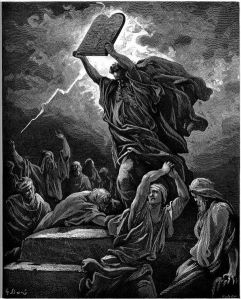
It used to be called the good news. The message was one of love for all people and acceptance of the poor, the outcast, the widow, and yes, even the tax collector. I forget which chapter in Matthew it is where Jesus suggests building a wall to keep the gentiles out. It must be in there somewhere next to the chapter where Moses builds a tower up to heaven and then names it after himself. He was, after all, the humblest man in the world. He could afford to throw away entire calves made of gold, right? Humility will do that for you. Since we’ve just undergone a major natural disaster, we might as well start pushing our own self-image again. If Moses promised to build a wall, even if thousands and thousands are suffering and could better use the money, he must push through with his plan to erect a wall. And when he’s done he’ll put his name on it for all to see. That’s the price of humility.
Once and Future Ape

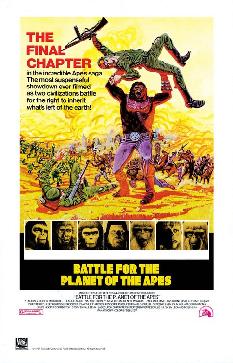
Battle_for_the_planet_of_the_apesThe original pentalogy of the Planet of the Apes franchise began a slow decline with Beneath the Planet of the Apes. Producing a movie per year from 1970 to 1973, the series died with Battle for the Planet of the Apes. Given that Dawn of the Planet of the Apes has been compared with this original final installment, it seemed time to reacquaint myself with it. The early seventies, as I recall them, were tense times. Social unrest both at home and abroad, coupled with a maddeningly increasing nuclear arsenal, seemed a recipe for disaster. Indeed, the world does end with the second installment of the pentalogy, a scenario set up in the final episode as the Alpha-Omega bomb, guarded by mutants, is declared worthy of reverence. Only through the magic of time travel do Cornelius and Zera travel back to the paranoid 1970s to start the whole series over again. The Battle for the Planet of the Apes, apart from its preachiness, does overflow with religious language and rhetoric. Indeed, it begins with a reading of Scripture from the Lawgiver. Pentalogy or Pentateuch?

Caesar is said to be the savior of apes and, like in the current Dawn, the sympathies of the viewer are with the apes. Gorillas, the frat boys of the ape universe, do indeed cause troubles, with Aldo becoming a kind of Cain who slays a fellow ape, Cornelius. (They even got the initials correct, if reversed.) Religion, and prejudice, it seems, have brought this fictional world to a crux, caught in an endless loop of new futures. As Virgil says, there are an infinite number of lanes on this highway. Presumably, traveling back in time opens up all kinds of possibilities.

Despite the number of reused shots in the film—the first ten minutes or so are simply a recapping of the previous two films—and the unfortunate pacing (how could a climax of two angry apes climbing a tree have possibly dragged on for so long?), the movie does have a message. Race tensions, high at the time, are overtly and covertly addressed. Disarmament is praised. The only future that seems not to exist is for one more movie. Interest moved on to science fiction’s apotheosis in Star Wars just four years later. Once again we would find ourselves in a world of black and white, with simple choices. There was no ambiguity among the Jedi. Still, for all that preaching, equality never did reach its goal. So even with its faults (didn’t we see that same tree-house bombed four times?) it is worth dusting off the Battle for the Planet of the Apes once in a while and pondering better possible futures.


Build-A-Bible

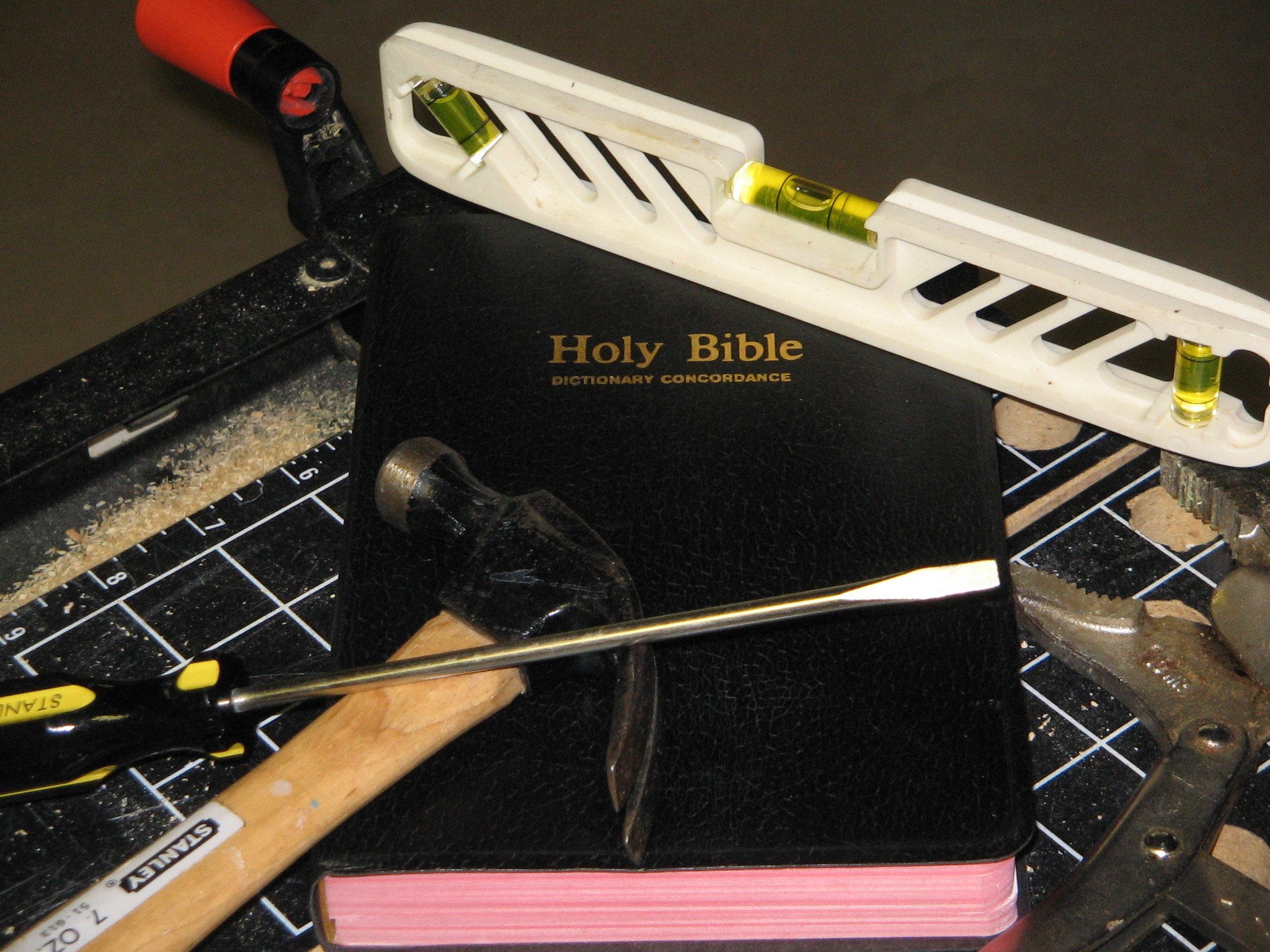
Winter Term is underway, and one of the first aspects of the Bible I discuss with students is the fact that the Bible was a book that was compiled instead of written. In our society we are used to the concept of the Bible as a document that is unified by divine authorship, often forgetting (or ignoring) that none of the authors was intending to write a book with the tremendous authority the Bible now enjoys. Students ask how the Bible came to be; it was a process of gathering material widely utilized in Judaism. No one knows the actual composition history of the Torah, but after the Pentateuch got the process rolling, scrolls were gathered in collections and added to the Bible en masse. By the end of the first century of the Common Era, we had a Hebrew Bible.

Sometimes this historical reconstruction is a hard-sell to members of a society where a divinely written book is accepted alongside sub-atomic particles and super novas. Despite the technological sophistication that accompanies growing up in our engineered world, students are often ill-equipped to accept the Bible as a product of human exploration. The writers, whoever they were, traveled this same path of discovery that we continue to tread. They wrote down their hypotheses, based on their experience, just like modern people continue to do. The difference is they did this a very long time ago.

Those books that were selected for inclusion in the Bible became the defining documents of western civilization. Even though there is now an international space station orbiting out of sight above our heads, and even though quarks, leptons, and bosons fly out of cyclotrons large enough to encircle most small towns, God still holds a quill pen. The fixation just after the age of cuneiform is a curious one. If only God had held out for the invention of the Internet, the compilation of the Bible would have taken a very different course, I suspect. Instead of beginning its title with the word “Holy” it would more likely have commenced with “Wiki.”