Pacific Rim

Pacific_Rim_FilmPoster

Pacific Rim is a movie that once again brings monsters and religion together in the cinema. Since I’m generally late seeing movies, I won’t worry too much about spoilers here, but in case you’re even later than me here’s the gist of it: giant monsters from outer space (properly an interplanetary portal) are emerging from the Pacific Ocean to take over the earth. These radioactive, dinosaur-like aliens are called Kaiju. Although they can be taken down with conventional weapons, the most effective fighting tool is the Jaeger, a colossal robot piloted by two humans acting as the two hemispheres of the brain. These humans must “drift”—share their brains—in order to control these massive machines in unison. Lots of action and destruction, of course, ensue. We later find out that dinosaurs were an earlier invasion of these same aliens, but that our environmental degradation has made the atmosphere much better for them, and this time they’re back for good.

The resistance is led by a mysterious marshal named Stacker Pentecost. Pentecost, of course, is the festival celebrating either the giving of the Torah (Jewish) or the giving of the Holy Spirit (Christian). In either case, it is a holiday celebrating God’s plan for humanity. As Pentecost leads his beleaguered and shrinking army of jaegers against the Kaiju, scientists Geiszler and Gottlieb disagree about how to conquer the beasts. Gottlieb swears, “Numbers are as close as we get to the handwriting of God,” while advocating the predictive elements based on the statistics of the attacks. Science and religion have come to an uneasy truce here. As Geiszler seeks a Kaiju brain to drift, he observes some of the masses in Tokyo praying to the fallen beasts. A blackmarket dealer in Kaiju remains explains that they believe the Kaiju have been sent by God. Pentecost unwittingly concurs when he declares it is time to end the apocalypse.

Pacific Rim, like most Guillermo del Toro films, is a complex movie. There is also more than a sprinkling of H. P. Lovecraft here. The worship of the Kaiju keyed me in to the fact that these were the old gods, come to earth, under the sea, from space. As the first category 5 Kaiju swims past the camera, I couldn’t help but think of Cthulhu. Although Kaiju is Japanese for “monster,” it even sounds like his sacred name. We fear that which is larger, stronger, and unknown to us. When that fear becomes reverence we are on the brink of worship, and our monsters have become our deities.
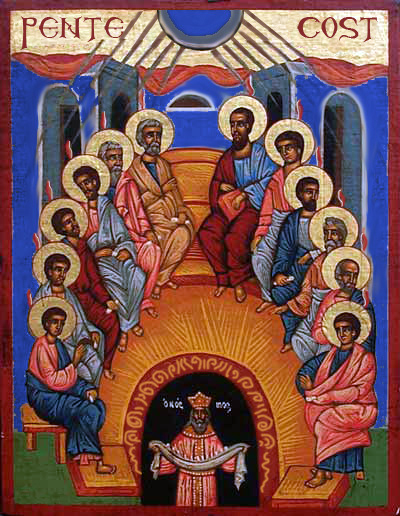

Tongues of Fire

“Do you want to see?” she asked me, fraught with all the emotions of a teen far from home. I’ve often questioned the wisdom of church groups sending large numbers of high school students to retreats or conferences where shear ratios of chaperones to teens guarantees intrigue. She was an attractive girl, and despite my commitments to asexuality early in life, I found her plea compelling. We weren’t supposed to meet after hours without the adults around. I was insanely curious, however. “A few of us will be gathering behind the gym,” she said. I demurred, afraid to break the rules. “Do you want to see now?” she insistently asked. We were in a room largely empty, as the adults were headed toward the food, the way adults always seem to do. I agreed. Nervously she closed her eyes in prayer. When she opened them, they were glassy and far away. A stream of nonsense words effortlessly bubbled from her mouth. This went on for what seemed like minutes, although I knew it was only seconds stolen from a scheduled curriculum. She closed her eyes, and coming back to herself, looked exhausted. “What did you say?” I asked, breathless. “I don’t know,” she admitted.

This was my first experience of glossolalia, or speaking in tongues. I was at the United Methodist Youth Annual Conference, and I’d just met the girl who’d revealed so much. Methodists, as a rule, aren’t much into glossolalia, but the Pentecostal movement has Methodist roots, and teens are the great experimenters of the human race. I can’t recall how I met her, or even her name. I felt an incredible attraction to a girl who could let herself be so possessed, however; so vulnerable to an Almighty deity. I decided not to go to the after dark gathering. Instead I sought out a minister I trusted. He explained that such signs, if truly divine, are only done in the presence of an interpreter. She was misguided. Yet I couldn’t get those glassy eyes out of my mind. Where had she been in those fleeting seconds when her mouth spoke a language she didn’t know?

While reading David Kling’s The Bible in History’s chapter on Pentecostalism, this all came back to me with incredible force. A few years later I attended a Pentecostal service with one of my college roommates who belonged to that tradition. Being in a room full of true believers speaking in tongues at the same time unnerved me. I never went back. Psychologists and neurologists have explanations for how glossolalia occurs. The standard evangelical explanation is quite different. For one young lady whose name I can’t recall, it was a sign she wanted desperately to share. A personal assurance that John Wesley himself encouraged his followers to seek. Not that Wesley ever suggested speaking in tongues. That only began in 1901, after a hiatus of nearly two millennia. To a teenage spiritual seeker in the presence of a young lady, away from home, it was a mystical experience indeed. The assurance, however, would have to wait.

Image credit: Phiddipus

Image credit: Phiddipus