Not Your Father’s Demon

AmericanPossRegan MacNeil is a name that can still send shudders up and down stout spines. Despite advances in CGI and special effects, The Exorcist is consistently rated among the scariest movies of all time. Demon possession, clearly, is a very troubling thing. American Possessions, by Sean McCloud, is not a place to go to find Catholic priests expelling the forces of darkness. Subtitled Fighting Demons in the Contemporary United States, the book, one might suspect, is saying more than it seems to be letting on. This is a book about Third Wave evangelicalism and its demon-fighting manuals. Although the term “Third Wave” may be unfamiliar, the next time you go to a Tea Party you’ll know you’re among them. These born again uber-capitalists believe in a literal demonic world. In fact, demons are so common that Jesus would’ve had a hard time keeping up with their exponential economic growth. These demons are more frightening than those that possessed Regan. The are more akin to a different Reagan.

Especially popular among Pentecostals (the fastest growing form of Christianity) this modern day belief in demons sees them in places Jesus didn’t think to look. Family curses (at places ruled out in the Bible, but still, apparently, possible), addiction, depression, sexual urges—these are all demonic. And once these modern demons are cast out, unlike that of Regan, they can come back. And if they don’t possess you they will oppress you. And they can live in your material goods, your house, and even the land it is built upon. They are everywhere, and they have to be fought against constantly. They also, apparently, vote Republican.

This view of the world, strange as it is to many people with a basic education in science, motivates a large sector of the United States population. Expelling these demons requires a specific view of Christianity—a view that absolutely excludes Catholics. And it is a view that promotes free market economics, blaming the victims of poverty for allowing themselves to be oppressed by demons. Many aspects to this belief system will strike the reader as completely unbelievable, all the more for being so seriously believed. At the same time, we are told, we should pay no attention to religion, at least as educated people. The problem with this is that these true believers vote. And the kingdom they would have come on earth is, in a way they would certainly deny, possessed.
Popeless

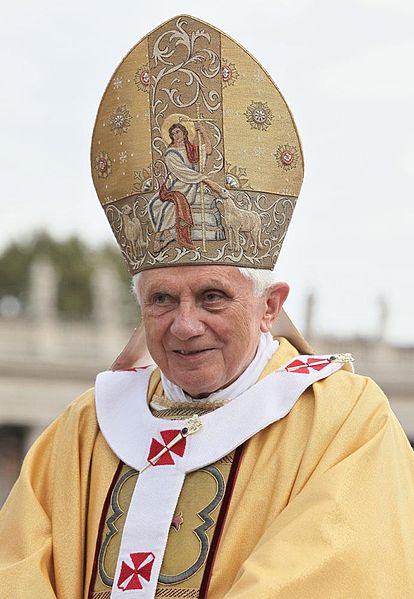
414px-Benedykt_XVI_(2010-10-17)_4 Pope Benedict XVI managed to catch many of us off-guard with his early retirement option. Not within living memory, or even very dusty, antiquated memory has a pope resigned. Such is the draw of power. Of course the founder and putative CEO of the organization stepped down at 33, or so the story goes, but after that the urge to stay on only grew. The papacy, some traditions claim, is as old as Christianity. Others suggest that the stresses and strains that eventually led to the primacy of Rome in the western church were much more intricate than that. Modern research has also indicated that one-size-fits-all Christianity really didn’t even exist from the beginning. Different groups claimed to be Christian but were labeled heretical by other groups. The Roman Catholic Church is still the single largest Christian denomination in the world, however, and that translates to quite a lot of weight.

According to the book of Acts, the first Christians were a communal lot, holding everything in common. Although we can’t call them communists, in a sense they were. It didn’t take long for that structure to break down, however. Before long it was obvious that leaders would emerge in the movement. At first they wouldn’t have been priests, but eventually that age-old designation came to describe what the clergy did. Worship became ceremony, and ritual requires expert leadership. Various religions have tried to break down the hierarchical structure of having one person over the others, but in this masculine world of CEOs and prestige, well, there’s only so much you can share.

What’s really striking is that no pope in 600 years has stepped down. There could’ve been many occasions. Presiding over about a sixth of the world’s population must be a heady experience, especially for a religious person. Already the speculation is thick on who the next pontiff might be. The fact that the faithful are already chomping at the bit shows something of the nature of the creature (one can’t very well say “beast” in such a context). The papacy has become a symbol in its own right, and even megachurches can’t hope to top their numbers. The Pentecostals, however, are racing to catch up. The two types of Christianity are about as far apart as possible while remaining under the same Lord. I suspect by the time the next pope vacates the office the religious landscape will be very different. Perhaps Benedict XVI is wise to call the game on his own terms.


Contextual Criticism

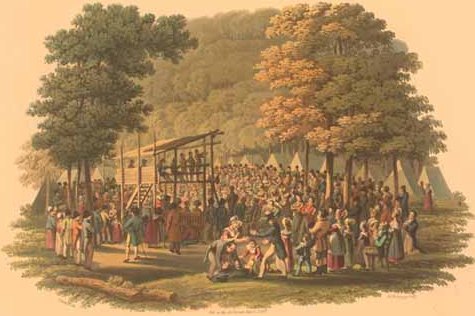
As I was reading Brian Pavlac’s Witch Hunts in the Western World, I learned about klikushi, or “shriekers.” These were Russian “witches” who appear as early as the seventeenth century and who are characterized by screaming, “wailing, barking, and writhing during worship services” (184). In that day this was taken to be a sign of witchcraft and women were arrested and tried for it. Fast forward a century or two. In the wilds of Kentucky what is generally called the Second Great Awakening was taking place. Manifestations of the Holy Spirit were, well, wailing, barking, and writhing, significantly, during worship services. These “signs” triggered the beginning of the Pentecostal movement, today one of the largest sects of Christianity. If the exact same behavior had taken place in a different context, the coverts would’ve been convicts.

It is safe to say that psychological explanations may be found for the bizarre activities of people living under a great deal of stress. No supernatural agency is required for glossolalia, spontaneous dancing, or canine vocalizations. If you look closely you’ll probably find any combination of the three in secular contexts during an average stroll through Manhattan. In a haunted country full of tales of the devil, they will be attributed to witchcraft. In a tent-meeting revival under the influence of an emphatic preacher, they will be called signs of the spirit.

Religions like to teach that they are universal, but in fact they are highly contextualized. What I used to tell my students about words applies also to acts—the meaning depends on the context. Whether somebody getting up off their ass is vulgar or merely a statement of fact depends on where the person is sitting. Religions are often rose-colored glasses, casting events in the shades we prefer to see. They are ways of interpreting the world around us and speculating on what, if anything, is outside our apparently closed system. There’s a lesson here to be learned by all. One person’s Monday may be another’s Thursday, but there’s no need for anyone to be crucified if they do it differently. Wouldn’t the world be a better place if we only believed that?

It's all a matter of perspective.


Tepe Temple

When a colleague sent me an NPR story on Göbekli Tepe, I was thrown back into the conundrum far older than archaeology itself—how can a site be identified as religious? Most of us hardly realize that when we enter a church or cathedral that the overall plan is based on that of the earliest temples we know. Conventional wisdom associates temples first with the Sumerians, the harbingers of civilization itself. The basic premise was that a niche existed for a cult image (statue of a deity, generally) with an altar before it. Although the concept was widely disseminated, many reformed and rereformed Christian groups tried to distance themselves from it, calling altars “tables” and making them mobile. Probably the most successful are the Pentecostals; last time I attended a service the “sanctuary” felt like a warehouse. Actually, it was a warehouse. In general, however, there has been little need to reinvent the religious wheel, so the standard plan still often applies. Enter Göbekli Tepe.

Göbekli Tepe is located in southeast Turkey, near what was actually Mesopotamia in ancient times. The hill-top site is a Neolithic structure, and that means it was built before agriculture became widespread, during our hunter-gatherer stage. It is the earliest known human religious structure. The article on NPR questions precisely this: is it religious? How do we identify structures in pre-writing cultures as religious? Some archaeologists are guilty of labeling any structure or artifact with no practical function as “religious,” but this is a little cynical. Part of the problem is that religion itself remains ill-defined, being a post-Christian category to describe behavior singled out for God’s benefit. As a child I wondered, if God exists how could anyone not devote all their time to God?—the very speculation that led to my profession. Ancient people, like all animals, felt the urge to eat, rest, seek shelter, reproduce—animal things. It was a full-time job. When agriculture simplified things a bit by giving some measure of control over food supply, other professions began to emerge. Priesthood, as a means of ensuring continuity among the entire system, was one of the coveted jobs. Göbekli Tepe predates the Sumerians by thousands of years. The large structure with reliefs carved into the rock seems temple-like to some, less so to others.

The NPR article points out, correctly, that the distinction between sacred and profane may be premature as applied to Göbekli Tepe. We can test the cases even today: certain human functions are considered profane, chief among them sexual acts. It is clear from the sexuality of ancient religious artifacts that the profanity of sex is not an ancient idea. Ritualized eating is very common and still takes place in highly stylized form among many Christian, Jewish, and Muslim groups. Work itself was considered to be a divine assignment in ancient times. Our ultimate bosses were the gods. Little room remained for “secular” pursuits. By compartmentalizing life into “religious” and “not religious” we have found a way to pursue our own selfish ends and still wind up in the pews on the weekend, congratulating ourselves for obeying the dictates of divine law. Where is true religion to be found here? Is it not more likely to reside among ancient people, like those of Göbekli Tepe who lived their entire lives in the service of the gods?


Mystic Messiahs

It is difficult to know where to begin when discussing Philip Jenkins’ Mystics and Messiahs: Cults and New Religions in American History. As a student of religion I early found myself drawn to the question of where religions begin. In the case of many religions we have an identifiable founder. Frequently that founder ends up being a god him (or more rarely) herself. In order for any putatively revealed religion to attain any credibility, the ultimate source must come from on high; God himself. So it is that we look askance at any religion that has appeared in the last couple of centuries, when, as we knew at the time, the earth was no longer the center of the universe and science had taught us to know better than to accept the old-timey stories of a god in the clouds. We can accept the ancient, time-honored stories, venerated as they are by centuries. If someone today tells us that God has spoken to him or her, we refer them to psychiatrists first, and then to the mind-altering drugs.

Jenkins, writing in the shadow of the tragedy of the Branch Davidians at Waco and the ritual suicide among the members of Heaven’s Gate (one of the members’ sons was one time a student of mine in seminary), tries to demonstrate that such groups are part of the fabric of religion. What is new in such movements is not the fact that they suddenly come into existence, or that society reacts violently to them, but that we now have a concept of “cult” to label them. Jenkins convincingly illustrates that fear of new religions stretches back for centuries. Even in the seventeenth century people experimented with new religions. When they survive, they become “churches.” Consider the Mormons, the Seventh-Day Adventists, and the Pentecostals. They all began as “cults” and are today considered just another variety of Christianity. Most adherents to religions do not inquire too closely as to the origins of their brand. Historically we know that the three denominations mentioned above are well under two hundred years old.

In a fascinating twist, Jenkins describes how the Zeitgeist of the early twentieth century was ripe for such developments. One of the sources, ironically, was the fiction of H. P. Lovecraft. His weird stories often invoked cult-like groups devoted to unusual practices that sometimes turned deadly. Also during that same time period, Christian Fundamentalism began as an effort to sort out what was “fundamental” to Christianity that set it apart from the cults (including Pentecostalism, now one of the most dominant Fundamentalist sects). As Jenkins points out, when these new sects become mainstream, they vehemently seek to destroy all new comers. Christianity began as a cult in the eyes of both Jews and Romans.

Religions are inherently conservative. As we will see in the approaching election, the religious background of a candidate plays a major role in public acceptability. We enjoy freedom of religion in the United States, but only to a point. Jenkins should be required reading for every religious believer. Tolerance would be the only proper and reasonable response.