Your Mystery

Few things glaze the eyes of others like somebody else’s genealogy.  That’s not what this is, so unglaze those peepers!  As with most of my posts, there is reflection here and that contemplation applies to just about everyone.  We don’t know our parents very well.  It’s only been when trying to connect the dots for my progenitors that I came to realize just how poverty-stricken that knowledge is.  I could (and did) talk to my mother frequently, until recent days, but even to her my father was a mystery.  I knew he was in the military for at least six years, so I filed a military records request with the National Archives.  You can do this if you’re next-of-kin.  That’s when I learned of the National Personnel Records Center fire of 1973 when at least 16 million records were destroyed.

National Archives fire, public domain (via Wikimedia Commons)

My father is a mystery to me.  The National Personnel Records request brought back a few hits, all documents partially consumed by fire (for which the administer apologized) that contained just tiny bits of information.  All of this makes me reflect on our limitations in knowing others.  Parents, spouses, children, siblings—they all remain mysterious in some ways.  And some more than others.  We go through life knowing only ourselves, and not even that person fully.  Consciousness brings these things to a new level, but we still really find ourselves bound by our minds.  That’s why, I suspect, some of us keep trying to cram new things in there—wanting to understand others as well as ourselves.  All it takes is a fire in the National Archives to wipe out entire lives.  Or parts of them.

Now that her earthly time has ended, I realize my mother is also a mystery to me.  It will take some time before I can sit down to write out what I knew of her life.  We grow up distracted by our own needs and wants.  Does a baby bird ever wonder at the enormous energy and strain on its parents as they bring food to their open beaks?  Even those of us who write leave gaps—some intentional—in the records of our lives.  Other people are mysteries.  Wouldn’t the world be a better place if we treated them as such?  Instead, we often act as if their roles (store clerk, accountant, electrician) are their lives, their essential selves.  It’s all we can do, I know, to take care of our own lives.  But it would be a more wonderful world if we could see others as doing just the same.


Morning Reflections

Morning thoughts are different from evening thoughts.  As we spin recklessly through the blackness of space on this globe, we really have no idea how consciousness works.  We assume, unless some “pathology” is present, that personalities are stable.  But we also think differently at differing times of the day.  I’ve long observed this as the work day progresses.  Anxiety tends to ratchet up during the afternoon, sometimes getting a head start in the morning.  Of course, all of it will depend on whether I slept well and have rebooted properly.  So the person you encounter when you see me will depend on when it is you come calling.  Many people prefer to know someone is coming.  Not only does it give you time to groom for the role you’re going to play, but it also allows you to prepare mentally.

I don’t see many people in the course of a day.  My job is such that I do not regularly have lots of meetings—sometimes going days without any.  During those times the only person I regularly see is my wife.  She’s more aware than most that my morning thoughts are different than my latter-day thoughts.  Those who think of me as a pessimist mostly know the me that’s been awake for several hours.  The morning me is generally optimistic.  And productive.  That cycle for me may begin a few hours before others awake, but it’s characterized by, in a word, inspiration.  The whetstone of a day grinds you down without always making you any sharper.  The problems of work are generally other people’s problems, but without the benefit of seeing them.  And I wonder, at what stage of morning to evening thinking are they?  That changes things.

Thinking is something that is constant.  It doesn’t slow down much, until the afternoon drowsies (with all that that implies—think carefully), but when it picks up again it’s quite different than morning thinking.  I tend to do my writing in the morning.  The freshness is important.  I realize others are on different timetables and at different points in their thinking day.  I wonder how much this has been studied by experts.  Me, I’m an amateur thinker.  I have some formal training in philosophy, but not as much as the professionals do.  I’m more of an experiencer.  An experiencer trying to make sense of life—or to assign it some meaning to help me get through the changes the day inevitably imposes on my thought process.  There’s a reason we appreciate sunrises on this wildly spinning planet, and it has something to do with the way we think in the morning.


In the Heart or in the Head?

I don’t have cable television. I don’t even have one of those digital conversion boxes. I’m afraid the costs and technology have gone beyond a guy who grew up with a black-and-white television with the screen the size of an old Mac Classic. I still try to keep a wary finger on the pulse of popular culture, and fortunately the internet provides just about everything in a condensed version. When I want to see a television show I generally do so through DVDs. Again, expense is prohibitive to the underemployed, but kindly family members often help out with occasional contributions. My brother surprised me this Christmas with the first season of the History Channel’s Monster Quest series (brothers sometimes see what you try to hide from the wider world). After a long weekend of class prep, I sat down to watch an episode last night that introduced me for the first time to the work of Dr. Robert J. White, a retired professor from Case Western Reserve University.

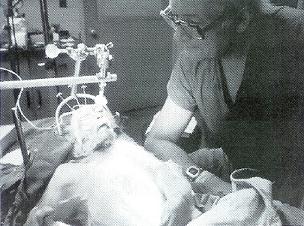
I have always been intrigued by the unlimited possibilities, no matter how remote, that science fiction can conjure. This episode, however, was factual and showed footage of Dr. White’s successful head transplant operations on monkeys in the 1970s. I had no idea that such work had ever really been conducted, let alone successfully. Visions from X-Files: I Want to Believe flashed across my cerebrum while I watched the footage. Not to mention the ubiquitous heads-in-jars of many a science-fiction movie! A plaguing religious question was also stirred back into life after having settled at the bottom of the tank for many years – where does the essence of a person reside? Organ transplants are everyday occurrences, and many lives are prolonged by the sharing of body parts no longer used by their original owners. And transplants do not stop below the neck – cornea transplants bring us very close to the brain, the presumed seat of our personality, consciousness, or, if you will, soul.

when a head meets a body

Dr. White’s monkeys that survived seemed to have retained the personality of the original monkey head on its new body, but I wonder if that was just an illusion. In our world where each individual is treated as a discreet unit, the essence of a person is thought to reside in the brain. Our brains, however, recognize our bodies and sometimes bodies reject the very organs intended to save them. Is there really any possibility of preserving the essence in one’s head alone? Or are we, like ants and bees and Portuguese Men o’ War, really all part of a collective organism? Maybe there is a good reason I don’t have cable or a digital conversion box.