
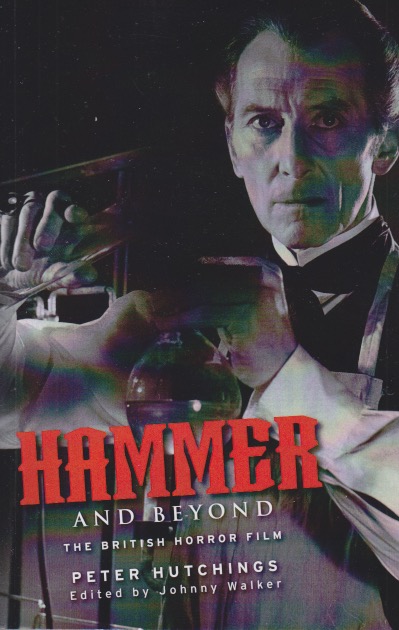
Taking my first, tentative steps into horror analysis, I had read a great many monographs on the subject. I had watched many horror films over the years, but since my family has no love of the genre, and since habitually under-employed I can’t afford to pay for many, my quota is fairly modest. I’ve missed out on many. When I could afford it, I started out with either movies I’d heard of when younger but had never watched, or packs of ultra-cheap B (C or D maybe) movies that nobody has ever heard of. As I lamented recently, British films were rare—Hammer, which held the English reputation for horror, was the undiscovered country. Then I saw that Peter Hutchings’ Hammer and Beyond: The British Horror Film had come out in a second edition. (The new edition contains three of Hutchings’ other articles as well as the original text.) I had to read it.
Although I’ve not seen many of the movies discussed in the book (again, access issues) it was fascinating nonetheless. Hutchings considers the elements of gender and Britishness in his readings of the films and there’s quite a lot there. Horror is generally seen as a conservative genre (it tends to uphold typical social values) and for many Hammer and other films this meant that male prerogative was important. Equally important, however, is that horror often disrupts this hierarchy. There are strong, and even fatal, women here. Horror embodies the acting out of the complex world of fear between women and men. The study, as befitting a revised dissertation, is laid out chronologically for the most part.
Some readers of this blog have kindly pointed out ways to access Hammer films in the US. Now all I need is the time. I’ve been able to keep up with my reading, at least. And this was a worthwhile book to read, even without having seen much Hammer. It surprised me, however, that their list of classic horror wasn’t longer. Having read about Hammer for many years, I suspected their output was massive. Instead it was mostly just impactful. The essays following the main body of the book make the point that British horror was/is distinctive. These days a lot of international cooperation takes place in the movie industry, and national cinema is becoming more global. We could use a little less nationalism just about now. So I’ll continue my quest for Hammer and try to make my way through the movies I really should add to my repertoire. It’s a good book that can make you want to do that.
 Steve A. Wiggins