Seeing in Darko

Having seen it I have to wonder why I waited so long.  Part of it was timing, of course.  I was still teaching at Nashotah House when Donnie Darko came out, and I didn’t watch as many movies then.  My loss of that job started me on my horror-watching spree, but Donnie Darko is more than horror.  In fact, it’s usually labeled a thriller instead.  Another reason I avoided it is, alas, the title.  It’s actually the name of the protagonist, and one of the other characters in the movie remarks that it sounds like a superhero name rather than a regular person.  What’s it about?  Well, that’s where it gets interesting.  Donnie has mental health issues, but those issues are tied in with time travel and philosophical discussions about the existence of God.  The high school Donnie attends, although not explicitly stated, seems to be Catholic but there aren’t priests and nuns about, and one of the teachers is seemingly evangelical.

Donnie has trouble distinguishing reality.  Instead of allowing the audience to get away with labeling him easily, the question of reality itself is left unanswered.  The movie is deep like Brazil or The Matrix, and is often considered one of the greatest independent films of all time.  It’s the story of Donnie’s October 1988.  He sleepwalks and sees a guy in a bunny costume who tells him the world will end in 28 days.  Of course he’s medicated and sent to see a psychologist, but what the guy in the bunny costume tells him ends up coming true.  The story is intricate and doesn’t bear a brief synopsis.  It is a movie that will make you think.  It’s become a cult film and I think I’ll be joining that crowd on this one.

Films that manage to put philosophical reflection in the spotlight are rare.  Even more uncommon are those that do so with high production values and convincing acting.  Movies that do this aren’t often cheerful—philosophers in general don’t tend to be a jovial lot (some are fun, of course, but they’re not the majority).  Thinking is serious work, even if those who do it aren’t really paid for their efforts.  Donnie Darko is a movie that will make you think.  Is it horror?  Some classify it so.  Others say sci-fi, but it didn’t really seem like that to me.  In fact, it’s very difficult to classify at all.  Many of the best movies are that way, in my experience.

At the Same Time

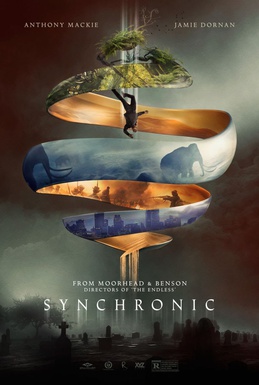
The philosophically adept movies by Justin Benson and Aaron Moorhead can be addicting.  At least for a certain kind of viewer.  These are independent films and they’re smart and worth the effort of tracking down.  Often they fall into both sci-fi and horror, but generally horror of the existential variety.  And they have social commentary.  Synchronic is gritty, delving into drug culture (as some of their other movies do as well) and taking its title from a fictional drug.  Synchronic, the drug, distorts the taker’s sensation of time.  If the user is young—their pineal gland hasn’t calcified—the drug physically transports them to the past.  Adults only experience it as ghostly images rather than physical displacement.  Two EMTs, Steve and Dennis, keep finding victims of the drug.  Steve is a black man with brain cancer that keeps his pineal gland from calcifying.  Dennis, a family man, loses a daughter to synchronic—she gets lost in time.  Steve decides to save her.

Here’s where the social commentary really kicks in (although it’s been there from the beginning).  A black man traveling back in time in Louisiana is at a distinct disadvantage.  Dennis is white but his brain won’t allow him to travel back physically.  Not only that, but it was Steve who took the initiative to find out how the drug works.  You spend only seven minutes in the past, unless you miss being in the right place when the drug wears off.  If you miss the return, you’re stuck forever in the past.  That’s where Dennis’ daughter is.  She’s caught in New Orleans in 1812.  Louisiana was, of course, a slave state.  Steve faces enslavement if he doesn’t make it back in time.  I won’t say how it ends, but it leaves you thoughtful.

Many “white” Americans feel that Black Lives Matter is too “woke” for them.  They seem to think everything is now free and equal.  It isn’t, of course, and those who are willing to look see that African Americans have an extra layer of struggles that they constantly face.  The movie addresses this as well.  When assisting an overdose victim after he misplaced his uniform, Steve is mistaken for a criminal by the police at the crime scene.  This despite the fact that the white officer who initially detains him, knows him.  A black man out of uniform must be up to no good.  I can’t believe that I went so many years without knowing about Moorhead and Benson movies.  Be careful if you start watching them—they can be addicting.


Thoughtful Transformation

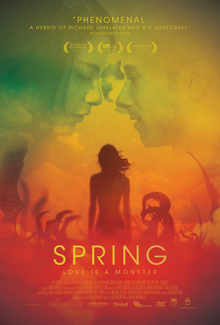
Philosophical horror’s a thing.  A friend introduced me to Moorhead and Benson films—these aren’t major studio productions—and I’ve been watching them as I can find time.  They’re intelligent and tend away from heavy gore, which is fine by me.  And they leave you with plenty to ponder.  I recently sat down with Spring, an unusual movie that sometimes gets classified as science fiction, probably because the lead actress plays a science student.  There will be spoilers here, so if you have plans to watch, please stop and do so now.  Here goes:  The story follows an aimless young man who’d given up college to take care of his dying mother.  To get away, he heads to Italy with no particular destination in mind.  He ends up in Polignano where he meets and is smitten with a young woman.  At least he thinks she’s young.

From the privileged point of view of watchers, voyeurs perhaps, we come to see that Louise isn’t who Evan thinks she is.  She’s a two-millennia-old woman who has to regenerate herself every twenty years to maintain her immortality.  When the twenty years wind down, she transforms into other creatures on the evolutionary scale on the way to humans.  Since she lives on she’s not really seeking a long-term relationship.  This leads to some discussions of religion, which I find intriguing.  Louise is a scientist, however, and even when she transforms into a monster, she refuses to call it supernatural.  Rather, she claims it’s just something that science can’t yet explain.

This perspective really does get at the heart of the debates between science and religion.  Are there things science simply can’t explain?  I.e., are there things beyond science?  Or is science really the panacea for all things?  The problem is that the human mind cannot sense or detect all things.  We don’t even have a clue as to how many things there actually are to detect.  How can one method be used to encompass everything?  Not a bad set of questions to be raised by a somewhat Lovecraftian movie.  Lovecraftian, by the way, due to its focus on the sea and some of Louise’s atavistic transformations.  Spring is an unusual and thoughtful movie.  It’s a love story as well, about willingness to face the unknown for love, and trusting evolution.  The characters are likable and you want them to thrive, which you don’t always get in this genre.  It’s one of the reasons I keep coming back to Moorhead and Benson, and always being glad I came.


Still Not Resolved

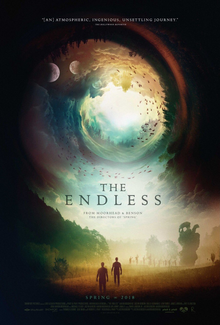
Yesterday I posted about the independent movie Resolution.   It’s actually part of a set, the other half of which is titled The Endless.  In The Endless the director and cinematographer, and co-directors of both films, interject themselves into the story.  While some suggest it’s only a partial sequel, to me it felt like a part of the same tale, giving, as it were, resolution to both movies.  Philosophical horror is something I always associate with Thomas Ligotti, but Justin Benson and Aaron Moorhead have given it a double punch with these two films.  So a pair of brothers (Justin and Aaron) go back to visit a “UFO cult” in which they were raised.  This immediately puts you on edge because Aaron doesn’t seem convinced that it was such a bad life, compared to that which they’ve been able to find on their own after leaving.

There’s definitely something very weird going on at Camp Arcadia, though.  Justin had convinced Aaron that it was a suicide cult (think Heaven’s Gate), but it turns out that everyone’s still alive, and apparently thriving.  Their means of livelihood was threatened when Justin went public that they were a cult, but they’re nevertheless glad to see their ex-members.  Once they get integrated into the camp, characters from Resolution begin appearing.  Both movies feature the same monster and the same means of delivering messages via media—often outdated.  The brothers come to understand that they are being trapped in a time loop and—spoiler here—that the cult members are in a sense dead since they live the same loop over and over.

In addition to being philosophical horror, The Endless contains substantial theological sophistication as well.  Discussions about God, and church, and belief systems run through the movie.  Thinking deeply can lead to horror scenarios such as this.  People tend to feel trapped when caught in nothing but repetition.  We’re curious and we seek a variety of experiences and new stimuli.  Eastern religions recognize the problem as well and offer ways to break out of the cycle of reincarnation (samsara).  The idea of using such things to suggest that this kind of repetition is a monster—when Justin sees it he’s convinced it’s a monster—is rich fodder for a thoughtful horror film.  At the end, it seems that “UFO cult” is an unfair characterization for the commune at Camp Arcadia, but, with enough determination, it’s just perhaps possible to break out of the cycle.  This one’s worth pondering.


Not Resolved

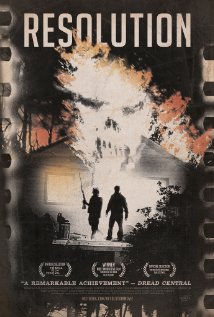
Some movies are intentionally mind-blowing.  Knowing the kind of movies I like, a friend suggested Resolution with the enticing note that it is free on Amazon Prime.  Since anything free is worth saving up for, and since I was having trouble staying awake on a warm, wet Sunday afternoon when the lawn couldn’t be mowed, I gave it a try.  Even after it was over I wasn’t sure what I’d seen, but I was glad that I had.  Part of the draw is how convincing the acting is.  Another is the bizarre nature of the threats.  Like Sinister (also released in 2012), Resolution involves found media that tell a disturbing story.  Only in the case of Resolution it’s set in a remote part of an Indian reservation and it involves a drug addict and his friend who’s attempting an intervention.

With the addict handcuffed to a pipe, his rescuer encounters a strange set of people in the area and has bizarre media delivered to him by an unknown party.  In fact, he goes to his friend because of a video emailed to him by the addict.  Only the addict didn’t send it.  The media (records, color slides, video tapes, computer files) tell increasingly strange stories until the media also begin to show the two friends almost instantaneously.  A stoned French researcher tells the rescuer that there might be some time-space dislocation here, or there may be a monster.  Reluctant to release the addict until he has several days to get the drugs out of his system, the friend attempts to figure out what all this means.  Then the media begin to show their short-term future.

I won’t say how it ends, but I will say that the title Resolution is well-chosen.  This is a very creepy movie.  A remote location where things just don’t seem right and the conviction that just a few days will save a friend’s life but only if they stay in place is a great concept.  In many ways it’s a movie about stories.  The resolution is the end of the story and that’s something that’s successfully kept up in the air throughout.  Anyone who writes stories knows the feeling of writing yourself into a corner.  Playing around with space-time opens up possibilities, however, corners or not.  I can’t say that I understood everything that was going on here, but it was edgy enough to keep me alert, even on a muggy, drowsy Sunday afternoon.