
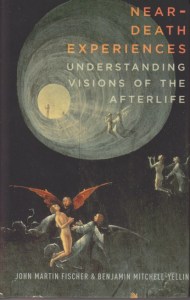
 Since new books are kind of rare right now, I’m reading through some of those I’ve collected but haven’t actually read. One is Near-Death Experiences: Understanding Visions of the Afterlife, by John Martin Fischer and Benjamin Mitchell-Yellin. I bought the book because the topic, as addressed by a university press book, is interesting. Fischer and Mitchell-Yellin approach the subject as philosophers. Their main focus is on the widely accessible and successful books by Eben Alexander and Todd Burpo. Also the somewhat less well known efforts of Jeffrey Long and Pim van Lommel. (Instead of taking up blog space with all these titles, just email me if you’re curious, or read my Goodreads post.) Applying standard scientific methods to spiritual experiences isn’t easy, and Fischer and Mitchell-Yellin are clear that they aren’t trying to take the value out of Near-Death Experiences (NDEs), but rather they are challenging how these authors try to make them authentic.
Philosophers parse words finely. The authors show that “real” is not the same thing as “authentic” and demonstrate how some of the more spectacular NDEs can possibly be explained by science. Those who’d temporarily died might’ve caught onto things that happened just before or just after brain activity ceased or restarted, for example, and then misremembered them. As a still-living guy who can’t remember where he left his wallet half the time, misremembering is an authentic reality. Still, I couldn’t help but wonder. Science and religion ask different questions. One of the mainstays of scientific method is Occam’s Razor—the solution that requires the least mental gymnastics to explain something is the most likely to be true. Many times this razor is flashed in the face of those trying to make a religious case for something.
Ironically, the authors here dismiss Occam’s Razor. They state that sometimes the more complicated solution is the right one. I happen to agree with them on this, but it proved a real distraction in reading the book. Many scientists use the exact opposite argument against spiritual things. It also struck me that a book so brief (less than 200 pages) would necessarily struggle to explain a complex phenomenon convincingly. Trade books, such as those by Alexander and Burpo, aren’t meant to be held up to the stiff standards of peer review. They are meant for selling lots of copies. Their authors aren’t philosophers. It’s almost a mismatch in categories. Some academic presses are now publishing on NDEs and asking plenty of questions about them. It’s no surprise that philosophers favoring physicalism would do the same. It seems a little hairy, however, to do so with Occam left firmly in the shaving kit.
 Steve A. Wiggins