Museum Haven

At various points of my career I’ve applied for museum curator positions.  Since those who actually land those jobs have degrees in museum studies, I’ve never gotten as far as an interview.  Still, I like to think I’d be good at it.  I spend time in museums and I’ve been told I have an okay eye for design.  And I recently read that museums are educational institutions.  That makes sense since people tend to be visual learners.  (This is something I took into account in my classes as well, illustrating lectures to make a point.  The traditional academic feels that pictures are somehow “soft” learning as opposed to the harsh realities of text and word-based instruction, but I beg to differ.)  We see things and they stick with us.

On a visit to the New York Historical Society museum I once looked at their somewhat abbreviated sculpture collection.  This isn’t the Met, after all.  One of the tricks I’ve learned about museum displays is that some curators place subtle humor in their framing of objects.  For example, my gaze was drawn to a figure of a pilgrim.  A stern-looking fellow, he’s captured in full stride, massive Bible tucked under his arm, determined frown on his face.  This is a man trying to create Heaven on earth, dour though it may be.  Taking a step back, my camera found a smile in this image.  On either side of this angry Christian were two naked women: one was apparently Artemis with her bow, the other perhaps a Muse.  The lines of the display draw attention to this juxtaposition.  There’s some humor here, intentional or not.
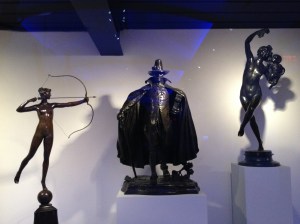
This also takes me back to yesterday’s post about Heaven.  Perceptions of what it is differ.  There’s a mindset like the pilgrim that sees a life of suffering being rewarded in the hereafter with endless bliss.  I do have to wonder whether too much hardship down here might not make one forget how to enjoy oneself.   It’s difficult to picture a Puritan in rapture.  It’s as if the journey—the hard road—is the real source of enjoyment here.  Each of us, I suppose, has her or his own view of Heaven.  Mine’s kind of like a library with all the time in the world without end to read.  Others, I suspect, would find paradise as a garden.  Yet others would see Heaven as a kind of museum, but it would be one where laughing out loud was okay, for the Curator definitely has a sense of humor.


Thanksgiving Day

This post is an excerpt from my unpublished book for young readers giving the history of American holidays:

When you think of Thanksgiving you may see visions of a big turkey dinner and a four-day weekend. If you’re like me (I hope not!) you probably think that ever since the first Thanksgiving dinner in 1621, Americans have had a big November feast every year since. This popular cozy image may be heartwarming, but it is wrong. Thanksgiving in history is a custom that goes back to the Puritan settlers. Puritans came to America so that they could practice their religion freely. They were religious people (not a great sense of humor); things had been pretty tough for them – crossing the stormy Atlantic in small ships, not knowing what to expect when they arrived, lots of people dying on the way – not an easy thing to do! Once they got here, there were no grocery stores and they hadn’t planted crops earlier in the year, they didn’t even know what would grow here. Many didn’t survive, they weren’t America-tolerant you might say.

What we think of as the first Thanksgiving involved English colonists (Pilgrims) in the Massachusetts Bay Colony and the Wampanoag tribe of Native Americans. One of the Wampanoag, Squanto, served as an interpreter – pretty big of him, considering he’d learned English from being a slave. He taught the settlers how to grow corn, which was unknown in Europe. (What the English called “corn” is what we call “wheat.” The more correct word for what we call “corn” is “maize.”) Squanto also taught the Pilgrims how to catch eels to eat – maybe he found a way to pay them back after all! The first Thanksgiving meal in 1621 followed the Pilgrims’ first successful harvest. They ate deer and some wild birds – enter the turkey! – along with their crops.

You see, both the Wampanoag and the English had traditional harvest festivals – many peoples do. “Thanksgiving,” however, has to do with, well, giving thanks. Did I mention that the Pilgrims were religious? They believed that God had successfully brought them here, so they thanked God. Not every early harvest was so great. In a bad year they had a day of mourning rather than a Thanksgiving feast. Some historians place the first “Thanksgiving” in 1923. The Pilgrims had experienced a drought. Frantically they prayed for rain, and, Flanders-like, it came. So they held a Thanksgiving. These Massachusetts Puritans held Thanksgivings in church rather than around a banquet table. For them, these irregular days of giving thanks marked the survival of difficult times, not fancy food. So they held occasional Thanksgivings, not watching football after a big meal, but praying in church. By the middle of the 1600s settlers began to have a harvest-day Thanksgiving pretty much every year, but not always on the same day. They had not set a specific date to give thanks and feast.

Puritans, you must realize, gave thanks at the proverbial drop of a buckled hat. They prayed before meals as a regular practice – something many families continue to do. To set aside a day for special prayers, like Thanksgiving, was as natural for them as women wearing bonnets. The practice of having an annual (yearly) day of giving thanks got underway in Massachusetts around 1630. Other colonies joined in, but not always at the same time. Remember, harvests come at different times in different places.

[See Full Essays for the rest of the story.]