Thinking Plants

Consider your sources.  As an erstwhile professor I grew accustomed to repeating that, and this was before the internet started up, making claims of all kinds.  Certain news sources—think New York Times, or the BBC—earn their reputations slowly, over many, many years.  That doesn’t mean they don’t make mistakes, but it does mean they’re often on the mark.  So an article on plant consciousness on the BBC is worth considering.  Consciousness is still something we don’t understand.  We have it, but we can’t always say what it is.  Many, if not most, people tend to limit it to humans, but it’s become very clear than animals share in it too.  Why not plants also?  A few years back I read a book by philosopher Thomas Nagel.  He made the argument that human consciousness must come from somewhere, and as we look down toward animals, and plants, what we see are smaller pieces of the same thing.

I’m not stating this as eloquently as Nagel did, but the idea has stayed with me.  The BBC article  notes how plants seem to react to human interaction.  And they seem to communicate back.  We lack the natural range to hear their responses, but some experiments indicate that plants at least communicate among themselves.  Being the BBC, the story reports but doesn’t necessarily advocate this point of view.  Still, it makes sense.  For too long we’ve supposed human beings to be the only intelligent creatures on this planet, taking the arrogant view that animals are automatons with no thinking ability.  To give them that would be to make them too human-like.

That particular viewpoint still exists, of course, but more and more scientists are starting to consider whether consciousness isn’t emergent from, as Nagel put it, smaller building blocks.  I tend to be on the more imaginative end of the spectrum—consider your source here—but it seems to me that plants could well have a consciousness too.  Trees move.  They do it too slowly for our species to notice it, fixated as we are on our own brief time in the world and our human affairs, but that doesn’t mean they don’t move.  It simply means that if we want to see it we need to shift our perspective.  Communication, it would seem, pervades nature.  If it does, isn’t consciousness somehow implicated?  Plants may respond when we pay attention to them.  To me that makes the world an even more wonderful place.
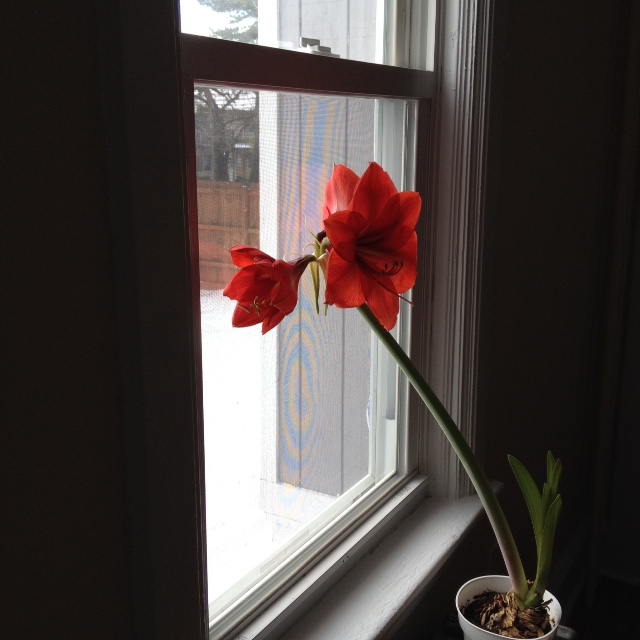

Growing in Intent

Balance has become a desideratum.  Ours is an age of extremism.  Black and white instead of shades of gray.  One of the unnecessary polarizations is that between science and religion.  Part of the problem, it seems to me, is the labels we insist on using.  Science is shorthand for evidence-based research—it is a way of understanding the physical world.  It doesn’t necessarily discount a spiritual world but its methods can’t engage that world, if it exists.  Religion is a poorly defined word, often one of those “you know it when you see it” kinds of phenomena.  Often it is characterized by blind adherence, but that isn’t necessarily what religion is either.  To me, balance between the two is an authentic way to engage the world and other human beings.

Take plants, for instance.  And take consciousness.  While consciousness isn’t always associated with religion, it is one of those things that falls out of the ability of science to measure or quantify.  We don’t really know what it is, but we know we have it.  We know some animals have it, but rather arrogantly assert it is only the “higher” animals, as if we comprehend the hierarchy of nature in its entirety.  We dismiss the idea of plant consciousness.  For many years I’ve been pondering intent.  Without it no life would be possible from sperm germinating egg to heliotropes following the sun.  There’s some kind of intent there.  Will.  Recently The Guardian ran an article about scientifically measured intent in bean plants.  Although many have been left scratching their heads, or pods,  over it, to me it makes perfect sense.

I planted an apple seed a few months back.  It finally sprouted in late December.  I carefully watered it, and put it by a south window to get sunlight.  It grew quickly for a few days and then began to wilt.  I watched helplessly as it gave up the will to live.  I’m no botanist, but I suspected it was the coldness of being set on a windowsill.  (Ours isn’t the best insulated house.)  December had been mild, and it sprouted.  January took a sudden shift to chill, and I realized that new plants outdoors wouldn’t sprout in winter.  The seed had germinated, but the plant had no will to survive in temperatures chillier than its genes told it that might be safe.  I’m not a scientist, but I observed this scenario carefully.  Is it possible that french bean plants show intent?  I think it would be more difficult to explain if they did not.