A Touch of Poe

One of the more somber aspects of our staycation in the Poconos occurred on our search for Tanners Falls.  It brought to mind a story by Edgar Allan Poe.  Here’s why:  Tanners Falls is not well signposted.  This is quite a rural area.  We were following our GPS when the signal died right after she said “arrived.”  The problem was there were no signs and although we tried a couple of tick-trails that ended up at a stream, nothing like a cataract was anywhere near.  Finally we realized that a tiny sign reading “Tanners Falls” was posted on a “Road Closed” barricade.  Since to road was actually open to the Falls, my wife brought the car but I wanted the exercise and went by foot. Walking along the way I found a roadside shrine and noted that in addition to the name Laura Lynne Ronning was a small plaque stating “Murdered July 27, 1991.”  Now, there was no signal out here, and I was alone on the road.  And I had no desire to bring my family down so I kept it to myself.
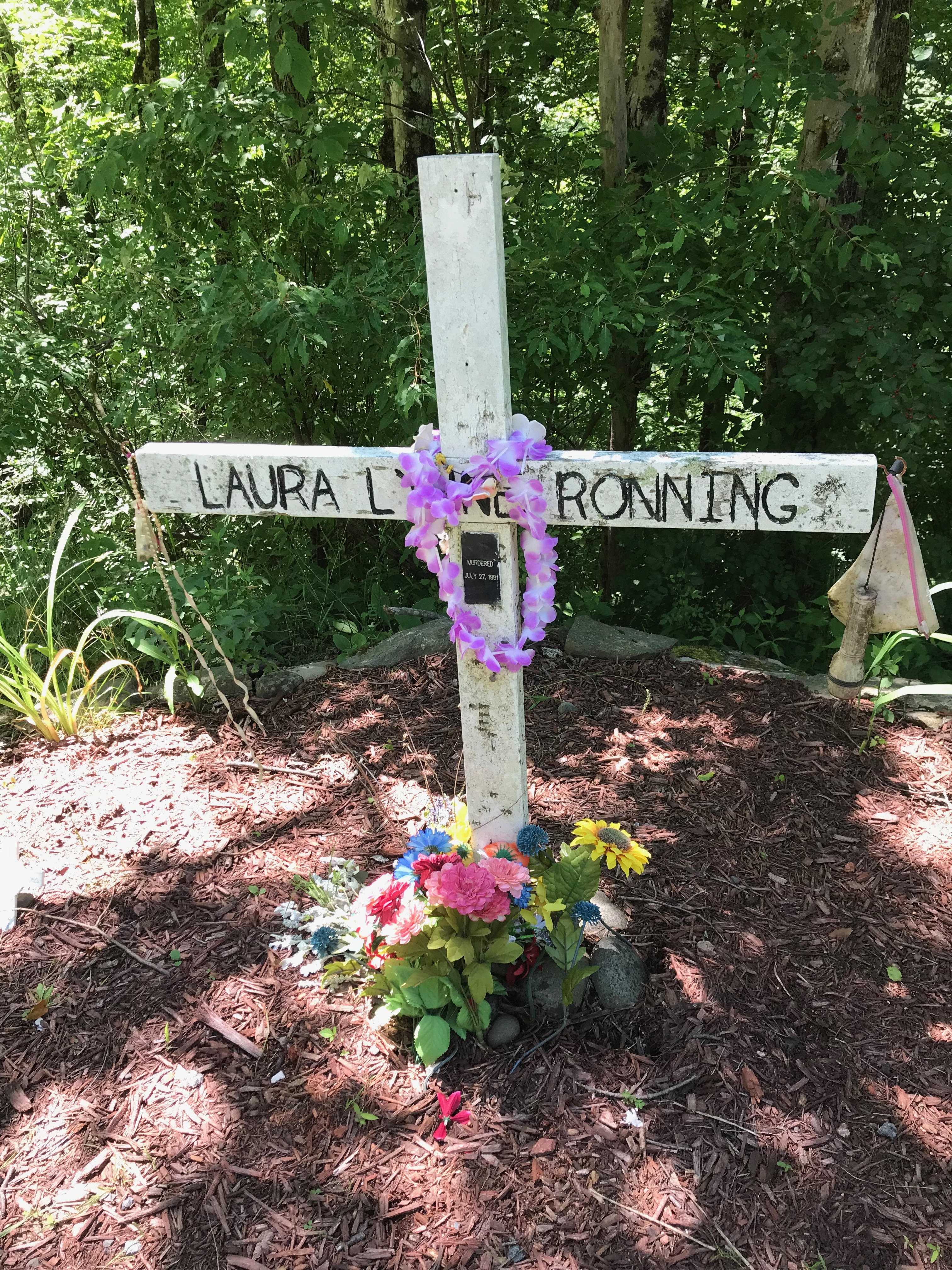
At the hotel (with wifi) I learned that Laura Ronning’s murder was never solved.  She was a counselor at a nearby camp walking to the waterfall on her day off when she was raped and shot and thrown into the woods.  The only suspect was a mentally unstable man (now since deceased) and the evidence was all circumstantial.  He was, unlike some known criminals of high profile, found not guilty.  The Ronning family moved out of the state, not wanting to be where someone could literally get away with murdering an innocent young woman.  This is where Poe came in.  His “The Mystery of Marie Rogêt” is the first detective fiction based on a true case—Poe was often, figuratively, first on the scene.  The murder of Mary Cecilia Rogers, whose body was found in the Hudson, was never solved.  Poe tried his hand at the by then famous unsolved case.

The murder of a young woman was a tragedy that Poe felt deeply, I suspect.  I took some academic flak for including Poe’s observation that the death of a beautiful woman was the most poetic theme in Nightmares with the Bible.  I realize this is a masculinist thing to write, but the fact is that some men feel very protective of women.  I know there’s a psychological name for this, but it isn’t chauvinism.  It is a sense of sadness, for what Goethe tried to express by writing “Girls we love for what they are; young men for what they promise to be.”  On staycations I try to look for literary angles, even when they are, from time to time, sad.

Following Irving

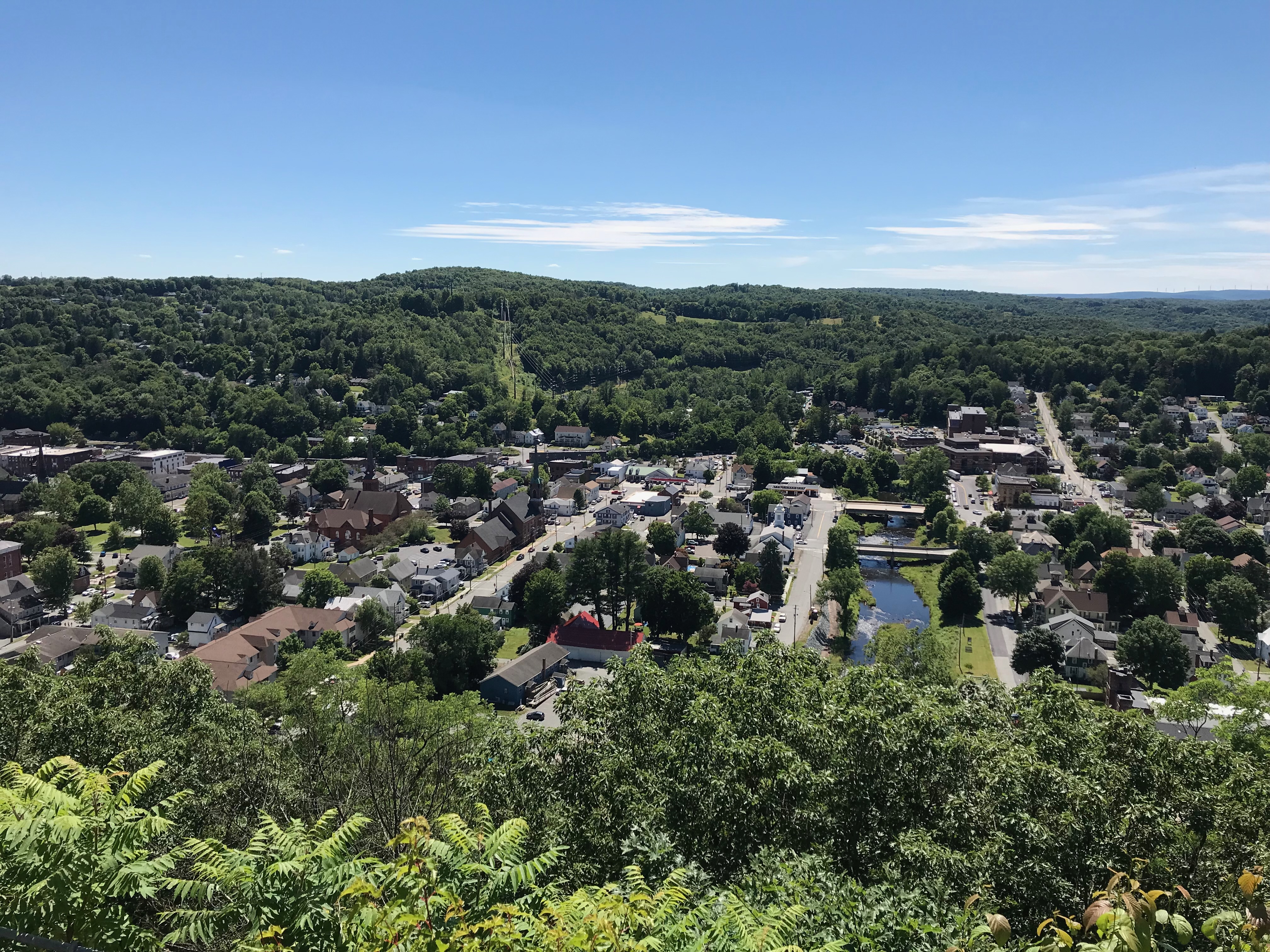
I’m growing fond of staycations.  Maybe it’s because I’ve become such a creature of habit that major disruptions seem daunting, but I still like a change of scenery with my family.  We settled on the Poconos because of, well, a chocolate factory.  More on that anon.  In any case, said location was near Honesdale, Pennsylvania.  Before setting out we learned that Honesdale is one of those quaint downtowns that has made it an island of culture in a sea of red, if you get my drift.  While researching things to do we learned about Irving’s Cliff.  This is an overlook of the town from a bluff atop one of the many hills.  What really caught my attention is that the Irving was none other than Washington Irving, the author of “The Legend of Sleepy Hollow.”  This cliff was a view he enjoyed, so it was named after him.

The view from Irving’s Cliff

Honesdale is a small town.  Less than 5,000 people call it home.  Growing up in western Pennsylvania I heard about more affluent people going to “the Poconos” out east.  It was a “romantic” getaway for some lucky high schoolers while the rest of us had to use our imagination regarding what such a place might be like.  Of course, living just south of the Poconos now we’ve driven through them many times, but we never stopped to linger here.  As I tried to commune with the spirit of Irving on his cliff, it occurred to me that he had been a world traveler.  Nipping across the border from his native New York to Pennsylvania must’ve been no big deal.  Still, he wrote incessantly and the locals obviously appreciated that a famous writer had tarried in their town.  Standing here, I knew the view he took in was quite different.  The hills would’ve been here, but a much smaller town and, above all, no cars.

My forthcoming book on Sleepy Hollow will have a thing or two to say about Washington Irving, of course.  It’d be a fool’s errand to try to follow in his footsteps, just as it would be to try the same for his namesake George Washington.  Besides, I was born in a western Pennsylvania town visited by our first president.  Although we couldn’t afford accommodation in Honesdale itself (it is a quaint town), we checked into our hotel knowing that “Washington Irving slept here.”  And when you’ve spent a few years writing a book about a guy’s work, well, a staycation to a place where he had one is worthy of comment.


The Price of Worship

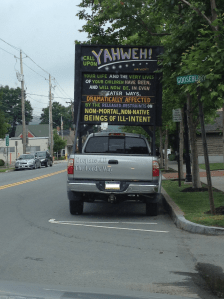
The wind resistance alone must drive the cost of gas up considerably. Of course, with Yahweh on your side you don’t need to worry about pocket change. We were driving through a sleepy town in the Poconos. A light rain was falling. We came upon a truck advocating not for the usual and expected Christ, but instead for Yahweh. Promising “dramatically affected” lives for those who do so, the implied message on this portable billboard is somewhat ominous. We are apparently being restrained by “non-mortal, non-native beings of ill-intent.” The grammar of the placard confuses things a bit since it seems to suggest that calling on Yahweh will “release restraints on” said non-mortals, and that’s hardly a good thing. I suppose they can’t reveal the nature of these entities without giving away spoilers for drawing the curious in.

This vague, supernatural world presided over by the personal name of the deity seems just a little out of place in Bible country. There’s a kind of literalism about Pennsylvania that I find strangely comforting. It is where and how I grew up. I never encountered God’s personal name—at least not with first-person familiarity—until I attended college. Even then we were encouraged to be careful with its use. The commandment about taking the divine name in vain is just a bit disconcertingly unspecific, considering that it isn’t spelled out in more detail. And who exactly are these beings of ill-intent? They’re all the more frightening for not being named. Demons, I must suppose, but I don’t recall the Good Book saying anything about their restraints being released. This is a new kind of apocalypse maybe.

The thing about the Bible is that it’s everybody’s book. Some modern translations use Yahweh rather freely, opting for the admission that translating it leads only to more questions and “Lord” is obfuscation. Still, it seems awfully familiar. The need to air one’s personal beliefs, in some quarters, is very intense. There’s a passion behind this proclamation that I can’t help but admire. People stop and stare. Some, like yours truly, will want photographs of your vehicle. I suppose that’s the point, nevertheless, not too many people like being stared at. Evangelical culture demands it, as I recall from my youth. Putting your personal beliefs out there comes with a price. Part of that may be reduced gas milage and, consequently, pocket change.


Holy Girdles

Religions, it seems, come in belts. Or at least elements of religions do. Although we may not all agree on what constitutes the “Bible Belt” we all have a pretty good idea that it includes several southern states, and parts of the Midwest. It doesn’t really resemble a belt that I can tell, but its convenience and assonance keep the phrase alive. Over this past weekend I was in the “Borscht Belt.” I’d heard the term before, but had no idea where this supposed belt was, or, indeed, why it was called this. Historically, three counties in the southern Catskills, so I learned, were attractive locations for summer homes for Jewish families from New York City. All within a easy day’s drive of Gotham, they provided the low mountain, resort feel of much of New York State and Pennsylvania. According to Wikipedia (surprisingly, I had no books on the Borscht Belt in my library) this designation is less descriptive now than it had been, back in the day.

BorschtBelt2

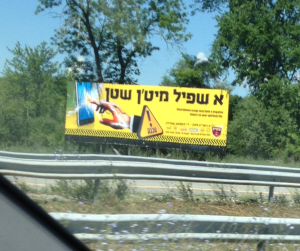
One of the immediately obvious features of the region, at least as recently as last weekend, were the number of orthodox Jews walking beside the roadways throughout these counties. I’m using “orthodox” here not as a technical term since I have difficulty identifying the different brands of conservative Jewish belief (there I go again!). Another obvious indicator was the number of billboards written in Hebrew. Just a hundred miles down the road west and these markers tend to disappear. By the time you reach the central part of “the southern tier” you come back to what was once called “the Burnt Over District” from the “Second Great Awakening.” Distinctively Christian in orientation. Religion is endemic in these hills.

The internet tells me that the Borscht Belt began to unbuckle with the relative ease of air travel. I have many Jewish colleagues who pop over to Israel on a fairly frequent basis. I suppose the Catskills just don’t compare with the Holy Land. Further south, along this same rocky spine, you come to the Poconos. I grew up hearing about this vacation paradise in my own state, but, like the Catskills, the region has been largely abandoned for higher mountains, bigger thrills. Having grown up in the foothills to the Appalachians, I learned in school that these are ancient mountains. Old ways are naturally preserved here. The religion I grew up in was old-time, for sure. There’s an agelessness to these weathered hills that seems to invite those with old religions to form enclaves and imagine that little has changed, despite what Wikipedia might say. And maybe it’s time to get a bigger belt, since conservative religion seems to be growing rather than shrinking.