
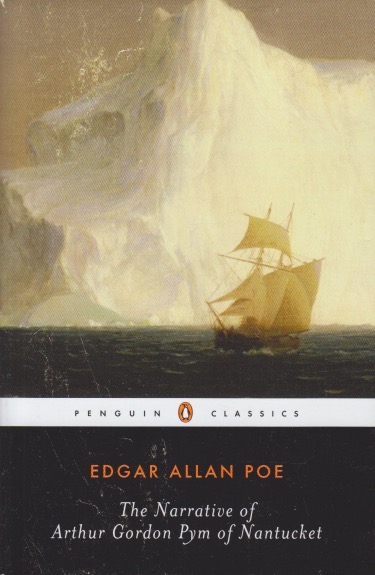
Certain authors, some great among them, excel at short stories. I know from personal experience that trying to publish a book of such stories is a very hard sell. For a writer like Edgar Allan Poe, who was trying to live on his words, it often led to periods of poverty. Thinking of him as a short-story author, I had never read his only novel, The Narrative of Arthur Gordon Pym of Nantucket. Hailed by fellow brief-tale writer Jorge Luis Borges as Poe’s best, I figured I’d better give it a try. I’m glad I did. I had, however, no idea what to expect. Those who write on Poe seldom pay it much mind. He was famous for his poems and stories, and this gothic, sea-faring novel was, according to the introduction, suggested to him by those who felt his making a living as a writer might improve if he used long form.
Concerning the edition: the novel is in the public domain. Penguin Classics, however, often contain nice introductions. Indeed, the intro by Richard Kopley in this edition is excellent. A few of his observations stood out to me—this novel was, in some measure, about Poe’s family. Both the protagonist and the author have five-syllable names with the same cadence, ending on a three-letter surname beginning with P. Also, as both the introduction and notes make clear, Poe was deeply steeped in the Bible. You seldom read about Poe and religion. Writers from America’s first generation, however, were uniquely brewed in it. I’d never considered that about Poe before. There are many editions of Pym available, but I recommend this one because of its introduction.
The story ends without resolution, just so you know. Pym, talked into an adventure by a somewhat devil-may-care friend, goes out on the ocean on a boat after a night of drinking. And herein hangs the tale. Well, actually, the friend convinces the young man with a taste for the sea to stow away on a whaler that his father captains. A mutiny, however, leaves Pym “buried alive” onboard. A shipwreck leads to near starvation and a boon companion survivor. Picked up by an explorer headed south, they discover a surprisingly temperate Antarctic circle where a native tribe turns treacherous because of their fear of the color white. It does seem that there’s a race narrative taking place here too. I enjoyed the story although the chapters about longitude and latitude don’t quite rise to the level of Melville’s maritime writing. It’s a tale worth the read, however, but find one with a good introduction and it will be smoother sailing.
 Steve A. Wiggins