Ending the Cycle

Curious to finish out the “Poe Cycle” of American International Pictures, I looked up The Oblong Box.  The only thing similar to Poe’s tale is the title, as viewers must’ve come to have expected even in 1969.  Poe was the marketing to sell the film, but not much more.  Okay, the theme of premature burial has Poe’s fingerprints all over it, but that’s not part of his story “The Oblong Box.”  Now, as for the movie, it has several subplots and a pretty high body count.  Its ending isn’t really explained, but after starting out as seeming racist, it comes out justifying the actions of the Africans at the beginning.  In the middle it’s a muddle.  Pacing is completely off and some sub-plots, such as the police investigation, are summarily dropped.  Apart from the positive view of Black people, which is important, the film is a confusing criss-cross of unsavory motivations.
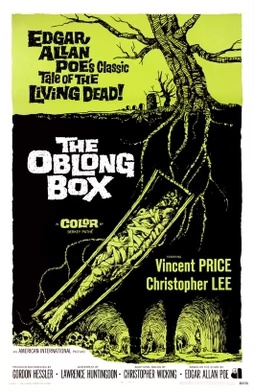
The Markham brothers own an Africa plantation and the trampling of a slave by a horse leads to revenge on the part of the slaves.  The scarred brother, Edward, is driven insane and he escapes his brother Julian’s care by being buried alive.  Grave-robbers, however, want him so Christopher Lee can experiment on his corpse.  Edward escapes again and dons a scarlet mask, but his insanity leads him to kill a variety of people, looking for the witch doctor who can cure him.  Meanwhile, an unscrupulous lawyer is cashing in on the brothers’ wealth but ends up being killed by Edward.  There’s a rather pointless bar fight, and, after killing Lee, Edward and Julian finally face off with Edward getting shot but biting his brother before he dies.  The witch doctor raises Edward from the dead, buried in his coffin, and Julian now has his brother’s scarred face (and presumably, his insanity).

The movie was the first to feature both Vincent Price and Lee.  The film had a change of directors, pre-production, and a script that was added to by another writer.  The plot verges on tedious and it’s difficult to feel sympathy for any of the characters, apart from the women, who don’t seem out to hurt anyone.  Price (Julian) also plays a “good guy” until the reveal near the end, but Edward dominates the screen time, all the while wearing a mask.  The “Phantom of the Opera” reveal is shot in the dark, however, and the results are not so grotesque.  And those who’ve read Poe’s story wonder where the ship might be.  This is the only Poe Cycle film not directed by Roger Corman, and he, as well as Poe, are both missed.

More Poe

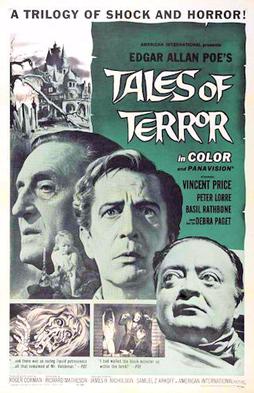
Having admitted to not having seen the entire Roger Corman Poe cycle, I figured I’d better get to work.  I had two movies left to watch and I found Tales of Terror for free on a commercial television streaming service.  As the title indicates, it is an anthology film, bringing together four of Poe’s stories in a three-featurette format.  At the same time, I am trying to catch up on Poe tales that I’ve never read.  More on that to come.  Tales of Terror begins with “Morella,” one of those stories I’ve not read.  There is a danger, of course, in watching a movie first since Corman loved to sensationalize.  I’ll need to wait until I find the time to read “Morella” to know just how much invention there is.  The movie version is an undeserved revenge from beyond the grave story.  Of course it stars Vincent Price.

Although “The Black Cat” gives Price top billing, the story focuses on Peter Lorre’s character, Montresor, borrowed from “The Cask of Amontillado,” with which it’s interlaced (The Cat of Amontillado?).  Montresor is an alcoholic who hates both his wife and cat.  Taking his wife’s money to buy alcohol (something I personally witnessed as a child), he eventually stumbles into a wine tasting convention where he meets Fortunato (Price).  When Fortunato begins an affair with Montresor’s wife it becomes an excuse to wall them both up in the basement.  Lorre plays his Poe characters funny and that makes this segment more a comedy.  Also, there’s a black cat.  The last featurette, “The Facts in the Case of M. Valdemar,” also stars Basil Rathbone.  I haven’t read this story either, so I’m not sure of its fidelity to Poe.  Yet.

The “Poe Cycle” was part of American International Pictures (AIP’s) collaboration with Corman.  Most of the movies were produced quickly and cheaply, although Richard Matheson did write the script for this anthology.  Of course, I hope I haven’t spoiled the two Poe stories I hadn’t read.  I do own an anthology of all of Poe’s fiction, and sometimes it takes movies to make me remove the ponderous tome from my shelf.  (Yes, I’m aware that Poe’s tales are also available for free online, but Poe deserves to be read from an actual book.)  As I’ve mentioned before, I never kept a record of the movies I saw, particularly on television, as a child.  Since the Poe Cycle was still being shown in theaters for part of my youth, I likely missed most (but not all of them) when they were aired on television.  I do remember seeing The Raven decades ago.  At least the internet does allow for a strange kind of resurrection since most of the cycle can be found for free online.