Dead Darlings

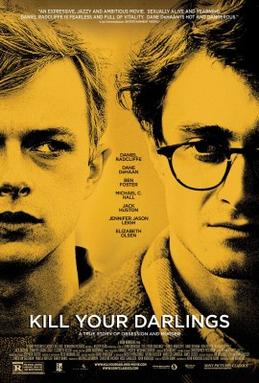
The thing about being a writer is that there’s no one size fits all.  I watched Kill Your Darlings because it is an example of dark academia, or so it’s sometimes presented.  I have read some Beat Generation writers, but the movie made me feel very ignorant of that aspect of American counter-culture.  The movie is based on true events and such things as coincidences of writers always makes me feel terribly alone.  In case you don’t know the story (I didn’t) Allen Ginsberg came under the influence of Lucien Carr at Columbia.  Carr had been surviving at the university by the writing of his one-time lover David Kammerer.  Carr introduces Ginsberg to William S. Burroughs and Jack Kerouac, and the four (excluding Kammerer) kick off what would become much of the Beats.  Carr, however, kills Kammerer and Ginsberg, who has become Carr’s lover, must decide what to do.
Ginsberg grew up in a broken home, as did Carr.  I could relate to their feelings of loss.  Of course, the Beats relied on drugs and alcohol and sex to write, breaking the rules of institutions like Columbia.  Now that I’ve written my “million words” (and more), posted for free on this blog, I think back to my literary friends.  Both in high school and college I knew guys (I was awkward with girls) who dreamed, or at least talked, of becoming writers.  Over the years this pool has dried up.  Seminary and doctoral study were too focused to find those who really wanted to write.  Academic books, maybe, but not forms of self-expression.  Now, I’ve never used drugs, nor have I wanted to.  I write nonfiction books that are creative forms of self-expression.  Naturally, they don’t sell.

Many of us who write were raised in broken homes.  With tattered dreams we set out to try to make something of our lives in a hostile world.  My behavior in college wasn’t exactly conventional, as any of my roommates could attest.  It often appeared that way on the outside, even as poems rejected from the literary magazine were called “too depressing.”  So I pursued an academic career, but there was, whether anybody saw in or not, always a wink in my eye.  The same is true of my writing since.  This blog scratches the surface.  There’s a huge pile of fiction, and yes, poems, underneath.  They may someday be found, but I do have my doubts.  Movies about writers will do this to me.  Even if they don’t really fit my tastes in dark academia.


Black Bird

Although we prefer typecasting—it’s so much easier!—Edgar Allan Poe had both depth and width as a writer.  He penned funny as well as scary, love poems and detective stories, even something like a scientific treatise.  One thing I’m sure he didn’t anticipate was his name being suborned for cheap horror movies.  Roger Corman is a Hollywood legend—a good example of a guy making it in the film industry on his own terms.  He paired Vincent Price with a number of Poe titles that had little to do with the actual works of the writer.  One that oddly stayed with me since childhood is The Raven.  This was well before I’d read the poem.  It’s funny how very specific things will stick in your mind.  I remembered the strange hat Price wore.  And I remembered—misremembered, actually—Price using a spinning magical device with sparklers.  Misremembered because that was Peter Lorre’s character, not Price.

That was it.  I didn’t remember that Boris Karloff was also in the film.  I was too young (as was he) to recognize Jack Nicholson as well.  Although I watched The Twilight Zone, I didn’t realize the script was by Richard Matheson.  This film was loaded with talent, but it really was goofy.  I recollected Price was a magician, but I didn’t know this was a rather silly battle to become chief magician.  Lorre’s ad libbed lines were surprisingly funny, even after all these years (I was about one when the film came out).  Surprisingly, the movie did well at the box office, despite its taking a sophomoric approach to perhaps Poe’s most serious poem.  

I’d avoided watching it again for all these years because of that sparkler scene.  I’m not sure why that particular moment wedged itself so firmly in my young brain.  It seemed so not Poe that I couldn’t get back to the movie, apparently.  With Price and Lorre camping it up—Karloff was, by all accounts, most professional as an actor—and Nicholson uncharacteristically timid, the cheap special effects, it’s obvious that viewers enjoyed a good laugh at this one.  It’s not true to Poe, of course.  It’s true to Roger Corman, however, a filmmaker who knew how to deliver cheaply and quickly and still earn some money at it.  I’d last seen The Raven about half a century ago.  I may be tempted to watch it again, after having seen it as an adult, but if I wait too long I’ll need to leave that duty to someone who’s read this and who isn’t afraid of sparklers.