
It may be superstitious, but one of the best ways to assure something else going wrong is to say, “I need something to go right just now.” This year, since June, has been that way. In the midst of dealing with everything, small moments of joy slip away—moments we want to hold onto during trying times. One of the touristy things we did in Charleston—or Sullivan’s Island, more precisely—was to visit Poe’s Tavern. We knew we had to grab a bite to eat there since Charleston is one of the many places to lay claim to America’s iconic writer. Poe was stationed at Fort Moultrie, perhaps a mile from the modern tavern, in his short-lived military days. His story “The Gold Bug” is set on the island, and it’s rumored “Annabel Lee” was about a girl he met in Charleston. We’d wandered around the fort and were shortly to meet family for the gathering that drew us here. But first we went to see Poe.
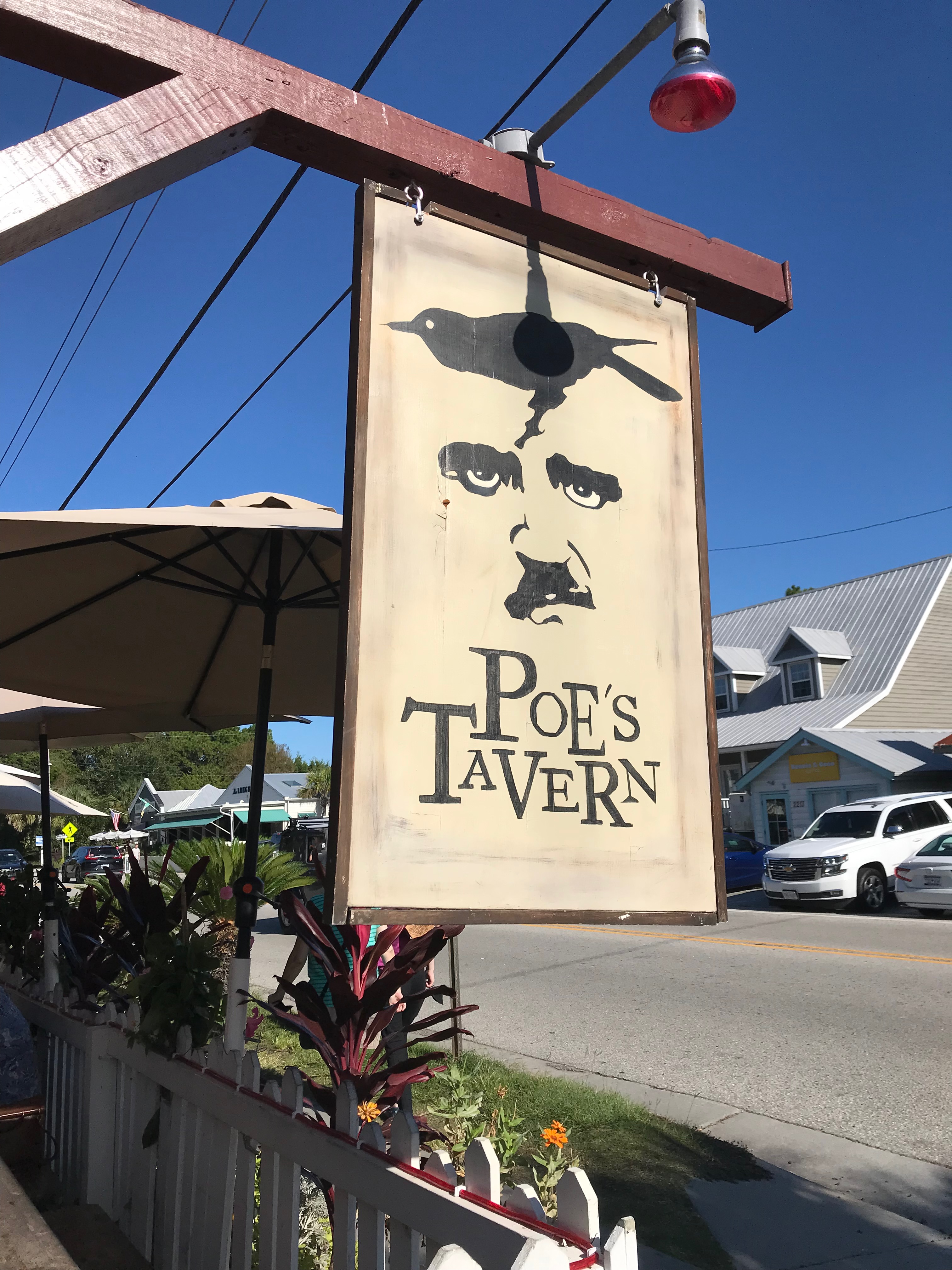
Poe himself never ate here—the establishment only dates back to 2003 (opened April 24)—but it participates in the mythology of Edgar Allan Poe. We have followed Poe—who lived and died as a writer—along the east coast. My family has visited his birthplace in Boston, his home in Philadelphia, his college dorm room in Charlottesville, his grave in Baltimore, and his Sullivan’s Island home at Fort Moultrie. There are many more places to visit, and although much of this is mythology, that makes it no less real.
Poe is a controversial figure. Both the anonymous peer reviewer and a named reviewer objected to my use of Poe in Nightmares with the Bible. What they perhaps misunderstand is that books are deeply personal effects. Something few understood about even my academic books is that they were intended as somewhat artistic pieces. Holy Horror and Nightmares with the Bible are bookends, carefully crafted to go together (and both priced beyond the reach of regular readers, and not marketed at all). Poe may well be the most recognizable American writer, largely because of an image that has taken hold. The Poe Tavern has Poe-themed artwork throughout and it participates in that image. It was crowded already around 4 p.m. when we stopped in for a nosh on a Sunday afternoon in October. Such drawing power speaks to the mystique of Poe all these many years after his short life and strange death. And of the fascination he holds for those of us who wish to write, driven by the same bug.

 Steve A. Wiggins