Homegrown Haunts

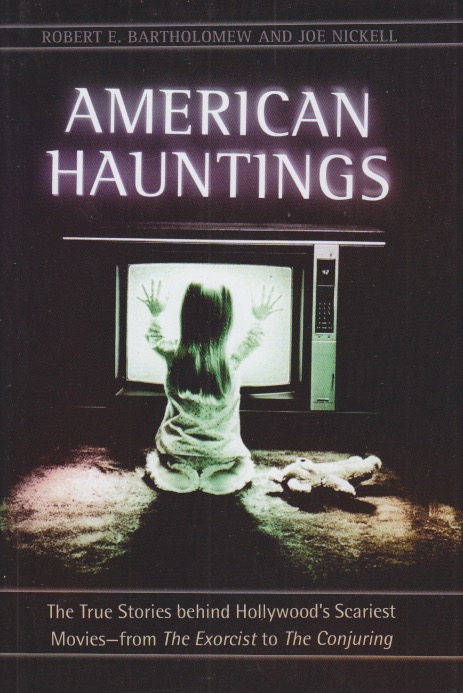
The thing about the unknown is that it’s, well, unknown.  Like many people I’m interested in getting at the truth behind ghost claims, so American Hauntings: The True Stories behind Hollywood’s Scariest Movies—from The Exorcist to The Conjuring, by Robert E. Bartholomew and Joe Nickell looked helpful.  Indeed, it is.  To a degree.  The book, however, devolves at points to debunking cases that aren’t in the movies and frequently asks “Why didn’t somebody take a picture?”  (In cases where there are pictures they say how they could be faked.)  Given the authors, you kind of know none of the claims will be accepted.  Even so, there’s a lot of good information here.  They do a great job of outlining the very probable hoax at Amityville.  For some of the lesser known cases they offer explanations harder to believe than the poltergeists they so abhor.

That’s the thing: for all the “hauntings” they default to poltergeists and then explain how poltergeists are faked.  They begin with An American Haunting, and move on to The Exorcist, Poltergeist, The Conjuring, The Amityville Horror, and The Haunting in Connecticut.  Sandwiched in there is also the non-movie Don Decker case.  What struck me as strange is they often seem offended that movies embellish stories.  That’s what movies do.  They’re quite right about the money aspect, however.  They also take in films that make no claims about being true, such as Poltergeist, which drew inspiration from an actual case but didn’t make that assertion.  It’s also odd that they didn’t ask some of the writers about this.  I once met Brent Monahan, author of An American Haunting.  He readily admitted some of it was made up.  In other words, taking offense at the “based on a true story claim” feels a bit naive.

In some cases they speculate what might’ve happened without visiting the location.  It’s hard to tell if a leaky roof can explain things when you don’t specify if the room is on the first or second floor.  Also, suggesting a young boy is faking because a professional magician can duplicate effects raises its own set of questions.  If a kid is as good as a professional, why doesn’t s/he go on the circuit and make some money from it?  That kind of question, by the way, characterizes much of the skepticism in the book.  Why not become a magician?  Because we don’t have the whole story.  It seems to me that dismissiveness doesn’t really help to get at the truth.  Nevertheless, this book contains much that is useful and skeptical voices should always be included when attempting to sort our extraordinary claims, even if you never , ever want to be caught without a camera.

Too Close?

What with the US Navy admitting that UFOs are real and all, it seemed like a good idea to watch Close Encounters of the Third Kind over the holiday weekend.  Like many of my generation I saw it in a theater—itself kind of a distant memory—back in 1977.  I’m not sure why it’s been on my mind lately, but since it’s a long movie it takes a long weekend to accomodate it.  As we settled down to classic Spielberg scenes—lots of khaki and crowds and desert locations—it was a reminder of how silly we all looked in the seventies.  (What were we thinking?)  Other than that the film has aged pretty well.  The plot, although not action-packed, is probing and has several moments that seem to have inspired Poltergeist.  What made the film blog-worthy at this time, however, was the wearing of masks.

When Roy Neary and Jillian Guiler arrive at Devil’s Tower the governmental cover-up is in full play.  A nerve-gas leak—and who can check out whether such a thing really happened?—has a mask-wearing restriction in place.  I wondered where one could get a gas mask today when the crowd scenes of the pandemic won’t even leave a roll of toilet paper behind.  Checking for rubbing alcohol to make homemade hand sanitizer I found it selling for $300 per gallon on Amazon.  Where are we going to get a gas mask in circumstances such as these?  That particular scenario never really stood out to me before although I’ve seen the movie many times over the years.  Back when I was a student at Boston University the school tee-shirt worn by Barry Guiler was the interesting cultural context.

Films that survive the years take on different aspects over time.  Some suggest that a branch of the military admitting to the reality of UFOs during a pandemic was intended to underplay the event.  Others have argued that a similar release of information many months ago received similar lackluster interest.  If there are aliens out there, I have trouble imagining that they’d travel all this way for a synthesizer concert at a national monument that received a major uptick in visitors due to the movie’s release.  Maybe we love our fictional aliens more than the possibility of meeting those that seem to be vexing our navy?  The movie was the right choice for the circumstances, it seems to me.  Some things about the seventies are worth revisiting from time to time.  Strangely, in retrospect, life seemed simpler then.


Turnabout

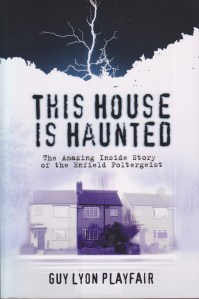
Fair play, so the adage dictates, includes turnabout.  Well, that may be overstating it a bit, but after reading Joe Nickell I decided to give the other side a shot.  Guy Lyon Playfair’s account, This House Is Haunted: The Amazing Inside Story of the Enfield Poltergeist, was originally written in the aftermath of the truly bizarre happenings at that location in the late 1970s.  My reason for reading the book, as maybe you’ve guessed, is that Ed and Lorraine Warren had a hand in the story.  Or at least a finger.  The movie The Conjuring 2 was based on the Enfield case and it placed the Warrens front and center in its resolution.  This is Hollywood, however, and since I’m working on a book on demons I need to try to dig beneath the surface a bit, into regions where tenure-seeking academics often fear to tread.

Interestingly, the Warrens are not even mentioned in Playfair’s book.  The edition I read was updated in 2011.  Playfair himself was one of the two primary investigators from the Society for Psychical Research.  The other was Maurice Grosse (who features in the movie).  Before eyeballs start rolling, it’s worth noting that the Society for Psychical Research is actually a respectable academic association.  As Playfair makes clear in his book, many of the members are skeptical and few believed that the evidence gathered by Grosse and Playfair indicated anything paranormal at all.  The book isn’t shy about dropping the names of the many investigators who dropped in—some uninvited—to either study or debunk the infamous poltergeist.  The incident, however, went on to inspire the movie Poltergeist by giving it free license to change almost all of the details.  Of the many investigators the Warrens remain unmentioned.

On this blog I’ve been chronicling the on-going struggle of trying to figure out what Ed and Lorraine Warren were up to.  Those who met and interviewed them invariably state that they were/are sincere.  They didn’t accept payment for their investigations, and often seem to have been genuinely interested in helping the people plagued by what mainstream science claims simply can’t exist.  Nevertheless, they had and have detractors even amid the parapsychology crowd.  Playfair’s account is quite interesting.  Called in early after the onset of strangeness on Wood Lane, Playfair recorded and recounted what he saw.  He caught some trickery and wasn’t shy about pointing it out.  At the end of the episode, however, he remained convinced that something unexplained had happened there.  Nickell dismisses it all with a sentence or two.  In the interest of fair play it would seem only right to hear the other side of the story.


Heilige Geist

Poltergeist is one of those movies that evokes mixed emotions. Sure, it was one of the really scary ones when it just came out, and the rumors of a curse after the tragic early death of Heather O’Rourke probably added to the mystique. I actually didn’t see the movie until over a decade had passed since its release. It came out when I was in college, and I didn’t often splurge to see a movie in those days. VCRs were still expensive and your only real option was to rent a movie. In any case, a few years back I bought a cheap DVD and, after having seen many horror movies, it felt a little tame. And the ending was over-the-top. I have a theory that being unemployed makes you vulnerable to suggestion. Over the weekend I was looking for a movie I could watch for free on Amazon Prime, when Poltergeist II showed up. I hadn’t even realized that there had been a sequel, and after watching it, I think I understand why the movie was buried.

Poltergeist-2-the-other-side

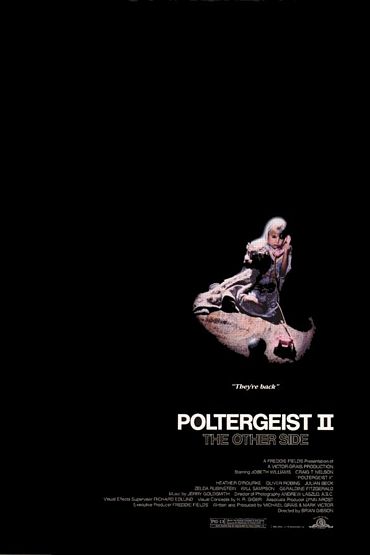
Poltergeist II: The Other Side picks up where the original left off. An added character, Taylor, a Native American shaman, brings good spirits to the Freeling family as the original poltergeists start to haunt Diane’s mother’s house, where they are staying. Interestingly, the ghosts are revealed to be those of a traveling, apocalyptic preacher and his followers. The preacher, Henry Kane, led his group to the desert where they awaited the end of the world and then died after it did not come. They were apparently the ghosts haunting the original Freeling house, and not those of the “Indian burial ground” that the first movie touted. Taylor brings the healing, Native American spirits into the conflict and they win out over the Christian sect ghosts. All of this was becoming more unbelievably campy until Carol Anne was rescued by her now deceased grandmother, in the form of an angel. This mythological cocktail left me feeling a bit dizzy.

Some interesting subtexts floated through this film. Native Americans were now good, rather than the haunting spirits of the first movie. Kane’s sect, which had to be a veiled reference to the Latter Day Saints, showed Christian millennialists as the truly dangerous otherworldly residents. Kane is a preacher (and Mezcal worm) that doesn’t really want to pass over into the light. Why he travels all the way to Phoenix to try to pick up a nine-year-old girl isn’t really clearly explained. Horror movies, of course, frequently make use of religion as a vehicle for what truly frightens. Often it is religion misunderstood. Kane was not a believable character, in this case, without the abject cynicism of an unholy ghost who traveled to the desert southwest to set up a new religion. Once Mormonism breaks into the mainstream, perhaps I’ll have the stomach to watch Poltergeist III and see where the evil shifts the next time.


The Truth of Ghosts

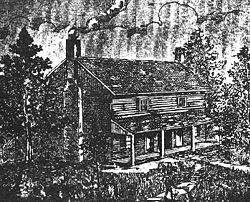
Strange noises in the night. Objects moving of their own accord. Disembodied voices laughing fiendishly. It must be nearing autumn. After having a brief discussion on novel writing with Brent Monahan earlier this summer, I decided to read his book, The Bell Witch: An American Haunting. Setting the story in the “found manuscript” genre, Monahan tells this famous account through the eyes of Richard Powell, one-time elected official in the Tennessee House of Representatives. The can be no doubt that the story has some basis in actual events, but the serious study of “ghosts” is a taboo that serious scholars break at their own peril. On my long bus rides this week I read Monahan’s version of the story as the rain continued to fall. As I read I was continually reminded how dependent we’ve become on genre labels. The book purports to be an eyewitness account and there is no genre declaration on the back cover. The Library of Congress Cataloging in Publication (CIP) data declares it fiction. Where is truth to be found?

Human beings are capable of great and terrible acts. Working in a city the size of New York after having been raised in small towns, the amount of distrust is very blatant. Security is evident in many places with cleverly locked doors and guards surveying those who enter buildings. We simply can’t trust everyone. Or anyone. When it comes to literature, stories often blend fact and fiction. Guidelines on books or classifications in bookstores help us to decide if our reading material is conveying actual events or not. The Bell Witch is one of those reminders that sometimes the truth will never be known. Historical records can be searched, but even these are often subject to human error. If someone tells us a ghost story, we base the veracity on the teller’s reputation. At the end of the day, sometimes we just can’t know.

Perhaps the most poignant aspect of Monahan’s version of these events is his reconstruction of the history. Although the supernatural remains intact at the end, Powell is able to uncover the “fact” that Betsy Bell was abused as a child and that the poltergeist-style events that pervade the story are an extension of her trauma. Actually, the treatment is very closely tied to the religiosity of the Bell family, good church-going folk who ran afoul of a fine point of church teaching. In the end, it is this rejection by the church that pressures John Bell to the point of incest. Is the story true? Yes. Did it every really happen? Probably not. The two are very different questions. In a society that increasing seeks easy answers, stories like this remind us that we are all a blend of fiction and fact. Easy answers are inevitably wrong. The movie An American Haunting once again revived “the Bell witch” but also raised the specter of the ambiguity of truth. Is it out there? If it is, how will we know when we’ve found it?

What really happened here?