Once and Future Ape

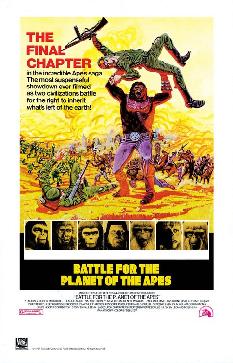
Battle_for_the_planet_of_the_apesThe original pentalogy of the Planet of the Apes franchise began a slow decline with Beneath the Planet of the Apes. Producing a movie per year from 1970 to 1973, the series died with Battle for the Planet of the Apes. Given that Dawn of the Planet of the Apes has been compared with this original final installment, it seemed time to reacquaint myself with it. The early seventies, as I recall them, were tense times. Social unrest both at home and abroad, coupled with a maddeningly increasing nuclear arsenal, seemed a recipe for disaster. Indeed, the world does end with the second installment of the pentalogy, a scenario set up in the final episode as the Alpha-Omega bomb, guarded by mutants, is declared worthy of reverence. Only through the magic of time travel do Cornelius and Zera travel back to the paranoid 1970s to start the whole series over again. The Battle for the Planet of the Apes, apart from its preachiness, does overflow with religious language and rhetoric. Indeed, it begins with a reading of Scripture from the Lawgiver. Pentalogy or Pentateuch?

Caesar is said to be the savior of apes and, like in the current Dawn, the sympathies of the viewer are with the apes. Gorillas, the frat boys of the ape universe, do indeed cause troubles, with Aldo becoming a kind of Cain who slays a fellow ape, Cornelius. (They even got the initials correct, if reversed.) Religion, and prejudice, it seems, have brought this fictional world to a crux, caught in an endless loop of new futures. As Virgil says, there are an infinite number of lanes on this highway. Presumably, traveling back in time opens up all kinds of possibilities.

Despite the number of reused shots in the film—the first ten minutes or so are simply a recapping of the previous two films—and the unfortunate pacing (how could a climax of two angry apes climbing a tree have possibly dragged on for so long?), the movie does have a message. Race tensions, high at the time, are overtly and covertly addressed. Disarmament is praised. The only future that seems not to exist is for one more movie. Interest moved on to science fiction’s apotheosis in Star Wars just four years later. Once again we would find ourselves in a world of black and white, with simple choices. There was no ambiguity among the Jedi. Still, for all that preaching, equality never did reach its goal. So even with its faults (didn’t we see that same tree-house bombed four times?) it is worth dusting off the Battle for the Planet of the Apes once in a while and pondering better possible futures.

The Truth about Elves

We are nothing if not certain. We know that there are no such things as intelligent non-human entities anywhere in the natural realm. We may reluctantly nod toward some animal intelligence, but that’s as far as the head inclines. Humans are the acknowledged and absolute top of the chain of command. Until you try to build a road in Iceland.

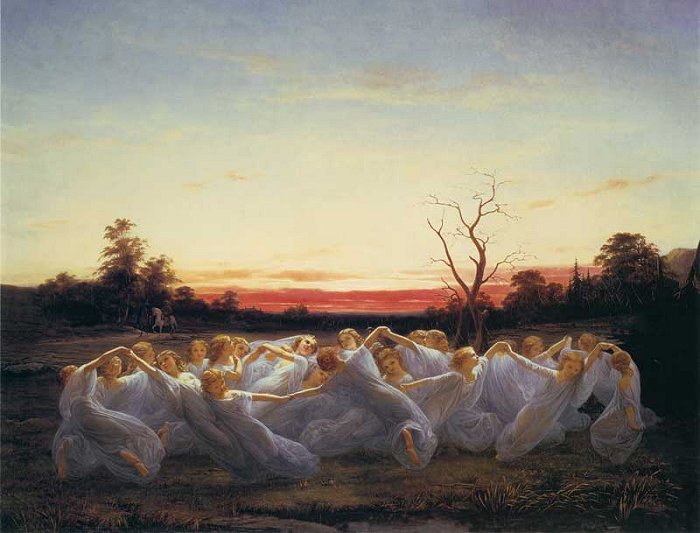
The story of how the road crews were called to a halt because of fear of infringing on elf territory hit the internet months ago. An article in the BBC News recently revised the scene. Emma Jane Kirby traveled to Iceland to see just how seriously this was being taken. I, for one, am glad that mythology survives on the surface in at least a few small places in the world. According to Kirby, surveys suggest about half of all rational adults in Iceland at least hold open the possibility that Huldufolk exist. The Huldufolk, or “hidden folk” are not diminutive, but human-sized and invisible. Who’s to say that invisible people don’t exist? Show me.

Ängsälvor_-_Nils_Blommér_1850

Rationalists are quick to jump out with the accusation that witch trials and other superstition will soon follow should we allow that perhaps the angelic, demonic, or folkloristic beings exist. Of course, it was the rational authorities of the day—often the church—that made those trials possible. Without religion, though, we never would have had science. I don’t think the invisible beings had anything to do with it. Human, all too human, hatred was the real culprit. Fear can lead even the most well-adjusted to the precipice on a dark and stormy night (with apologies to Edward Bulwer-Lytton). People are inclined to mythology to give meaning to a world that, no matter whether scientifically described or not, must make sense to us. Sometimes the elves seem to be the most likely explanation.

The only thing really lost by catering to the belief in elves is money. It might take a little more time and a bit more effort, and empty the coffers just a bit more, but in the end both elves and humans are happier. This worldview has a sense of wonder that a money-padded saunter through Manhattan simply lacks. When faced with the choice between mean money or disgruntled elves, I know the path I would rather take.


Walking Monsters

It was a moment of weakness, or at least tawdry cheapness, that made me watch The Monster Walks. Just the day before the Cable Vision guy had stopped by, detailing how much money we could save by switching. We haven’t had television service since 2004, and even then it was only with a cheap aerial. Back in the days of Borders, I sometimes caved in and purchased the “Classic Features” movie boxes with 50 B, C, or D movies for what seemed a steal at less then 25 dollars. Maybe five or six of the movies from each set were actually worth the time spent watching them, but many of them proved an education. So it was with The Monster Walks.

Now, I readily confess to having a weakness for B movies. Made by people who were really trying, but who seemed to lack talent, I often identify with their efforts. So when I popped The Monster Walks into my DVD player, I had no idea what I might learn. The first revelation occurred in the opening credits where a character named “Exodus” was introduced. Since this was 1932, the character had to be African American. And comic relief. To spare you the pain of watching the movie, the plot is rather simple: rich man dies, helpless daughter inherits all to the chagrin of surviving brother and domestics, who plot to kill her by pretending to be a murderous ape. There also happens to be a murderous ape locked in the cellar. You get the picture. Aptly named Exodus is purely there as a foil for the educated, privileged white family. He was played by the talented but underappreciated Willie Best. As might (nay, should) be predicted, the scheme of killing the girl backfires and the ape kills the killer. Okay, so I can confess an hour wasted and get on with my reading. But the final scene arrested me.

Exodus wonders to the lawyer (who is there to read the will) why the rich man even had an ape. The lawyer, metaphorically transformed into a judgmental William Jennings Bryan, states that it was because he believed in Darwin’s theory of evolution. Exodus responds by noting some family resemblance to the ape. The blatant racism was hard to take, but in Black History Month the painfully obvious collective sins of our society should be laid bare. In 1932 Fundamentalism, often implicitly allied with racist causes, castigated Darwin’s theory for bringing all of humanity down to the same level. As long as a white god is creating the universe, the Anglo-Saxon can claim superiority. Never mind that Genesis was written by a Jewish writer living in Asia. Self-righteousness comes in many forms, but it always involves bringing others down to a rung below where the blessed stand. Has not the great Rick Santorum told us that even the Crusades were merely misunderstood?