Bonnie the Brave

As a preemptive warning to my regular readers (am I’m sure you both know who you are), I am off today for a stint in my old haunt of Scotland. Before you get out your congratulations, be advised that this trip is for work. The Society of Biblical Literature, in addition to the big meeting about which I sometimes post, holds an international meeting every year. Since my employers frequently want me out of the office, I am being sent to the fair city of St Andrews in the kingdom of Fife for a week. Although I studied across the Firth of Forth in the wondrous town of Edinburgh, I ventured to St Andrews a time or two during my postgraduate days. By that time anyone in tune with popular culture had seen Chariots of Fire, and it was almost a requirement of credibility to visit the famous beach on the North Sea where the actors iconically ran as the movie began. And as in Chariots of Fire, I’m not sure that wifi access will be readily available. Should I find access, I shall gladly update my blog with my customary observations. If I fall silent, you’ll know why.

Scotland had a tremendous draw for me as I was contemplating where to complete my studies of religion (as if one ever can). Not that I was Presbyterian, and not that I have Scottish ancestry (although Celtic is represented in the Irish stowaway on my father’s side a few generations back)—it was the antiquity that drew me. One of the mysteries, to me, of new religious movements, is how people can believe in a religion that recently began. Should there be a supernatural, I’ve always supposed, and should that supernatural be concerned that humans have the truth, why wait so late in the story to start? It was such thinking that drew me from Methodism to its estranged parent, the Episcopal Church. Among the Episcopalians are many who argue for a continuity with the Catholic tradition, separated, literally, only by a matter of divorce. And Catholics go back to Jesus himself, a member of a religion so old that even the Romans grudgingly respected it (Judaism). I guess I’m guilty of old-school bias.

Kim Traynor's Edinburgh, from Wikicommons

Kim Traynor’s Edinburgh, from Wikicommons

So it was that I came to spend some years among the Presbyterians at Edinburgh University. The Ph.D. that I earned there translated to an unfortunately brief career doing what I’m best at—teaching. My tenure at Nashotah House never offered the opportunity to travel back to Scotland, or even England with its Anglicans. And as I prepare to board a plane across the Atlantic, although strictly for work, I can’t help but to reflect on those years of intensive learning, hoping to do my Scottish alma mater proud. And returning to the States to have my career shipwrecked on the rocks of unforgiving religious dogma. It may be that once I’m back among the heather and thistles, I may cast my laptop aside and try to claim religious asylum in a past that I can only see through rose-coloured glasses.
Just Books

It’s very difficult to make your voice heard in this world. I’ve been talking for nearly half a century, and most of the time it’s like nobody’s listening. For those who follow the Chronicle of Higher Education, the fact that Herbert Richardson, the founder of Edwin Mellen Press, is threatening to sue some librarians for comments made on various blogs, is not really news. When the Chronicle ran a story this week on Herbert Richardson’s career, I gained a renewed appreciation for what he’s doing. I say “renewed” because I remember the days when I was very poor. My first year of teaching, with my wife in a university program and my own student loans due, I was paid a measly ten grand for a salary (this was in 1992). Despite these privations, my wife and I attended the Society of Biblical Literature annual meeting on a very tight budget. For those of you who’ve not been, SBL offers a book orgy for scholars. Publishers of all descriptions offer books at a discount, but even so, many titles are out of reach. My wife was researching Methodist hymnody for her thesis, and Edwin Mellen Press had a resource that she needed. We simply couldn’t afford it. Herbert Richardson saw our earnest discussion at his book stall, walked over, picked up the book, handed to my wife and said, “Take it.”

Although Herbert Richardson would not recognize me, he has on other occasions, shown me unsolicited kindness. Reading the Chronicle account, I learned that he is a Presbyterian minister and that he had taught at Harvard Divinity School. He is unconventional in some respects, but he also enjoys bucking the trends. Edwin Mellen Press publishes good research that mainstream publishers pass up because their eyes are always on the prize. The bottom line. I never published with Mellen, but I have had snooty presses turn down very careful scholarship of my own. My sympathies are with the underdog, and with the guy who tries to help the underdog. Academia is a cruel world. Some of us have received nothing but backhanded salutes from “established institutions” for all of our adult lives. It’s hard to feel sorry for them. What are the needs of one man in a machine so vast? Not much, apparently.

I’m not the litigious sort. Lawyers have generally caused mostly grief, in my experience. But I don’t castigate the important work Herbert Richardson is trying to do. It might be easy for those lucky enough to be welcomed by academia to forget just how lucky they are and noses are easily looked down towards those of us who never received a chance to shine. No, I wouldn’t sue those who bad-mouth me, and I’m sure there are plenty, but I think Herbert Richardson’s heart is in the right place. As a guy who would happily work for books if food, shelter, and healthcare could somehow be had, I know what it is to covet a book and not be able to afford it. I know what it is like to feel want. Herbert Richardson, based on my encounters with the man—we continue to cross paths from time to time—understands those who love books. That is a principle I can live by.

IMG_0506


Nouveau Riche

Among the vibrant areas of interest for scholars of religion is the emergence of new religions. Unlike the religions of antiquity, New Religious Movements provide a direct view, occasionally in “real time,” of what constitutes religious belief. The possibility of sitting Jesus, or even Paul, down for an interview remains vastly remote. The same is true of Ellen White or Joseph Smith, but here we have many historical records upon which to draw and a clearer context against which such religions might be read. Supposing the religious urge is something people of antiquity felt, we can get a sense of what might have satisfied that itch, at least in an oblique way, by looking at the modern period. As a student of religion I was mired in the ancient period. Learning obscure, dead languages, I supposed, would lead me back to the earliest forms of religious belief, therefore the most authentic. Like many of my colleagues, I came to discover that the origins quickly disappear into the distorted view our poorly ground telescope into the past reveals. As one writer recently suggested, if humanity evolved in Africa, so did religion.

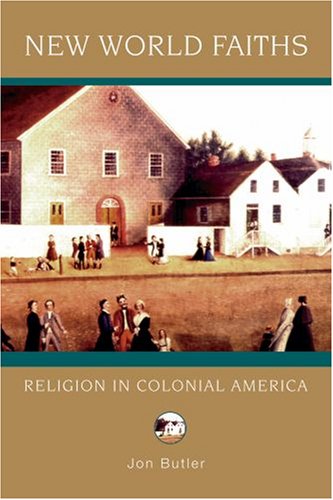
This past week I read Jon Butler’s New World Faiths: Religion in Colonial America. Growing up I always felt that our own history was too young to be interesting. As I learned more about the horrid treatment of Native Americans, my sense of newness was accompanied by a sense of collective guilt. I like to think I wouldn’t displace a population in hopes of getting wealth, but as Butler demonstrates, the colonial experiment from the beginning was a profoundly religious one. We all know the pilgrims were dissenters from the established Church of England. Butler takes time to pause and consider the unwritten religions of those subjugated to European rule and sometimes extermination. How many of the first to brave the Atlantic crossing did so with missionary zeal, convinced of the superiority of a Christian culture. Not incidentally, they noticed great wealth could be had in this new land. Slaves would be needed to extract it and the Bible seems a slave-friendly document.

Butler’s little book is a good guide to the larger issues. The religion of African slaves grew into something to be feared. Colonial religion split along hairline fractures of doctrine, leading to the fascinating multiplicity of religions we now have in this country. Then, in his discussion of the early Presbyterians of Philadelphia, I ran across a sentence with immense explanatory value: “At the same time, congregations found that they could exercise their own power over clergyman through controlling their ministers’ salaries.” Conviction quickly falls by the wayside with a God whose arm is too short to save. The paycheck is something you can take to the bank. Religions develop into something different once gold enters the equation. I have watched the birth of empires with megachurches and televangelists in my own lifetime. I know that we are witnessing the birth of yet another human scheme to acquire eternity in the form of liquid assets.


Determinism to Succeed

I’ve been watching some episodes of Morgan Freeman’s Through the Wormhole, the recent Science Channel sop to the masses to explain what scientists are thinking. I always appreciate when scientists (and other specialists) are willing to abandon argot and talk to the rest of us in plainspeak. Even if the implications are a little scary. The episodes I watched this weekend shared a near determinism. The physicists interviewed stopped shy of saying that all is ordained by the rules of science, but the implications still rang loudly in my ears. This concept is at home in the church.

Back as a college student attending a Presbyterian school (I have never ascribed to this particular flavor of Christian thought), I first chanced upon predestination. In fact, the subject was well nigh unavoidable. Students of all majors and backgrounds ended up discussing it around dinner tables as well as in the classroom. The instigator, instead of physics, was John Calvin. His theology suggested that mere mortals had no say in their destinies; God created some to be saved, the rest to be damned, fairness be confounded. I sat through many classes where the professors would argue with erudite words that all this had been foreordained. Some, “double predestinarians,” went as far as to argue that every firing of every synapse, every motion of every muscle, had been predetermined by God before the creation of the world. When I asked “why?” I was told that God has his (always “his”) reasons, and that I, a non-Presbyterian, should simply accept my fate.

Four years of wrangling and no one managed to convince the opposite party. One of my more intelligent professors once told me after class, “you free-willers always win on philosophical grounds, but we predestinarians always win on scriptural grounds.” He seemed to think that solved it. Perhaps he was predestined to conclude that. I disagreed. No greater monster could exist than a deity who predestined the horror we’ve created in our world. To see all this human suffering, much of it pointless, and simply shrug and say “God has his reasons,” is to implicate the creator in a cosmic Nuremberg. For me, I’d feel safer with the physicists saying it is all a matter of unfeeling cosmic laws. Perhaps I’m predestined to write this, but I still think they’re all wrong.

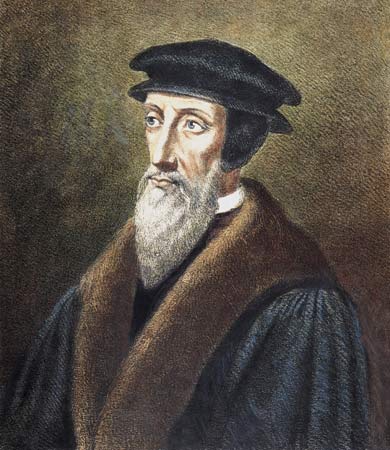
Was Calvin predestined to wear that hat?


Presbyterian Penance

Over the past week the Presbyterian Church (USA) has been in the news because of its overtures toward accepting gay clergy in committed relationships into ministry. While this is undoubtedly an honest approach to the issue, a disturbing subtext lies beneath the surface. That subtext, which may be practically impossible to escape completely, is that heterosexual clergy claim to have the right to “allow” homosexual clergy into “their” sanctioned leadership roles. The implied superiority is troubling. People have always found it easy to believe what suits them, the facts be damned.

Homosexual clergy is a picture-perfect example. Until society had evolved far enough to recognize that homosexuality is not a matter of choice, those who were homosexual existed in a kind of limbo. There was no lifestyle that could be displayed, just a secret predilection that could cost a person’s life if discovered. There were homosexual clergy, however, even in those days. They have very likely been part of Christianity from the first century on. In a society without the conceptual fortitude to realize that some people are born homosexual and others heterosexual – let alone the possibilities of evolution or stem-cell research – the lot of the homosexual clergy was one of pretense. There can be no doubt that homosexuality existed among the clergy, but the idea simply had no way to be delivered.

Many clergy, many of the best clergy, in my personal experience of the church, have been homosexual. Sexual orientation should make no difference in their ability to function as regular members of the clerical ranks. Only those with their eyes solidly closed can fail to recognize that Jesus never said anything about homosexuality, according to the Bible. What the early church taught was that all members should be equal. Somewhere along the past couple of millennia, however, the illusion slipped past actuality and the heterosexual (mostly male) clergy began to make all the rules. Perhaps we all have something to learn from the Presbyterians after all.


Truth in Fiction

In my more optimistic moods, I like to think of myself as a literary sort. Not constrained by the narrow confines of academia’s hallowed — and often hollow — halls, I have spent much of my life reading literature. I can’t say what started me on this track; my parents were not readers and the small-town school I attended encouraged little beyond subscribing to MAD Magazine. When I stumbled onto the literary giants, I was hooked. There are still great writers I have yet to explore, but one that I only really discovered at the prompting of my wife is Mark Twain. I’d of course known who he was. In my youth I never read any of his books. Then on a fateful, if carefully planned out, trip to Hannibal, Missouri to dig geodes during my geologist phase, we were rained out. The geode farm was closed. Sullen beyond shattered rock-hound dreams, I was at my wit’s end (not a long trip) when my wife suggested we not waste the miles we’d traveled, since Hannibal was also the boyhood home of Mark Twain. While there we bought souvenir quality volumes of Tom Sawyer and Huckleberry Finn. Upon returning home, I read them non-stop.

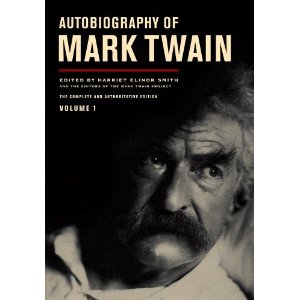
While on vacation last week my wife was discussing her literary pursuits with her family and it emerged that the full, uncensored, autobiography of Mark Twain will begin its public appearance in November of this year. One of the topics to receive his attention is religion. Twain was a Christian, insofar as any Presbyterian can make that claim, but he was critical of formal religion. A quote purporting to be from his autobiography runs: “There is one notable thing about our Christianity: bad, bloody, merciless, money-grabbing, and predatory. The invention of hell measured by our Christianity of today, bad as it is, hypocritical as it is, empty and hollow as it is, neither the deity nor his son is a Christian, nor qualified for that moderately high place. Ours is a terrible religion. The fleets of the world could swim in spacious comfort in the innocent blood it has spilled.” A bit caustic, but honest. When the books come out, I’ll be able to check it for veracity.

One of the things I value most about Mark Twain was his ability to hit his readers without giving away that they’d been hit. He accomplished this through a brutal honesty, often cloaked in fiction. When I explain myth to my students I tell them that it is an attempt to clarify the truth through story. Modern people tend to be fixated on historicity and sometimes miss the importance of a story because “it never happened.” If Huckleberry Finn never navigated a raft down the Mississippi, it would not affect the truth of the story or the insight of the author. It seems to me that with a writer so honest we would do well to consider what he had to say about his own religion before unsheathing our swords and rattling our sabers.