Long Revision

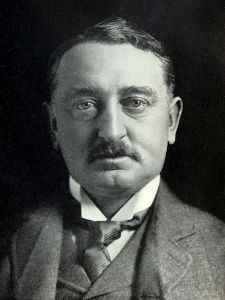
Cecil_Rhodes_wwThose of us who write know all about revising. You go back to a piece you wrote, maybe even just days ago, and you see all the things you want to change. Corrections, improvements, deletions, retractions. Histories are particularly prone to being viewed in new ways with the passing of time. I once thought histories were factually true, but in this postmodern age we’ve learned that while histories contain some facts, they are largely interpretations of those facts. Even the Gospels are interpretations. Recently I’ve been reading about student movements wanting to efface some facts of history because they make current-day people feel bad. A piece in The Guardian, for example, explains how some students want to remove the statue of Cecil Rhodes from Oriel College, Oxford, because Rhodes was an imperialist and a racist. A similar movement is afoot at Princeton University to give Woodrow Wilson the old Akhenaton treatment for similar reasons. Student interest groups, as The Guardian points out, don’t want to be reminded of their once marginal status. Removing Rhodes (or Wilson) from his pedestal, however, won’t change history.

I wonder if those in these special interest groups have enough experience to realize the implications of their complaints. What if, for the sake of argument, one of these student leaders became a national leader? What if her (or his) nation became oppressive during her or his lifetime but s/he didn’t see it because it was the operating milieu of the age? And what if their nation later repented and brought those from their former oppressed colonies to their homeland and those who came turned against that past leader? The point of this scenario is to suggest that none of us—or at least very few of us—have the ability to think beyond our age. Can we be blamed for being children of our time? Will removing our mementos change the facts of history that will have transpired? Will it make us feel better to bury the truth of what happened?

What's behind that self-satisfied smile, Akhenaten?
What’s behind that self-satisfied smile, Akhenaten?
An issue that often weighs upon my mind when I hear of these groups of the marginalized is that there is a very large, and very diverse marginalized class that has no voice, even today. The poor. Sure, some of us raised in poverty can claw our way to a descent living, but succeeding in a world where you need connections and favors owed and special knowledge of how a system works will be forever beyond our grasp. I knew a refugee, once upon a time, who was a student of mine. He used to complain to me of the costs of having his shirts sent out to be laundered. His clothes were tailor made. He refused to use a washing machine. He was also quick to point out that I was the oppressive race. This he did without a nanogram of irony. Cecil Rhodes may have been as evil as some say he was. His money, however, made it possible for some of the heirs to his oppression to study in his shadow. And I write that with a heavy dose of irony. Do they not realize that Akhenaton is now considered by many to be the most interesting Pharaoh of them all because he was erased from history?


The Great Slumbering

Even in days of secular education—I am a product of public education throughout my childhood—Jonathan Edwards is a name that still retains recognition among many Americans. Perhaps best remembered for his sermon, “Sinners in the Hands of an Angry God,” Edwards thrived at a time when being a clergyman was a recognized path to success in this world as well as the next. Not that all ministers became famous, of course, but those with the inclination had access to books and time to study. They could write books and influence public policy. Indeed, Edwards was part of the “Great Awakening” that spread throughout the young United States, before its independence. George Whitefield had brought a showman’s sensibility to preaching, and people gathered to listen to roving reverends who brought their wisdom to new locations. In fact, revivals continue to this day—I had attended a few as a child—and they are largely responsible for the denominational map of American Protestantism even today. The “Second Great Awakening” brought Methodists and Baptists into the mainstream to stay.

The first major revivals, however, were fueled by a Calvinistic intensity. Having spent many of my educational years in schools established or supported by Presbyterians, I know their theology well. Judgment is important in the Reformed tradition. Indeed, without the element of threat, the heat is stolen from much of revivalism. Edwards’ sermon encapsulates so well the vital element of a theology that preached total depravity, unconditional election, limited atonement, irresistible grace, and perseverance of the saints. In other words, unless God has already selected you, you’re out of options. As Presbyterian teachers were eager to state, you should still try to live as if you were saved (“elect”), even if you were going to Hell because of, well, you know, an angry God. Campus rules at Grove City embodied that ethic in a real-time way.

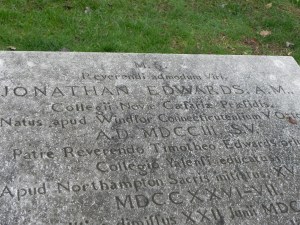
Jonathan Edwards went on to become president of Princeton University (the College of New Jersey, at that time). He died at about my age, having been inoculated for small pox—he was a believer in science—to demonstrate the value of the practice to students. He contracted the disease and died merely weeks later. Ironically, Edwards felt he was past his prime and had to be persuaded to take an academic job—somewhat of an extreme rarity today—and largely because his son-in-law, Aaron Burr, Sr., had recently died as the incumbent. Today, starting on the path to ministry is often a fast-track to job insecurity, popular derision, and poor earnings. For all that, it is difficult to be accepted in the ordination track without jumping through many hoops. So Jonathan Edwards came to rest in Princeton, New Jersey, as a famous, published, and highly respected man. A more different world then his in such a short time in the same location, is hard to imagine.

DSCN6140


Post Script to Art

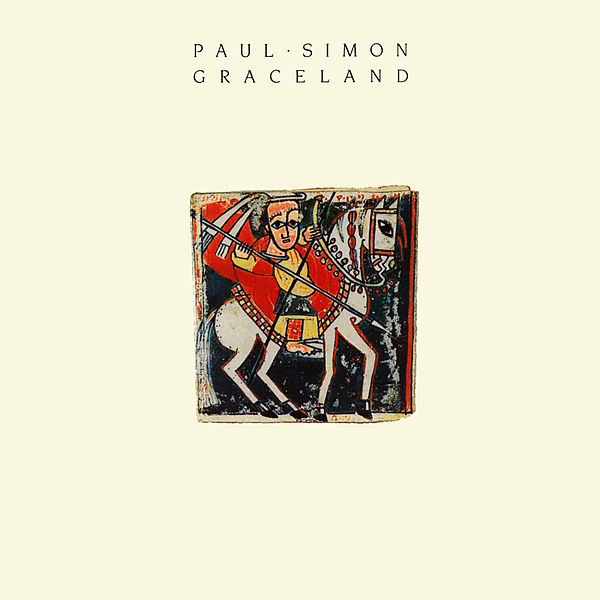
At work Christian Century is a magazine that sometimes lands on my desk. I suspect the book reviews are the main reason for this, but I like to skim the headlines to see what the more progressive, popular periodical has to say about the world. I always glimpse the news in brief section, and quite often the quotes of the week are poignant. This past week I read one from Paul Simon, who was speaking at Princeton University. The quote ran, “We are living in an anti-art age. The world is now a brutal place and obsessed with speed and wealth.” I found my head nodding as I read that sentiment. While I was a little too young to be aware of Paul Simon’s considerable contribution to popular music while it was happening (although I was old enough to appreciate Graceland when it came out), I nevertheless listened to Simon and Garfunkel during college and beyond, amazed at the depth and accuracy of Simon’s poetry. Here was a true artist.

What a difference half a century can make. I find myself not recognizing the world that I took for an assured thing as a child. Drawing back to get some perspective—which is something I think Paul Simon would appreciate—I think about the world without technology. Other species, for example. The behavior of, say, deer is the same today as it was when Europeans first invaded these shores. While deer still wander out onto roads in their natural quest for food, we race at them in heavy machines that leave them dead and twisted grotesquely at the roadside. Deer may not have the mental capacity to think, “hey, there’s fewer predators than there used to be,” but they are frequently brought into contact with a technology that is so nineteenth century, and the result is fatal. Where has the artistry gone? The deer remain the same.

I read a lot of older stuff. When I see the literature that was clearly published for its beauty of language and artistry, it brings a tear to my eye. We don’t publish work like that any more, unless it can make money. Everything has become a calculated capital venture. If you can’t make money off it, it’s not worth doing. When I was stressing out in college over exams, I would sometimes put on my old Simon and Garfunkel records and listen to the deep and complex lyrics to “Mrs. Robinson,” or “Bridge over Troubled Waters,” or “The Sound of Silence.” Despite the angst, this was a world that had a place for beauty for its own sake. It’s not just the music that’s changed since then, because I knew that I was listening to the words of a prophet. And prophets only appear when there’s trouble ahead.

Graceland


Magnificat

IMG_1857One of the advantages of a huge endowment is the luxury to experience culture. Although we don’t live in Princeton, we don’t live far from it, and most years we venture down to hear the free Advent Concert given by the Princeton Chapel Choir. For those of you who’ve never been to the Princeton campus, or perchance have not visited the chapel there, the setting is part of the experience. On the order of a small Medieval cathedral, the campus chapel at Princeton is by far the largest I’ve encountered, and the acoustics from the soaring stone are impressive, even to an untrained ear such as mine. Since my wife is the musical one in this marriage, she reads the program with an avidity I lack, but I do recognize striking music when I hear it. This year’s concert included a piece I recollected from a few years ago, Christine Donkin’s “Magnificat.”

I’m at the age where it is no longer surprising to find very talented people much younger than myself. Christine Donkin is in this class. A Canadian composer, she has had her music performed in major venues such as Carnegie Hall. Her “Magnificat” is the only piece with which I am familiar, but it is a powerful work that can be compared to a mystical experience in the listening. Written for women’s voices, the piece evokes a spirituality that seems to come easily to those who are submissive. The Magnificat is, by tradition, Mary’s psalm of submission to the divine will, based on 1 Samuel’s account of Hannah conceiving the prophet Samuel. In a world dominated by male humans as well as a male deity, the song of Mary is one of the subtle poems celebrating the upsetting of the entrenched power structures that have held women down. If you listen closely enough, its subversive elements become clear.

Donkin’s “Magnificat,” in a darkening cathedral on a December evening, is a moving experience. It is a piece that leaves me feeling as if I’ve temporarily been somewhere else. And that elsewhere is far from the turmoil and troubles of daily life. And there are no men involved.

Over the years we’ve heard many impressive performances in that stone edifice. None, however, it seems to me, so powerful as that of a young woman confronted with a reality beyond that of everyday life. A reality that men cannot touch, but which, when the circumstances are right, they might hear if they’re willing to listen, and in doing so might find their own burdens lightened for a few minutes on a winter’s evening.


Jolly Saint Nicholas

StNick

Each December the Princeton University Chapel Choir performs a free holiday concert in the impressive university cathedral (actually, it is a chapel, but given its size I’ll stick with cathedral). This year’s concert was Benjamin Britten’s “Saint Nicholas.” The association of Saint Nicholas with Christmas, not really a major holiday until relatively recent times, was an aspect that developed long after his death in the fourth century. The date of his death, December 6, and his association with the giving of gifts, made him an obvious model for Santa Claus (who still bears his name). Most of the gifts I’ve received from bishops involved losing a livelihood and personal dignity, so it is little wonder that Nicholas is venerated. Few bishops of his generosity exist today.

The stories of Nicholas of Myra, however, are full of mythical accounts that bear less resemblance to history than to legends of old. Eric Crozer’s lyric for Britten’s piece invokes several of these miraculous tales. Saint Nick, it seems, stilled a storm at sea, multiplied food and walked on water like Jesus. The lyric also tells the legend of how he raised three pickled boys from the dead, although I have to admit I couldn’t get my mind off zombies after that. This story seems to owe something to the myth of Tantalus, who, like Nicholas, was from Anatolia. In real life we do know that at the Council of Nicaea Nicholas punched Bishop Arius in the ear for his heresy. Theological discussions are like that sometimes. And I wonder if that might not be the origin of another curiosity of which a friend recently reminded me—Saint Nicholas doesn’t travel alone.

Our modern version of Santa Claus takes its roots mostly from germanic traditions. In that culture the saint is accompanied by a more sinister character who doles out punishment to the naughty. He is known by many names: Krampus, Ruprecht, Schmutzli, Zwarte Piet, or simply the Devil. Instead of using their diabolical fists, they generally carry rods to smack the not-so-nice, kind of the Republican side to the liberal Santa. This dark figure does not appear in Britten’s “Saint Nicholas” where a (mostly) kinder, gentler saint appears. A saint who raised briny boys from the beef barrel also belted another theologian upside the head. Life, even for saints, is full of contradictions.


Holiday Cheer

Christmas carols are, it seems, intended to fill holiday shoppers with good cheer. Good cheer opens wallets and purses and everybody is happy until January’s bills make their epiphany. Until then, sing songs of gladness. Princeton University, one of the few financially stable institutions of higher education, each year gives a gift to the community. Some Sunday in Advent a free university Chapel Choir concert is given in a campus chapel the size of a modest medieval European cathedral. The music varies from year-to-year, but seldom is the church not full with locals taking time out from holiday shopping or grading papers. One of the carols yesterday, was the 1914 French piece, “Christmas Carol for Homeless Children.”

Princeton, like most schools, does have a heart buried beneath its deep, cold, jobless front. Chapel choirs like to shake up the status quo by throwing in an occasional piece that requires somber thoughts and social consciousness amid the joy. The French carol dates from that fearsome first year of World War One, a time when France was especially under the gun. The wish for the world at the time was peace – material gain had not yet become the measure of God’s grace. The hymn is sober and wrenching:

We have no more house nor home!
Enemies took all we had;
all gone, all gone,
even our own little bed!
The school they burnt;
they burnt our teacher, too.
They burnt the church and also the Lord Jesus Christ,
the poor old beggar too who could not get away!

Singing it in French may take away the vinegar of the words, but wartime is not the only circumstance that finds people without sufficient means. Even unchecked capitalism will lead to the same results. Only, instead of the Lord Jesus Christ being burnt, he is sold in the markets to make a tidy profit.

Baby Jesus says, "Bring on the gold!"


SpongeBob’s Evolution

My daughter has, unfortunately, outgrown SpongeBob SquarePants. She was my putative excuse for watching the (literally) brainless eponymous lead character going about his inane adventures. The creator of SpongeBob, Stephen Hillenburg, is a marine biologist and much of the fun for adults watching the cartoon derived from the biologically correct remarks made by the characters about their physiological conditions. Watching the laughing yellow sponge with his inimitable voice was a pleasant escape from the constraint of my own biological existence.

Today the New Jersey Star-Ledger announced that two researchers from Princeton University may have discovered the oldest animal fossils ever recorded. It seems that for a while, some 635 million years ago, the earth was undergoing its Cryogenian Period when the planet surface was all but completely frozen. The earliest discovered animal fossils were discovered from after that period. Princeton geoscientist Adam Maloof has recovered what appear to be animal fossils from 650 million years ago, 15 million years before the big freeze. This find had been anticipated by genetic scientists who had suggested that such early animal forms likely existed prior to the appearance of the earliest sponges 520 million years ago.

For now the new finding shifts the fossil record back by about 90 million years. There will be massive gaps to be filled in by scarce traces left in inaccessible rock. Creationists will no doubt gloat that the fossil record is now even more full of holes than ever. This is frequently the quality of ambiguity that they suggest will topple the evolutionary lie. The truth, however, faces the opposite direction. The oldest creatures found are ancestors to the common sponge, pushing SpongeBob’s ancestors back many millennia before those of the Adam who discovered them. It seems to be the silly yellow sponge who will have the last laugh.

Gee, did I really cause all this?