Word Words

So, in the old days, when books were paper, printers would rough out the typesetting on trays called galleys.  Prints from these plates would be sent out for review.  Naturally enough, they were called galley proofs, or simply “galleys.”  After those came back from an author marked up, corrections and further refinements, like footnotes, were incorporated.  Then page proofs, or second proofs, were produced and sent again.  The process took quite a bit of time and, as I’ve now been through six sets of proofs for my own books, I can attest it takes time on both ends.  Electronic submissions have made all of this easier.  You don’t have to physically typeset, much of the time, unless you merit offset printing—books in quantity.  You can often find uncorrected proofs in used bookstores, and sometimes indie bookstores will give them away.  That’s all fine and good.  The problem comes in with nomenclature.

These days proofs are sometimes still called “galleys” although they’re seldom made anymore.  If someone asks about galleys, it is quite possible they’re asking about page proofs.  It is fairly common in academic publishing for an author to see only one set of proofs—technically second proofs, but since no galleys were set, they could be called that.  Or just proofs.  Now, I have to remind myself of how this works, periodically.  It was much clearer when the old way was in force.  There were a couple reasons for doing galleys—one is that they were, comparatively, inexpensive to correct.  Another is that authors could catch mistakes before the very expensive correction at the second proof stage.  Even now, when I receive proofs I’m told that only corrections of errors should be made, not anything that will effect the flow, throwing off pagination.  This is especially important for books with an index, but it can also present problems for the table of contents.

Offset printing. Image credit: Sven Teschke, under GNU Free Documentation License, via Wikimedia Commons

The ToC, or table of contents, also leads to another bit of publisher lingo.  When something is outstanding and expected before long, many editors abbreviate it “TK” or “to come.”  Why?  “TC” is sometimes used to mean “ToC” or table of contents.  There are hundreds of thousands of words in the English language, yet we keep on bumping up against ambiguities, using our favorites over and again.  That’s a funny thing since publishers are purveyors of words.  None of my books have printed in the quantity that requires galleys.  In fact, academic books, despite costing a Franklin, are often pulped because they’re more expensive to warehouse than they are to sell.  This is always a hard lesson for an academic to learn.  The sense behind it is TK.
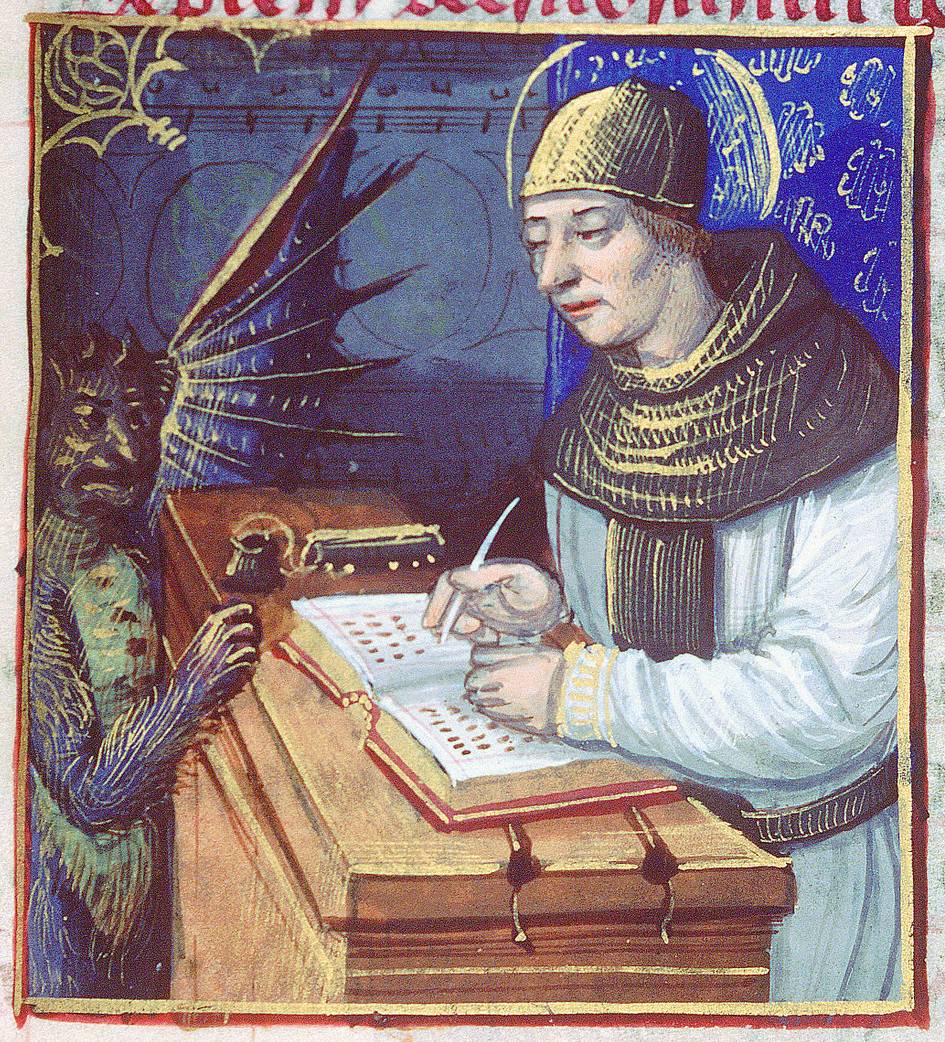

Demons and Gremlins

Gremlins have an ancient pedigree, whether they know it or not.  Credited with airplane problems during the Second World War, these meddlers in technology had an older cousin in the demon named Titivilus.  Titivilus was a demon said to be responsible for errors in the works of scribes.  Long before the printing press hit Europe, manuscripts were copied by hand, of course.  Anyone who works with Bibles, for example, knows that no ancient manuscript exists without errors.  But scribes copied more than Bibles, and anyone who has tried to copy an entire manuscript knows that errors always creep in.  (When I was a college student I tried to get my local church back home to set up a Bible-copying station so that when hungry parishioners were leaving the service they might stop and copy a verse.  This was to show how errors appeared in biblical texts.  The experiment took place but results were disappointing—full of errors but we didn’t get past the early chapters of Genesis).

However that may be, having a demon to blame for things going wrong proved to be mighty handy.  The tradition lasted well into modern times.  In the days of manual typesetting the young printers’ apprentices were called “printer’s devils.”  Demons were blamed for spilled cases—capital letters were kept in the upper case, and minuscules in the lower case—and other mishaps.  It may be a stretch, but such a demon interfering with humans trying to accomplish something important, led to ideas such as gremlins.  Most of us, I suspect, don’t like to confess that we’re sometimes clumsy or sleepy and make errors.  One of my notebooks is all crinkly because I knocked a nearly full water bottle over onto it while trying to catch a bug in my office.  ’Twas no demon, just haste making waste, as it does.

The idea of someone not human to blame is compelling.  All the more so because sometimes we are the legitimate victims of circumstance.  Life offers many opportunities to wander, unknowingly, into situations that might not turn out so well.  We don’t have minds well equipped to see the entire picture.  Even if we could the universe, we’re told, is infinite.  Who doesn’t make mistakes because of limited knowledge?  And sometimes those mistakes can eat up years of your life.  Doesn’t it seem more likely that a demon or gremlin lurks behind an all-too-human error in a judgmental world?  I’m sure that, for most people, if we knew better we wouldn’t have done it.  So we invent our demons.  We sometimes even give them names, and thus Titivilus was born.

Image credit: artist unknown, public domain via Wikimedia Commons