Mirroring Reality

I watched Oculus for two reasons: it kept coming up as a “freebie” on a service I use, and I’d been thinking about haunted mirrors.  Well, three reasons—I also liked the sound of the title.  (Not all decisions are a matter of science.). I was pleasantly surprised that it turned out to be pretty good.  I’ll probably throw in a spoiler or two, so if it’s on your list, you’ve been warned.  Kaylie and her brother Tim were attacked by their parents, but Tim was being framed by the mirror.  Both parents attempt to kill the children, but end up dead instead.  Tim is sent to an institution since he pulled the trigger, and Kaylie has spent eleven years researching the mirror.  When her brother is released she convinces him that they have to keep their promise to destroy the mirror.
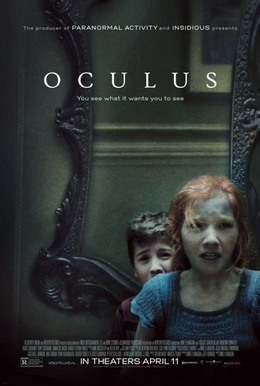
The problem is, the mirror messes with perceptions of reality.  The two go back to their childhood home where Kaylie has set up a device to drop an anchor onto mirror.  This is set to happen with a wind-up timer since the mirror can control electronics.  She’s also set up the room so that everything is being recorded.  If she can prove the mirror is what she believes it to be, her father will be exonerated and her brother proven innocent.  The movie gets a little tricky to follow since their current story is intercut with flashbacks as to what happened when they were children.  Also, the mirror records events on the cameras that didn’t really happen.  Add to this the fact that Tim has undergone therapy for eleven years and he’s convinced that his sister is delusional.  It’s one of those movies that messes with your perception of reality.

When Tim doesn’t see his sister in front of the device meant to destroy the mirror, he accidentally kills her.  The police arrive, believing he has repeated his murderous attack from eleven years before.  The ending is rather nihilistic, but the scares are effective.  There are a few gross-out scenes and some jump startles, but overall it is the story that conveys the fear.  For me, the mental issues were almost triggers.  But then again, I watched it on a day when I was a bit fuzzy-headed because of waking up too soon.  I really didn’t know what to expect when I hit “play.”  I’ve done that enough times and ended up with films that were wastes of time, so I was glad to have found a competent one this time.  These are my reflections, in any case.

Carpenter Ward

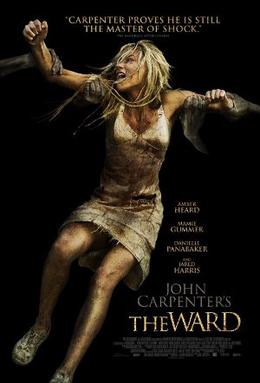
Surveying my streaming service for something free, I found The Ward.  It advertises itself as “John Carpenter’s The Ward,” and Carpenter has proven his mettle more than once.  I found out afterwards that this 2010 film is his last, to date.  Although it has jump startles and scary sequences, it isn’t as frightening as his best work, such as Halloween and The Thing.  The eponymous ward is a psych ward.  A young woman with amnesia is brought to the facility in 1966.  She’s somewhat violent but begins to make friends with the other four girls in the ward.  It won’t be satisfying to discuss this without a major spoiler, but I’ll try to hold off for another paragraph before giving it.  Overall the movie is creepy and atmospheric, but not really a classic.  Movies about mental hospitals have built-in scary material, and The Ward meets expectations there.

Kristen, the girl with amnesia, is resourceful and nearly escapes a few times.  She’s worried because a ghost in the asylum is killing the other girls.  Nobody will believe her, of course, since she’s an inmate.  Now the reveal: the other girls are all projections of Kristen’s personality.  Actually, Kristen’s name is Alice, and she’s been at the asylum for some time, a patient with multiple personality disorder.  The other girls that are killed by the “ghost” are part of a new therapy her doctor uses to try to get Alice back.  The other girls, or personalities, had banded together and “killed” Alice and her “ghost” is now seeking them out and killing them.  In reality, only Alice is there.  While the viewer is rooting for the other girls, they are preventing Alice from being cured.

In some ways this is similar to Split, but that would come six years later.  The horror here is the loss of self-knowledge.  The little backstory that is given shows Alice suffering trauma as a child, forcing the dissociation that leads to her split personalities.  As a horror movie The Ward has the jump scares and eerie atmosphere that often work in the genre.  There are chase scenes and a monster.  The story, however, rides heavily on that final reveal.  It really doesn’t live up to Carpenter’s full potential.  It does, however, take the final girl trope seriously.  It’s not really a surprise that it failed at the box office.  Although Split came later, other such films had been produced earlier.  What this one lacks is Carpenter’s characteristic flair.  Still, there are many other films that deliver less when they stream for free.


For the Camera

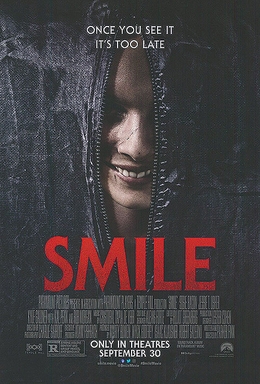
Smile 2 is getting some good critical notice and I hadn’t seen Smile (1) yet.  Psychological horror often bothers me, but I figured I’d grin and bear it.  I’m glad I did.  The ideas in the film, which participates in “the stigma trope,” are disturbing because it’s unclear if Rose (the protagonist) is mentally ill or not.  The stigma trope posits that something has infected someone either by having seen something they shouldn’t (as in Ringu) or by physical contagion (It Follows) and the victim can’t shake it.  Smile may trigger viewers with suicidal phobias since the premise is that an entity feeding on trauma passes from person to person by having the new victim witness the previous victim’s suicide.  Rose is a therapist who hasn’t gotten over the trauma of her mother’s death.  Rose witnesses a patient die by suicide, and who smiles just before she does it.

The patient told Rose that she’d watched one of her professors die by suicide.  Rose subsequently learns that the professor also witnessed a suicide and so on and so on.  Each prior victim had watched someone else die.  Now Rose has to figure out how to break the cycle, otherwise she’ll perpetuate it.  The idea of inadvertently obtaining a “sticky” entity is pretty scary, and a very human concern.  One of the more frightening aspects of possession movies is the belief that now that demons know that you know, they will target you.  Interestingly, what makes this film provocative is that the victim has to have suffered trauma before.  As such, it is a study of trauma and its lasting effects.  I suspect most people don’t intentionally traumatize others (world leaders excepted).  Trauma can be dealt with (or not) in very different ways.

Smile did quite well at the box office.  I suspect there are a lot of us traumatized people around.  Capitalism encourages traumatizing others through slow violence, if not the more obvious quick way.  People don’t easily walk away from events that scarred them, particularly if they happened at an early age.  Such people, if experience is anything to go by, find themselves in vulnerable positions in life and rather thoughtless people, often for religious reasons, end up traumatizing them even further.  I have to admit that there were triggers for me in Smile.  I still struggle with a few of my own traumas that were never resolved.  Like Rose, I sometimes don’t know who can really be trusted with such things.  This is a perceptive movie.  I guess now I can put on a happy face and see Smile 2.  But first I’d better talk to my therapist.


Non-Demon

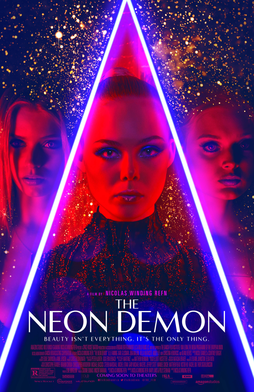
The psychological horror film The Neon Demon isn’t about a literal demon.  It’s a movie about rivalry between runway models in Los Angeles, but there isn’t a great deal of story.  And what story is told doesn’t really make sense.  Sixteen-year-old Jesse, who should probably technically be an orphan, has made her way to LA because all she has is her prettiness.  Some photos get to an agency that agrees to hire her.  The other young women become jealous of the attention Jesse receives.  Only one, Ruby, a make-up artist, befriends her.  The jealous models confront her, and the creepy hotel manager where she stays seems to prey on the women who are trying to break into the dream of the city of angels.  Jesse escapes to Ruby but Ruby’s interested in a sexual relationship that Jesse doesn’t want.  Ruby and two rival models kill Jesse and eat her.  This leads to the death of Ruby and one of the models.

Some of what I describe here is speculative since there are abstract, dream sequences thrown in and it’s not always clear what is going on.  I kept finding myself wondering if this was horror, as presented in the list where I found it.  The unrelenting male gaze could be considered horror for women, but the movie doesn’t take up that narrative.  There are a few male characters, and one of them actually seems to be a good guy, but the threat comes from the other women.  Reviews for the movie were deeply polarized.  Some declared it one of the best movies of the year (2016) while others gave it abysmal ratings.  At the box office it earned about half its budget back, and that budget was a respectful seven figures.

Horror is a difficult genre to define.  I keep coming back to the fact that it’s artificial.  The history of the term began with monster movies but eventually other films with dark themes were included.  Some have no monsters unless a human acting aberrantly counts (and some do count such as monsters).  Slashers have their serial killers and gothic tales have their haunted houses.  Well over seventy sub-genres of horror have been defined.  Casting about for freebies on the weekend leads to some that you just can’t pin down.  Neon Demon does, ultimately seem to fit the label, but many viewers will probably wonder exactly how.  Being out on your own can be frightening, and cannibalism is creepy, so I’ll go with that.