Who Knows?

While I have nothing less than respect (and just slightly less than utter awe) for my alma mater of Edinburgh, I cannot help being bemused at times by the alumni magazine. Between my wife and I, when we fail to cover our tracks adequately, we receive almost as many alumni magazines as exclusive credit card offers. Anybody intelligent enough to graduate realizes that these magazines are attempts to raise money, but they maintain the illusion of giving actual news. Thus it was I found myself facing a pithy piece stating in no uncertain terms that “Near-death events are ‘tricks of mind.’” The rationale given is that psychologists at both Edinburgh and Cambridge have decided it is so.

Now, I’ve never had a near-death experience, nor do I really ever want to. I don’t know what to make of the stories of those who claim to have “crossed over.” The problem is, there can be no winner to the argument of authentic experience versus mind trick. Those who know, by definition, can’t tell. Each side has good points to make. Some religions, particularly those of western orientation, tend to offer an afterlife anyway, so when someone appears to have slipped over the edge and claims they saw a great light, well, why not? Scientists often make the equally valid point that the rapid images that occur in the brain may seem to stretch on into minutes or hours and may incorporate images that our culture lends us of what to expect when the darkness falls. The near-death experience is, they say, final jolts of electrical “noise” just before brain activity ceases.

Some things we just can’t know, even if we attended Edinburgh. “Near-death experiences are not paranormal but are triggered by a change in normal brain function, according to researchers.” So the article says. There seems nothing paranormal about death—it is as natural an event as exists. It is common to us all, including pets and pests. The “paranormal” is the idea that something continues after death. If that something includes a deity or two, it becomes “religious” rather than “paranormal.” Whether religious, psychological, or paranormal, intelligent people continue to debate what is actually happening to those who have been briefly dead and have the medical records to prove it. For my part, if there’s something on the other side, I hope it’s a lot like Edinburgh. Maybe with a few less alumni magazines, however.

Life, and then this.


In God We Lust

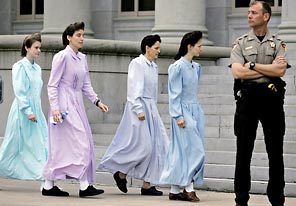
One of the entrenched ironies of human mentality is that reason will not suffice to change religious views. Many studies have repeated demonstrated that faith is impervious to logic, and this has appeared with Ektachrome clarity in the case of Warren Jeffs. Rev. Jeffs, the leader of the Fundamentalist Church of Jesus Christ of Latter-Day Saints, has painted himself into a mental corner that makes the logic of legal proceedings appear as slapping the idiot. Logic and faith do not connect. Any Christian who has read the letter to the Hebrews should know that. Nevertheless, Rev. Jeffs, having illogically dismissed his team of lawyers, has been attempting a divine defense to justify his alleged sexual abuse of minors. He remained silent during his opening statement, despite judicial advice that such a tactic might harm his case. Breaking silence yesterday with a nearly hour-long sermon, faith responded to logic and was found wanting.

Society at large fails to consider that studies of religion have been carried out from multiple angles over many decades. We have erudite studies of the philosophy of religion, the psychology of religion, the anthropology of religion, and the sociology of religion. They all point to the human origins of this phenomenon, often demonstrating that a basic disconnect remains when religious belief is brought into the harsh light of logic. Neurologists and biologists have explored the utility of religion as a survival tactic, and evolution seems to have blessed it. Yet trial lawyers, judges, law enforcement officials, and politicians—often themselves religious individuals—are charged with apprehending and convicting others who simply take their religion to extremes. Religions make untenable demands on adherents. God has a poor record of turning up in the courtroom. His divine statements are absent from the stenographer’s tape.

Not knowing the details, it is difficult to find much sympathy for Rev. Jeffs, should he be found guilty. Yet at the same time, his interpretation of religion differs only in a matter of degree from other religious sexual ordinances. Is it normal for a clergyman to live a lifetime of enforced celibacy? Although signing on the dotted line may indicate a tacit agreement with church policy, what young man can clearly anticipate the pressures of decades fighting biology and psychology? Yet the practice is perfectly legal. Until the nearly inevitable inappropriate results squirm out. Public rancor runs high, as it should, against child molesters. The children are innocent victims. The perpetrators, however, believe themselves to be following divine dictates. It would seem that much suffering would be ended if God would go on the record here, so that we might have solid evidence with which to judge the case. If it please the court.

Photo credit: Tony Gutierrez, AP, from The Seattle Times


Out of the Depths

You’d think that a lifetime of theological study would be excellent training for repairing a toilet. If, however, you live in an old rental unit that has been ritually neglected for decades and that has a plumbing system designed by the Marquis de Sade’s evil twin, you’d soon think otherwise. All I tried to do was replace the flapper—something I learned how to do before leaving home. When the overflow tube snapped off, corroded all the way through at the bottom, I figured I’d just replace the unit. The bolts holding the toilet tank, however, were installed before Noah even built the ark and therefore wouldn’t budge. The leverage room for a wrench, is, of course, negligible. So it was, temperature about 100 degrees, no air-conditioning, no working toilet (bad combination) on a weekend, that I came to face the human condition once again.

As biological creatures, humans have constructed themselves a grand, spiritual universe that kindly overlooks the basics of daily living. Religion, in origin, seems to have had a survival value. Psychologists have suggested that the sense of hope that religions often project might have led to a stronger desire to thrive. Others have suggested religion is part of the curse of consciousness—aware of our own mortality, we attempt to overcome it like any other obstacle. Religion gives us the leg-up over pure biological existence. Unlike other creatures, many western religions assert, we survive our own deaths to face a (hopefully) better world beyond.

In the meantime, however, we are faced with a messy biological existence. Some of our compatriots in this venture stumble along the way and cannot meet the expectations like those who know how to work the system. Religions have traditionally dictated a moral imperative for those who are in positions of power to assist those who are weak. Of late, however, that has somehow shifted—at least in popular Christianity—to the overarching objective of looking out for one’s self. As a species we are all, rich and poor alike, constrained by the same biological necessities. It would speak well of our religious constructs should they reflect the same. As the temperature climbs once again, and I must face my plumbing nemesis, I realize that the metaphor may go deeper than I originally surmised.

The theologian's best friend


Voted Off the Island

One of my readers sent me an article about the Church of Sweden. According to this article only about 15 percent of the members of this national church “believe in Jesus.” The question raised by this statistic is a vital one in a world where politics and religion become inextricably intertwined: what is Christianity and who decides? As the recent vote in New York permitting gay marriage (about time!) shows, many who identify themselves as Christians in America equate that religious outlook with conservative political views (even on issues the Bible says little about). It is what the believer says they “believe” that defines the religion. Ancient religions, as I have noted before, show that this outlook on devotional practice is not the only alternative.

Religions began as a matter of praxis—what people did rather than what they believed. What does an almighty deity gain from theological assent in the heads of believers? Is it a warm, fuzzy feeling or something more? Belief, a very strong motivating factor in humanity, is a psychological phenomenon, not a spiritual one. Many religious groups today are reluctant to accept that psychology covers the territory formerly covered by spirituality. Both phenomena (or the phenomenon) occur in the brain. If a brain does not assent to the typical belief structure, is it thereby deported from the gathering of a religious body? Many times in religious history that has been the case, but what do we say to the Church of Sweden? Kick out 85 percent of your members? I can see many unhappy, unemployed clergy in such a future.

What does it mean to be Christian? Is it to deny civil rights to anyone who differs in outlook or lifestyle from you? Is it sleepily to say “yea” when you wake up after a sermon? Or is it following the teachings of Jesus? The same one who once taught his followers to love those who differed from them, to turn the other cheek instead of proactively pulling out their handguns? It seems that in the modern furor to laid hold of claims of absolute righteousness humanity has somewhere fallen between the cracks. I’ve never been assaulted by a Swede, and I don’t recall, in recent years, Sweden invading other countries to further its economic fortunes. Could it be that, to paraphrase a religious thinker of antiquity, a Swede shall lead them?


Cheating God

Anyone engaged in education long enough will eventually encounter cheating in one form or another. Social psychologists have suggested that whether one believes in God or not has little bearing on moral behavior. A recent report in the International Journal for the Psychology of Religion demonstrates that belief in God does not effect cheating by undergraduates. Among those that believe in God, however, those that believe in an angry, punishing God cheat less than those who believe in a loving, forgiving God. An explanation of the study may be found at Medicalexpress.com.

Someone's watching you

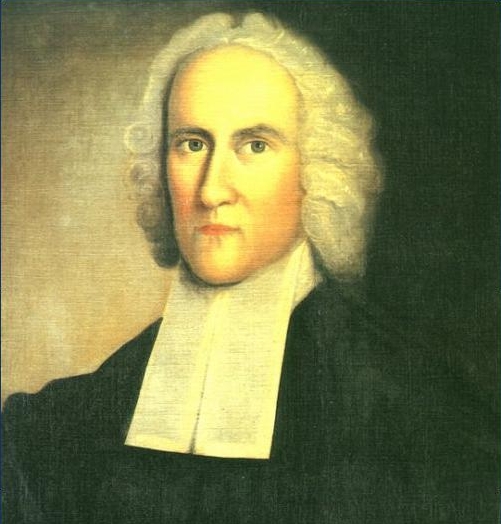
Jonathan Edwards’ famous sermon, “Sinners in the Hands of an Angry God,” it seems, is the bane of cheaters. The Great Awakening chased along the heels of a wrathful deity baying “believe or else!” Those believing in a nicer God are more apt to take liberties. The interesting corollary of this finding is that it does not divide believers along denominational lines but rather along personal outlooks on God’s kindliness. Nobel pagans and fearful believers share a strong moral center.

An informative follow-up would be a study to determine how many believe in a loving versus a wrathful God. From such data we might be able to extrapolate who is more likely to cheat on taxes, spouses, or any other big-ticket items in the economy of our society. Given the number of high profile spouse-cheatings among televangelists and Christian politicians, one thing seems clear: belief in a friendly God willing to look the other way is in no danger of extinction any time soon. Oh, and please keep your eyes on your own paper.


Mummery and Divinity

The human psyche is a fascinating study. As an undergrad I stopped just shy of a psychology minor (partially this was due to the place, but also to a haunting feeling that psychologists are often attempting to resolve their own problems). Even as an armchair psychologist there are plenty of human tendencies to note. One that I occasionally mention in this blog is pareidolia, the attribution of significance to random information. Pareidolia often comes in the form of seeing faces, entire people, or even animals, where they don’t actually exist. This has been proffered as the source of belief in everything from ghosts and aliens to God himself. No doubt pareidolia is a strong tendency in the human mind. When my family recently saw Mummenschanz this was again confirmed.

This Swiss mime troupe – pioneers in experimental theater – makes simple objects come to life. The illusion works because of pareidolia. When we saw the show, even the youngest audience members could be heard exclaiming what obviously non-human tubes, slinky-like characters, and shapeless blobs were trying to do. “It wants the balloon!” “It likes that other one!” “It feels sad.” As the various abstract pieces moved about the stage, a laugh was guaranteed if they flashed a simple round orifice at the audience that clearly perceived it as an eye. We attribute intentionality and purpose to objects unvivified without the soul of Mummenschanz inside them.

Prior to the current tour, the last time my wife and I saw Mummenschanz was about two decades ago in Edinburgh. This was long before I’d been introduced to the concept of pareidolia, and, although I enjoyed the show, the more recent experience was more profound for it. Some of the adults present without children left at intermission, perhaps not finding the abstract personalities engaging. Children, however, seemed to comprehend what was going on. This does lend credence to the power of pareidolia to make sense of a bewildering world. When faced with the unfamiliar, we put a human face on it, ascribe it intention, and call it either a deity or Mummenschanz.


Explaining Religion

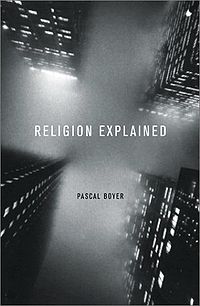
Religion Explained, by Pascal Boyer, is one of those books that I wish had been written earlier and I had read earlier. Like several of my recent reading projects, this book was suggested to me by my cyber-friend Sabio Lantz’s blog. In the course of a very busy semester, it took several months to read, but Religion Explained is an astounding book that raises the ultimate issue: whence religion? Among the many revelations in this monograph – based on solid anthropological and sociological data, as well as neuroscience – is that religion has multiple origins. As Boyer demonstrates repeatedly throughout his book, religion arises from several mental processes symbiotically supporting assumptions that, taken alone, would often fail to survive in the meme pool.

Summarizing Boyer’s work would require a book in itself, but a few of his points struck me as particularly apt to today’s struggle between religion and society. At one point (140) Boyer demonstrates that doctrine is not nearly as important to religions as most specialists assert. In fact, most regular adherents to a religion misunderstand the doctrine to which they give lip service. After having spent too many years in a doctrinally ossified seminary, reading Boyer’s analysis was like liberation at this juncture. As Boyer points out later (282) Christian doctrine emerged in the conflicted environment of revolutionary movements with differing ideas as to what a messiah was. Only after the situation became too complex did one group decide that councils were necessary to decide what they in fact believed. Not really an inspiring story for those who wish to claim absolute certitude about their belief structure! Boyer also draws from other religions around the world to support his case.

Having stated that, Boyer does not attempt to destroy religion, but to explain it. The very premise itself will obviously strike many as blasphemous, but religion, like all human practices, can be studied with a scientific outlook. Accessing anthropological studies and neurological analyses, and the battery of tools provided by decades of psychological and sociological research, Boyer’s portrait is lifelike and believable. Religion developed as an amalgamation of human survival strategies that synchronized into a relatively consistent system that helped to explain a confusing world. If I had read Religion Explained when I was in college, my lifelong religionist enterprise might have turned out rather differently.


Super Sensitive?

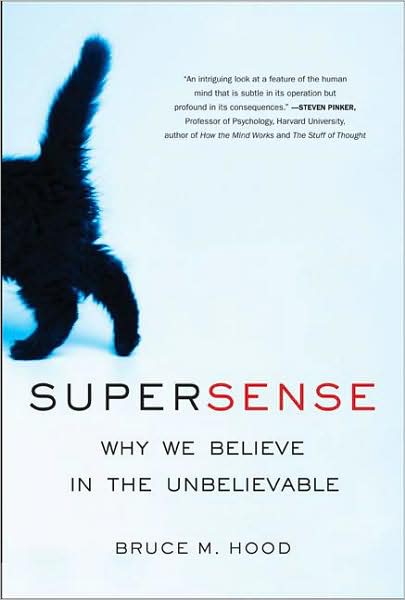
As not infrequently happens, I take my reading cues from others. In general I am reading half a dozen books at any one time, so when I finish one I cast around for something of a similar genre. One book that I just finished I learned about from my cyber-friend Sabio Lantz’ Triangulations blog – Bruce M. Hood’s Supersense: Why We Believe in the Unbelievable. Hood is a respected psychology professor, and his writing style is engaging. The book itself, while fascinating in its ability to offer an overarching theory to explain why people believe in the supernatural, is deeply disturbing. I grew up in a family where the supernatural was taken for granted. Many of Hood’s explanations are cogent and logical, but that was not what I found to be distressing.

The overall premise of the book is that if science cannot measure a phenomenon, it is “super”-natural. If it exists in nature, science can define it. To me this seems far too limiting. It assumes that science has already probed the infinite aspects of an infinite universe. Yes, we understand (to a degree) matter. We have discovered the sub-atomic world with its quarks and other tiny bits. We understand a great deal about energy as well. Could there not be, however, an entirely natural aspect of either matter or (more likely) energy that science has not yet learned to measure? And could not this aspect be a piece of the larger universe that we inhabit? In other words, when all that is not defined by science is “supernatural” then we have already decided on the limits of our world.

From a psychological viewpoint, I find Hood’s analysis quite agreeable. The human psyche does have a need to find the supersense in the world. We do look for irrational causes. Not all unexplained phenomena are supernatural, however. It is a semantic trap. If we define “supernatural” as anything outside of current understanding, then his thesis stands. If, however, we define “supernatural” as that which violates physical laws not as they are currently understood but as they actually are, then who is to say whether there is anything supernatural at all? “Unexplained” and “supernatural” are not the same thing. Such a distinction would not be troubling were it not for the fact that Hood defines “reality” (another problematic concept) only in terms of “scientifically known.” If it has not been measured by science, a phenomenon is not real since our physical brains (measured by science) are the filters through which we experience the world. There is no room for what has not yet been found.

Far more distressing than that is his assertion that freedom is an illusion. One of the most distasteful theological travesties ever is the concept of predestination. The idea that a loving God would create most people to suffer eternal torment simply to fulfill his own arbitrary assignment of justice is something for which Presbyterianism can never be forgiven. It is about the most immoral God that can be imagined. The same goes for the psychological premise that we must react according to our biology. I found myself wondering why Hood wrote the book at all, if life is all predetermined. What if he had chosen not to write it, or to write it differently? You could argue that this too was predetermined, but does this not simply justify the income and fame of those who are “important people”? It runs a true danger of being terribly bourgeois, if not downright supportive of eugenics. Not that Hood would advocate such an action, but any time predetermination is raised, it presents the grandest of excuses for the most heinous of behaviors. Even the psychological observations that support it may have been misunderstood. Of course, if you disagree with me, don’t blame me; it was predestined that I should write this.

That having been said, I found Supersense overall to be a wonderfully fascinating book. At points Hood’s argument seems to consist of the post hoc, ergo propter hoc fallacy he rejects as unscientific, but if this can be irrationally forgiven, there is much useful material to be gleaned from this book.