
I guess I wasn’t sure if Stoker was horror or not. It’s similar to Hitchcock in many ways, and some suggest it’s a “thriller” rather than horror proper. One of the refrains of this blog is that horror is a poor genre designation. Too many other genres bleed into it and it grows into several others also. Still, Stoker was conceived of as a horror movie and it fits that, generally. The title made me think of Bram, the most famous bearer of that surname, at least in my mind. I’m pretty sure that others had the same impression, since some websites take pains to mention that this is not a vampire story. It’s not. It is, however, a story about a psychopath or two. But it generally gets compared to Shadow of a Doubt rather than Psycho. I’ll spoil things below.
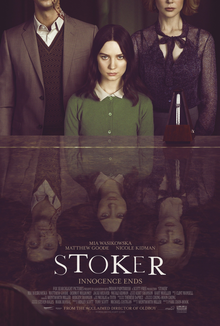
On India Stoker’s birthday, the family receives the news that her father has died. She was very close to her father and distant from her mother. During his funeral she notices someone watching from afar. It’s an uncle she didn’t know existed and who’s decided to live with them. This uncle, we learn, was released from an asylum. As a child he’d killed his younger brother. After arriving at the Stoker mansion, people who recognize him disappear. India was trained as a hunter by her father and senses something is wrong. The uncle meanwhile seduces her mother so she doesn’t see his obvious faults. (He’s a charming psychopath.) He’s goal is to have his niece, India.
There’s a creepy atmosphere throughout, and it’s difficult to determine what India’s end game is. She’s able to take care of herself, mostly. She does rely on her uncle to save her, though. India discovers that he’d been institutionalized at the fictitious Crawford Institute, interestingly in Crawford, Pennsylvania, not far from where I grew up. Instead of accepting his plans for her, however, she charts her own violent course. This is an odd film as far as determining character motivations go. It’s not really clear what India or her mother really wants. The uncle’s straightforward about it, but he’s a serial killer. It’s difficult to know upon whom to cast your sympathies. A movie about family dynamics as much as about horror (a character kills both his brothers, his aunt, and a housekeeper that he feels is in the way), it has no clear message. And there are no vampires anywhere to be seen.
 Steve A. Wiggins