
Last night I assisted my daughter with a stint of volunteering at the local community “haunted house” for charity. This is one of the high points of October, so I was glad to be asked. I reprised my role that I developed for Nashotah House: in that context the character was called “the Black Monk,” based on a local ghost story. While I was on the faculty of Nashotah there were plenty of students who swore the Black Monk story was true, the actual event involved an early student who drowned while trying to walk across water (something many students think they are capable of) – this was actually during the winter, however, and Upper Nashotah Lake is not always as thickly frozen as people assume. The poor student broke through and is buried in the cemetery on campus. Halloween was a major event at that Gothic location until a new, evangelical administration came along. During a haunted hayride, the kids of the community lumbered along on a hay-wagon while costumed students jumped out to scare them. I played along in a costume my wife made where my face was invisible and the flowing black robes eerily blended into the night.
In my current secular context, of course, I was simply The Grim Reaper. This character has a very ancient pedigree. Religions from the earliest times have personified Death as a character that all people inevitably meet. The Mesopotamians had Ereshkigal, the Queen of the Underworld, the Ugaritians had Mot, the god whose name is “Death,” and the Hebrew Bible has “the Angel of Death.” We are often not given a physical description of this baleful but sometimes beneficent supernatural entity. When Revelation was finally penned, Death is one of the four horsemen, and he rides a pale horse, but we do not find many physical details. In the fifteenth century Death was pictured as a skeleton, often with a scythe. His role is that of the classical psychopomp, or guide to the next world. He is not evil, but when the doorbell rings you’d rather hope it had been Avon calling rather than the G.R.
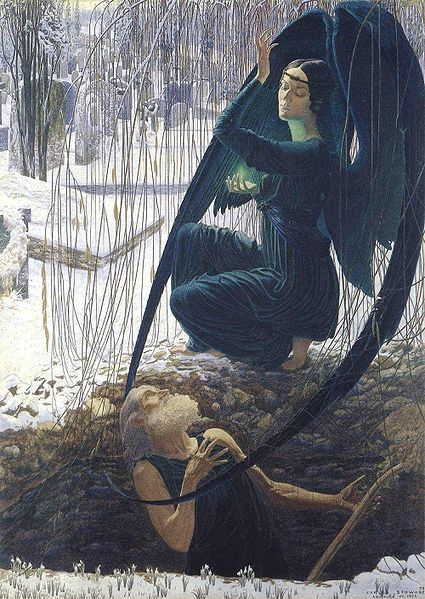
Carlos Schwabe, Death of the Undertaker
Appealing to the fear of the unknown, I lurked last night in the shadows, face completely obscured, not speaking, stepping out to reminded holiday revelers that what is really scary is that which we can not define. When playing the silent ghoul, sudden movements are not necessary to frighten, shouts and screams are unimportant. The simple reminder of mortality and the unspoken question “is he here for me?” are sufficiently frightening on their own. Whether the Black Monk or the Grim Reaper, this character has a natural place on the chilly nights of October. And sometimes it seems there is just not enough October to keep all of us in line.
 Steve A. Wiggins