Posting

I’ve seen The Post before.  Maybe it took recovering from a vaccine to make me realize, however, just how much we’ve lost with the rise of electronic publication.  Yes, there is now a shot at recognition by the lowliest of us, but publication used to mean something important.  Consider how Watergate, the coda to the film, brought down Nixon.  Now we have a president who could’ve never been elected without the world of the internet, and who is coated with teflon so thick that even molesting children can’t harm him.  I work in publishing these days.  I often reflect on how important it used to be.  Ideas simply couldn’t spread very far without publication.  That’s what makes The Post such an important movie.  It’s the story of how the Washington Post came to publish The Pentagon Papers.  Said papers revealed that the United States was well aware that the Vietnam War was unwinnable, even as the government sent more and more young men to their deaths.
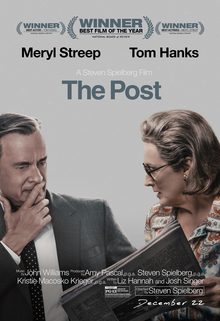
There are many ways to approach this film, including the doubt that it instills in even free democracy, but what struck me as the vaccine was wearing off is how publication has become a more challenging and endangered as the Wild West of the internet continues to expand.  Newspapers used to be the harbingers of truth.  Early in the history of the broadsheet, however, there were those who’d make things up in order to sell copies.  (Capitalism is always lurking when skulduggery is afoot.)  Over time, however, certain papers gained a hard-earned reputation for reliable reporting and publication with integrity.  A story going out in the early seventies in the Washington Post could influence history.  Now it’s owned by Jeff Bezos.

There was a time when a book might change the world.  Now there’s a little too much competition.  Publishers of print material struggle against the free, easy access of the internet.  All that publishers really have to offer is their reputation.  Those that have been around for a long time have earned, the hard way—you might say “old school”, the right to tell the world the truth.  Now the truth comes through Twitter, or X, or whatever it’s called these days and more often than not consists of lies.  Of course I don’t believe the internet is all bad.  I wouldn’t contribute daily content to it if I believed that.  Still, I fear we’ve lost something.  Something important.  And right now we have nothing to replace it.

Release Date

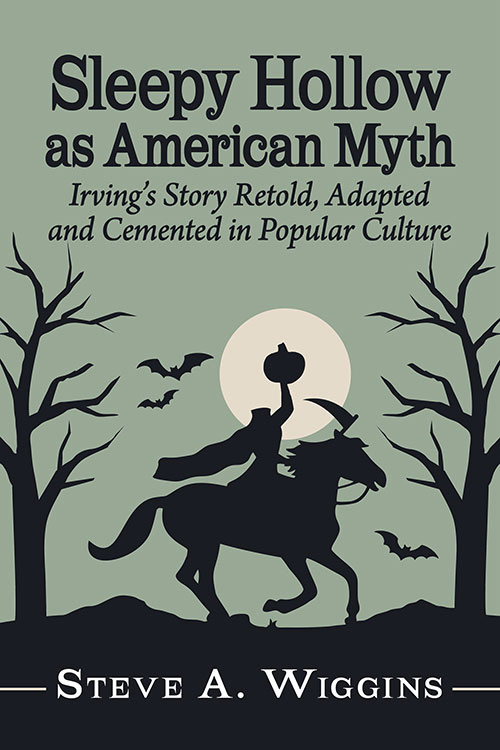
July 16.  That’s the release date for Sleepy Hollow as American Myth.  If you’re so inclined, preordering helps to earn a book attention.  (I know it’s pricey, but thanks for considering it for a second.)  This book has been, like most books, a long time in the making.  As my wife will attest, reading the proofs nearly sent me into a spiral this time around.  It wasn’t because they were bad (I only found 7 mistakes) but it was because of my own doubt about how well I’d done this one.  I found myself between elation at some parts, and dread at others.  I really like this book but I spent my proofreading journey anticipating what critics would say.  I do take a few chances in this one and it has what I believe to be an important message.

Writing books is like walking into a library naked.  There may not be many people there, but those who are can see more than you want them to.  I love the Legend of Sleepy Hollow.  I learned a lot about Washington Irving doing this research.  I learned a lot about Halloween—that’s one of my favorite chapters.  I also like the conceit I applied to the book itself as a labyrinth.  And I’m already looking forward to reading more renditions of the myth once the dust settles a little.  Reading the proofs took a good portion of the weekend, as well as after-work time the previous week.  I could focus on little else.  Books, you see, are parts of their authors.  I feel a little bit crazy for even writing them in the first place.

That having been said, I’m chuffed with a July publication date.  The best time for Halloween books to be available is the summer.  My last two Halloween titles (Holy Horror and Nightmares with the Bible) both came out in November or December.  Not that there were angry mobs at Barnes & Noble demanding them at the end of October.  The other deadline I’d set myself was to have this published before Lindsey Beer’s reboot of Sleepy Hollow hit theaters.  I seem to have managed that one by quite a margin; there’s still been no release date announced.  For her, that is.  I just received mine yesterday.  I guess it’s time to start touching base with those good folks in the Hudson Valley who expressed an interest in the project when I first told them about it.  I’m anticipating Halloween already.


Poe Day

Perhaps best known for his rabidly racist The Birth of a Nation, D. W. Griffith was nevertheless influential in early filmmaking.  I’m fascinated by how literature made its way to celluloid, particularly in the early days.  It was thus that I discovered Griffith’s Edgar Allen [sic] Poe, a silent film from 1909.  A dramatized version of Poe’s writing of “The Raven,” this seven-minute movie opens with Virginia Poe—the “Lenore” of the poem—in the process of dying at the Poe’s hovel.  Not able to keep warm or to find nourishment, she languishes on a cot until Poe arrives home and covers her with his coat.  At that moment a raven appears on the bust of Pallas above the chamber door, leading Poe to write the poem in a white heat.  He knows it’s a masterpiece and leaves Virginia promising success.

In a scene only too familiar to any writer, Poe takes the poem to the publishers, three of whom simply dismiss him, the third laughing at his work.  This particular scene rings so true.  A fourth editor buys it from him on the spot.  This is, in fact, how publishing works.  I’ve had 33 short stories either published or accepted for publication.  By far the majority of them were rejected multiple times.  One of them, previously turned down by six editors, ended up winning a prize.  So it goes.  You’ll never find an editor who “gets” you every time.  Even those who like your work may eventually start sending you elsewhere.  I often wonder how many writers of what would be classics died unpublished because of some editor’s choice.  But back to Poe.

Screenshot: public domain,

Newly paid for his work, he buys food and a blanket and returns home jubilant.  Of course, it is only to find Virginia dead.  Poe’s life did have its share of intense drama.  His death remains mysterious all these years later, and Virginia’s death was a severe blow to him.  “The Raven” was published in 1845 and Virginia died two years later, with Poe himself passing yet two years beyond that.  This film, which I learned about from Jonathan Elmer’s In Poe’s Wake, was made sixty years after Poe’s death.  He’d already become an icon by then, instantly recognizable in pancake makeup.  But even now, more than a century later, publishing is still a matter of the same process.  One of my own novels has been declined over 100 times, despite having once been under contract.  I do know the feeling of being rejected by publishers, even as I participate in a ritual as old as writing for publication.  Happy birthday, Mr. Poe.


Review, Please

I realize few academics read my musings.  (Heck, few non-academics read them either!)  Nevertheless, I have a plea: please be a peer reviewer when asked!  I get hit with this particular conundrum from both sides—as an editor potential reviewers simply don’t want to do the work (hint: we’re all “too busy”!) and as an erstwhile member of the academy, I also get asked to do reviews.  Out of a sense of obligation, I always accept the invitations, if at all possible.  You see, I know how hard it is to secure reviewers.  In the past two-and-a-half years, I’ve been tapped as a reviewer five times.  Ironically, when I had my full-time teaching position (for fourteen years!), I was never asked.  How times have changed!  Editors are now beating the academic bushes for those of us in the hinterland who have credentials and good will, even as we’re out gathering twigs.

You see, academic publication simply cannot go forward without peer review.  If you publish, someone was willing to review your work.  Don’t you think it’s only fair to offer the same courtesy?  Academia used to be, and still should be, a community.  Yes, those who break into those coveted teaching positions are often Lone Ranger types, shooting from the scholastic hip.  Still, the system only works if we help one another.  One of the long-term accusations against the academy is that those within have tunnel vision.  (I suspect there may be some neurodiversity going on here.)  That may be true, but try to consider the wider picture.  Teaching jobs are tough, yes, but the rewards are enormous.  Believe me, if you haven’t had to work a 9-2-5, you may not realize just how privileged you are!

Many editors dread the prospect of having to find new reviewers.  They spend time on university websites that are designed for recruitment, inviting them back to school (believe me, it’s tempting!), not to help editors find experts.  And we don’t like to use the same person over and over.  Reviewing also has some benefits—there are carrots as well as sticks!  I encounter new and untested ideas as a peer reviewer.  Who doesn’t like to be the first to get a crack at new knowledge being born?  My own portfolio of review requests stretches from semitic goddesses to the weather to monsters.  I’ve published in those areas and colleagues had to read my materials to make that possible.  So if you’re an academic and someone asks you to be a peer reviewer, please say yes.  Pretty please, with sugar on top.


Some Bible Lovers

I’m on a train heading to Boston. If you notice a dearth of religion scholars in your neighborhood this weekend, it’s because it’s time for the American Academy of Religion and Society of Biblical Literature annual meeting. If a religious emergency comes up, take two of your favorite scripture and call the office next week. Viewed from the outside, this must be one of the stranger scholarly gatherings. A few thousand people get together in posh hotels and convention centers to exchange ideas about which the larger world cares very little. Ironically, the vast majority of people in the world are religious, but as a society if we know enough about the Bible to get us through the most recent indiscretion, so we’re good. Let the scholars have their fun.

This year there’ll be a session on monsters and monster theory that I helped to organize. That doesn’t mean I’ll get to attend it—the conference is a very different beast for those on the exhibit hall floor—but I’ll have the satisfaction of knowing that it’s happening. Years ago I discovered that many of my colleagues who are teaching shared an interest in monsters. Many of us weren’t aware of the others because this isn’t the kind of thing you talk about in polite company. One thing an editor may be is a vector. We hear what widely separated people are working on. Every great once in a while we’re able to put the pieces together. So it was with monsters. There seemed to be a critical mass, and two or three colleagues took the idea and ran with it. Or ran from it, whichever you do with monsters.

For me Boston will be a series of meetings that will blend into one another until I’ll have to consult my notes to remember anything at all. If I could feel this wanted outside the conference I’d never have to dream of being a rock star. You see, editors are the gatekeepers of academic publication. For those lucky enough to have teaching jobs, it’s publish or perish, so the editor is a vital link. The rest of the year we fall into the background. Emails go ignored. Reminders are forgotten. Requests unanswered. But here, out on that carpeted concrete, we’re the ones they’ve come to see. What we do in the conference matters very little to the world at large. But we do it anyway. We gather together just before Thanksgiving, thankful to be reminded that there are others like us.


Books Anonymous

If you stick with something long enough, you’ll get onto all the mailing lists. These days even if you innocently click on an internet ad it will come back to haunt you for weeks on every web-page your visit. One kind of ad I don’t mind is the book catalogue. For those of you old enough to remember print catalogues, you’ll know what it was like, paging through. You’d see volumes you didn’t know about, but suddenly you couldn’t live without reading them. Around the time of the American Academy of Religion and Society of Biblical Literature Annual Meeting, your mailbox would fill up with these catalogues from anyone who publishes books on religion. Not a single year passed when I didn’t come up with a wishlist based on those catalogues.

The other day one arrived called simply “The Religion Flyer.” I flipped it over to see from whom it came. No indication. Inside the offerings were largely Catholic. But then some evangelical publishers appeared there too. And the Society of Biblical Literature. The only commonality I could find here was the Bible. These were biblical books. Again, as I taught Bible for nearly two decades, this was no surprise. Still, who was to benefit from these sales? I’ve been in publishing long enough to know that books aren’t produced if they aren’t projected to make money. Sad, but true. So who sends out a catalogue with no contact information? Who benefits? The backside has a list of bookstores, along with an order form. As in the catalogue itself, the stores are mainly Catholic, with a few Evangelicals thrown in. The Society of Biblical Literature, which sells its own books, didn’t make the cut.

Could this be truly altruistic book advertising? Not many people suppose that biblical study is good for the world, so I admire the conviction of these stalwarts, whomever they may be. Publishing is a business like any other. The powerful voices that say knowledge should be free don’t, I notice, office their classroom instruction without university tuition to pay their salaries. We’re all the victims of capitalism, I fear. Someone, or ones, took from the limited time that they have to produce a catalogue simply to promote the subject. They were likely hired to do so—I’m not really that naive—but they did so without drawing attention to their own efforts. There once was someone who said that acts of goodness should be done by one hand without the other hand knowing. Not many believe that any more. Even though it’s biblical. Who benefits? Those who have eyes to read.


Write or Wrong

Lots of people write for lots of reasons. Some love it. Some hate it. Some can’t help themselves. For those who know me primarily through this blog, it may not be obvious which of these sorts I am. After having read Dani Shapiro’s Still Writing: The Perils and Pleasures of a Creative Life I finally feel confident putting myself in category three. It’s not that I don’t like writing—I live for it. The kind of person Shapiro describes, however, is the one who defines their entire being through writing. Each day I post between 300 and 500 words on this blog. I’ve been doing it since 2009, which means I’m somewhere over the million-word mark. But those compelled to write will never be satisfied with just that. One does not live by blog alone, after all.

Once in a great while I get asked how many books I’ve written. Well, that’s not a question with a straightforward answer. Two of my books have been published. I’ve written at least ten. Some of them never made it from my desk to a publisher’s wastebasket. A few of them have. Like others who are addicted to writing, I can’t stop. Ironically, with a decade of experience working in publishing I’m not so good at getting my own work placed. Some of it is fiction. Some of it is non. Some of it is even poetry. If you’re a graphomaniac, I don’t need to explain any further. If you’re not, think of chocolate, or sports, or anything else you just can’t get enough of. That’s what it’s like.

Shapiro’s book, although not point-for-point, but more than not, is like wandering through my own gray matter. I had no idea that other writers—including a successful one like Shapiro—felt the same constant, nagging doubts and insecurities. I didn’t know that others considered staring off into the middle distance (there’s not always a window nearby) as work. Or that sometimes you write something and when you’ve finished it seems like it wasn’t you at all. Writers can be a trying lot. We tend to be introverts. We have odd habits (in my case, waking up at 3 a.m. to write on a daily basis). We tend to be able to spot one another in a crowd, but more likely as not we won’t say anything to each other. And strangely, we write even if we don’t get paid. With lifelong royalties somewhere in the low triple digits, economically it makes no sense to do what I do. Generally the world feels creative sorts aren’t terribly productive. It’s because we measure value differently, I expect. I’m glad to have met another traveler on this path although, as is often the case, our meeting will only be through writing.