The Price of Writing

Academic writing strives to remove personality from your work.  It can be soul-crushing.  I remember well when my daughter—a talented writer—came home in sixth grade with a note from her teacher.  An otherwise ideal student, she was writing her science projects with *gasp* her own voice!  Mr. Hydrogen and how he joins Mr. Oxygen—that sort of thing.  Granted, it would never be published in a scientific journal, but it was a personalized expression that demonstrated an understanding of the concepts.  Having been the recipient of an old school education, I also learned that academic writing should lack personality.  Those who’ve bothered to read my academic papers, however, may have noted that I don’t always obey the rules.  Subtle bits (very small, I’ll allow) crept in amid the erudition.  And now I find myself wishing I’d persisted a bit more.

Pure objectivity, anyone living in a post-modern world knows, is a chimera.  It doesn’t really exist.  We all have points of view, whether they eschew adjectives or not.  I still write fiction, but since my publication history has been “academic” I indulge in it while trying to break through where someone’s voice isn’t a detriment.  I’ve been reading non-fiction by younger women writers and one of the things I’m finally catching onto is that your own voice shouldn’t be the enemy.  It may be so for most publishing houses, but I’m wondering at what cost.  So many ideas, just as valid as any staid publication, never see the light of day beyond some editor’s desk.  That’s not to suggest that anyone can write—I’ve read far too many student papers to believe that—but that those who can ought not be shackled by convention.  If only I could get an agent who believes that!

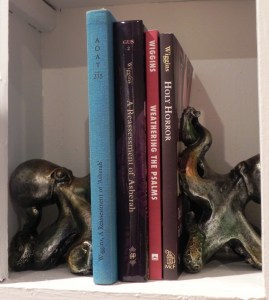
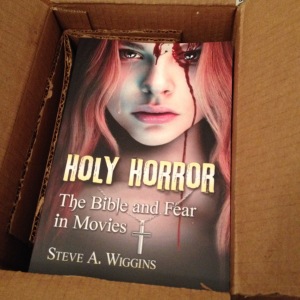
Holy Horror isn’t exactly flying off the press, but it does represent a kind of hybrid.  It’s transitioning to a kind of writing that allows some personality onto the page (yes, I’m old enough to still believe in pages).  A now departed family friend—he’d known my grandfather—was determined to read Weathering the Psalms.  He didn’t make it through.  It was an academic publication.  In the humanities, it seems to me, we need to allow authors to be human.  It’s in our title, after all.  Please don’t take this as professional advice; careers are still broken on the wheel of tradition.  Writing, however, shouldn’t be a caged bird.  But then again, the clock says it’s now time to get to work.


Fearing Errata

Well before I became an editor, I noted mistakes in books.  I go through phases of marking up books as I read them—in pencil only, please!—and not doing so, but I used to mark mistakes when I found them.  At that point I hadn’t realized the complexity of the process of book production and I had no idea of the many ways in which errors might creep in.  I’m a bit more forgiving now.  In any case, errors are a regular part of book publishing.  Older books used to carry pages with incantational-sounding titles like “errata” and “addenda et corrigenda.”  Errors, in other words, were considered inevitable because every time you have another set of eyes look over the manuscript it adds to both the costs and time for the production schedule.  Then I started writing books.

Now, before I get too far I should explain that many book editors don’t line edit submissions.  The standard “editor” is an acquisitions editor, which means you sign up books for your press, but you don’t necessarily (if ever) actually edit them.  I still have the sensibilities of a copyeditor, however.  That’s the main reason I fear to read my own books after they’re published.  I’m afraid I’ll find mistakes.  I do take the proofreading stage seriously, but often a writer has little control over when proofs arrive with a tight turnaround time.  You have to drop everything to get them returned by the deadline.  I’m always worried that errors might’ve crept in.  For example, with Holy Horror, I corrected with website copy for the book.  The errors, however, remain online.  They’re minor, but as the author you’re always considered culpable for such oversights.

Now that I’m working on a presentation to give for Holy Horror, I find myself facing my fears.  I need to go back to a book already published and look inside.  Since writing it I’ve completed another book, Nightmares with the Bible, and my mind can’t help mixing up a little in which book I said what.  To make sure I don’t tell potential readers the wrong information, I need to go back and reread parts of my own work.  What if I find errors?  Will I have to mark up my own copies like I used to do to those of others?  Will I need to compile an errata sheet?  I tend to be a careful reader, especially with proofs.  But facing possible errors is nevertheless a terrifying prospect, even if it’s a regular hazard for those who attempt to write books.


In Praise of Paper

I’m working on embracing the electronic age.  No doubt it’s convenient.  And fast!  Publishing is, and always has been, a slow industry.  As connoisseurs of anything know, quality takes time.  This brings me to my paean to paper.  I generally write these blog posts on a computer.  That makes sense since they have to go onto the web and to do so they must be keyboarded.  Many of them start, however, on paper.  Sketching and free-flowing lines can become ideas, yet to draw on a computer you have to buy specialized (and expensive) equipment and software (which costs even more) to use it.  You’ll lose months of you life learning how to use said software.  In the end you’ll probably have forgotten, what?  I forget.

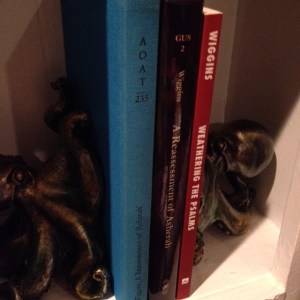
The other day I ran into an author who wanted maps.  In an electronic age the easiest way to get maps is to take them from the web.  Google Maps seems innocent enough.  Only it’s covered by copyright, and commercial use requires permission.  As I went through the whole permissions process I was thinking of tracing paper.  Copyright covers the execution of ideas, not the ideas themselves.  Coastlines, rivers, and mountains added through the miracle of tracing paper become the copyright of the maker.  (Don’t try this by rewriting written words through tracing paper—that doesn’t work.)  Tracing paper’s old school.  The illustrations in many older books used a similar technique.  In A Reassessment of Asherah all the illustrations were ones I drew by hand.  You can do that on paper.  The only investment is a single sheet and a pencil.  A scanner can handle the rest.

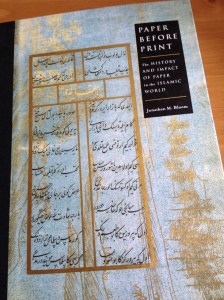
Technologists like to espouse that there’s no such thing as a page.  Authors, they aver, must learn to write without references to page numbers.  Avoid the words “above” and “below” to refer to something discussed elsewhere in the text.  This “format neutral language” (for it has to have a fancy name) is intended to ease the reading experience for the ebook.  With my Kindle software, however, there are still pages.  Don’t we call them webpages?  Don’t we bookmark both our place in Kindles and on the web?  Why then can’t we have our page numbers?  Have you ever tried to make your laptop into a paper airplane when you’re bored?  It’s often hard for progressive creatures like ourselves to admit that maybe we have had it right the first time.  Maybe reading and paper need each other.  A future without paper will be very sterile indeed.


Seeing the Future

Nine.  That’s the number of people before me in line.  It’s not yet 4:30 a.m., and our day began at least an hour ago, but work won’t start for another two.  As the bus pulls up to the stop, I think about work.  Well, like most people I think about work a lot.  You see, I’m often asked about how to get into the publishing business.  There’s a cosmic irony to this because I had never planned to be an editor and never undertook any of the usual training.  The anticipated trajectory of a doctorate in the humanities used to be teaching, which is what I did for many years, but when an educational career slips off the rails in a capitalistic society you have to be willing to learn real fast.  (Fortunately the long years of schooling do help with that.)

I’m sure that I’m not the only person whose career plans didn’t pan out as anticipated.  Back in seminary one night long ago, three friends and I had a “future dinner.”  We prepared a supper and each came as who we would be twenty years down the road.  I recall that I was a world-traveling professor and the author of several books.  “Come on,” my friends complained, “be realistic!”  It’s a bit beyond those two decades now, and I was a professor for many of them.  I have written several books, although so far only three have been published.  World-travel?  Well, that’s been a bit modest in recent years, I have to admit.  One of the other friends I’ve lost track of.  Another committed suicide after graduating.  We really can’t see far into the future.

Publishing is a challenging gig.  My rapid career contortions perhaps prepared me better than I think.  I have a kinship with those who ask about how to get started in it.  Generally we’re educated people who like books and wonder what kind of career you can find with that combination these days.  (There are more of us than you’d think!)  Compared to higher education academic publishing is a small world.  I’ve come to know many more academic colleagues since being an editor than I ever did as a professor.  I have something they want—a reputable venue for publishing their latest book.  Often I have to do a lot of educating since publishing doesn’t work the way that most people think it does.  It’s like being a professor without the status.  No, I didn’t see this in my future.  As I look for a seat on the already crowded bus I wonder how many of these other early risers planned their careers just like me.

Difficult to see where this is going.


The Root of All

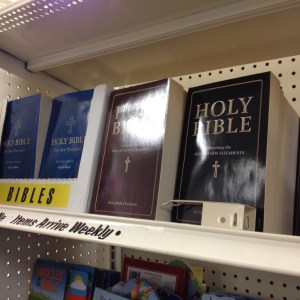
The other day I was in one of those stores where everything is sold really cheaply.  I figure it helps balance out all those times when I’ve been overcharged for things at other stores because I was pressed for time and needed something quickly.  In any case, these dollar store establishments have a constantly rotating stock, it seems (things move at a buck!), and so you might or might not find exactly what you’re looking for.  While just looking around, acquainting myself with the content, I came upon a shelf of Bibles.  God’s word for a dollar a pop.  This isn’t a place I’d normally come looking for books.  Then it occurred to me: many of those who shop in such stores are committed to a faith that keeps them in their economic bracket.

That suspicion was confirmed by other items at the store.  Many of them were Christian-themed.  This seemed like the opposite of the prosperity gospel.  People trying to scrape by, to shave enough off the budget to make it to another paycheck.  Many Americans live like this.  Many of them support Trump.  Selling the Bible to them cheaply definitely involves a mixed message.  There’s indeed a message, as I’ve learned in the publishing, in the way books are priced.  Getting a thousand-pager printed where the unit cost is below a dollar requires a massive print run.  Someone knows that Bibles sell.  You won’t find such cheap divine revelation at Barnes and Noble.  The same content, maybe, but not at the same price point.

The economics of cheap Bibles contains a message.  Those who can’t afford much can be guided toward spending some of it on the Good Book.  While just reading the Bible may indeed bring comfort to those who know where to look, as a whole this book requires major interpretative work.  As I’ve been indicating over the last several days, Holy Writ is not nearly as straightforward a reading experience as many suppose it to be.  Trying to figure out what Nehemiah’s differences with Sanballat the Horonite have to do with the rest of us isn’t an easy task.  To find out, if the internet doesn’t give us quite all the knowledge we want or need, can require some intensive study, up to and including seminary.  Even then you might not get it.  Studying the Bible requires further commitment than simply picking one up for a Washington might imply.  But then, it costs less than a lottery ticket.  And you can get it while saving money on other things you need.


The Price Is Wrong

The costs for academic books can seem criminal.  Don’t get me wrong; I work in academic publishing and I know the reasons—or at least the reasons publishers seem to believe—for such pricing.  Still, when I see a book that my little public library will never be able to convince its network that it should be able to borrow, I look at the prices and blanche.  At least the pallor looks good with my skin type, or so at least I’m led to believe.  Why are books so very expensive when so few of them retain any resale value?  Publishing—the information business—is unlike any other.  In fact, it could be argued that the printing press was the earliest internet.  Ideas could be spread more quickly, among those who were able to read, than they could have previously.

These days books are the handmaidens to the internet.  The problem, of course, is that the web contains ideas that haven’t been vetted.  Publishers offer that service, but you have to pay for it.  Books don’t sell like they used to—physical books, I mean.  Inflation, however, ensures that the cost of paying employees is constantly going up.  This is the hidden factor of “overhead”—the cost of doing business.  You need to sell a lot of books to pay a staff.  Not only that, but unlike most “commodities”—I shuddered as I typed that word—books can be returned to a publisher if they don’t sell.  It’s like an entire business model run on consignment.  And the honest truth is—academic authors may want to cover their eyes for this part—very few books sell more that a couple hundred copies.  That means that the per unit cost has to go up.  Next thing you know you’re selling a kidney to continue your research.

I keep a running list of books I’d like.  Some are for research and some are for other pleasures.  The list grows quite lengthy when more and more interesting books get published.  I look at academic books and I wonder if maybe there’s another way.  If they were priced down in the range of mere mortals, would they sell enough copies to meet their costs?  I’m well aware that Holy Horror is priced at $45.  Believe it or not, that’s on the lower end of academic extortion pricing.  Many books on my “must read” list cost three times as much.  Are we paying the price for keeping knowledge solvent?  Or is all of this just criminal?


Green Eyes

All of us fall prey to the green-eyed monster once in a while.  For an editor like me, it starts lurking when I see others make content production look so easy by taking copyrighted material from elsewhere.  I’ve read books—often self published—that take great swaths of material under copyright and reuse it with no permissions acknowledged.  You can build big books that way.  Quickly.  And there are websites that use  crisp, clean images that look more immaculate that any kitchen counter.  Often those images, however, come from sources “protected” by copyright.  With a web this large, who’s going to find them?  They’re not making money off them (usually) so what’s the harm?  My jealousy, I suppose, comes from working in publishing where copyright is a daily concern.  It’s the currency in which we peddle.

Copyright isn’t intended to make websites like this one look lackluster.  No, it’s intended to protect the intellectual property, or visual or auditory inspiration, or the creator.  It’s a remarkable idea, really.  If I have an idea, it’s mine.  Once I express it in written, aural, or visual form, it is covered by copyright.  (We haven’t figured out a way to regulate original smells and tastes yet, beyond protecting their recipes.)  Putatively copyright is to protect the creator’s rights.  In fact, it tends to impact the publisher more.  This week at work I had to spend some time, once again, reviewing copyright law.  One thing most authors don’t comprehend is that a book contract is a negotiation for trading rights for royalties—turning ideas into money.  Even intangibles can be purchased.  Intellectual property can have a fence around it.  And a dog or two in the yard.

I try not to violate copyright.  When I want to borrow my old published ideas in new venues, I rewrite them.  When I want to use somebody else’s pictures on this blog I take them from public domain or fair use sources (thank you Wikimedia Commons!).  A great number of them are my own that  I cast upon the web, hoping they will come back to me in time of need.  With the exception of one guest post many years back, all the words on this blog (approaching a million-and-a-half, at this point) have made their way from my addled brain through my trembling fingers and onto the internet.  Maybe I just want to protect my babies.  Maybe some would call it jealousy.  I like to think of it as a mother bear and her cubs.  Or perhaps the spawn of a green-eyed monster.


Something Blue

I’ve worked for two British publishers.  This probably has nothing to do with the fact that I lived in the United Kingdom for over three years, but the two situations have this in common: they’re bloody complicated.  I say that for a reason.  I’ve always wondered why “bloody” is considered swearing in Her Majesty’s realm, but not over here.  Profanities tend to be culturally specific, of course, while some forms (scatological and blasphemous, in particular) are generally universals.  I had always assumed “bloody” had something to do with religion, kind of like the more tame “zounds” is an abbreviated form of “God’s wounds.”  In fact, the folk etymology of bloody suggests just that.  Folk etymologies, I learned as a budding philologist many years ago, aren’t the same as scientific etymologies.  In other words, like folklore, they aren’t entirely accurate.

One of the lessons I learned in Britain was that if you wish to cite a lexicon, it should be the Oxford English Dictionary.  It’s The authority.  So I thought I’d bloody well check it out on this.  There, it turns out, the emphatic use of bloody has to do with breeding, not bleeding.  Back in the seventeenth and eighteenth centuries there were rowdy aristocrats, or “bloods,” that gave the phrase it’s referent.  These privileged wealthy classes, as befitting the stereotype, could afford idle drink.  They did not work, so life was a matter of passing the time with aristocratic pursuits, such as imbibing.  This led to a phrase “blood drunk,” which, disappointingly, didn’t refer to Dracula, but meant drunk like a blood.  It was only a short, tipsy walk to “bloody drunk.”

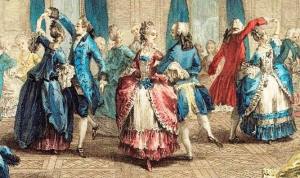
Antoine-Jean Duclos, from Wikimedia Commons

Disengaging the adjective—like the saucer part of the Enterprise pulling away from its iconic Star Trek hull—you get stand-alone “bloody.”  This swear has nothing to do with sacred blood, but rather blue blood.  Which brings us to the realm of sacre-bleu, in which the word “blue” (bleu) features.  But this has nothing to do with the color blue (such as Marian blue, known from mythology of the virgin) but from the fact that bleu rhymes with dieu, and using the name of a deity (although “god” is actually a title, not a name) is swearing.  In fact, it is technically what is meant by blasphemy.  Working for British-based publishers has been its own kind of education.  It’s easy to get lost in etymological labyrinths.  But is that the bloody time?  I’ve got to get to work.


Quiet on the Winter Front

There’s a weird silent time, after a book is published, when you start wondering how it’s doing.  Holy Horror was apparently released November 29, and published December 29, if done according to standard publishing practice.  The release date is when stock is received in the warehouse.  The book is printed and technically available, but not yet published.  Publication is about a month later when the sellers, distributors, etc., have received their orders and can begin sending them out.  Publishing, as I’ve noted before, is a slow business.  Somewhere around this point you start wondering how your book is doing.  Reviews take some time to appear.  The publisher falls silent (I know this from the editorial perspective as well).  You start thinking, did it really happen?

This is the internet syndrome.  We’ve become used to instant results and it’s difficult to believe that can get by without minute-by-minute updates.  The problem is publishing is slow.  Reading a book takes time.  Not all readers review.  It’s perhaps the kind of malaise you expect in late winter.  In my case, however, my book was an autumn book that missed its release date by a few months.  Yes, hardcore horror fans are still chomping at the bit for upcoming features like Us, but the public in general is well on its way to Valentines Day and what comes after.  We are pretty much a holiday-driven culture and Holy Horror was a Halloween book released after Christmas.  That, and the combination of Bible and horror is unexpected, with many, I’m guessing, thinking the book is something it isn’t.

Often at work I ponder how publishing has changed, even if it runs like sap in January.  Professional writers—those who lived from their books alone—used to be rare.  Most authors were otherwise employed, and many of them worked in publishing.  It stands to reason when you think about it.  I’ve worked for three publishers and finding other writers is, and has been, a rarity.  Instead editorial boards consist of people who largely don’t have the experience of writing a book of their own talking about author expectations.  A disconnect has emerged where writers find employment in other industries and find themselves wondering why publishers do things the way they do.  Even with that background knowledge, I do wonder how my little book is doing.  It’s only natural.  And now that we’ve progressed to February, it’s only eight months more until October.


Epigraphic Ephemera

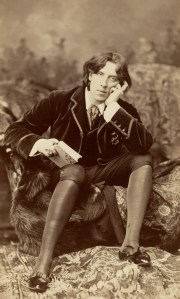
Photo credit: Napoleon Sarony, via Wikimedia Commons

“We live in an age when unnecessary things are our only necessities.” ― Oscar Wilde

In certain kinds of books, epigraphs are popular.  In fact, I’m currently reading a book where every part of every chapter begins and ends with an epigram.  It starts to taste like an epigram cracker after a while.  Don’t get me wrong, every great once in a while there’s a quote that just illustrates your point in a chapter so pithily that you can’t resist.   Still, epigraphs ought to come with a warning label.  Working in publishing one of the first things I learned is that unlike quotes in the body of a text, an epigraph that’s covered by copyright isn’t considered “fair use.”  It’s an ornament, an embellishment.  If you want to use one, you need to get permission from the rights holder.  (Unless it’s in the public domain.)

While the idea of copyright itself isn’t that complicated—the creator of intellectual property is the owner of said property—copyright laws can be complex.  Publishers discourage the use of epigraphs (which only academics seem to use any more) because of permissions complications.  You see, when you publish a book (or article) you’re trading your copyright for whatever emoluments the publisher or the journal has to offer.  Most publishers, no matter how noble, are businesses.  There are costs with producing books.  If someone wants to reuse part of a another book—apart from the standard academic quote—they must have permission to do so.  Epigraph permissions can really slow a book down.  And make it expensive.

Reading is an involved process.  We human beings are seldom given such direct access to the interior lives of others.  Think about it—books are private thoughts made public.  Sometimes writers like to show that others have been thinking along similar lines, especially if what they have to say challenges convention.  Thus the epigraph.  The quotable quote.  But did you have permission to take that?  I like poetry.  It takes longer to read than prose, but it says so much in so few words.  That means using poetry in epigraphs becomes a nightmare.  Rights holders often charge by the percentage of the poem used.  And once a book becomes e book there no stopping the spread of its epigraphs used so carefully by permission.  Indeed, e-books are easily pirated, increasing the concerns of those who sell other’s thoughts for a living.  Before sticking that clever quote at the start of your chapter, it’s worth pondering the epigraph above (in the public domain, of course).


Book Life

Like a book, life can be divided into chapters.  This is perhaps an instance of art following reality, or perhaps it’s the other way around.  The episodic nature of life suggests the chapter structure of books.  As I was waking up this morning (disappointingly before 4:00 a.m.) I was reflecting on the chapters of my life.  As with a book, the most recently read decade is perhaps freshest in one’s mind, but the decades do seem to fall roughly into format.  We tend to think of that first decade—childhood—fondly, even if in reality it wasn’t all games and candy.  It’s biology’s way of encouraging us toward that weird teen chapter of puberty with its intense emotions and maturing bodies.  That chapter is recalled, at least in my experience, as a turmoil involving both good and bad.

The twenties, in my book, were spent in higher education.  It was a cerebral chapter.  Finishing college and starting grad school.  Finishing a masters and discovering employment difficult to find with a master’s degree.  In my book marriage was in the twenties chapter, along with a doctorate.  The next chapter, the thirties, was spent entirely at Nashotah House.  That involved becoming a father as well as a professor.  The other faculty were fathers of a different sort.  I always thought chapters should show some continuity but the forties chapter was that part of the book known as the crisis.  The upending of convention.  The self-reinvention.  The move.  I suppose in terms of a novel that was when it started to get really interesting, but from my perspective life had been plenty interesting enough by that point.

The fifties have been a bit more settled.  The publishing chapter.  The house-buying move added drama, of course, but otherwise the nine-to-five is like a mind-numbing drug.  Mine involved a commute that lead to its own unpublished book, as well as two somewhat academic  tomes.  All of this was going through my head the way thoughts do when you can’t force yourself back to sleep.  The paradigm suggests itself to someone who has, in one form or another, been writing for his entire life.  Or writing his life.  My first attempts at being a novelist began in chapter two.  On yellowed paper somewhere in the attic I still have that first handwritten attempt at literary expression.  The current chapter has me becoming a gruncle (with a nod to Gravity Falls fans) and wondering how a great niece might read a book written like this.  If she will even have an interest.  That’s the way of books, as any librarian knows.  Maybe some warm milk and a cookie are indicated.

Life is a book.


Not about Pigs

Pseudepigrapha always struck me as a great name for a pet guinea pig.  Neither members of the porcine family nor from Guinea, these rodents are remarkably companionable.  But like the word pseudepigrapha, this post isn’t about guinea pigs.  I’ve been reading various documents among this sprawling category of texts, and I can see the fascination they hold for scholars of Second Temple Judaism.  My own specialization was on the earlier end of the spectrum—Ugarit had ceased to exist even before a first temple was built and provided clues to how this whole religion got started in the first place, but that’s a story for another time.  The account of the pseudepigrapha  cannot be summarized easily.  Some of the documents have been known to scholars for a very long time.  Others have been (and continue to be) discovered, some quite recently.

Not a pig.

The documents classified as pseudepigrapha generally bear the name of someone who couldn’t have been their “author.”  We now know that ancients didn’t think of writing the same way we do.  They didn’t publish books like modern writers do, and scholars have been exploring how the category of “book” distorts even the Bible, let alone books that didn’t make the cut.  None of this diminishes the intrigue of these ancient texts.  The world into which Jesus of Nazareth was born contained many texts and traditions.  There was no Bible as we know it today—it was still being written (or compiled)—and no canon, literally a measuring stick, existed to determine what was holy and what was not.  

As discoveries in Mesopotamia have made clear, although few could read or write, writing itself was prolific, at least given the technological limitations.  Today if one wishes to specialize the literature of one subsection of one time period, and probably even some subdivision of that, has to be selected.  Universities don’t see the point, and much of this ancient material is understudied because there remains money to be made in looking at economically viable topics.  The pseudepigrapha have nevertheless come into their own.  Perhaps because some of the stories these documents contain have made their way into pop culture.  Even as I make my way through many of these texts that are young in my eyes, I realize the proliferation of writing made such growth almost inevitable.  There remains, however, a high-pitched squealing that demands attention, regardless of what the exact genus and species of the creature may be.


Instant Gramification

To be a writer these days, so industry publicists tell us, one must be savvy on social media.  But do not spend too much time, they tell us, on that same media.  What publicists don’t understand is that social media has become a zero-sum game.  It demands your time.  Just for instance, I was trying to get set up on Instagram.  Why?  Because, apparently, there is a large presence of those who like looking at pictures of books on Instagram.  The real problem for anyone who writes is to let people know when you’ve got a book out.  (By the way, I have a book out.)  Print catalogues and newspaper ads don’t have the same punch they used to, and social media is the reason.  So I tried to get set up on Instagram.

It took a few hours before I realized that Instagram is meant only for mobile devices.  My phone is several years old now and although it does (mostly) what I need it to do, it has trouble with upgraded apps.  Instagram, for instance.  You might say “it’s time for a new phone, then,” but I don’t like feeling coerced into upgrading when an iPhone 4S is already smarter than I am and it functions just fine as a phone.  And a camera.  And a GPS.  And a tape recorder.  What it doesn’t do so well is social media.  Ah, yes, and that’s what got me into this mess in the first place.  My thumbs aren’t dextrous enough to text, let alone post.  I feel old fashioned because I use a computer.

After a few hours, during which Dropbox kept telling me my storage was almost full and for a recurring charge I could upgrade it, I finally managed to get a photo (not my best) posted on Instagram.  I can’t access my “library” where a number of decent photos dwell.  It complains vociferously if I try to access said photos.  I’m not even sure it will do any good to bring awareness to my recent publication.  Our publicists like Twitter better anyway.  You can’t tweet during the day, however, when people from your company follow you.  Herein lies another of the dilemmas of a working writer.  You’ve got to manage to keep your day job.  Writing books, unless you’ve got an agent, doesn’t bring in enough money to pay your electric bill, let alone your mortgage.  And besides, work is where I learn such valuable things from publicists, like using social media so that I have a readership for my reduced time to write.


New Horror

Now that Holy Horror is out I’ve been noticing an increasing number of scholars who are writing on the topic of monsters.  Book writing takes several years, as a rule, and when I began work on my contribution to the discussion the bibliography was a touch slim.  There weren’t many books out there and academics who addressed the topic did so warily.  Now scarcely a day or two will pass when I won’t find another book I should read on the topic.  Publishing may be an industry in crisis, but there’s no dearth of new books being produced.  Monsters—which define horror—are a means of coping with the realities of a world out of control.  Since 2016 many of us have felt a vague, if at times pointed, sense that something is seriously threatening out there.  Horror seems a logical response.

Academia tends to run behind trends rather than setting them.  Academic books in general don’t sell too well, and monsters often have crossover appeal.  The longer I’m at this, the more I think of how knowledge as a whole is gathered.  Having that shiny Ph.D. doesn’t do so much anymore when it comes to credibility.  It may get you in the publisher’s door, but to attract readers it helps to pick topics that scholars have typically avoided.  Monsters are a calculated risk in this regard.  Those who publish in the field become somewhat suspect among their colleagues, as if the subject is one that can only play itself out in naivety, an under-developed sense of sophistication.  Anything popular tends to be devalued in the academic mindset.  It is, therefore, encouraging to see others addressing my beloved monsters.

A new year is starting and, like many people I have high hopes that it will show some improvement over the past.  I can actually dream of a world without monsters and although pleasant it isn’t realistic.  We have evil with which we must deal.  Horror allows for a fair amount of practice in that regard.  I’m very well aware that many people find the topic repugnant, or at least distasteful.  Academics, it seems, are following their restless curiosities to the darker corners of the mind.  It’s getting difficult to keep up with the monster books appearing, even from reputable presses.  Holy Horror is my first contribution to the discussion and Nightmares with the Bible, which I hope to finish this year, will continue the conversation.  It looks like it’s becoming trickier to find a voice in this crowd already.  I wonder if that implies a better 2019, as we run behind the times.


The Night before Reading

Like many people bound to their circumstances by work (and now a mortgage) I see travel to far-off places is a dream.  On my personal bucket-list is Iceland.  Perhaps that’s a strange place to yearn for in winter, but it’s on my mind today because of Jolabokaflod.  I’ve posted on Jolabokaflod before, but in case the concept is unfamiliar I’d summarize it by saying Icelanders, who are exceptionally literate, give each other books on Christmas Eve and spend the dark hours reading.  For the past three years I’ve taken part in a reading challenge that lists a book in translation, and invariably I choose one by an Icelandic author.  Publishers in Iceland, being less corporate than our native species, accept books for publication somewhat more readily—I’ve been shopping a novel around for nearly a decade now and I’ve read worse.  If it doesn’t jack up the dollar signs, so nobody around here’s interested.

I’m sure it’s not all sweetness and light in Iceland.  I suspect, for one thing, it’s hard to be vegan there.  Then there’d be the need to learn Icelandic.  The nights would be even longer in winter, but then, those long nights would be filled with books.  I sometimes imagine how different America would be if we loved books that much.  I remember well—as you may also—the classmates who grumbled about “having to read” as part of their school curriculum.  And this began well before high school.  Young people’s bodies are full of energy and they want action (which can be found in books, I might add) and new experiences (ditto).  Our culture feeds them the myth that such things lead to happiness.  Instead, they find sitting still tedious.  When life leads them to commute, they fill bus time with devices.

The other day I had an electrician in our house—the previous occupants had some strange ideas about power distribution.  He, as most visitors do, commented that we have a lot of books.  I’m beginning to feel less apologetic about it than I used to.  We have books not only because it’s been part of my job to read, but because we like books.  One of the painful memories of 2018 was the loss of many volumes due to a rainstorm that flooded our garage right after our move.  It still makes me sad to go out there, remembering the friends I lost.  Nevertheless, it’s Christmas Eve, at least in my tradition, and the thought of books combined with the long hours of darkness brings a joy that I’d almost characterize as being Icelandic.  At least in my mind.  Jolabokaflod might well be translated, “silent night, holy night.”