Secret Formula

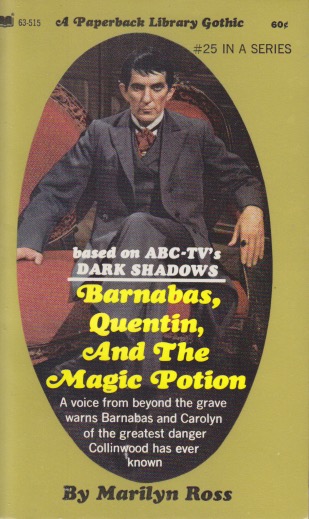
When writing fiction, I’ve never tried a series.  Some, such as Harry Potter, can set a writer for life.  I’ve always had the sense that the Dark Shadows novels were more potboilers.  There was a built-in fan base, and somehow in the sixties and seventies we didn’t expect Rowling-level writing.   It was the entire package: the Gothic, the recurring characters, the moody setting of Collinwood.  And of course, Barnabas Collins.  These novels may be journeyman writing, but here at number 25 in the series, Barnabas, Quentin, and the Magic Potion, there are some signs of literary improvement.  They are slight, rather like the first tinging of leaves with yellow as August begins to settle in, but they are there.  The series is nearing its end for me (provided I can actually find the last few books), but maybe it’s getting better.

What’s my reason for such a burst of enthusiasm?  Well, in this episode we see some features of Quentin that are more in line with how I remember him.  First of all, Ross tries some misdirection.  Quentin is presented as a master of disguise in the series and here there’s some clever hinting that, if you’re trying to think it through, leads you to mis-guess early on.  Not only that, but there’s a more positive view of Quentin here.  He’s not the evil satanist that he is earlier in the series.  Perhaps Ross had figured out by now that if people liked the idea of a Barnabas who is a conflicted victim, the same might apply to Quentin.  He’s not evil, but when you’re a werewolf, well, what can you do?

The “magic potion” is just as contrived and sketchy as most of the plot devices in this series—Harry Potter this is not.  It’s just a get rich quick scheme for a reprehensible old man and serves to move the plot along without really adding anything to it.  Carolyn here discovers that Barnabas is a vampire and, it seems to me, some of the plot devices for the Tim Burton movie might’ve been picked up from this particular novelization.  Although still not belle lettres by any stretch, the story here seems to have made some progress over the previous 24.  As a child, of course, I didn’t read these in order.  I relied on what I found at the bin in Goodwill, when I could find them.  I never had the whole series.  While trying at times, reading them may be a worthy exercise as an adult.  Perhaps series too grow up.

Premature Burial

I have recently finished writing an article for a collection of essays on the Bible and horror.  Have no fear—I’ll pass along details once it’s published.  I do have to wonder, though.  All those years I was teaching and publishing regularly in ancient Near Eastern studies nobody ever approached me about contributing.  It took coming out of my monster closet for that to happen.  Monsters, you see, are a guilty pleasure topic.  They’re so much fun that they hardly seem like work to write about.  Or read about.  I was a child when Dark Shadows aired as a daily soap opera on ABC.  For reasons about which I’m beginning to speculate I found this series strangely compelling.  Marilyn Ross (W. E. D. [William Edward Daniel] Ross) based some 32 of his over 300 novels on the series.  I collected them as a kid and then got rid of them when I went to college.  I’ve been collecting them again in a fit of nostalgia over the past several years.

I just finished Barnabas, Quentin, and the Crystal Coffin.  The story was actually quite different than typical Collinwood fare.  What drew me to these novels as a child was their atmosphere and, if I’m honest, the fact that Barnabas was a vampire.  Memories of youth are fleeting things at my age, but it may be that Barnabas Collins was my introduction to vampires.  I was four when the series first aired, and I’m not sure if I discovered it before I came across Dracula or if it was the other way round.  Dracula, once I was experienced enough to have an opinion on such things, was my favorite monster.  I liked the others as well, but he was rich and immortal—the things sickly kids in poverty idealize.

In my fascination with Dark Shadows I’m not alone.  Despite Tim Burton’s movie version, Johnny Depp (who is my age) admitted growing up wanting to be Barnabas Collins.  Friends about my age have discovered PBS’s recent re-release of the original series in all its campy glory.  For whatever reason, however, it is the books that always draw me back in.  They, for me, defined the Gothic novel.  Ross’s writing is formulaic and predictable.  His adjective choices feel forced and subtleness was never his strong point.  Still I can’t stop myself from occasionally dropping into the world he manages to recreate in the woods of Maine.  Afterwards I move on to more profound writing, but then, his work is the very definition of a guilty pleasure.