
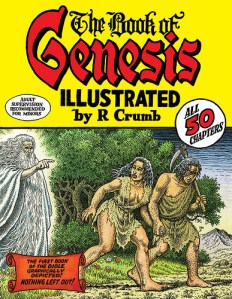
The book of Genesis is elusive and evasive, telling stories that have been read as both science and fiction, but never revealing its own deepest secrets. For over two decades I have been researching the book, never publishing my work since there is so much more yet to read on it. Many truly bizarre interpretations on the introductory section of the Bible have appeared with the proliferation of publication — Robert Capon’s Genesis the Movie and Harold Bloom’s Book of J come to mind — even by otherwise careful scholars. Nobody seems able to get to the essence of the book while everybody thinks he or she already understands it. As a piece of literature it is perhaps the most influential ever penned since it is the basis for so much of the world we’ve constructed around it. Maybe the reason we can’t understand it is that we don’t have it in pictures. Now that’s all changed: R. Crumb’s (serious) comic book version, The Book of Genesis Illustrated, is finally available.
R. Crumb is well regarded in the comic book world, but less recognized in the biblical academy. He is not the first to storyboard sacred writ, nor will he be the last, but he is grappling with the same material that defies definition. Creationists can’t live without the assertions of Yahweh’s creatio ex nihilo, that they read into Genesis (for those who are willing to read what’s there, chaotic water is pre-existent, not created), and many biologists wish that J and P had shown a bit more discretion and humility before setting the framework that dogs their each and every evolutionary observation. Those who take Genesis too seriously will likely be offended by a comic-book version, but the text is based on the revered King James Version and Crumb said in an interview that he had “no intention to ridicule or make visual jokes.” The problem is, the text is full of its own riddles and jokes, along with serious assertions of the superiority of Yahweh over Marduk and Baal and Teshub.
Unlike many Bible readers, Crumb does not stop his Genesis with the Flood or the Tower of Babel. Instead he takes his readers through the entire book where “iron-willed Old Testament matriarchs” are presented in his characteristic muscular style, perhaps recalling She-Hulk more than Sarah. The images may be unfamiliar and a little frightening, but I applaud Crumb for taking on the patriarchal chokehold over shy, hand-wringing wives wondering why they can’t seem to take the biological package their virile husbands send their way. The Bible was written in a man’s world, but it is now ensconced in a more enlightened age and it is ready to benefit from a new, and unfamiliar reading.
 Steve A. Wiggins