Lions and Lambs

This brief break between Christmas and New Year’s Day, taking into account the vacation days expended to enjoy it, is a time filled with movies, reading, writing, and sufficient sleep. In short, it’s like a dream. I’ll get around to addressing the movies eventually, but right now one in particular is on my mind: Zootopia. Disney movies weren’t a big part of my childhood. We did watch the Wonderful World of Disney on Sunday nights, but movies were an expensive treat. I remember seeing The Jungle Book, Bedknobs and Broomsticks, and Herbie the Lovebug. When we could afford a movie, it was frequently at a drive-in where a carload was cheaper than individual seats. I missed several of the childhood western canon—I never saw Mary Poppins until I was in college. Becoming a parent in the 1990s meant becoming conversant with Disney.
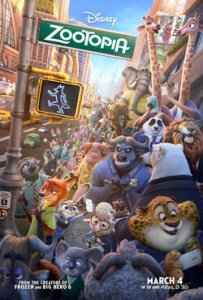
zootopia

Oh, I’ve heard the conspiracy theories: Disney is “the evil empire,” part of the Bilderberg Group, the Illuminati, and any number of other collectives that want to run the world. They have access, we are told, to the young and a reach that excludes few before the age of ten. I know little of Disney’s business practices, but Zootopia suggests to me that they are telling our children the right message. The movie follows the ambitions of Judy Hopps, a bunny that want to be a police officer in Zootopia, the largest city in the animal world. Threatened and bullied because she’s a girl, and small—traditionally prey—she nevertheless overcomes the obstacles necessary to meet her dreams. Once she meets success, however, she finds herself engaging in prejudice against predators. Species profiling takes over and the white sheep (literally) take over.

The message of not assuming someone is a slave to their “biology” is a powerful one. Nick Wilde, the fox that assists Judy to her goal, becomes a victim. The only way forward for Zootopia is to recognize that profiling—gender or species—is wrong. Since the story isn’t preachy, it’s all the better. Watching unchecked prejudice surging through our political machinery today, it was difficult to believe that this movie was released all the way back in March. The prey animals are the majority, and they feel threatened and so follow the leadership that controls, deports the predators who’ve been law-abiding citizens all along. Only when we once again see shrews living peacefully next to elephants, rabbits, lions, and polar bears, do we get the sense that everything’s as it should be. I know nothing of Disney’s business practices, but with messages as important as this, I have but few worries.


The Land of Who?

“Parochial” is a name we small-town types dread. Growing up with television, which gave us a magical view into New York and California, as well as other cosmopolitan locales, we could easily feel the accusations of being small-minded and unsophisticated. Although I never wanted to move to the New York City area, I did decide to get away to Boston, then Europe, to be educated. I didn’t want anyone accusing me of being an intellectually challenged rustic, just because of where I happen to have been born. People around my home town, however, aren’t as closed minded as portrayed. Well, not always. You see, apart from conferences where some institution or corporation foots the bills for hotels, I tend to stay in more reasonably priced places when I travel. Even on the road I can’t sleep in, so I find myself chomping at the bit for the breakfast area to open in the morning. Sometimes I’m the first one there.

On a visit to my hometown in the not too distant past, I happened into a breakfast conversation in media res. A local back in town for a holiday weekend was vociferating his views in stentorian tones that could be heard down the hall. The television in the breakfast room, as always, was on. Apparently a story had been shown that teed this old-timer off. His daddy had been a local policeman and he just couldn’t understand why blacks were rioting about unfair treatment at the hands of the police. I cringed as I filled my coffee cup. “They ought to be gassing them and reading their rights later,” he lamented. An older couple, also returning to the area from their home in Baltimore, seemed to agree. I tried to find a corner out of earshot. Unsuccessfully. I could barely hold in my indignation. We were all Caucasian here—what did any of us know of racial profiling, deep-seated prejudice, or being prisoner in our own country? “Why don’t they just stay home?” he said. Home, ironically, of the free.

DSCN4676

I could see that he was elderly and afraid. The media—likely Fox news—had instilled a kind of terror in him that could only be assuaged by reliance on force. The world his daddy knew. I was also reared here. It was pretty much a white town, but some of my best friends growing up were the few African-American kids in my school. My small-town mother taught me not to judge anyone by the color of their skin. The hotel I’m staying in is run by an Indian family. The local stores now reveal a healthier mix than that in which I grew up. I wanted to tell this fellow parochial patron that we need not be afraid if we only seek justice. The region in which I grew up has become more homogenized, and I believe we’re all healthier for it. Until, however, civil rights are truly rights for all, we need to stand with those who’ve been clearly wronged, even if at personal cost. That’s something I learned growing up in this small town.


Welcoming the Stranger

Profiling is alive and well. In our post-9/11 state, we are even more suspicious than those who are different than we were before. After the Ferguson decision, profiling once again led to unrest. If we didn’t do it so much, cases like this wouldn’t be necessary. If we didn’t shoot first and ask questions later, how much more would we understand? It happens, unfortunately, at all levels. I have no desire to trivialize the tragedy that continues to unfold over race relations, but divisions of those perceived potentially to cause trouble occur at even smaller, less significant levels. We tell ourselves that it is possible to gauge a person’s potential for violence based on a number of factors which happen to fall along lines of gender and race. Your typical airport screening is an example.

As my readers know, I object to the millimeter wave scanners in use in many airports. In general, I object to being treated as a criminal when I have been a pacifist since high school. (And likely before.) I am treated like a law-abiding citizen everywhere except the airport. Flying home from San Diego, I noticed that at check-in men traveling alone were separated out and sent through the scanner. The side on which I had to pull off my shoes and belt and coat, empty my laptop from my bag, and stand on the chilly floor awaiting an opt-out, was very masculine indeed. The woman in front of me, who looked far more frazzled than I did, was sent to the metal detector, along with her stroller. No threat there. Being male, however, is always a threat. Two priests stood before me in line. They didn’t go for the pat-down.

Potential terrorists, all.

Potential terrorists, all.

On the plane, many passengers began to talk about the American Academy of Religion and Society of Biblical Literature meeting. After all, about half the passengers had just come from the conference. For me, I was ready for some quiet. Some time to center myself after playing the extrovert and talking to people I don’t know for four long days. As debates about religion broke out on the Boeing 737, I began to understand why religious folk are often profiled as potential threats. Their convictions, public and firmly held, are more likely to remain constant in the face of contrary evidence than are most opinions. I wonder if airport security couldn’t save us all some time, money, and embarrassment. Couldn’t they just ask passengers to declare their faith? Of course, we’d need to find some other employment for government officials whose duties involving feeling strangers with latex gloves before wishing them a pleasant trip. While high above the planet riots are breaking out down below because we distrust those who are different.