Looking North

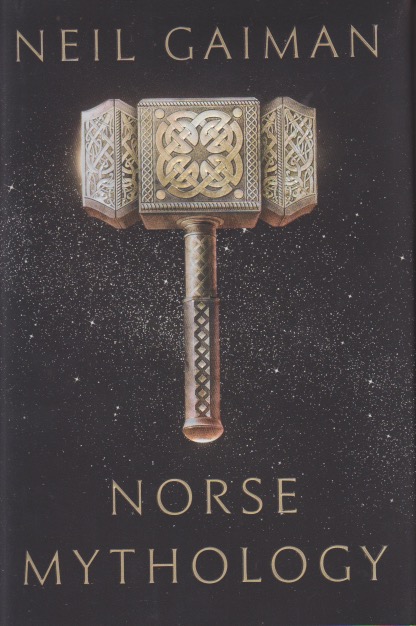
As organized religion continues its slow decline, mythology remains.  Indeed, it seems to be growing in interest.  The problem with many mythologies, for monolinguals, is that they come in languages other than English.  Translation always loses something, which is why, I suspect, Neil Gaiman was tapped to retell the Norse myths.  A very talented story-teller, Gaiman has written about gods before.  He knows their literary potential.  Norse mythology is rather odd in the canon of western thought.  The stories feature gods with as many foibles as humans and with conflicting motivations.  In some ways they are more believable than the monotheistic tradition.  They are both fun to read and poignant.

At the same time Norse Mythology is a somewhat perplexing book.  It’s difficult to tell, without being an expert, what is Gaiman and what is ancient.  In fact, the book sits next to another one with the exact same title on my shelf.  That one is labeled nonfiction, and it’s a bit more academic.  Perhaps it’s an occupational hazard that I tend to want to approach mythology in original languages, if possible.  I’ve never studied Nordic tongues and it would be a little difficult to justify starting now, with all the other things I’ve got to do.  It’s not that I don’t trust Gaiman, it’s just that every retelling is an interpretation.  Still, I’m sure the book gives the flavor of the records that survive.  One of the fascinating features of Norse mythology is that gods die.  Since it ends with Ragnarok, that seems inevitable.

Many mythologies have the world ending with the establishment of the happy reign of a singular deity.  Ragnarok, which Gaiman (and perhaps the originals) sets in the past, sees the gods dying on the battlefield against Loki and the giants.  As the earlier myths make clear, however, death in battle is the most glorious way for the Norse to end their lives.  (And seeing how it has led to a pretty peaceful adult nation, one wonders if the mythology had a calming effect.)  I’ve not read extensively in other versions of Norse mythology so I don’t know if Gaiman’s ending with Balder returning and the world starting anew is his innovation or part of the original.  Having gods who die, however, seems like a potential leveler for humans who suffer from greater powers.  There’s a sobriety to it that lends gravitas to the whole.  And like all good books, Norse Mythology has left me hungry for learning more.

Gods and Giants

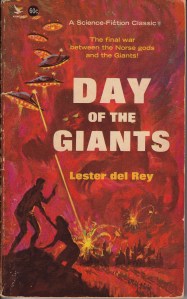
Day of the GiantsComing back to a book you first read as a tween, in the days before tweens even existed, can be a revelation. Lester del Rey’s Day of the Giants introduced me to Norse mythology as a kid, and, along with Thor comic books, was my Nordic Bible. The last time I read it was probably in the Ford administration. As part of a reading challenge I’m undertaking this year, I had to select a book I’d read before and, amazingly enough, I still had my copy. Reading the book as an adult, however, proved a very different experience from reading it as a child. For one thing, I noticed quite a bit more of the implicit theology of the story. Del Rey was no theologian, of course. This little book, however, makes a statement that is difficult to miss regarding the gods: they are victims of tradition.

It is probably not worth worrying about spoilers over half a century after a book was published, but I’ll try to be sensitive nevertheless. Leif Svensen, our protagonist, finds himself in Asgard on the eve of Ragnarok. All the familiar Norse gods are there: Thor, Loki, Odin, and kith and kin. As they prepare for the battle with the frost giants, who, in the mythology win the contest, the deities are decidedly subdued. They believe their fate is sealed by a prophecy of defeat. Leif, being a true American, gives them a rousing speech about overcoming the old ways. Gods, by nature, are conservative. They don’t have to bow to tradition—they are gods, after all. The deities are not swayed by the logic of a mere mortal, even after his apotheosis. Fate, it seems, trumps even gods.

I’m pretty sure that Lester del Rey wasn’t attempting to make any profound theological observation here. One can be an accidental theologian. Ideas of gods and what they must do can be a detriment to their own future. Even with the evidence of the failure of their own prophecy, the gods can see no way forward other than that they’ve recognized as fate. They are, without saying too much, out-maneuvered by human resourcefulness. A man tames his god, and it can become a man’s best friend. I wasn’t expecting such theological insight from a sci-fi book from my youth. Then again, you never know what may happen when you come back to a book after leaving it on the shelf for four decades.


The End of the Gods

RagnarokHovering somewhere between fiction and fact, A. S. Byatt’s Ragnarök: The End of the Gods is a compelling reimagining of Norse mythology. Starting in childhood, the stark and bleak icons of a world where even the gods die captured my fantasy in a way that the more real myths of my own faith did not. Like “Greek mythology” the tales of the Norse don’t come in an authoritative canon. Like the tales collected by the brothers Grimm they are bits and pieces that Byatt brings to life with honest description and the willingness to trust the outlook of a child. Mythology is too often castigated as puerile and of no inherent worth. We would not, however, be human without it.

I suspect we all secretly envy the gods, begrudging them their strength, but especially their immortality. Most myths admit that gods might die, but often they come back or become greater for their demise. Ragnarök is the final death of the gods. In fact, it isn’t so far from the “heat death of the universe” that some scientists warn us is surely coming. All good things come to an end. Even gods. The Christian God, who becomes omnipotent, omnipresent, and omniscient over time, loses something of his likableness for it. Vulnerability lends us a sense of sympathy. Who cannot help but weep for Balder? Odin, the God hung on a tree, dead and brought back to life is swallowed by a wolf. Even mighty Thor succumbs to the poison of the serpent. The world feels impoverished for their loss. Victorious gods have a way of making warriors of their worshippers. Maybe we have something to learn from the gods of the folk.

Mythology is out of fashion among academe. The only money it brings in is from the movies it inspires. Truth may be had for bargain basement prices, so why pay to learn what makes us believe in the impossible? Reading of the end of the gods instills a kind of inspiration that orthodoxy only smothers. No, these deities never really lived. These events never really happened. Still, humans have always found mythology to be uniquely satisfying. Ragnarök explains a chaotic world where our ideas of justice and fairness are often left disappointed. As Byatt points out, Loki is a compelling figure perhaps because he represents what we all know to be true—visions of control are only delusions. In a world with one, monolithic, monotheistic God, we find things hard to explain. Postulating a world where the gods know that they too face an end, even if only in fiction, may help us better understand a world where facts just don’t add up.


Thor’s Return

Once as I sat in the office of an Ivy League professor of Greek religion, I asked about the myths of the Classical gods. The professor (who knew that I had taught religion as well, but at more like a Noxious Weed League school) appeared genuinely insulted and told me in no uncertain terms that scholars of religion didn’t take that nonsense seriously. The study of “myths” was left to Classicists, not actual scholars of religion. Is it any wonder, then, that we don’t really have a grasp on what the average person believes? Being a blue-collar scholar, I always took seriously what students told me about their beliefs. It wasn’t really a great surprise, then, when my wife pointed me to a story in The Guardian about a temple to the Nordic gods being built in Iceland. According to the story, the modern adherents of Ásatrúarfélagið (thank you unicode) don’t really believe in a literal Odin or Thor or Frigg, but see them as metaphors to help them face the way life is. A millennium after becoming Christian, some Icelanders are apparently getting back to their roots.

There has always been, to me, a fascination with the Nordic gods. These rough-and-tumble deities inhabited the harsh and snowy regions where daily life was often a struggle to survive against the elements. Frost giants were enemies and nobody really emerges as the winner after Ragnarok. In the Bible Yahweh does sometimes come out swinging, but for the most part he seems a deity content to sit on his throne and issue commands. The Scandinavian gods were characters of action. In some sense they seemed to struggle just like the rest of us do. They are, of course, more powerful and as the movie makes clear, Thor has a charisma that more self-righteous deities appear to lack. Lest anyone be ready to run to their priest at this point, please be aware that this too is a metaphor.

On the other side of the equation there are sure to be critics who argue that building a temple to fake gods in this day and age is obviously a waste of human talent and resources. Such are people with no imagination. Religious belief, metaphor or not, has been part of the human psyche from the very beginning. Elsewhere I have suggested that animals show the same behaviors as what we Homo sapiens would declare rudimentary religion. Rationalism has not provided a reasonable alternative to religious expression. Even a Stoic knows to appreciate art, although beauty provides no essential element to simple survival. Simply put, humans enjoy the finer things of life. Perhaps unappreciated since long sublimated, among those finer things are the old Nordic gods. And their return is a kind of resurrection.

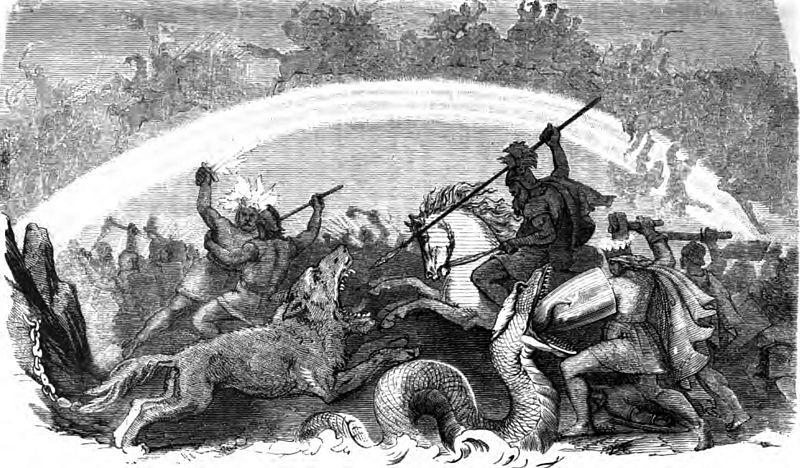
The Battle of the Doomed Gods

The Battle of the Doomed Gods


Twilight Zones

It was twilight last night when I drove into Binghamton. My thoughts naturally turned to The Twilight Zone since one of my childhood heroes, Rod Serling, had grown up here. Binghamton University was also the professional home of novelist John Gardner, of Grendel fame. Seeing the colorful leaves fading to the gray of a falling evening, I thought of how evocative a word “twilight” is. We are creatures with an in-born fear of the dark and twilight is our last hope of light before the night settles in. Maybe it was having just so recently read Grendel, but twilight and gods together brought “the twilight of the gods” to mind (it might have helped that a sudden thunderstorm broke out at the moment). When I first saw the word Götterdämmerung, in junior high school, I thought it must be a potent swear word, what with all those doubled letters and umlauts. My German teacher calmly explained that it was the fourth and final cycle of Richard Wagner’s opera, Der Ring des Nibelungen and it translated to Twilight of the Gods. It is itself a translation of the Norse word Ragnarök, with its single umlaut. Even though it wasn’t swearing, the concept sent a shiver through me anyhow.

I’ve never sat through a performance of The Ring, but I have heard the music with its famous Ride of the Valkyries. Based on Norse and Germanic mythologies, The Ring has deep roots in a pagan mythology where night plays a prominent role. Although J. R. R. Tolkien denied having been inspired by Wagner’s work (there was a certain political incorrectness to it, along about the early-to-mid-1940s), both four-part cycles draw on the Norse mythology that continues to fascinate us with movies like Thor and The Avengers. What impacted my young mind the most, however, was the very concept that the gods could be defeated. How was such a thing even possible? We were raised to believe good conquers evil. How can the gods—even pagan ones—lose? It was a world-distorting concept for someone yet to face high school.

Last night I was literally in the twilight zone. Having driven through the Endless Mountains region where autumn’s reds and yellows inspired me with just how colorful death can be (a European friend once confessed to me that driving along a wooded road in Pennsylvania his first autumn here he had to pull over and weep for the beauty), twilight was already on my mind. October fades into the twilight of the year. The mythologies of the northern races, the Norse and the Celts, seem almost obsessed with the ominous, growing darkness. There is a beauty to it, but also an abiding fear. Are the gods powerful enough? It was a question first raised when my eye fell on that striking word Götterdämmerung that somehow became a part of me.

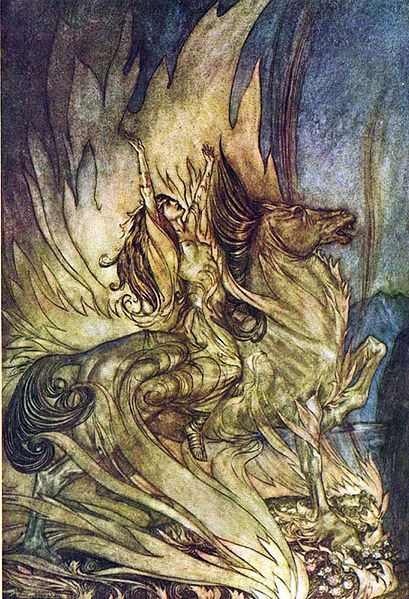
409px-Ring63


Return of the Frost Giants

We have ceased believing in the gods, but we still feel their wrath. The recent winter storms encompassing much of the nation demonstrate our arrogance in the face of the uncontrollable. It has long been my contention that the chief god is a personification of the weather. No matter how many HAARPs we put into place or how many satellites we hurl over our heads, the atmosphere remains a chaotic system. Global warming triggers unpredictable weather and extreme conditions. Yet people claim the moderate level of snow in the northeast is proof against the facts. I say the gods are laughing. How quickly we forget the ice ages.

As a child Norse mythology was among my favorite pagan religious systems. Obviously those responsible for naming our weekdays felt the same. The struggles and weaknesses of Odin, Thor, and Loki are far more honest than claims of pristine intention on the part of the majority of gods. The most captivating aspect was the eventual victory of the frost giants at a kind of Ragnarök. In Scotland, so close to the landfall of many a Viking, I took advantage of indulging in Viking sagas and myths. My understanding remains that of a curious layman, but I sense a deep wisdom at work here.

A recent email from a university dean on a particularly treacherous weather morning admonished all instructors that classroom presence was a commodity that paying students have a right to expect. Deans, with their six-figure salaries, are not accustomed to not getting their own way. How hard it is to admit that the gods have bested us! There are those who’ve not bothered to study global warming but nevertheless like to make pronouncements about it. They claim such weather disproves that the world is heating up, despite the global warming models that predict erratic and localized colder weather. We have released the frost giants. The more we mess with them the more dangerous they become. So, what is my solution to the dilemma of too much weather? Well, I’m morally obligated not to say until I receive my six-figure salary.

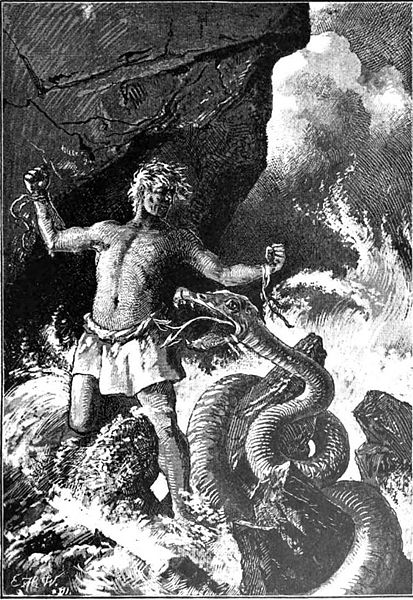
The little wolf laughed to see such sport


All You Zombies

Not being a cable subscriber bears a burden all its own. Not only would paying the extra monthly fees for television prove a hardship, but the constant temptation to watch it would rate as a deadly sin. So on this “All Saints Day” I find myself wondering if the world is still out there after last night’s much-touted “The Walking Dead” premiere. The new AMC series has been written up in local papers and this week’s Time magazine. The latter calls it “a zombie apocalypse.” The fascination with zombie goes beyond holiday-fueled monsters. As James Poniewozik states in his Time article, zombies symbolize society’s insecurities: pandemics, terrorism, economic instability. The unrelenting undead remind us that death is perhaps not the worst thing to fear.

The religious side of this trend is fascinating. Revenants have no place in traditional Christian, Jewish, or Muslim theologies. Perhaps the closest semi-sanctioned version is the golem, a soulless protector of persecuted medieval Jewish communities. Traditional zombies are inextricably connected with magic, a means of manipulating the physical world through supernatural means. Like modern vampires, modern zombies have shifted from supernatural to biological, or at least scientific-sounding, explanations. Even Night of the Living Dead had an errant satellite to blame. The zombie has been reborn in a secular context, making it safe for religious believers to add it to their repertoire of fictional ghouls. And yet, the religious aspect has not completely vanished. The “apocalypse” that accompanies “The Walking Dead,” whether it is Armageddon, 2012, or Ragnarok, is a religious concept. Humans simply can’t face the end of the world without religious implications.

Audiences feeling a little let down after October’s terminal scare-fest, however, might find some cheer that Halloween is an end, but also a beginning. It is the start of the darkest time of year. Very soon not only do we drive home in the dark, but light will not have dawned by the time we start the car for work. In northern reaches of the globe, people can’t help but feel a little stress at finding our accustomed visual assessment of our world a little bit impaired for months at a time. And when we see that shoddy-clothed stranger straggling along in the half-dark, it may be time to remind ourselves that despite the naturalized zombie, there are still those who prey on their fellow humans. They may not be the undead. They may dress well and drive expensive cars and live off what they can legally draw from that stranger on the street. They may be the true harbingers of the apocalypse. They are the ones we should really fear.
Whose apocalypse?


Jersey Vampires

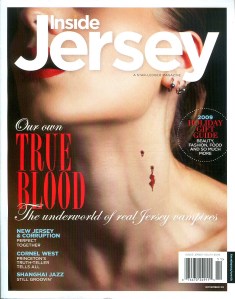
Subscribers to the New Jersey Star-Ledger receive a periodic local-interest magazine called Inside Jersey. Since I’m already inside Jersey and have too much to read as it is, I generally ignore the freebie unless a story catches my eye. Anyone who has followed this blog for long knows of my contention that what truly frightens us is related to religion, or lack thereof, including fictional movie monsters such as vampires and werewolves. Despite the claims that such interests are juvenile and immature, this month’s Inside Jersey features a story reflecting just how serious such issues can be. When my wife showed me the cover, I knew it was blog-worthy.

VampireJ

There are vampires among us. Not Bela Lugosi or Christopher Lee-type Draculas, but actual blood-imbibing vampires. Only those who have shunned bookstores like a crucifix will not be aware that the Twilight series of teen romances have dominated middle and high school female reading lists for the last few years. The vampires in this magazine story, however, are not conflicted teens, but conventional young adults. The story covers what religionists call a New Religious Movement, or NRM. It is a religion, growing in the larger New York City area (as well as in other parts of the country), where consenting adults don artificial fangs and sip blood from willing donors. According to the story these groups, which include professional people who join under pseudonyms, engage seriously in religious rituals not unlike traditional Christianity’s sacramental rites. Now before snatching up your holy water and fresh hawthorn stakes, consider for a moment that adherents to this sub-culture are actually exercising their religious freedom.

Older, established religions are often quick to judge newer religious rivals. The fact is, however, that every religion on the planet was once a new religion. Believers often attribute the origin of their species of religion to the divine: special revelation, enlightenment, or a growing-up of humanity. All other religions, therefore, must be false. The difficulty here is that there are no final arbiters who can stand outside human religious institutions to tell us which is the right one. Lessing’s three rings have reached mass production and still there is no Ragnarok so that one religion might brag “told you so” to all the others. While I’m no vampire — I’ve been a vegetarian for over a decade — I have to accept the claims of those who are that this is their religion. The article ends with a revealing quote from a member of a local Court, so I give the final say to an actual interview with a vampire: “So many people think being into a certain lifestyle, you cut yourself off from the divine. It’s quite the contrary. To me, when you become more attuned to yourself, who you are uniquely, it brings you closer to God.”