More Rats

I’ve asked other survivors of the 1970s if they knew that the Michael Jackson hit “Ben” (his first solo number one recording) was written about a rat.  Most had no idea.  The song is the theme for the sequel to Willard, namely, Ben.  Now, I have a soft spot for seventies horror movies.  Before the days of streaming I repeatedly looked for Willard in DVD stores and never did find it.  I eventually found it on a streaming service and even wrote a Horror Homeroom piece on it.  One winter’s weekend with not much going on, I finally got around to seeing Ben.  Neither are great movies, but I’ll give them this—people in my small hometown knew about them.  Everyone I grew up around knew that “Ben” was a song from a horror movie.  In case you’re part of the majority, Ben is the chief of the intelligent rats who turns on Willard at the end of his movie.
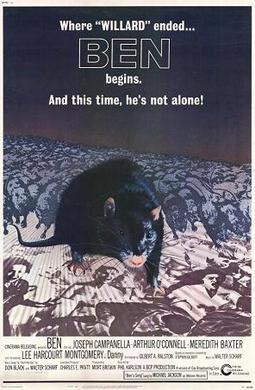
An incompetent police department and other civil authorities can’t seem to figure out how to exterminate rats when they begin attacking people.  A little boy, Danny, has no friends.  He is apparently from an upper-middle class family, and he has a heart condition.  Ben finds him and the two become friends.  Danny tries to get Ben to lead his “millions” of rats away from a coming onslaught, but for some reason Ben decides to stick around and nearly get killed.  In the end, badly injured, Ben finds his way back to Danny.  Cue Michael Jackson.  It really isn’t that great of a movie—the number of scenes reused during the tedious combat scene alone belies the pacing of a good horror flick.  I felt that I should see it for the sake of completion.  Check that box off.

It’s a strange movie that ends up with viewers feeling bad for the rats.  They’re not evil, just hungry.  They do kill a few people (poor actors, mostly) but it’s often in self defense.  The best part is really the song, and the premise behind it—boy meets rat, boy falls in love with rat; you know how it goes.  Michael Jackson famously loved horror movies, and as many of us have come to realize there’s not much not to like.  This movie is pretty cheesy (with the rats attacking a cheese shop, but only after an unintentionally hilarious spa scene) but it has heart.  And it has a fair bit of nostalgia for those of us who grew up in the seventies.

Solomon’s Rats

Some ideas keep coming back.  Since you can’t copyright an idea, retelling a story is always an option.  In fact, some writers suggest they’ve written nothing new—the classic ideas are out there and are ripe for rewriting.  I’m on the fence about Solomon’s declaration that there’s nothing new under the sun.  Some startlingly original stuff is out there, it seems.  In any case, a few months ago I watched Willard for the first time.  Although it’s quite dated in many respects, it was quite a big splash when it came out.  I remember being curious about it as a kid but although we were allowed to watch monster movies on TV, going to a theater to watch horror was out of the question.  That would have to wait for college.

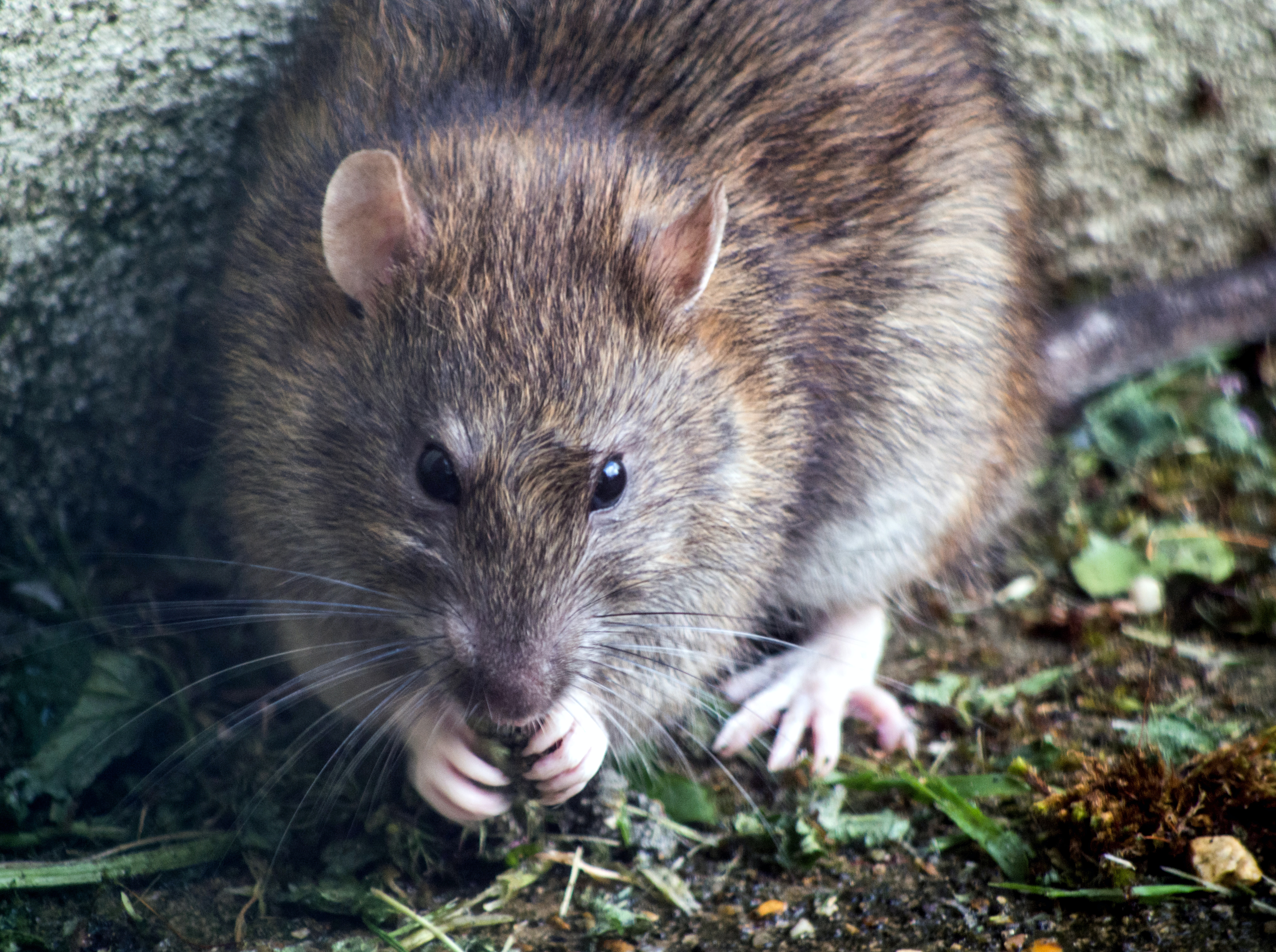
Discussing Willard with a friend after seeing it, the idea came up that it had quite a bit in common with Disney/Pixar’s hit Ratatouille.  I’m not the world’s biggest fan of Pixar or Disney—it seems they try too hard much of the time, although they hit it out of the park with Wall-e.  Still, this connection seemed worth pursuing.  I’m not going to discuss the commonalities here since I just had an article published in Horror Homeroom about it.  The connections are pretty striking.  I would classify Willard as swarm horror.  Rats naturally follow people around because we give them many food options.  To gather from older movies, rat bites used to be a big concern.  These days we tend to think of them as a big city problem, but rats are not far from where people live.  The problem is the swarm.  Being overwhelmed, even by a fairly small animal, is terrifying.

Photo by Brett Jordan on Unsplash

With the warming weather, getting out and doing repair work around the house has made finding weekend time to watch horror rare.  I’ve got a long list of movies and an even longer list of repairs.  Recently another friend has struck up a conversation (via email) about horror films.  The thing is, at my article suggests, they aren’t that far removed from mainstream fare.  Many children’s films come close.  Most movies based on anything by Roald Dahl have dark undercurrents.  More recent efforts—and here I’m thinking mostly of Pixar—seem to jump from crisis to crisis without having that underlying story old Solomon seemed to appreciate (or to have been weary of).  That’s why I find such connections worth pondering.  Even classic revenge tale can be made gentle for younger viewers.


Funny Business

Do animals laugh?  The question sounds innocuous enough, and when my wife played me a RadioLab episode on that very question, the conclusion, although cautious, was that at least rats and chimpanzees do.  This is an instance in which the very question strikes me as terribly speciesist.  Despite the fact that evolution suggests otherwise, Homo sapiens are constantly seeking that fabled northwest passage that will separate us from animals once and for all.  One by one, over the decades, the defining traits have fallen aside.  Animals make and use tools, they build dwellings with ornaments, they solve puzzles, they communicate, and they laugh.  Were we not so obsessed with our own greatness (and consider whom we’ve elected over the past few years!) we might easily recognize that we have evolved to be what we are.

Perhaps it’s because we wish to retain our right to exploit animals.  After all, eating animals is big business and it’s harder to eat someone who’s not so very different from you.  In our culture certain animals are taboo for fodder: dogs, cats, and horses, for example.  This isn’t universally the case, and knowing that animals laugh might just make it a little worse.  We like to think animals “react” using “instinct” rather than respond with genuine emotion.  Until we fuss and fawn over Rover, and accept his affection as genuine.  Consciousness can be quite a burden to bear.  Funny, isn’t it?

We accept evolution up to a point.  Is it any wonder then that creationists still are a force with which to contend?  Often we fail to recognize that science, as it has developed in the western hemisphere, gestated in a largely Christian context.  The reason for drawing a hard line between animals and humans is ultimately, in this setting, biblical.  We’ve moved beyond the idea of God creating each separate species one-by-one, but we haven’t gotten beyond the literal truth of Adam naming and dominating them.  If we don’t consider the biblical origins of these ideas they continue unchallenged, even into the laboratories and sterile rooms of today.  It makes us a bit uncomfortable to consider just how influenced we still are by the Good Book.  At the same time we consider its meta view on the biological world, even as the evidence continues to pile up that little, if anything, really separates us from our faunal kin.  Try explaining that to the rats.  That sound you can’t hear without special equipment, by the way, is their laughing.