
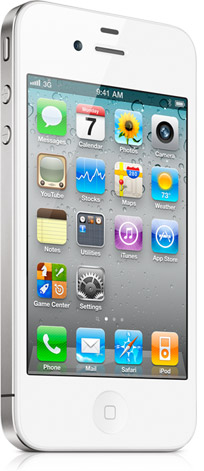
The scientific study of religion poses dangers to the native environment. It doesn’t take a specialist to realize that different people respond to different religious stimuli; some like smells and bells and others prefer the stripped-down Puritanical style. Even beyond that some people get their religious thrills from nature, others from meditation, and some from controlled substances. In a story on CNN late last week, it was revealed that some Apple users find worshipping their favored brand a religious experience. A study by British neurologists discovered that the same areas of the brain are stimulated by both thoughts of the deity and Apple gadgets. MRIs have been utilized for many years now to study where the brain “lights up” during intense spiritual states. It seems we now have proof that God is a Mac user.
While some would cite this story as an example of idolatry, others would interpret the results in a more technological way. Our brains resemble motherboards, in some sense. Even Stephen Hawking’s famous interview of last week had the genius saying that human brains are just like computers. (I must confess to siding with Stuart Kauffman (Reinventing the Sacred) on this one—the brain does seem to be more than the sum of its parts.) If our brains are computers, then the Mac question is a literal no-brainer. Having worked in offices where every PC tries to be a Mac knock-off (wake up, folks! Windows is a Mac emulation environment) I too can sense a superior being behind that Apple with Eve’s first byte removed.
Should we attempt to explore where religious impulses originate? As intimated by Newberg, D’Aquili, and Rause (Why God Won’t Go Away), if we are able to find the God centers in our gray-matter and stimulate them electronically, we may trigger religious rapture on demand. How does this artificial stimulation differ from the religious experience brought on by years of meditating, praying, or fasting? Or Apple products? Our brains are complex and only imperfectly understood. Religions have been around long enough for us to get a grip on their origins. Billions of believers worldwide, however, would prefer that other people keep their hands off their Apples.
Original thin?
 Steve A. Wiggins