A Dusty Return

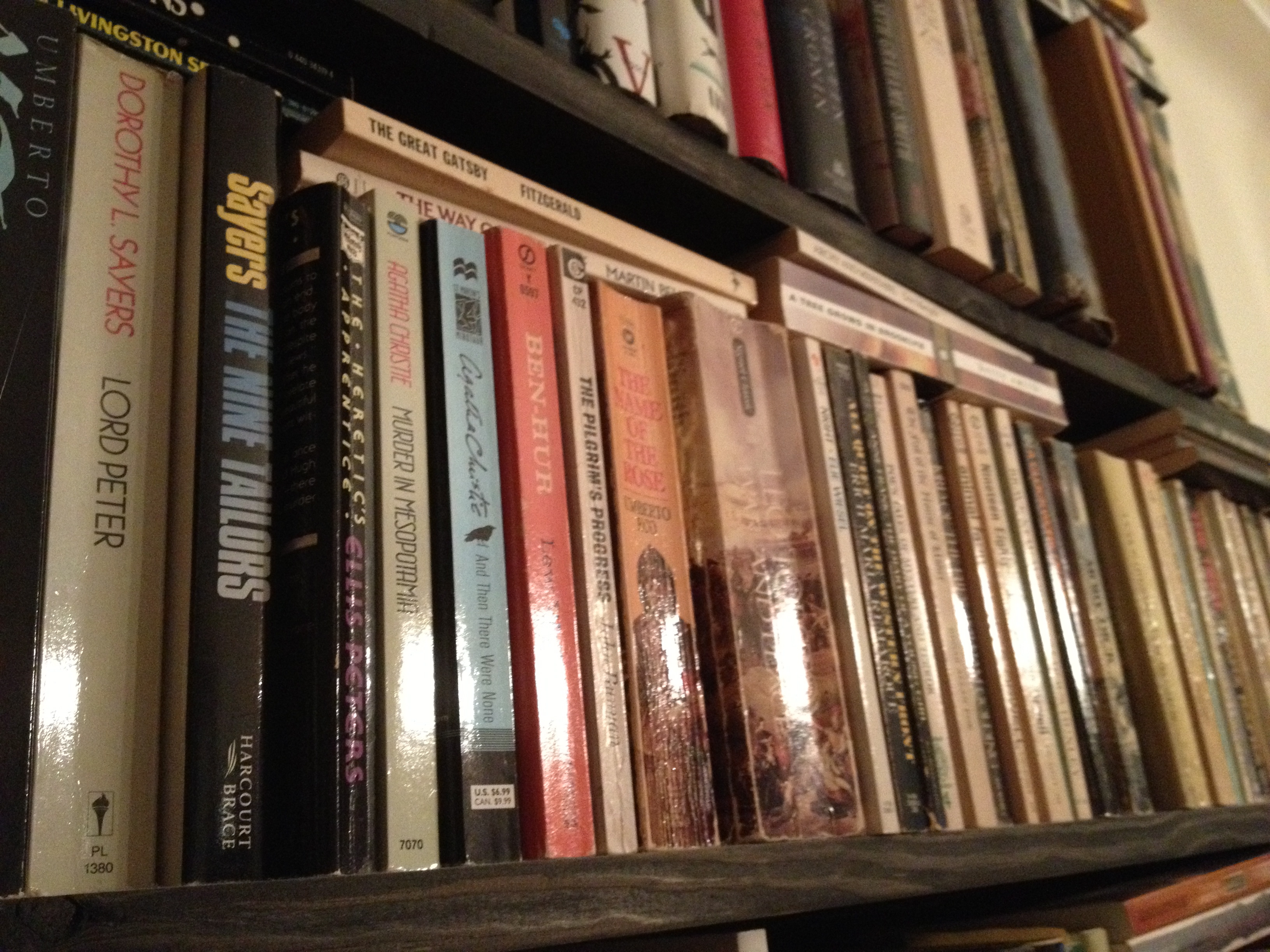
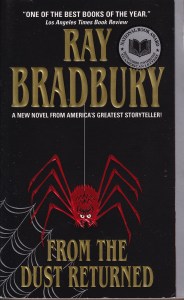
dustreturnedThe fiction author who had the most influence over my formative years was Ray Bradbury. Wait—let me qualify that a bit. I read of number of series aimed at juvenile, male interest (Doc Savage, Dark Shadows, and such) but these weren’t really intended as “literature.” I also read quite a bit of Poe, and his influence may certainly have rivaled Bradbury. The thing was the latter was still alive and producing books, mostly of short stories that tickled my imagination. Despite my reluctance to let books go, there have been several periods in my life where I’ve had to sell off my collection (this is the mindset of the non-affluent) and all of these childhood collections went, except for Poe. Now that I’m a more reflective adult, so I’m told, I have found a renewed interest in some childhood classics, and Ray Bradbury books are seldom expensive. When I found From the Dust Returned in a used book shop for a steal, I said “why not?”

This particular book came from long after I’d sold my Bradbury collection. I had never seen nor heard of it before. As an adult, interestingly, Bradbury doesn’t seem scary at all. From the Dust Returned, like many other Bradbury collections, is a somewhat novelized set of stories. This one is set in a haunted house where, in his usual descriptive style the storyteller offers artful prose and painterly writing, but no real scares. As we are coming upon Banned Book Week, however, I did note one of Bradbury’s common themes—the lack of belief leads to the death of characters. I’d read some of his stories where this took place before. Still, this time he goes a bit further. Tapping into things just ahead of the rest of us, as he had a talent for doing, one of his characters laments the loss of belief in religion as well as creepy, Addams-esque characters. People are no longer believing and it causes ghosts pain.

Part of Bradbury’s appeal is clearly to the young imagination. I’ve promiscuously read hundreds of authors since my last Bradbury book. My tastes have evolved. I find the same is true when I go back to the Dark Shadows books that were so cheaply had at my neighborhood Goodwill. I still go back to these early writers, however, and there is a kind of innocence about them. These were stories I’d read before I’d learned that Poe was certainly not as macabre as real life could be. “Marilyn Ross,” “Kenneth Robeson,” Edgar Allan Poe, and Ray Bradbury may not feature of lists of banned authors. Some of them aren’t even whom they seem to be. They did instill a childlike belief in reading, in my case. Even if they’re now on the bargain shelf they will still receive my admiration for starting a lifetime of reading.

British Libraries

Quintessentially intellectual, the mental image of the British goes, they are often the sophisticated, educated, literate, worldly individuals. I know I’m stereotyping, but play along a minute. Perhaps Americans and other colonials feel a sublimated respect for the nations that gave us our start, and even today the major academic publishers are British companies. Think about it. So when we ponder the United Kingdom, we conjure images of the pinnacle of urbane, cultured, society. Perhaps this is one reason that I decided to study in Edinburgh. One of my memories of being in that fantastic city is going to a library book sale. I’d never seen inoffensive old ladies throwing such hard elbows before. The hunger for books was palpable. So it is with dismay that I read John Harris’s Guardian piece, “In a country like Britain, obsessed with the now, libraries are a political battleground.” (Did I mention that Brits are also loquacious?) The article, however, has a disturbingly American feel to it. We live in the now, not in the past. Libraries (and museums) are the repositories of thousands of years of human wisdom and achievement. Who needs them?

Harris is concerned with the trend of libraries discarding books. After all, publishing is an industry, and if industry is anything it is about producing more. More books are now being published than have ever been since our human ancestors crawled from the primordial soup. Some are purely electronic, but as survey after survey shows, the majority of readers still appreciate a book in the hand. One might say that a book in the hand is worth two in the Kindle. But libraries, desperate for both funding and space, are resorting to throwing out books. They will be replaced with books, and who will miss them? I can’t help but think of Ray Bradbury. Do authors’ souls perish when their books are destroyed? Where will we go to find out, if our libraries have weeded their gardens too thoroughly? My biggest obstacle to continuing research as an independent scholar is the lack of a good university library. I agree with Harris, without our past, our now is but a passing fancy. When tomorrow becomes today, will we wake up and realize what we have discarded? Will we have to start from the beginning again?

Over the weekend I went to a local Barnes and Noble. I’ve never been a fan, but now that Borders is gone, B&N is the only show in town. (I visit the independent shops far more frequently, but this is winter and I don’t want to venture far.) I read about a newly released novel, still in hardback, and wanted to see if they had it. Amid the toys, videos, and puzzles, I stumbled upon a rack of books. New releases. The shelf of hardcovers wasn’t very large, so I stepped around back thinking there might be more. How naive I am. The store was nevertheless crowded. Those checking out weren’t buying books. The book bags, almost apologetically, bore quotes about how books change the world. I look down. I’ve got a puzzle in one hand and a game in the other. The world has only so much space. With what we choose to fill it says volumes about who we are. Our only hope is that our now contains those who, at least in the future, will live to read.

DSCN5025


Casing the Promised Land

In one of the great ironies of the English language “flammable” and “inflammable” mean the same thing. Sometimes an extra syllable can make all the difference. “Ideas are incombustible,” wrote Ellen Hopkins in the final stanza of “Manifesto.” Unlike inflammable, that which is incombustible can’t be burned away. Most literally expressed in Ray Bradbury’s Fahrenheit 451, ideas are, however, endangered in a culture that claims to support them while secretly allowing them to be banned. Orwell called it doublespeak, and we all owe it to our heirs to fight it wherever we can. Sometimes the promised land may not be all that it seems. Can the brave truly be this afraid? Some politicians think “Born in the USA” is a complimentary song. Never has there been a better case for emphasizing literacy.

We fear the ideas our children might encounter, making them into the people they are meant to be. I’d like to return to an idea I broached at the beginning of this year’s Banned Book Week—the Bible has been a banned book. According to the antics of various preachers and vigilantes, so have been the Quran and the Book of Mormon. Destroying books or their authors, however, only creates martyrs. Until the world begins to understand that memes are more durable than genes we will fight our futile wars to drive the thoughts away. Azar Nafisi in Reading Lolita in Tehran tells of how some regimes want to control even our dreams. As if cutting the wings from angels were even possible. How do you physically cut an incorporeal being? Some may need to look “incorporeal” up in a dictionary.

I can’t remember when I started to read for fun, but I do know I haven’t been able to stop since. I have no idea how many books I’ve read, but it certainly comes out to more than the money I’ve ever been able to save. I write this with not an iota of regret. In my humble opinion people are products of the books they read, the songs they hear, the movies they watch. Ideas. Ideas permeate us and we, like sponges, absorb our nutrients from them. Inevitably we come to resemble the concepts we ingest. Ingesting concepts is perhaps the best way to think of Banned Book Week. Inflammable and flammable mean the same thing. Incombustible, however, is something completely different.

IMG_1497


Romney Wordsworth

TheTwilightZoneLogo

The Twilight Zone, one of my favorite fallbacks when I’m alone, doesn’t shy away from religion. I remember watching some of these moody tales in my childhood, already in reruns by the time I was old enough to appreciate them, and occasionally having my young mind shaken as a result. The frisson of having reality not being as it appeared kept me wanting to see more of Rod Serling’s universe, evaluating, re-evaluating, speculating. Often heavy with psychological realism, despite the obviously outlandish premises, these half-hour plays in black-and-white still have a strange power to alter a mood. I recently viewed the episode “The Obsolete Man,” which closed season two. Having been declared obsolete myself, more than once, I found this story particularly chilling. A totalitarian state declares what worthwhile occupations might be, and Romney Wordsworth, as a librarian, doesn’t hold one of them. With shades of both Orwell and Bradbury, Wordsworth is sentenced to death.

In startlingly strong language, Serling has Wordsworth declare that, despite the decision of the state, there is a God. He wants his death televised, to which the Chancellor is happy to acquiesce. Locking the Chancellor into his room where, Wordsworth reveals, a bomb is about to go off, he tests the steel of the state by accepting his fate. Wordsworth spends his last hour reading the Bible. The Chancellor sweats and chain smokes himself frantic, finally calling out, “In the name of God let me go!” Wordsworth, of course, does. Rod Serling was not known as a particularly religious man. Many of his characters are hard-bitten, tough-talking caricatures whose bravado masks a profound uncertainty about life. The writing may not be stellar, but the ideas are beyond the stars. Religion is very human.

Many of these Twilight Zone episodes I have never seen. Still, they do reveal a world of imagination that had a tremendous impact on Cold War America. Bomb shelters, revolutionaries, and invaders haunt the minds of not just those born in the fifties, but of every generation since. The state that protects us is the very one that breaks open our luggage to look at our unmentionables when we want to fly. To keep us safe from ourselves. A decade before Serling’s series, George Orwell was looking a quarter century ahead, calculating the trajectory. The good guys, it turns out, have the wherewithal to decide who is obsolete and what is subversive. And if you don’t see things their way, they’ll start talking impeachment or perhaps worse. Your next stop, the Twilight Zone.


Atomic Girls

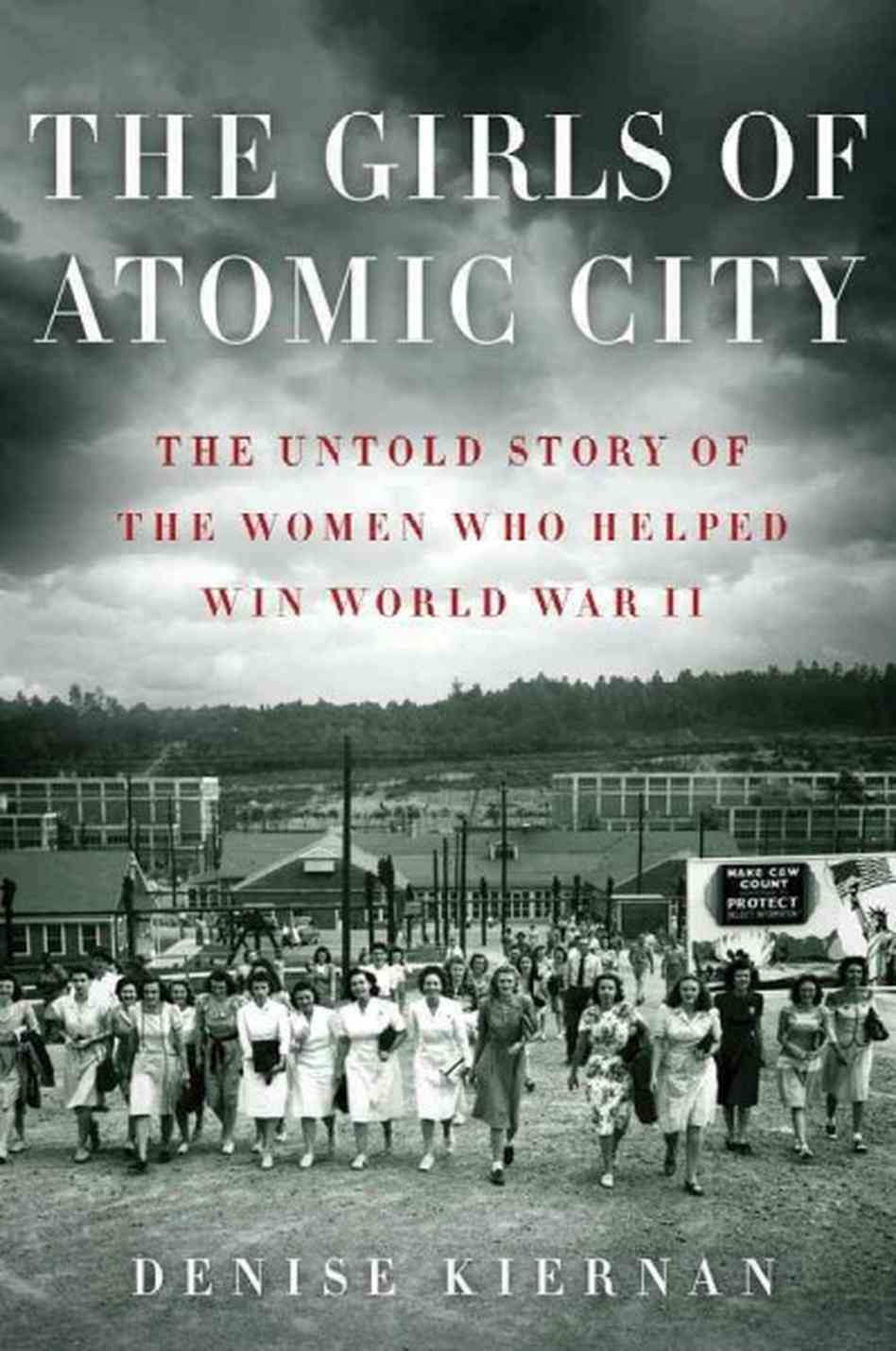
GirlsofAtomicCityRay Bradbury. Ray Harryhausen. Radioactive dinosaur loose in Manhattan. What’s not to like? I was inspired to watch The Beast from 20,000 Fathoms again for a single line, where Dr. Nesbitt informs the marksman his grenade has “the only isotope of its kind this side of Oak Ridge.” You see, I had just finished reading Denise Kiernan’s The Girls of Atomic City: The Untold Story of the Women Who Helped Win World War II. Atomic City, in this context, is Oak Ridge, Tennessee, a city built almost overnight with one objective: to produce uranium for the atomic bomb, then under development. The employees, many of them women, were not told the nature of their work and were not allowed to speak about the little they knew, putting many strains on marriages and human relationships. It is a captivating story, especially since Kiernan doesn’t pull any punches—the facility was in a segregated south, women scientists were belittled to their faces, and the end result was thousands of people incinerated in Japan. It is like the end of Eden, the loss of humanity’s innocence.

Growing up in the 1960s, I had heard of Oak Ridge. I knew it had something to do with nuclear stuff, but my understanding only went as far as the planetary model of the nucleus of an atom. I feared nuclear war. The height of that fear in the 1950s may have passed, but I was born just a month before the Cuban Missile Crisis began and all through the Reagan era that veiled threat of total, mutual annihilation hung heavily in the air. The religious had claimed God had created all this, but human hubris threatened to erase it all. On the eve of a friend’s wedding I sat across the Susquehanna River, eyeing Three Mile Island for the first time. Just six years earlier even those of us hundreds of miles to the northwest wondered if we would succumb to its radioactive glow. The power of the atom, as Kiernan demonstrates, was considered to be the basic power of the universe. And it was not divine.

When the war was over, a symbol of peace was erected at Oak Ridge. The International Friendship Bell was challenged as recently as 1998 by a local claiming that ringing the bell endorsed Buddhism, and it was therefore a religious symbol that had no business in a public place. For those who believe, ringing the bell is a form of Buddhist prayer. For others, it is a sign of goodwill between nations that have put their differences to rest. It is easy, sixty years after the release of The Beast from 20,000 Fathoms, to laugh smugly at Harryhausen’s famed stop-motion animation and the incessant worry about atomic fallout. But near the beginning of the movie, George Ritchie says of the atomic blast they’ve been monitoring, “You know, every time one of those things goes off, I feel as if I was helping to write the first chapter of a new Genesis.” Indeed, at least as far as chapter three. With the dawn of the atomic age, we had outgrown our need for the final chapters of Revelation as well.


Ban This

It should be a scarlet letter week. In honor of Banned Book Week, I’ve started to re-read Kurt Vonnegut’s Slaughterhouse-Five. Somehow I made it through high school and college without having been exposed to Vonnegut. A friend started me reading his works when I was about ready to start my Master’s degree, and I’ve always enjoyed coming back to him. When my daughter asked me why Slaughterhouse-Five had been placed on The List, I honestly couldn’t guess. Banning books, of course, is a scheme chiefly intended to keep children unexposed to ideas that adults find uncomfortable. We can’t go around telling other adults what not to think (although that hasn’t stopped many a religious tradition from trying), so some individuals figure that we can protect our unthinking young by putting in the corner literature that asks awkward questions. More radical conservative elements suggest destroying them. These are the true grapes of wrath.

Ideas can be wonderfully dangerous things. We now face a brave new world of internet access where ideas float lightly on the web and unless we watch our children constantly, we can’t control what they might see. Ideas as traditionally expressed in literature go through a tremendously long and convoluted birth process. We even use the language of conception to describe how they begin in one’s mind. Ideas implant, gestate, and grow. For the writer this might represent weeks, months, or years of writing, erasing, re-writing, and yes, parenting the idea. The written book has to meet the approval of publishers and only after yet another editing process are they pronounced fit to see the light of day as books. Having passed through many hands, many heads, such ideas become part of their culture. If we find them objectionable, well, isn’t that just part of life? Perhaps that is the largest message to be gleaned from the world of books: no one will be pleased with them all. Even the diary of a young girl will raise alarm.

Some of the finest literature to escape human minds has been challenged or banned. Ironically, in the land of the free and the home of the brave fear of books runs at a fever pitch seldom encountered elsewhere. Afraid of mice and men. What has made this country such a wonderful experiment—the embracing of diversity—has somehow morphed into a neighborhood where nobody feels safe if there are objectionable words on the bookshelf. Ironically Ray Bradbury’s critique of banning books, Fahrenheit 451, is itself a banned book. What most proponents of stopping literature probably don’t realize is that according to OCLC, the source for library data, the most banned book of all time is the Bible. To be honest, those who’ve read it know that it has sex and violence and many other adult situations. In the original languages there are even “swears.” Maybe it’s time people just grew up. The best way to accomplish that is to read a book. Hey, it’s a jungle out there.


The Illustrative Man

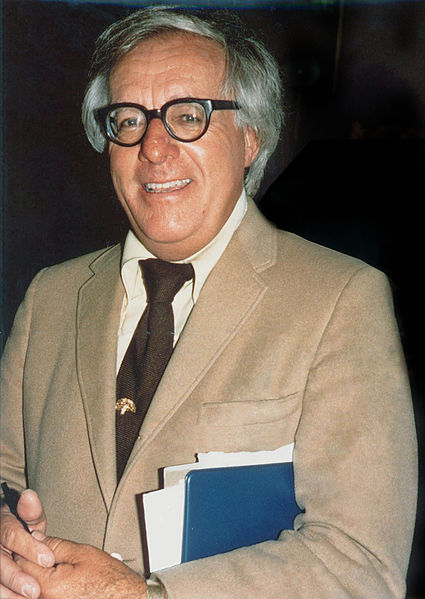
To a young boy growing up in an economically depressed small town without money to buy fancy things, escapist reading is a natural hobby. As with many boys, science fiction held my undying attention. My favorite writer was Ray Bradbury. His stories were short enough to consume in a single sitting, and they were full of wonder, and imagination, and possibility. I had nearly all of his books. So today, when I learned that Ray Bradbury had died, it felt as if another author’s works had been burned and the great man himself simply disappeared. Along with Edgar Allan Poe—whom I discovered early—and H. P. Lovecraft—whom I discovered late—Ray Bradbury represented what I believed a short story should be. I began writing short stories when I was in grade school. I still have a few of them, and the influence of Bradbury is most profound. At times it feels like the world is running out of dreamers.

Instead of churning out young people eager to explore the possibilities—and even the impossibilities—of the world, our educational system has become much more prosaic. We teach our young how to find jobs. Walking across Manhattan in a weary mood one morning it occurred to me: we go to college and we receive specialized training to make us fit for more cerebral jobs. We work those jobs in order to make corporate executives wealthier. Work benefits the one-percenters most. All the way to the office I dream of a life where I might have pursued creativity and exploration. I still awake before 4 a.m. every day to scrape together a few fragments of a moment to write before heading off to work in the big city. The characters I invent live in my head and die a subtle death as email and book proposals force their bossy way into my consciousness.

The worlds Ray Bradbury imagined were places where the familiar and the strange easily mixed. Many of his tales would be categorized as fantasy rather than science fiction today, but they manage to instill an almost religious reverence among those who believe paradise might be just over on that next unexplored planet. Or perhaps it will never stop raining there and the universe will drive us mad. When I “grew up” and needed to liquidate my juvenile assets, I sold most of my Ray Bradbury books to a used book dealer. Rarely a day passes when I don’t regret that impetuous move. And some days, such as today, I feel it especially deeply. One commodity that our fumbling world simply can’t afford to lose is its dreamers. On an unexplored planet somewhere out there, I know Ray Bradbury agrees with me.

From Wiki Commons


Quran 451?

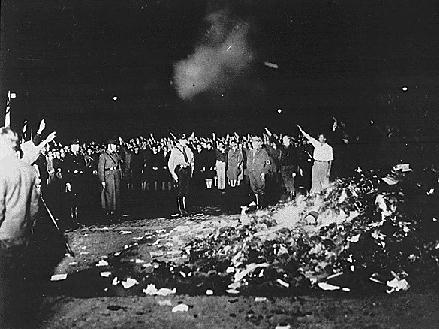
One of the saddest books I remember is Ray Bradbury’s Fahrenheit 451. Any society that burns books has whip-lashed far beyond Fascism into the enemyhood of humanity. Much of ancient culture has been lost through the natural or premeditated destruction of misunderstood “inflammatory” writings and we are much the poorer for it today.

According to an Associated Press story, the ironically named Rev. Terry Jones of the even more ironically named Dove World Outreach Center in Gainesville, Florida, is agitating for a “burn the Quran” day on September 11. Other than momentary, self-righteous catharsis, nothing is to be gained by burning books. The contradictory impulses here lie thick and deep: a Christian clergyman feels insulted by an extremist attack that killed indiscriminately (Muslims and well as Christians, Jews, and Atheists died in the September 11 attacks), bearing the symbol of peace he wishes to declare his personal war, and the follower of the willing victim of Nazareth wears a gun.

Burning books does not solve any problems. Surely Rev. Jones knows that plenty of copies of the Quran abound throughout the world. His action is calculated as a poignant symbol. Is such a symbol anything more than a base expression of outright hatred? When, apart from medieval Christendom, has Christianity insisted that violence is the way forward? All you need is hate? For although the burning of books may not physically harm anyone, the violence in this hatefully symbolic act is the very antithesis of tolerance and understanding that the religious world so desperately needs. Islam has given much to world culture, and we reap the benefits of Muslim scholars and thinkers each day, without any conscious consideration. Rev. Jones needs to read more than just Fahrenheit 451. He must learn truly to read and, like Montag, weep.

Jones' theological comrades


Writing the Divine

The media has displayed considerable interest of late in the views of well-known writers towards the divine. Given the vast numbers of non-famous people daily consigned to Hell by the righteous, there are more tears shed for Anne Rice than for the thousands who’ve never written a vampire novel. Equally fascinating is a story from CNN yesterday on Ray Bradbury’s views on God. I cut my literary teeth on Ray Bradbury. I don’t even recall how I discovered him in the small town where I grew up. More likely than not I found used copies of his story collections at Goodwill. Already interested in science fiction, his tales of the future or fanciful past and alternate worlds captured my imagination. Living in a town where nothing ever seemed to happen, Bradbury was a doorway into someplace colorful.

According to John Blake and Bradbury biographer Sam Weller, the doyen of the sci-fi short story is an avid believer in something out there. Reluctant to accept any single religion, Bradbury embraces religious concepts as the wisdom of the sages. He believes, according to the article, that we have much to learn from religions. The views suggested in the interview may lack the rigor and sophistication of the professional theologian, but Bradbury’s emphasis on love comes close to the mark for several religions. People build superstructures around their religious founders and insist on orthodoxy and military adherence to human speculation about them. Often in the process, love becomes just another tenet left over, if you have time for it.

For many decades as I pursued formal degrees in religious studies, I was taught to put away childish things. I gave away my Ray Bradbury books and purchased hefty tomes of incomprehensible gibberish that passes for theological erudition. Then my daughter was assigned Fahrenheit 451 as high school reading. I picked up Bradbury again. His writing lacked the absolute wonder and fascination it held for my twelve-year-old eyes, but it was like greeting an old friend once again. My thinking had been partially shaped by this storyteller, and it is perhaps even possible, in a Bradburian sort of way, that I felt a “spiritual” connection as I read his books as a young boy. Reading his amateur views on religion was a quiet sort of homecoming.

An old friend