O My Stars

I know many conservative religious believers. I also know a lot of nones and atheists. One thing they all have in common is that they want to believe the truth. They want to do what is right. Enter the media. A day of peace and prosperity for all is a slow news day. To keep the pot boiling, differences need to be emphasized and people’s fears and frustrations must be highlighted. Nowhere is this better on display than in party politics. Do people really not get along at all? Are we really so polarized? A friend recently sent me an internet story about the Republican elephant. Honestly, I’ve never paid much attention to the posturing of the GOP since so much of it is obviously show. The coalition, cynical at best, between the evangelical camp and the fiscal conservatives has created a kind of Frankenstein’s monster of the party which began out of an anti-slavery movement and was represented in the politics of Abraham Lincoln. I have trouble seeing him approve of Reaganomics or some of evils that have flowed from it. We are more deeply divided now than we ever were during the Civil War. And better armed too.

Republicanlogo

So, what about the Republican elephant? The stars on the blue top half are upside-down. I’m not sure if this represents a change or not. The problem, of course, is that the upside-down star is a “pentagram” associated with Satanism (which is not what most people think it is). The insinuation is that the symbol was subtly changed to reflect the true values of the party. I don’t know if the stars on the elephant were ever right-side up. As long as I’ve been politically aware, the Republican party has been the one that supports the wealthy while trying to cut the poor and working class from the budget in any way possible in order to build an ever stronger military to protect the plutocracy for which it stands. One nation, under Mammon, with surveillance and distrust for all. Principles, in my opinion, far worse than Satanism.

Ironically, in this media fueled division of the nation, conservatives know and hate Satanism. In fact, seeing a pentagram pattern in school bus taillights can send the internet into a tizzy. We’re afraid, but of what we don’t properly know. Must be those liberals with their radical ideas of liberty and justice for all. On the street things haven’t felt like they’re getting better for a very long time. Each year since the overspending Bush decade the economy has found inventive ways to get worse and worse. One thing remains constant—the ultra-wealthy flock to the political party that once stood for freeing of slaves and uniting a deeply divided nation. The best way to keep us together is to keep us afraid. That’s easily done when economists tell us you can’t hope to retire with the medical benefits and living standards of the middle class without at least a million dollars in the bank. Something’s upside-down alright, and it doesn’t take a genius to figure out what.
Moocher Man

Influenza seems to be going around. Since I spend at least three hours a day on a crowded bus I get to observe all kinds of uncouth behavior. Not that I’m always Mr. Manners (New York has a way of doing that to you), but I do cover my face when I cough or sneeze and sometimes I feel that I’m in the minority. My wife, concerned with supplies dwindling, made an appointment for me to get a flu shot at the local clinic. I went in and took a number. I guess I’ve been cursed with good health, and that may be a good thing. For my first five years in New Jersey I couldn’t afford health insurance—this was known as Bush Care—and hadn’t needed to see a doctor. Yesterday was my first time in the clinic. Although I had a confirmed appointment, a kind of argument broke out in the office (this is, after all, New Jersey) because non-patients weren’t supposed to be given the inoculation. Or they were, but they had to pay for it. Or their insurance would be charged and they could get the shot as long as they had insurance. Or why didn’t people just go to Walgreens instead. In the midst of the melee, a nurse called my name and a few minutes later I was being jabbed and sent on my way.

In all of this, one of the largest ethical issues of this country is highlighted. Who has a right to basic medical care? Among the conservative crowd that even includes some who can’t afford insurance, there are those who decry moochers. I grew up without health insurance. My mother relied on welfare to help raise three boys whose father had disappeared and our medical care was very, very basic indeed. Maybe people just didn’t say it in front of kids back in the 60’s, but I never heard anyone grousing that the poor should be left to fend for themselves. That took Reaganomics. In any case, working as hard as I could to break out of that lower class, I earned a Ph.D. only to be turned out of a job by a devout worshipper of George W. Bush. No medical insurance. Again. Now with a child of my own. What I’ve heard since the new millennium is that for those who can’t afford insurance—too bad! Just get a job, bum!

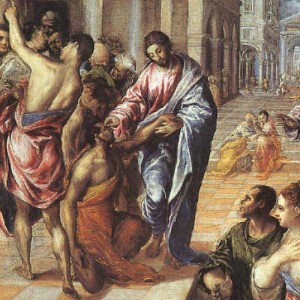
JesusHealing

I often think about those who make such statements and how they valorize the Bible. If I recall correctly, Jesus handed out free health care. Socialized medicine existed in his corner of the world twenty centuries ago. And we in one of the most prosperous nations on earth argue about who can get a flu shot. In the end, I paid for it; I’d even taken my checkbook along with that intent. Nobody thought to ask me. But as I sat there within full view and certainly full conversational distance, I was objectified by the medical system. I wasn’t a guy who sits on a crowded bus with people who don’t cover their mouths. I was a moocher. A liability. In the waiting room around me I noticed patients tucking away passports and green cards. This is New Jersey, after all. For many, however, despite the cold we’re experiencing, it might feel like a much, much hotter place indeed. A place where, the Bible intimates, nobody cares about anybody else and the flames never die.


For the Love of Gold

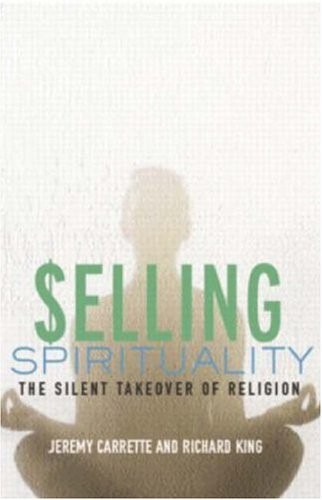
Do you ever get that feeling that you’ve been led along by a false premise that has gotten out of hand, like a practical joke that has gone too far? If I had to rate the books discussed on this blog in terms of urgency, Jeremy Carrette and Richard King’s Selling Spirituality: The Silent Takeover of Religion would top that list. I’ve felt for a long time that something’s been wrong, but I didn’t possess the training or resources to discern what it might be. I think Carrette and King may have named it. Just a few pages in and I knew there was profound insight here. Religion has been taken over by capitalism and the result is that alternatives to the godless, sanctified free market are rapidly disappearing. In a truly Orwellian sense, we have been taught the language of capitalism and have lost the ability to frame our ideas in any other way. Free markets take no prisoners—one must assimilate or die. Religions, which had traditionally served as correctives to selfishness and greed, have been co-opted into the forces of unbridled gain for the few. Amorphously marketed as “spirituality,” what sounds like religious conviction now lives in the service of consumerism.

By slowly shifting all our language and metaphors into those of Reaganomics (the very fact that you know what that means shows how far gone we already are) the capitalist machine, supported by the flaccid terms of spirituality, has established a new god—capital—and has pilloried any who dare question it. Think of the trashy phrase “prosperity gospel” for just one minute and you’ll see what I mean. Those of us who disagree with the orthodoxy that meaning can be found in money have become the resistance in a war we did not start. The twin hellions of privatization and corporatization have sunk their fangs deeply into the jugular of society and its old-fashioned value of caring for others. People are, like strangers in a strange land, just marks for the powerful. We’ll buy anything if it looks attractive enough.

The problem with consumerism is that it is easy. We all love to play along because—who knows?—we might end up getting rich in the process. We have gained the world and lost our souls. Carrette and King show clearly how entrepreneurs have learned to market the language of religion while divesting it of its venom. Go along, it urges, everything is fine. Even the economic collapse brought on scarcely two decades after Reaganomics has failed to convince the average citizen that they are but a petroleum bi-product to grease the unrelenting gears of commerce. Anything, even salvation, can be sold. Back in April I stood beside the graves of Eric Arthur Blair (George Orwell) and Karl Marx. And maybe in an unguarded moment I shed a tear or two that critical thinking seems to have been buried along with those who were brave enough to state the obvious.