A Bookseller’s Son

Be kind.  One of the best reasons, apart from innate rightness, is that we don’t know the burdens other people carry.  Yes, some will tell us and others will not, but one thing is certain: we all bear scars.  I met Andrew Laties because of the Easton Book Festival that he organized.  Andy is half-owner of Book and Puppet Company, an independent bookstore in that town.  A colleague of mine from Lafayette College introduced us back in 2019.  Whenever I go to Easton I stop in the store and pick something up.  Andy has kindly slotted me into each annual Book Festival, except last year, because of a burden I happened to be carrying.  I recently finished his book, co-authored with his son Samuel, Son of Rebel Bookseller: A Very Large Homework Assignment.  Andy had revealed one of his burdens before I read it, and I appreciated the slight cushioning of the shock.

Samuel is a posthumous co-author.  I have had friends—too many—who have lost children.  It is a devastating blow.  I’d casually chatted with Andy for five years without realizing he had this to bear.  This book is an unflinching stare at the unfairness of life.  You get a good idea of what Sam must’ve been like, through his writing and his father’s description.  His brilliance is evident, even as we learn of his mental illness.  The two often go together, and even contemporary successful authors, such as John Green, have  revealed their mental struggles to the world.  There are many great writers, like Edgar Allan Poe, who clearly had some issues.  The stigma must disappear.  Our culture would be so very poverty-bound without it.

Son of Rebel Bookseller is available on Bookshop.org.  Or, if you’re in Easton you can stop into the shop.  The title makes reference to Andy’s previous book, Rebel Bookseller, which I mentioned here a couple years back.  This, however, is a much more personal story.  An anguish screaming to be released.  Something that I’ve picked up on during editorial board meetings at work is that books by authors with a compelling personal story have something special about them.  They may not end up published by the Big Five, and they may really find only a local readership.  That doesn’t mean, however, that they can’t have an impact.  The vast majority of books have limited readerships, and some of them are far more important than those that line bestseller lists.  And this one reminds me once again the importance of kindness, and striving to be as humane as a human can be.

Bookstore Odyssey

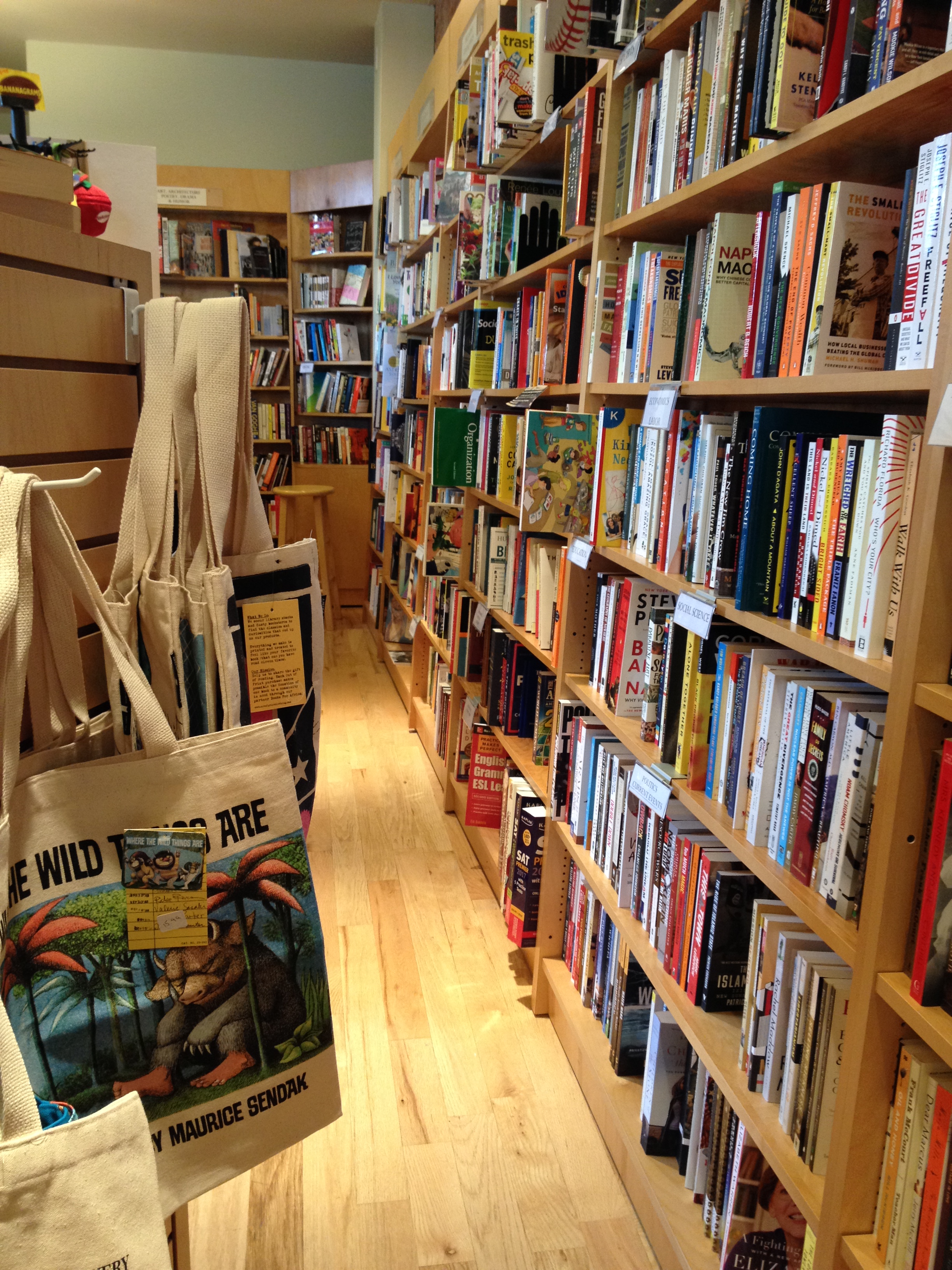
Work isn’t the best place to express yourself.  Once a marketer asked for input from everyone concerning their favorite independent bookshop.  Well, I might’ve gone a bit overboard, admittedly.  I listed several, each with their attributes.  I was living in New Jersey at the time so The Bookworm in Bernardsville and The Labyrinth in Princeton featured large.  But so did Farley’s in New Hope.  And the Clinton Book Shop in, well,  Clinton.  Then my mind roved to the unfortunately deceased River Front Books in Binghamton.  Then back to Wisconsin where we lived within walking distance from Books and Company.  Then to Illinois before that, where Pages for All Ages was a hangout.  We’re spoiled here in the Lehigh Valley with the Moravian Book Shop in Bethlehem,  Book and Puppet in Easton, Let’s Play books in Emmaus, and plenty of used bookstores about.  And the Montclair Bookshop back in New Jersey—okay, I told you I went a bit overboard.

Ithaca, New York, is the very definition of a college town.  Home to Cornell University and Ithaca College, it has a sizable student population.  It once boasted seventeen bookstores.  By the time we’d started visiting they were down to one indie new book store (Buffalo Street Books) and two used bookstores.  Since then one of the used stores has closed.  Like a phoenix, however, a new indie has opened: Odyssey.  On a recent trip to Ithaca we stopped in.  During a pandemic I feel compelled to make trips short, but there was a lot to see there.  Like most indies, it’s small.  As Andrew Laties notes in Rebel Bookseller, such shops thrive by becoming part of the community, and stocking books the community will buy.

Our visit, I suspect, proves his point.  If you set up shop in a university town you can stock intelligent books and make a living at it.  Despite the weather and the virus we weren’t the only customers in the store.  And we didn’t leave empty-handed.  The independent bookstore is a symbol of hope.  Books are not clutter.  Literacy is not dead!  As much as our beloved internet tries to tell us the future is digital, I like to open the door and step outside once in a while.  And leave my phone behind.  During this pandemic I’ve gone to four kinds of stores only: grocery, drug/necessity, hardware, and book stores.  The pandemic has been a shot in the arm for trade books—bored with staring at screens all day, people are starting to read actual books again.  I’m not naive enough to think it will last beyond Covid-19, but I just remembered Watchung Booksellers in Montclair and the Town Book Store in Westfield…