Books and Mormons

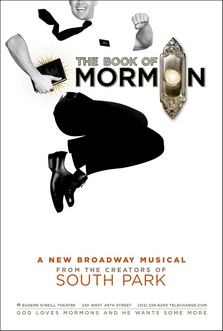
Some time ago we went to see Book of Mormon on tour.  I really knew very little about it other than it was consistently praised as being very funny.  I’m always a little concerned about poking fun at anyone else’s religion because I know people take their beliefs very seriously.  As I reflect on the show (which was quite funny) it seems that it wasn’t so much poking fun at the Latter-day Saints so much as it was poking fun at religion itself.  That’s less problematic as it’s not singling anyone out for ridicule.  It’s a system that’s being made light of.  Or at least any religion that is an effort to convert others.  There’s a kind of violence to it.  And if Book of Mormon is about anything, it’s about missionaries.  Amid the laughs it makes some valid points—trying to convert people without first trying to understand their culture is a fraught activity.

People want religious specialists who thoroughly understand their tradition.  I can say from experience, both as an erstwhile seminary student and a seminary professor, that the time given to become an expert is insufficient.  The older I’ve grown the wider the perspective I’ve tried to step back to see.  To be an expert on a religion really requires some facility with understanding other religions.  To understand, say, Methodism, you need to understand Anglicanism.  To understand Anglicanism, you need to understand Catholicism.  To understand Catholicism, you need to understand early Christianities.  To understand early Christianities, you need to understand Judaism.  And so the widening concentric circles go.  Nobody can be an expert in all of them, and each of these religions mentioned has, in its own right, sub-specializations that have their own experts.  Who has time to learn the religion of those they intend to convert?

Any religion that makes supernatural claims (and many of them do; it’s their nature) makes extraordinary allegations.  Those allegations, when examined closely, reveal some improbable elements.  Trey Parker and Matt Stone, two of the authors (most famous for South Park) apparently said that they had no intention of making fun of anyone’s religion and a spokesperson for the Latter-day Saints indicated that no real offense was taken, acknowledging that it’s parody and parody is only offensive if it’s taken seriously.  Many religions have thin skin when it comes to parody or satire.  The serious part is that some religions, in real life, take conversion of all others with a zeal that could (and does) become dangerous.  Still, this musical is very funny, as long as it’s not taken too seriously.


Saint Francis

With the death of the most saint-like Pope in living memory, it feels a little like fate that I’d seen Conclave just three days before.  Francis was the only Pope I’ve seen, and am likely to see.  He cared for people more than dusty doctrines that still repress.  He laid hands on the sick and genuinely loved human beings.  Given the reactionary world of politics, I suspect his successor will be conservative, but I would be glad to be wrong.  All this seesawing on the way to progress makes me a bit seasick.  And Francis was a man who, from a humble background, understood the necessity of moving forward rather than pretending things always stay the same.  I already miss him.

It was on the rare occasion of being invited to a New York City church to offer a program that I saw him.  Since I’d be staying a couple nights in Manhattan, my wife joined me.  On the way to meet her after work on that Friday, I saw large crowds along 34th Street in Herald Square.  The buzz indicated that the Pope would be going this way on his way out of town.  The police refused to confirm that, but it seemed like a good bet.  I asked Kay, “Do you want to see the Pope?”  We found a place in the crowd (this was pre-pandemic, of course) where we had a good view of the street and eventually the motorcade rolled through, Pope Francis in his trademark Fiat, the window down, waving at the crowd.  And then he was gone.  

In New York City you see motorcades.  I’d seen President Obama’s go by once, on the way to the United Nations, I think it was.  But still, seeing the Pope was incredible.  Not shielded behind bulletproof glass, his care for the nameless crowds felt genuine.  I empathize with those raised in humble circumstances who manage just to survive, let alone become the head of the largest branch of Christianity.  I like to think he was a reluctant Cardinal, and a reluctant Pope.  Conclave is fiction, of course, but the idea of choosing someone who really doesn’t want the job is immensely appealing.  How different from world leaders we’re now burdened with!  Men (almost always) who see themselves as God’s gift to us, clawing at power.  At the same time, Francis, who was a divine gift, actually remembered what Jesus said and did.  The world is poorer for his death but richer for the lessons he taught by example.


The Sin of Syncretism

Syncretism may not be dead, but it should be.  What is it?  Well, in my field it means a religion that has been “corrupted” by the adoption of some element(s) of another religion.  The term was all the rage while I was working on my doctorate which involved, of course, comparative religions.  By the time I was being edged out of academia, there was a recognition afoot that the concept of syncretism was itself corrupt.  It depends on the idea that there is a “pure” form of a religion and that foreign elements debase it.  There is no pure form of any religion, and the more we learn of the history of religions the more obvious it is that religions influence each other, and have always done so.

What prompts this post is that I increasingly see clergy using the term “syncretism.”  Now, clergy tend to run behind scholars by a fair pace.  Those of us out there trying to figure out what religion is and how it works have a daily duty to analyze and reassess and theorize.  Clergy have many other things to do and read scholarly tomes as time permits.  Syncretism is now only used by conservative scholars who believe a religion (usually the form of their religion that they personally happen to believe) is pure.  Other religions are corruptions.  Ironically, I once heard a Unitarian Universalist minister use the term.  For a religion that accepts all other religions as valid, it struck me as odd.

Photo by Noah Holm on Unsplash

As I used to tell my students, nobody knowingly believes “the wrong religion.”  By far the majority of people accept the religion that their parents taught them.  Often without question.  I know I did.  Then I studied religion.  I began to realize things weren’t as simple as “that old time religion” pretended they were.  Fundamentalism borrows from other religions just as much as any other tradition does.  Religions don’t have sharp boundaries.  There are fuzzy edges between them.  Those edges are permeable and quite wide.  Syncretism was a concept that religion scholars used, often in the context of monotheistic religions, to show where impurities entered.  The thing is, impurities were there from the conception on.  If one religion were born fully grown from the head of Yahweh, it would be obvious, wouldn’t it?  The Bible describes the religion of Israel and how it borrowed and adapted from other traditions.  Thus it was in the beginning, is now, and ever shall be.  The world would be a much better place if we made our peace with this and buried syncretism in the graveyard of obsolete ideas.


More Than It Seems

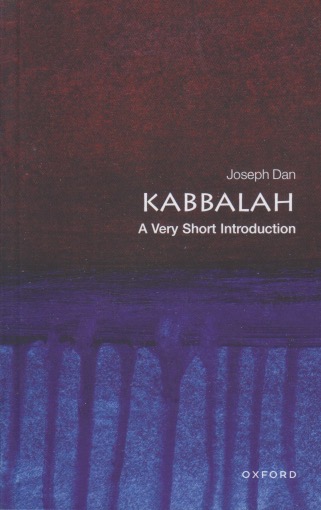
One of the most fascinating mystical concepts is the idea that words and individual letters have some kind of magical power.  This is perhaps illustrated by the way certain words gather an aura of mystery that can be quite unlike their original denotation.  “Kabbalah” is one such word.  The reason I read Joseph Dan’s Kabbalah: A Very Short Introduction is that I’d found myself growing increasingly confused by the usage of the word.  Given that this is me writing, it was a horror movie that got me wondering.  In one of the movies discussed on this blog (happy hunting and viewing!) one character tells another something like, “It’s the Kabbalah.”  This is said in reference to an ancient and mysterious book.  There is not ancient and mysterious book called The Kabbalah.  So what is it?

I’m not going to be able to give a satisfactory answer to that here.  Dan has about 30,000 words to describe it and he admits that’s not really sufficient.  Sometimes I think, if one could make a living doing it, I’d have been content to sit at the feet of rabbis to learn the depths of the many ancient books Judaism has given the world.  I first became aware of some of them in college, majoring in religion.  At each step of my education and career I’ve uncovered more and more.  Reading this little book added yet further examples.  Judaism, and its direct descendant Christianity, were full of books.  They still are.  And books are full of words and perhaps these words have some kind of mystical power.  But wait, the point of this brief tome is to suggest the word itself isn’t just about mysticism.

Kabbalah can refer to many different things, some of them hardly mystical at all.  For the modern usage of the word, which includes Christian as well as Jewish Kabbalah, we have to get to, well, modernity.  The concept stretches far back in Judaism and means basically, “what is received.”  The initial reference is to Moses on Mount Sinai.  Then there’s the oral Torah, codified in Mishnah and Talmud.  And books, so very many books!  The rabbi is one of those permitted to, and sometimes expected to, come to know these ancient texts and their modern applications.  That’s not to suggest Judaism is particularly mystical.  It can be, just as Christianity can be, but isn’t necessarily so.  It’s complicated.  If you’re curious, whether because of a horror movie or not, I can recommend this book.  It’ll give you plenty to think about, and even more to read and learn.


What You Believe

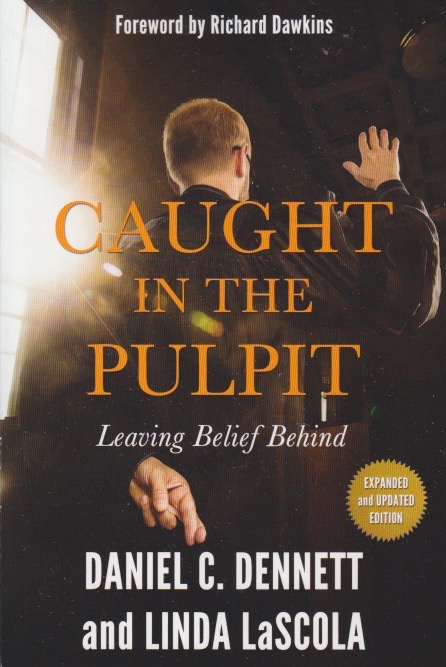
This is an important and frustrating book.  I just can’t figure out if the black-and-white thinking is disingenuous or if it was really believed.  I don’t mean about the subjects of Daniel Dennett and Lisa LeScola’s Caught in the Pulpit.  I wonder that about the near-arrogance of the model they propose while exploring the very real problem of, as their subtitle says Leafing Belief Behind (for clergy).  You see, I’ve read, and even walked a little way with the “new atheists” (my private beliefs are private but one thing I will say is that beliefs constantly change for anyone who seriously seeks the truth.  If you want to know them, get to know me).  This book, which explores clergy and other religious folk who’ve lost their faith, addresses something very real and very important.  It’s just that the framing feels wrong.  I appreciate that the authors exhibit such sympathy for their subjects—it is difficult to change the religion in which you were raised.  But it it’s not black-and-white.

Apart from the “either/or” outlook, there’s also the fact that what many people interviewed lost was not so much a belief in God as it was a belief in the Bible.  These are different things.  No doubt, our love of Bible has caused quite a lot of damage.  Since many believe the Bible to be a magic book, losing that particular lens can make things blurry.  I guess that’s what I missed in this book—a sense of blurriness.  Scientism is a belief system just as fundamentalism is.  Interestingly, I keep coming back to something that should be obvious to scientists—our brains did not evolve to learn “the truth.”  Our brains evolved to help us survive.  There is much we still don’t know.  What’s wrong with being humble about it?  Perhaps it’s sour grapes since I was ousted from a religious career just when this study was taking place, but I didn’t qualify because I believed.  Not that they’d have found me, in any case.

Many clergy, I know, do not believe what their congregations think they believe.  As you go into theological education some things are revealed that it is in nobody’s best interest to broadcast.  It might be good, however, if it weren’t atheists trying to lead the charge.  I was pleased to see Dennett himself suggest this in the book.  I was also glad to see him admit that “the new atheists” do not struggle with the very real issues raised by theological education (whether in formal settings, or through private reading).  There is a very real disconnect here, and this book serves a valuable function in bringing it to public attention.  What’s missing is a solution.


Indigenous Gods

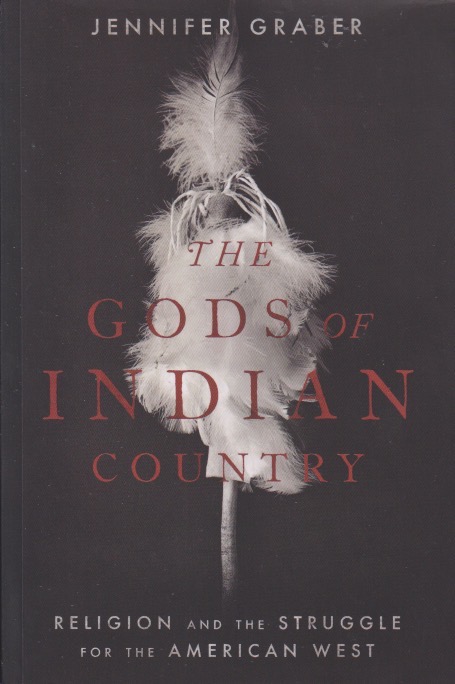
Engulfed by capitalism, it is too easy to ignore the indigenous population of this country.  I grew up thinking, in some way, that American Indians were extinct (this was small town America, after all).  Then we visited a place—in upstate New York, I think, but the recollection’s hazy—where there were real Indians.  This was before exoticism was a bad word, and I thought them quite exotic.  Maybe it was the way I was raised, but I’ve never thought of myself as better than anybody else.  Certainly not on the basis of race or gender, or even personal worth.  In any case, there were still Indians.  I’ve always been an admirer of their culture.  Jennifer Graber’s The Gods of Indian Country is an informative monograph on, as the subtitle says, Religion and the Struggle for the American West.

My interest in American history is relatively recent.  Growing up, I always found European history of greater interest, and then, for many years, the ancient history of the states along the eastern coast of the Mediterranean.  It was the antiquity of it all.  History feels safer when it’s at a great distance.  American history is not old.  When hearing that some of the events discussed by Graber took place in the 1910s, I kept thinking, “were we really that naive just over a century ago?”  Or was our nation willfully blind to the plight of the people who lived here before the Europeans arrived?  The narrative has changed.  And if it hasn’t, it must.  How would we like it if, say, aliens landed and assumed the right to take over capitalistic America?  It’s only our arrogance that prevents us from treating Indians better.

Religion, particularly Christianity, fueled many interactions with the Indians, as Graber ably demonstrates.  The assumption was that Indians had to assimilate to capitalistically-fueled Christianity.  Private ownership.  Free trade.  Otherwise the cultures could not share the land.  Treaties were broken because the “Christian” rules of the new overlords demanded it.  Graber also explores some Native American religious practices as well, chiefly among the Kiowa.  Since the book is fairly brief, it doesn’t include any kind of comprehensive coverage of Indian religion, nor, of course, of early American settler religion.  What happened is that religion and politics joined forces to justify stealing what belonged to someone else.  Those who study the history of religion recognize this pattern.  It isn’t a rarity, unfortunately.  Although my interest in American history is recent, it is growing.  What happened in your own backyard determines so much of how we’ve become who we are.


Old Movies

Something strange is happening.  (“How’s that new?” you might well ask.)  There seems to be a bifurcation taking place in my brain, what techies might call “partitioning.”  Specifically it regards what I think of as “old movies.”  By this I don’t mean movies from the sixties or before.  No, I mean movies I saw some time ago, often on DVD or even VHS, sometimes in theaters, that became part of my standard repertoire.  I imagine most cinephiles have certain films to which they keep coming back.  But for me, the “old movies” are those I haven’t blogged about.  Also, they predate streaming so, in that sense, they are “old.”  You see, I’m not a very internet-savvy thinker.  It took me quite a few years to figure out I could link my posts with other posts on my own blog so that in the rare event that someone might want to read more they could click on the links like you do on Wikipedia.  (Now that you’re here, stay a while!)

Photo by Denise Jans on Unsplash

This blog was started in 2009.  For most of its history it has been daily.  I didn’t automatically start blogging about movies, though.  For a few years I tried to tie all my posts into religion, widely conceived.  Then, kind of establishing my own “brand,” I started writing about less ethereal topics.  Including movies that don’t have religion in them.  By far most of the movies I discuss on this blog are first-time films for me.  Occasionally I’ll go back and address one of my “old movies.”  This occurred to me the other day when I went to link to Tim Burton’s Corpse Bride.  I thought I’d posted about it, but it’s one of my oldies, so I hadn’t.  I don’t even remember when I first saw it.  If feeling nostalgic, I’ll look backward, as an historian is wont to do, but it doesn’t happen often.

Since we can’t see ahead in our lives with any real clarity, I didn’t anticipate this blog focusing on darker themes. When I started, finding a position back in academia seemed like a possibility.  For me this blog is therapy, but this is as good a place as any to talk about movies, and most of mine fall into an ill-fitting genre called “horror.”  Even among these, my “old movies,” like The Exorcist, The Amityville Horror, Sleepy Hollow, or even Paranormal Activity, which now more or less define my research, were missed out for having been too old (having been seen too long ago).  Most of the movies discussed in the past few years here have been streamed.  Many of them are easily forgotten.  But the old ones, they’re stuck, apparently for good. Such is the power of old movies.


Getting By

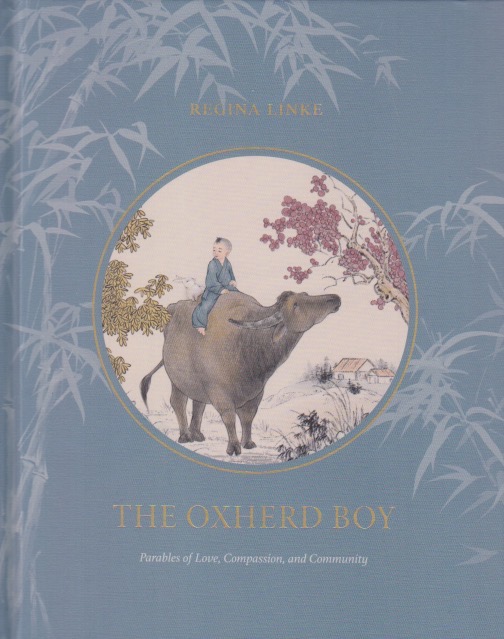
There are some books, such as Trina Paulus’s Hope for the Flowers, or Charlie Mackesy’s The Boy,  the Mole, the Fox and the Horse, that are inherently hopeful and that you like to have around.  Especially in the coming four years full of hate-filled rhetoric.  My wife asked for Regina Linke’s The Oxherd Boy: Parables of Love, Compassion, and Community, for Christmas.  Of course, I read it too.  It is yet another to add to this hopeful shelf.  The thing about these three books is that you could easily read them all in an unrushed afternoon.  All three are profoundly hopeful outlooks on life.  I would recommend having them at hand.  The Oxherd Boy is a combination of beautiful artwork with bits of wisdom drawn from Taoism, Buddhism, and Confucianism that can keep you centered in difficult times.

There’s no real storyline here, but rather reflections.  “Eastern wisdom” is kind of a tired trope, but the “religions” of that part of the world can infuse a bit of sanity into many of the facades western religions throw up.  I’m not anti-Christian; I fear our society is.  It has taken one of these facades and claimed the name “Christian” so that it can get its hate on and feel righteous doing so.  There are seldom positive benefits when politics finds religion.  If any.  The Oxherd Boy reminds us to look for the good in simple things.  A life with friends and one in which love is the primary outlook.  I believe Christianity began that way, but it became politicized in under four centuries and politics tend to engender hatred.  A truly Christian state, through and through, has never, ever existed.  And it’s not coming here.

We know hate mongering will take the norm.  In fact, while out driving recently I noticed an increase in rude and angry behavior on the part of not a few drivers.  There was a noticeable uptick in such behavior shortly after Trump’s first election.  In a nation of people that imitate what they see on the media, I suggest staying inside and reading a book.  I would recommend The Oxherd Boy among them.  As long as you’re stocking up, don’t forget Hope for the Flowers and The Boy, the Mole, the Fox and the Horse as well.  Books don’t need to be written by academics to try to make the world a better place.  In fact, sometimes I wonder about the choices I’ve made.  So I’ll pull down the books that give me hope, and reflect.


Festival Spirit

Festivals.  These common events, often outdoors, are ways to be around other people while not really seriously engaging them.  I spend a lot of time by myself, or alone with family.  We don’t know many folks locally (I’m pretty sure very few locals read this blog), so online community is often how I connect.  Still, even we introverts crave the human touch now and again.  In October we attended the Covered Bridge and Arts Festival in Bloomsburg, Pennsylvania.  It is one of the largest free festivals on the east coast, and just a couple of hours from us.  While there, we learned about the much smaller Riverfest in nearby Berwick, held the same weekend.  We decided to stop there on our way home.  The thing about craft fairs is that you get used to seeing pretty much the same kinds of things over and over.  That’s fine, because we’re here for the atmosphere.

At one of these events, while my wife and daughter were examining the wares, an owner came up to me (I was just outside the tent) and said, with a bit of surprise and wonder in his voice, “You have the spirit of God.  You can tell someone who does.”  Now, this can be a sales ploy, of course, but he seemed sincere.  He really didn’t nail my spirituality, but he was correct that I am a very spiritual person.  Given his talk of Jesus, I suspect he’d have been put aback if I told him that horror films are one form of spiritual practice for me.  So I remained relatively noncommittal until he turned to my wife to tell her about the products in his tent.  Still, the encounter left me reflective.  I don’t think myself any kind of spiritual guru, but I have been singled out by a number of people over the years and I wonder what it is that they see.

Some New Agers suggest we all have auras.  That’s generally considered paranormal, of course.  I’ve known people, however, who’ve been accurately “read” by strangers who seem sensitive to such things.  Or are extremely good at cold reading.  When I go to a festival I don’t mean to have my aura showing.  I spend a lot of time alone, so maybe I’m hiding my aura in my house.  No neighbors have complained about the light pollution, in any case.  I admire those who see something special in strangers, even if it’s an attempt to get them to buy something.  That’s why we go to festivals, I guess: to have a kind of spiritual experience that comes from being with others.


Powerful Belief

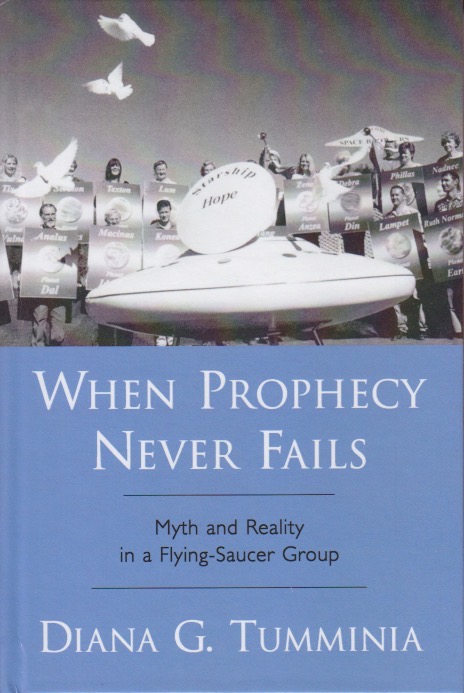
Even someone who’s spent a lifetime studying religion can’t know every single sect.  People are far too creative in that regard, and some belief groups are fairly small.  I had never heard of Unarius, for example, before reading this book.  If I had, it simply washed over me, getting lost in the noise.  Part of the trouble with defining Unarius is that it calls itself a science.  Words can be slippery, and Christian Scientists also use that designation in a similar way.  The word “science,” etymologically speaking, denotes “knowledge.”  In our materialist culture we often suppose that means the physical sciences, grudgingly allowing it to be borrowed by the “social sciences.”  There is a science of religion, but this leads to its own set of discussion points.  Let’s look at Diana Tumminia’s title: When Prophecy Never Fails: Myth and Reality in a Flying Saucer Group.  That give you an idea. 

The “prophecy” part concerns a “failed” prediction, or two, of when the spaceships would land.  Being a sociologist, Tumminia’s real interest is what happens then.  And here’s where things get interesting.  Failed predictions generally don’t lead to true believers giving up their convictions.  History has played and replayed this for us—it’s happening around us this very second—and yet “rationality” supposes that when the ships don’t land, people simply move on.  The Millerites outlived “the Great Disappointment,” after all, when the world didn’t end as predicted.  Their heirs include a sizable Christian denomination.  All this talk of AI has muddled our thinking about what it means to be human.  We are emotional.  More than that, we are believing creatures.  Our society is living proof.

Perhaps the most important, and ill-studied facet of being human, is belief.  Belief (no matter what in) is a religious phenomenon.  This study of a fairly small group shows that convinced people cannot be dissuaded, no matter how many facts are presented to them.  One need not look far to find the same phenomenon surrounding Trump.  (I do not condone violence, but history can inform us if we allow it.)  Make no mistake—he is the center of a new religion.  Unarians have absolute belief that their system is right.  Mistaken predictions—even very public ones—will not convince true believers otherwise.  It seems to me that our society, our democracy, cannot survive without intensive study of belief and how it affects the way otherwise completely rational people think.  My study is full of books exploring various aspects of belief, but we are still no closer to any kind of definitive answer.  And voters, at least a great many of them, follow their beliefs.


Mystic Thoughts

Those who know me primarily from my writings on horror are perhaps whiplashed when I muse about spiritual matters.  I don’t mean just religion, but spirituality—the two are quite different.  If life had unfolded differently I would likely have ended up as a mystic.  The problem is “rational mystic” is an oxymoron in most minds.  Either you’re one or you’re the other.  To become a proper mystic, in any case, you can’t be bothered with such things as secular work.  Mysticism—direct encounters with the divine—requires development and practice.  You can’t always control when a trance or vision might hit you.  What if it comes during a meeting?  Say your performance and development review at work?  You see the problem.

I seriously considered becoming a monastic as a young man but I had a problem.  I was a Protestant.  Protestantism was based on the idea that Catholic practices, such as monasticism, were wrong by default.  Miracles don’t happen—haven’t done since New Testament times—and God is a biblical literalist.  Why spend valuable church funds, then, on establishing monasteries?  Still, mystical experiences happened to me.  (You’ll have to get to know me personally to find out more about that.)  I talked to my (Protestant) professors.  “You don’t want to become a mystic,” I was told.  “They always have trouble with the church.”  Eventually I became an Episcopalian, a tradition that was more open to mysticism.  It became clear in 2005, however, that the Episcopal Church wanted nothing more to do with me.  Besides, I’m a family man.

Monasteries for married folk is an idea whose time has come.  Monasticism is based on the idea that you need to isolate yourself from the world’s distractions to grow spiritually.  To me, as I noted recently regarding sacraments, the “distraction” of marriage isn’t the problem.  It’s the constant need to earn money.  More and more money.  Monasteries became wealthy because other people were glad to pay money so that someone else could do the spiritual heavy lifting for them.  You can get into Heaven on borrowed virtue.  (Even Protestants believe that.  If you doubt it, get a degree or two in theology and you’ll see.)  So why not provide monasteries for those poor souls that just don’t fit into the capitalistic ideal?  I have the vision that such places would become havens for artists of all stripes.  And that, with the goodwill of society, locations where your needs were met for an exchange of goods—building good spiritual karma for a world where most people are content with trying to get rich—might just work.  It’s an idea whose time has come.  Who’s with me?

Photo by Luís Feliciano on Unsplash

Politicking

It was weird seeing my face on a 27 x 40 poster.  When I went to give my campaign speech I was wearing dress clothes that I’d bought at Goodwill.  My “campaign manager” said I did a great job, being witty and somehow confident.  I didn’t win.  Still, my stint in politics was not yet over.  The next year one of the presidential candidates asked me to be his campaign manager.  I took on the job with gusto, and, claiming no credit, I would note that he won.  So where was all of this politicking going on?  At the United Methodist Church Conference Youth Council.  I ran for council secretary one year, and lost.  I kept the poster with my face on it for a few years but the ink faded and the paper was cheap, and besides, I’ve never considered myself much to look at.

Thinking about the resources allocations (I didn’t pay for the poster—couldn’t have if I’d wanted to), I have to wonder about the priorities of the church.  Of course, it was only much later, after I’d gained significant seminary experience myself, that I realized just how political a job “ministry” is.  Yes, I had students while I taught in seminary, already strategizing on how to become bishop.  It was a political game.  Such games are no fun without power.  And money is power.  So maybe the Western Pennsylvania Conference was funding some learning experiences on the impressionable minds of the young.  It just took me a few extra years to catch on.  (Some things never change.)

I dislike politics.  Even now I wouldn’t feel compelled to do anything beyond voting my conscience were it not the clear and obvious danger that we’re in, courtesy of what used to be a conservative political party.  Any party that can’t keep a demagogue from receiving its nomination has embraced fascism and that’s a perilous road to travel as Germany and Italy discovered about a century ago.  My dislike of ecclesiastical politics certainly played a large role in my decision not to pursue ordination.  I’ve been a church insider, and what happens at board meetings?  Politics.  The person in the pew often doesn’t realize just how political religion is.  I learned Robert’s Rules of Order from church meetings.  My nomination to elected office in the organization led nowhere.  I was left wondering if there’s anywhere left that politics don’t apply.  The print on the poster faded.  The very last time I unrolled it, it was completely blank.


Wachet auf

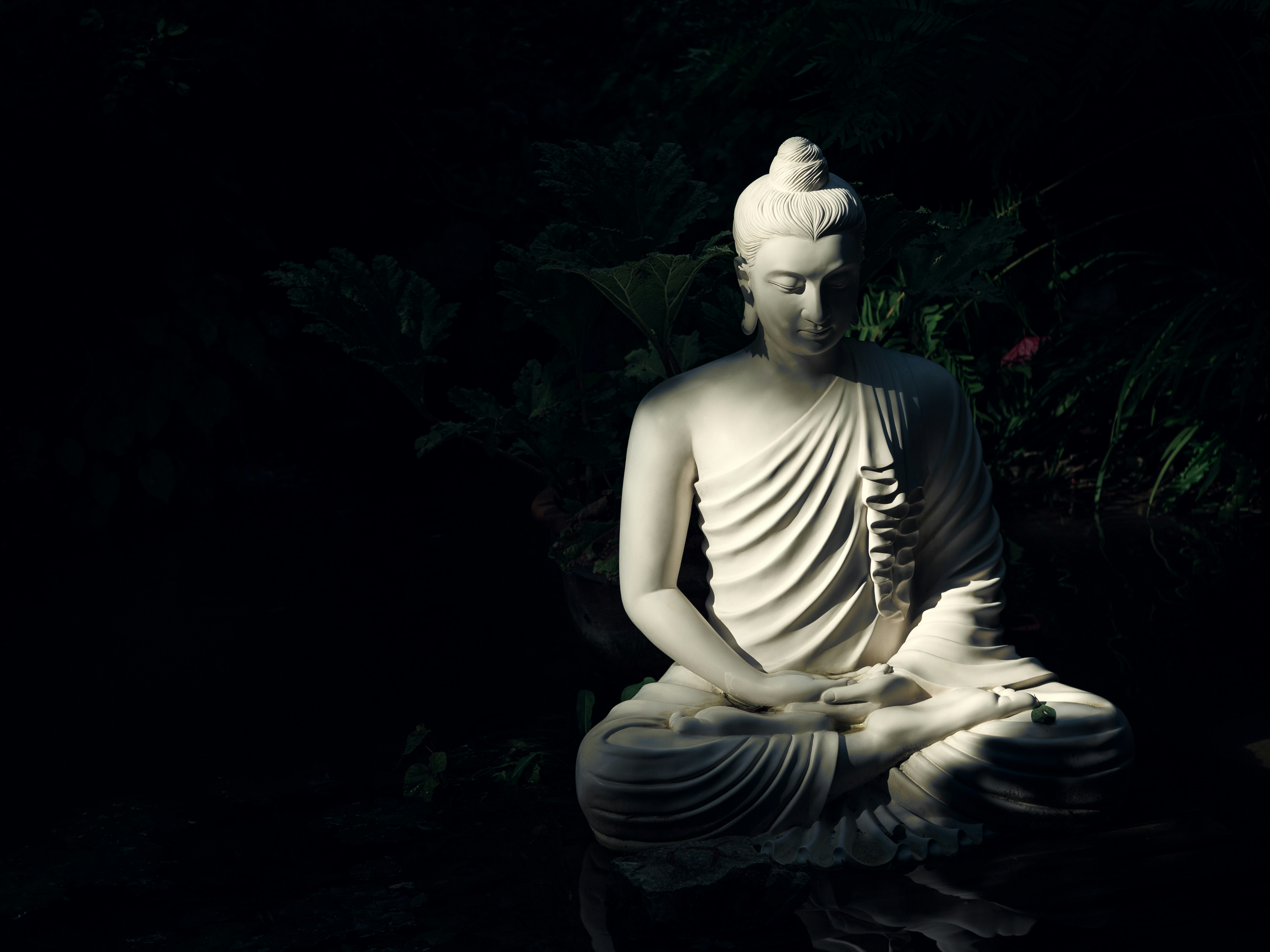
I have a proposition.  Some folks in town have a big “Anti-Woke” (aka, “asleep”) flag on their house, along with various Trump paraphernalia.  Since the Republican Party has largely become reactionary and would, admittedly, still prefer to be asleep, perhaps Democrats should adopt Buddha as a symbol.  I know this would be dangerous in a nation that prides itself as being the city set on a hill, but “buddha” means “awoken one.”  I’m not a Buddhist but I have no problem with it.  The Eightfold Path makes a lot of sense to me.  In any case, a good symbol is something to be cherished.  I think of Gordon Deitrich having a Qur’an in his house, even as a gay man, in V for Vendetta.  Symbols are important.  The anti-woke seem to have forgotten Matthew 24.42 “Watch therefore: for ye know not what hour your Lord doth come.”  The Bible generally advocates wakefulness.

Photo by Mattia Faloretti on Unsplash

Trump-branded Christianity is a strange beast.  Certainly the use of a Buddha symbol would become a cudgel.  Ironically so, for a faith that promotes nonviolence.  The “foreignness” or “not-Christianness” outweighs the positive outlook it entails.  Any religion that advocates violence should reassess its principles.  Buddhism isn’t perfect—no religion is.  The basic ideas of right view, right intention, right speech, right action, right livelihood, right effort, right mindfulness, and right concentration work well enough with Christianity, as Thomas Merton discovered.  For some, however, the Asian outlook (overlooking that Christianity began in Asia) is a deal-breaker.  Strange for a global religion.  Not so unusual for those who prefer to be asleep because Fox News sings them a lullaby.

One of the most stirring Christian hymns is “Wachet auf, ruft uns die Stimme,” based on a Bach cantata.  Perhaps better known as “Sleepers Awake,” the words take their origin from Matthew 25, the parable of the ten virgins.  If I recall correctly, the virgins ready to be woke are those who fare better in this tale.  They’re less concerned with condemning other religions and more interested in being able to wake and trim their lamps swiftly when the time comes.  As I told a friend the other day, I’m an unrepentant idealist.  I do believe that we have it within ourselves to treat all people as having inherent worth and dignity.  The real draw to having Buddha is a symbol would be the introspection.  Instead of telling other people how to live, the principles are applied at home.  Of course, a person has to want to wake up for any of this to work.


Just Ask

I see a lot of headlines, and not a few books, that puzzle over something that there’s an easy way to resolve: why do evangelicals (I’m thinking here of the sort that back Trump despite his pretty obvious criminal, predatory nature) think the way they do.  The solution is to ask evangelicals who’ve come to see things a bit differently.  I’m not the only one, I can assure you.  Many professors of religion (particularly biblical studies) and not a few ministers came from that background.  If they were true believers then, they can still remember it now.  At least I do.  I was recently reading a report in which the authors expressed surprise that evangelicals tend to see racism as a problem of individual sin rather than any systemic predisposition society imposes.  To someone who grew up that way, this is perfectly obvious.

I’m not suggesting this viewpoint is right.  What I am suggesting is that there are resources available to help understand this worldview.  To do so, it must not be approached judgmentally.  (I sometimes poke a little fun at it, but I figure my couple of decades being shaped by it entitle me to a little amusement.)  I don’t condemn evangelicals for believing as they do—that’s up to them—I do wish they’d think through a few things a bit more thoroughly (such as backing Trump).  I understand why they do it, and I take their concerns seriously.  I know that many others who study religion, or write articles about it, simply don’t understand in any kind of depth the concerns evangelicals have.  It’s only when their belief system impinges on politics that anybody seems to pay attention.

Maybe this is a principle we should apply to people in general.  Pay attention to them.  Listen to them.  Care for them.  Relentless competition wears down the soul and makes us less humane.  Religions, for all their faults, generally started out as means for human beings to get along—the earliest days we simply don’t know, but there is a wisdom in this.  In any case, if we really want to know there are people to ask.  Who’ve been there.  Whose very profession is being shoved out of higher education because it doesn’t turn a profit.  Learning used to be for the sake of increasing knowledge and since that’s no longer the case we see guesswork where before it would’ve been possible to “ask an expert.”  I often wonder about this, but as a former member of a guild that’s going extinct, I simply can’t be sure.


Squeaky Clean?

A New York Times story, apart from the expected misunderstanding of actual Evangelicals, made me sad.  The article points out that, especially since 2016, “Evangelicals” have taken to soft-core porn, cussing, drinking, and premarital sex.  In other words, Trump has given them license to behave like secular folks while still claiming the name “Evangelical.”  Why should this make me sad?  I lament the loss of place for those who grew up, like me, striving for clean living.  It’s an image—a mirage—rather than a reality, of course.  But still, if conviction holds, you can get pretty close to the ideal.  That vision of life has been occluded by a guy who runs for President because he cares only for himself.  Jesus, on the other hand, was all about caring for others.  Going as far as, if the Gospels are to be believed, sacrificing his own life.

Like fiscal conservatives, such legitimate Evangelicals now have no public voice.  One of only two political parties has become identified with an individual rather than ideals—what used to be called a platform.  I have Republican friends.  I grew up identifying as a Republican.  I also grew up as an Evangelical.  I studiously avoided things like bad language, sex, tobacco, and alcohol.  Even at Evangelical Grove City College I was a bit of an outlier for how seriously I took all these things.  Of course, studying history can be dangerous, particularly for ideologues.  Still, “clean living” had its own virtues.  Those who continue to try to live that way are swimming into a rip tide, it seems.  For some Trump seems like the Second Coming, sans the white horse.  And this, above all, is sad.

There are those who claim, often loudly, that religion is bad.  I agree that when a religion tries to force others to obey its standards it can quickly become evil.  Still, the baby should be left behind when the bathwater’s discarded.  Religion has led to much good in the world.  Hospitals, charities, and yes, “clean living.”  These things, along with retirement homes and affordable apartments for low-earners in their autumn years, are necessary to pick up the slack that the government leaves.  It is cause for sadness that the clean living camp has succumbed to Trump-style hypocrisy.  Heck, religion gave us the word “hypocrisy.”  The standards of classical Evangelicalism are often impossibly high.  If we look at current Evangelical leaders we find many, many skeletons in a house with many closets.  And a wagging finger warning the young, “Do as I say, not as I do.”