Final Rites?

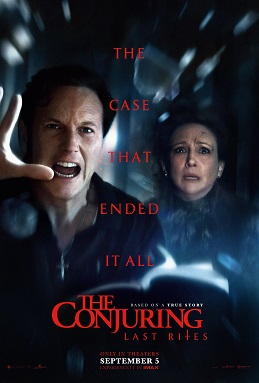
The Conjuring: Last Rites, aka The Conjuring 4, is more of the same.  Reusing tropes that have ceased to be scary, it draws Annabelle back into the story and sets up the possibility of future films by getting the Warrens’ daughter Judy involved.  It is kind of a downbeat to pick up the Smurl haunting since this is widely considered to have been a hoax.  And the movie pulls out all the stops.  Levitation, upside down crosses, and demonic faces suddenly appearing have all been done before.  The conceit that a demon is using ghosts to torment the Smurls is familiar from earlier films in the series.  The franchise, however, remains quite Protestant despite its Catholic trappings.  The somewhat heavy-handed suicide of Father Gordon once again demonstrates the lack of deep comprehension of how Catholicism operates.  It is meant to parallel the suicide that starts the movie, but really adds nothing to the plot beyond shock.

The film tries to do too much and loses any pathos among the Smurls because of the strong subplot, if not the main plot, of the threats against Ed and Judy Warren.  To do this they had to make the real life Judy much younger than she is in real life and cast the unnamed demon threatening the Smurls back to an attack on Lorraine, while pregnant with Judy, in the 1960s.  This allows for a Stranger Things aspect of the 1980s for the action.  It also strangely misrepresents Pennsylvania.  The script seems to presume West Pittston is near Pittsburgh (it’s not, but rather close to Scranton) and it shoots the location in England, obviously for cinematic reasons.

There’s a lot of insider knowledge presumed here—you need to know the fictionalized backstory the series has been building up over eight films.  This comes to a head in the revisiting of actors from the past Warren cases at Judy’s wedding.  Perrons, Hodgsons, and a Glatzel attend, valorizing the often controversial work of the Warrens.  (They were ejected from the Perron house and visited the Hodgsons for maybe part of a day.)  The other movies in the series tend to hang together better but the lack of deep understanding of Catholicism remains perhaps the largest hurdle.  Interestingly, at the box office this has been the highest performing film in the franchise so far.  Since the Conjuring universe is encroaching on 3 billion dollars (2.7 at the moment) gross profit, clearly it strikes a chord.  And there’s every reason to suppose, prequel or sequel, it’s not really the last rites after all.


Preying

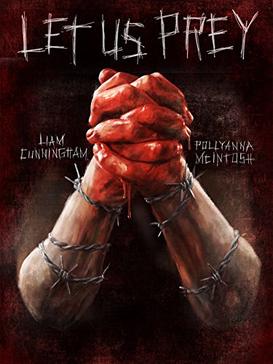
Several aspects of Let Us Prey don’t make a whole lot of sense.  The police in this small Scottish town are all corrupt, at best.  And when push comes to shove, they choose to murder one another.  For some reason the sergeant wraps himself in barbed wire as he tries to bring the wrath of God onto his subordinate officers.  The night starts out with four prisoners being locked up and only one survives.  He’s shown emerging from the sea, with ravens, at the start of the movie and he’s never really explained.  He’s there to collect the souls of sinners and he seems to be able to control other people.  The whole thing turns into a bloodbath before it’s over.  In other words, it lacks the subtlety of much Euro-horror that I’ve watched.  One thing it does have, though, is plenty of use of the Bible.

I suppose with a title like Let Us Prey such a development shouldn’t be unexpected.  Rachel is a new constable in the police station.  The story begins with the stranger, Six—the number of his jail cell—nearly being hit by a car.  Or having been hit.  The teenage driver is arrested and finds a pedophile teacher already in the lock-up.  Two other police officers, after having sex in their patrol car, find the stranger and bring him in.  The local doctor examines him but when the doctor attacks him, he’s arrested as well.  Finally, Six is locked in.  It’s discovered that the doctor had murdered his family earlier in the evening, and the reckless driver had earlier hit and killed a classmate while out driving.  The pedophile kills himself and the two other police officers murder the doctor.  Then the sergeant, who’s a serial killer, comes back to kill everyone left alive.  Six and Rachel survive and Six reveals that he’s collecting wicked souls and invites Rachel to join him.

The Bible quotations (some not accurate) all come in the context of retribution.  The sinners are to be punished.  Rachel, however, escaped a childhood abduction and seems to bear no burden of sin.  The other police—who had all decided Rachel should die—end up dead themselves.  A gritty, supernatural police story, this film suggests a larger backstory without providing a lot for viewers to go on.  The openly Christian sergeant wears a cross, drinks when he drives, and kills his homosexual lovers.  Is there perhaps a message that the movie’s trying to convey?


More Curtis

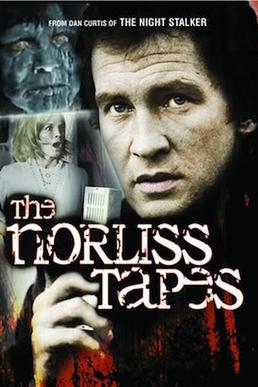
Dan Curtis was the mind behind Dark Shadows, an important part of my childhood.  Reading about his work in film and television, I learned that he produced a lot more than Barnabas Collins, and was an influence in horror in his own right.  A friend recommended that I find The Norliss Tapes, which I did.  This made for television movie was cut from the same cloth as The Night Stalker, which Curtis also produced.  The ending of the movie makes clear that The Norliss Tapes was a pilot for an intended series that never materialized and is a good representation of religion and horror, which is likely why it was recommended to me.  Here’s the story.   David Norliss was given a large advance by a publisher to write a book debunking the supernatural.  Before he can, he goes missing, leaving behind a set of tapes explaining what happened.  The first tape is the pilot episode.

Norliss is contacted by Ellen Sterns Cort, a widow who claims to have had a supernatural episode.  Upon following her dog to her late husband’s studio one night, she encounters her undead husband.  She shoots him, but the police can find no evidence of any body.  It’s revealed that he purchased an occult scarab ring that permits him to return to life to raise a demon who will, in turn, bring him back to real life.  To get the raw materials he needs (such as blood) he has to kill a few people and this again alerts the authorities but they insist on covering it all up.  Removing the ring from his finger will stop him, but that’s easier said than done.  At the end the demon is stopped but this is just the end of the first tape.  His publisher starts to play the second tape.

Dan Curtis productions have a certain feel to them.  I’m not sure how directors and producers do that—I’m not sure of all the tools they have in their box.  What is obvious is that watching The Norliss Tapes brings back echoes of Dark Shadows.  That’s not surprising since Dark Shadows wound down just two years before the Norliss Tapes came out.  The Night Stalker was sandwiched between them, but Kolchak: The Night Stalker was not a Curtis production and doesn’t have a Curtis feel to it.  Even though I’d never seen Norliss before, it was nostalgic watching the movie for the first time.  There’s a trick to it, I just don’t know what it is.


Eyes Have It

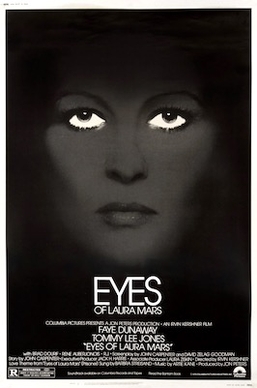
Seeing things from another person’s eyes is perhaps the most important social trait our species has.  We can empathize because we see someone else’s suffering.  It’s a shame to see this breaking down in real time.  Nevertheless, in the case of Laura Mars it may have saved her life.  The Eyes of Laura Mars is a psychological horror film about a controversial photographer (Mars), who suddenly sees things through the eyes of a killer.  The movie is a whodunit, keeping viewers guessing who it is that’s stabbing the eyes out of those Laura works with and cares about.  It’s not a great movie, despite the fact that it was written by John Carpenter.  Both this film and Carpenter’s Halloween were released in 1978.  Eyes is often considered a photo-slasher and Halloween was, of course, a full-blown slasher.  The former was Carpenter’s first major motion picture, while the latter was his first as director.

Screenshot

I’m about to spoil the ending, I fear, so please be warned.  Before I do, however, I will say that the film isn’t bad, even if it isn’t that good.  I had guessed the villain reasonably in advance of the reveal, but the movie did keep me second-guessing my conclusions.  The speculative element of Mars’ ability makes this a supernatural horror film, but one which seems relatively believable.  And the Bible is quoted in it, making it eligible for a Holy Sequel.  The characters—a high society artist and a New York City cop—aren’t terribly religious, but John Neville, the detective, moralizes about Mars’ work at a publicity event.  Okay, so here comes the spoiler.

After floating several possible murderers—a couple members of Mars’ crew are hinted at, as is her ex-husband—it turns out that the detective has dissociative identity disorder and although he and Laura have fallen in love, the moralizing part of his personality is a killer.  He provides Laura with a gun and tells her to shoot the man who comes after her.  When he finally does, he begs her to do it.  The twist ending, at this remove from the original, may be guessed ahead of time, but there is still quite a lot of tension in the story.  The murderer falling in love with his intended victim is a reversal of the more common lover-turned-murderer trope.  It’s not a bad freshman try on the part of John Carpenter, but when his directorial debut came out two months later, his ability in the horror genre was more fully in view.


Play Time

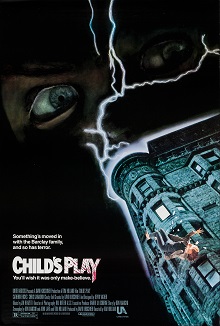
Of course I’ve seen Child’s Play before—what kind of poser do you think I am?  But that was back before I started blogging.  After writing a post about Puppet Master, I thought I should watch it again because it didn’t really strike me as memorable the first time around.  Probably the reason for that is I knew the basics of the story before I saw the movie and, like zombies, possessed dolls are a little hard to buy into.  Still, on this second viewing I was a bit more impressed.  The idea of the monster that won’t stop coming is a scary one, and I’d forgotten just how much Chucky had to be dismembered before being stopped.  And there are some legitimately scary scenes, despite unanswered questions.  In case you’re not familiar: criminal Charles Lee Ray is shot to death in a toy store, but not before transferring his soul, through voodoo, into a Good Guy doll.  This doll is bought on the black market by a widow who can’t afford one, for her son’s birthday.

Chucky befriends the boy but starts taking revenge on those who’ve wronged him, including the police officer called to investigate his first murder.  The officer happens to be the one that shot Ray at the beginning of the film.  Nobody believes that the doll is alive until it attacks them personally.  Nobody, that is, except Andy, the six-year-old owner of Chucky.  (Although it isn’t cited as such, I have to wonder if Toy Story’s Andy wasn’t actually based on this one; that’s not the official story, but still…)  Child’s Play wasn’t the first horror film to portray an animated doll, but it was perhaps the most influential.  Chucky went on to become a repeat slasher villain with wide recognition.

I’d completely forgotten the appropriation of voodoo as the animating force behind Chucky.  Of course, that leads to the very obvious weirdness of a doll using a voodoo doll to kill someone.  To modern sensitivities, the use of Vodou feels inappropriate, but this was in the eighties, and other religions were fair game for horror.  In fact, religion was fair game.  Without it, no animated Chucky, and no threat to Andy and his mother.  Religion and horror have played together from the very beginning.  The possession aspect also ties into religion and there have been no end of possessed dolls since Chucky first lunged out the screen with his knife.  It was a good play date, it turns out.


City Children

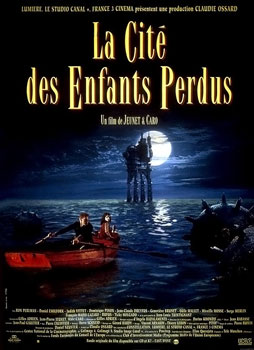
Some movies are very difficult, if not impossible to classify.  City of Lost Children is one.  One label that seems to have stuck is steampunk, and I think that’s accurate.  A touch confusing, not least because it’s in French, it is visually stunning.  So, the lost children are kidnapped by a kind of mad scientist who cannot dream.  He takes the children’s dreams (with pre-echoes of Inception).  The initial dream sequence of multiple Santa Clauses could be horror—much of the film is unnerving, as well as disorienting.  This mad scientist is attended by a set of clones, a tiny wife, and a brain in a fish-tank.  Meanwhile, thieving orphans, controlled by women who are conjoined twins, steal valuables.  A circus strongman, One, sets out to find his kidnapped “little brother,” and finds the orphans.  He helps them on one job but one of the lead orphans, Miette, takes pity on him and tries to assist in finding his brother.

The brother is in the hands of the mad scientist.  Miette is nearly drowned but saved by an amnesiac submarine pilot.  She leaves to fine One, whom the twins tried to kidnap.  One and Miette team up once again to rescue “little brother.”  They find the mad scientist’s lair, but the submarine pilot is about to blow it up.  One and the children escape, but at the last minute the submarine pilot regains his memory and realizes that he was the creator of the mad scientist and clones, but he is blown up along with the lab.  Accompanying this there are striking visuals in a world that is a cross between Existenz and The Matrix, but with steampunk overtones.  I suspect multiple viewings may be needed to get it, but the cinematography would make that a pleasure.

The cyclopses (did I mention them?) are the religious part of this world.  They believe in the plucking out of eyes in order to see.  This they do with eyes from the scientist and the cyclopses, in turn, capture the children for him.  Their religion is violent but somewhat biblical.  Although this is an alternate universe, it’s one where such features as religion might cross over.  Often religion is neglected in world-building, even though it comes naturally to our species.  It’s easy to get lost in this kaleidoscopic world.  Even so, you come to care for One and Miette and the value of loyalty.  Funny, creepy, confusing, and emotional, City of Lost Children is a movie that has to be seen to be believed.


Folk Kill

Kill List is a movie that I wish came with some interpretative material.  It’s a touch hard to follow.  The basic idea is that Jay and Gal are Army buds who take a job as hit men.  Jay is married, but not exactly happily.  Gal’s girlfriend leaves him early on.  It seems that Shel, Jay’s wife, knows what he does for a living but seems strangely unconcerned.  Jay is recognized by his victims, but he doesn’t know why.  He becomes insanely brutal on the second of their third jobs, torturing his victim before killing him and then going after his accomplices (not on the eponymous kill list).  At this point Gal and Jay want out of the deal but their unnamed employer won’t release them.  Jay is presented as a man traumatized by a past military action.  He fights frequently with Shel but is very devoted to their son.  Spoilers follow.

The last job is a hit on a member of parliament.  The MP, however, is in a folk religion group that requires human sacrifice.  Jay begins shooting them but he and Gal are outnumbered.  Gal is killed and Jay is subdued.  He then has to fight a hunchback in front of the masked believers.  He frees the knife and kills the hunchback only to discover it is his wife with their son attached to her back.  A rather bleak ending for a rather bleak film.  Kill List is generally considered folk horror.  That is to say that fear derives from both the landscape (less rural in this example) and from the native religion of the non-Christian traditions.  What exactly this religion is is never specified, and it seems that, unbeknownst to himself, Jay is a pretty major player in it.

Perhaps not surprising for a film titled Kill List, this is quite a violent movie.  The somewhat constant fighting of Jay and Shel is unnerving in its own right, and Jay’s berserker-like attacks are also disturbing.  There is a religious element involved, however, beyond paganism.  The first victim on the hit list is a priest.  The reason’s not explained, but the expected religious imagery is there.  This is never tied in with the folk religion exposed at the end.  Although effective as a horror film, it leaves quite a few questions unanswered.  That being said, this Euro-horror is one that I’m unlikely to go back to.  I’m not even sure who made the recommendation to me in the first place.  Folk horror is a fascinating genre and this movie has been compared to The Wicker Man in that regard.  Only in the latter case the plot was easy enough to understand.


Monkey Shines

While religion isn’t a major part of the story, it appears enough in The Monkey to be noted.  The movie presents probably the most inarticulate priest in cinema, played for laughs.  But then again, there is quite a lot of comedy in among the gore.  It’s difficult to say if the movie would’ve succeeded had it been straight horror.  Based on a Stephen King short story, the plot revolve around a toy ape, actually, a drum-playing chimp that is wound up with a key.  The problem is, when the last drum-stick comes down somebody nearby dies in a bizarre way.  As is the way in such stories, if the “monkey” (I’ll just give in and call it that) is destroyed, which it is from time to time, it keeps coming back.  When purchased by a father for his twin sons, tragedy follows until only one is left standing.  The religion comes at the funerals.

The twin sons, Hal and Bill, the main human focus of the film, hate each other.  This is mainly because Bill, the firstborn, bullies Hal, driving resentment.  They discover the monkey among their absentee father’s effects and when they wind it up they soon end up as orphans.  When it kills their guardian uncle, they put it down a well where it stays quiet for 25 years.  Bill acquires the toy as an adult and harboring resentment, believing Hal killed their mother, he sets the monkey off again in the hopes that it will kill his estranged brother.  A string of bizarre deaths occur, cluing Hal in to the fact that his brother is back at it.  Only one of them survives while the town lies in ruins.  The deaths, although gruesome, are comedic, making them bearable.

The story is dark enough that director Osgood Perkins’ decision to make it comedic appears to have been the only way to make it palatable.  Horror comedy is often difficult to pull off well.  Many such films wind up being simply silly or losing any potential to be frightening.  The Monkey manages to blend fun and fear effectively.  It also continues the long line of horror films that animate toys of various sorts, making all kinds of commentary about childhood.  Of course, this film begins with Bill and Hal’s childhood and has them learning to deal with death at an early age.  At the end even Death on his pale horse has a cameo. Handled differently, it could’ve been quite terrifying.  Especially since the religion in this world is so completely ineffectual.


Q’s and P’s

I finally had to break down and buy it.  Quatermass and the Pit has been on my “to see” list probably longer than any other single movie.  I managed to stream the first two of this telinema series for free, so I guess it was like getting three movies for the price of one.  Aired in the United States as Five Million Years to Earth, this isn’t the greatest sci-fi-horror movie ever, but it isn’t bad.  The pacing is a bit slow but the story is intriguing.  Rocket scientist Quatermass gets involved in the excavation of what turns out to be a buried rocket ship from Mars.  Surrounding the ship in the five-million-year-old matrix are the remains of apparently intelligent apes.  The scientists discover that the apes were artificially enhanced by insectoid martians that resemble the devil.  It’s pointed out that any time digging has taken place near Hobb’s End, strange phenomena occur.  It’s noted that Hob used to be a nickname for the devil.

This detail leads to a perhaps unexpected connection to religion and horror.  Quatermass and Barbara, a scientist who has the ability to “see” the creatures via collective memory, realize that the hauntings that have taken place around Hobb’s End for centuries may have been the image of demons, or the devil, emanating from the evil of these would-be invaders.  At one point a priest argues that their influence is essentially demonic, but the scientists realize that these modified apes are actually the creatures from which humans evolved.  All the human tampering with the ship eventually frees the spirit of the martian insects, resembling a devil.  The way to destroy it is with iron, relying on folklore which, in this instance, works.

The four Quatermass movies (I don’t plan on seeking out the last) were theatrical reshoots of television serials.  The last movie is essentially the TV series stitched together as a movie.  From at least the seventies on (Quatermass and the Pit was released in 1967) the first and third installments were considered fairly good horror films.  They aren’t always available in the United States, probably due to digital rights management.  It seems ridiculous that in this day and age that companies still restrict access, even to those willing to pay a modest fee, for movies that are essential parts of the canon.  Hammer (all three Quatermass movies are Hammer productions) films are still difficult to access in the United States.  At least, with the willingness to wait half a century, I’ve finally be able to see Quatermass and the Pit.


Experimenting with Quatermass

Hammer films are coy.  In these days of digital rights management, they’re often difficult to locate in the United States.  Even on streaming services.  I’d known about Quatermass since I was a kid.  I’d heard about Quatermass and the Pit as a pretty scary early science fiction-horror offering.  I’ve still never seen it.  Quatermass was a BBC television character, a kind of mad scientist figure.  The Quatermass Xperiment was the first of a set of four Hammer films based on him.  Also known as The Creeping Unknown, it was cast with an American Quatermass (ironically, it turns out) to appeal to American viewers (who can now seldom access the film).  In any case, one of the streaming services finally acquired rights to the 1955 movie.  The special effects were naturally primitive, but that doesn’t stop this from becoming a scary film.

Watching these early movies is like studying history.  Other films were influenced by The Quatermass Xperiment, most notably Lifeforce.  I couldn’t help but think of Night of the Living Dead as well.  Quatermass, a rogue scientist, sends a rocket into space with three astronauts.  Since this was before we had any kind of conception of how this might actually be done, the idea seems implausible, of course.  The rocket returns with only one of the three crew members, and he’s morphing into something else.  Despite his arrogance, Quatermass realizes he has to cooperate with the police to contain the menace.  Inspector Lomax describes himself as a “Bible man,” unacquainted with science, and Quatermass considers his work superior to that or mere police.  When the hybrid is finally located and destroyed, however, it is in Westminster Abbey.

Although the runtime is just over an hour and some of the acting is quite wooden, this is an affecting story.  The scene where the transforming man encounters the little girl’s tea party bears elements of the pathos of Frankenstein.  Without the budget, science, and even acting resources of modern productions, The Quatermass Xperiment manages to fall squarely into horror with a monster I’d been waiting since childhood to see.  In those days you were at the mercy of your local television offerings.  Now that we have worldwide content on the worldwide web, we still restrict viewing so that the most money can be made from a movie that’s seven decades old, and its cohort.  In any case, this experiment has left me determined to find what Quatermass discovers in the pit.  Once that becomes available on a service I use.


X-Rayed

If you’re of a certain age, you’ll remember the comic book ads for x-ray specs.  That’s the idea behind a Roger Corman film that Stephen King thought one of the scariest he’d seen.  X, subtitled The Man with X-Ray Eyes, came out in 1963.  Not to be confused with the X of the modern trilogy, this X follows a Doctor Xavier who develops a formula that allows him to see inside people so that he can accurately diagnose and cure them.  This formula may affect his sanity, however, and he kills a friend who is trying to take the ability from him.  A wanted man, he finds a carnival barker who exploits his gift as a trick.  It was a bit jarring to see Don Rickles in a horror movie, but stranger things have happened.  In the midst of this exploitation, an old friend finds him and drives him to safety.

Then to Las Vegas, where his sight allows him to win unabated.  When the police are called he steals a car and increasingly sees through the fabric of the universe.  He stumbles into a road-side revival where the preacher encourages him to take Matthew 5 literally and he does so as the congregation chants “pluck it out!”  What makes this final scene so arresting, apart from qualifying it for Holy Sequel, is that before the minister tells him to mutilate himself, the doctor says he sees through the darkness to the eye that “sees us all.”  He sees God.  The minister interprets this as the Devil, confusing the most elemental entities that exist one for the other.

The movie has some lighthearted moments, some even apart from Don Rickles.  When the doctor begins to see through everybody’s clothes, it’s presented in a humorous way.  But for the most part, the film is played straight and it manages to raise some serious issues for those who think through the implications.  Our senses evolved to help us survive.  Accessing abilities beyond that is a catalyst for disaster.  Indeed, Dr. Xavier early on notes that he’s approaching godhood because of this newly won ability.  It also means that an individual might know too much.  It seems that at the end he does.  The movie is remarkable even today in several ways.  Technology has made special effects more believable, but the human side of this story remains unaltered.  A doctor wanting to help patients becomes more of a monster than a man, in some respects.  And perhaps the most remarkable aspect is that this is a serious horror film made by Roger Corman for AIP. Scary even to a young Stephen King.


Bible and Horror

Having written Holy Horror, I keep an eye out for Bibles in horror contexts.  In the context of A Nightmare in New Hope there was the torso and head of Fr. Alameida from Stigmata.  In his hands he clutches a Bible.  Of course, if you’ve seen Stigmata you’ll know that Alameida is already dead at this point, having been so from the start of the film.  Those visiting a horror museum are likely completely nonplussed by seeing a Bible there.  Much of the horror genre builds on religious themes.  Witness The Nun.  The original costume for her is standing over in the corner right there.  If I had enough time (i.e., if I were in an academic post again) I would be spending my time trying to figure out this connection.  I’ve written about religion and horror in four books, in several articles on Horror Homeroom, and in too many blog posts to remember.  There is a connection that only professors have the luxury of thinking time to explore.

A couple hours later at Vampa, Vampire Paranormal Museum, Bibles were again in evidence.  Indeed, in profusion.  Vampire hunters, it seems, never wanted to be without the Good Book.  Many of the vampire hunting chests (entire chests!) included a Bible.  As noted in a previous post, Michael Jackson owned a vampire hunting kit for a while, until the Jehovah’s Witnesses convinced him he shouldn’t.  In one of nature’s ironies, in the mail when we got back from the museum was a handwritten letter to me from the local JW Kingdom Hall.  Religion and horror.  Vampa also owns a rarity, an exorcism chair.  Things get a bit muddy here since the chair dates from the nineteenth century but exorcism as we know it largely derives from the movie, The Exorcist.  And that takes us back to New Hope.

My interest was primarily in artifacts from actual movies.  The Exorcist head of Regan McNeil in Nightmare in New Hope was, I believe he said, a cast.  A horror museum without at least a passing reference to The Exorcist would feel strangely incomplete.  And then there’s Maxxxine.  The entire X trilogy is framed around religion that leads to horror, over a couple of generations.  There’s a connection here and I haven’t found a convincing explanation for it yet.  It’s one of the many books that I’m working on at the moment.  But time is limited.  And Fr. Alameida’s presence in this room, holding tight to his Bible, reminds us that the topic bears exploration.


Good Hearts

If you’re looking for more religion-based horror, you might try the 1987 film Angel Heart.  As I’m discovering quite a bit lately, I could’ve used this one in Holy Horror as well.  The religious elements are pretty hard to miss, beginning with the protagonist’s name, Harold Angel.  (Hark the, any one?)  A private detective, Angel is hired to find a missing person for a Louis Cyphre.  His search takes him from New York (where a guy keeps a pistol in a Bible (there’s maybe an entire book in this trope), down to New Orleans.  First he meets Cyphre in the back room of a black church but soon he starts getting chased out when he starts to uncover any clues.  Time to head to the Big Easy.

In New Orleans he finds all kinds of occult practices taking place.  And the folks are none-too-friendly when he starts making mention of the guy he’s after.  He ends up witnessing a voodoo ritual and complains about the bad religion he encounters.  The big reveal indicates that there’s been a case of mistaken identity.  Louis Cyphre (Lucifer) has actually been setting an elaborate trap all along.  The portrayal of the Devil as a sophisticated gentleman isn’t new, of course.  There is a scene where Angel and the Devil are in a church and Angel, being a detective, uses inappropriate language.  Lucifer (not yet revealed as such) has to remind him a couple of times to watch his tongue while in a sacred place.  Satan is more pious than Angel.

The movie has multiple issues, but it has become a cult film over the years.  Like many others that I’ve discussed on this blog, the entire plot draws its horror from religion.  Angel has a difficult time with the non-Christian worship he witnesses.  But really, it is the Christian Devil that’s the antagonist here.  Quite often in movies like this, fear of other religions is based on the supposition that Christianity is correct.  That’s been a broad American trait for centuries, and it gives horror room to run.  The idea of a generic Christianity (which is probably what most Christians hold to) overlooks the doctrinal differences, often quite significant, between denominations.  This particular avenue isn’t much pursued in horror films, at least in my experience.  Interestingly, like Cat People (1982), it places this religion-based horror in New Orleans.  There’s plenty to explore in that connection as well.  Angel Heart is not a great movie, but it can lead in some interesting directions; a holy sequel may be necessary.


Step Far

It made a bit of a splash when it came out, Longlegs did.  It took a while to get to a streaming service I can access, but I can say that it’s a movie with considerable thought behind it.  And religion through and through it.  I would’ve been able to have used it in Holy Horror, and it is one of the very few movies where a character corrects another, saying “Revelations” is singular, not plural.  Somebody did their homework.  Although the plot revolves around Satanism, you won’t be spoon-fed anything.  The connection’s not entirely clear, but it does seem to involve some form of possession.  The plot involves ESP and a literal deal with the Devil.  Things start off with a future FBI agent encountering Longlegs just before her ninth birthday.

As an adult, she’s forgotten the childhood encounter but a set of murders with a similar MO indicates that a serial killer, called Longlegs, is on the loose.  The murders are all inside jobs, and it turns out that a doll with some kind of possessing ability is responsible for inspiring fathers to murder their families.  No details of the connection between the dolls, Satan, and the reason for the killings ever emerges.  The movie unnerves by its consistent mood of threat and menace.  Satan, the guy “downstairs,” appears more properly to be chaos rather than a kind of literal Devil.  Satanic symbols are used and there are plenty of triple sixes throughout.  The Bible has a role in breaking the killer’s code, but talk of prayer and protection also find their way in the dialogue.  Longlegs uses a ruse of a church to get the dolls into his victims’ houses.

I’ll need to see it again to try to piece more of the story together, but Longlegs is another example of religion-based horror tout court.  Serial killers are scary enough on their own, but when their motivation is religious they become even more so.  Nicholas Cage plays Longlegs in a convincingly disturbing way, but there’s definitely some diegetic supernatural goings on here.  The art-house trappings make the plot a little difficult to follow, particularly early on.  Religion, however, shines through clearly.  The FBI agent, although psychic, has ceased believing in religion while trusting the supernatural.  Even as the credits rolled I had the feeling that I’d missed some important clues.  And those clues would be important, particularly if I ever do decide to write a follow-up to Holy Horror.


Belting Beltane

Things have been so busy that I forgot that today is Beltane.  That’s all the more ironic because yesterday I’d been on a panel to address the British Association of Film, Television and Screen Studies special interest group on Horror Studies, about The Wicker Man.  Lest you get the wrong idea, BAFTSS did not approach me to talk about my book (which has largely disappeared, as far as I can tell), but another recent Devil’s Advocate author approached them about having a panel featuring recent titles.  This special interest group has a program called Weekday Night Bites where they gather virtually to have speakers talk about horror.  Yesterday there were seven of us, discussing five books, one of which was The Wicker Man.

The theme of the panel was No Safe Space, about place and space in horror.  This meant I spoke briefly about The Wicker Man as folk horror.  As I told the assembled group, I actually interpret Wicker Man as holiday horror—it’s based on May Day, and I didn’t even think to mention that it was today—instead of folk horror.  One of the the hallmarks of the Devil’s Advocates series is that it tries to approach horror films from unexpected angles.  When I first contacted the editor who started the series at Auteur (who has, unfortunately left), he told me that they didn’t have a Wicker Man volume because everyone was pitching it as folk horror.  He wanted to see a different interpretation.  I’d been writing a book about folk horror and decided to give that a try.  The critics liked it, and thus my book was born.  And here it is, May Day, and I’d forgotten all about it.

There was a reasonably sized group present for the discussion and it was a lot of fun.  It reminded me of my Miskatonic Institute for Horror Studies course on Sleepy Hollow two years ago.  Both of these were efforts to stir some interest in my books.  Horror and religion is a new avenue of approach and there are a handful of us working in this area.  The others, it seems, have a knack for getting their books published in places where you don’t have to take out a mortgage to afford them.  I’m more in the group whose books are relegated to the Summerisle of sales.  Either that, or I’m actually Sergeant Howie, unwittingly flying there to help someone I think is in trouble. Who knows?  Anything’s possible on Beltane.