First Stories

I won’t say more than that her first name was Tina.  She lived next door to us in the earliest boyhood home I can remember.  She was a few years older than my brothers and me and, according to my mother, grew into quite the delinquent.  She ended up in jail, I’m told.  Still, even in a childhood full of scarring memories, I remember Tina as being the first person who told me a scary story.  Funny how these things stick with you.  We lived in Franklin, Pennsylvania, a town on the edge of the woods.  Indeed, Venango County is largely wooded and populated by some of the most avid hunters I’ve ever seen.  There were woods across the street from our house, climbing one of those ubiquitous hills that make the area so beautiful.

There was a man in those woods, Tina told us, who’d been kidnapping small boys and cutting out their hearts.  She was telling it as the truth and well over half a century later I remember the fear that story instilled in me.  Of course, Mom told her to stop telling us scary stories.  I was only five or six at the time.  Maybe four.  My path to watching horror movies wasn’t straightforward.  We were a religious family, but taking care of three young boys and an ailing mother with no husband around eats up all your time.  Mom was content to let the television babysit us in the next room at times.  And as late monster boomers, we watched monster movies on Saturday afternoons.  They gave me a cozy feeling.  Things could be worse than not having a father.  Much worse.

After high school I gave up monsters for the Gospel.  Went to college to become a preacher.  I ended up teaching in a seminary and didn’t want my daughter to grow up scared, like I had done.  Then my world collapsed.  Fundamentalists fired me from my first and last full-time teaching position.  I dealt with it by watching horror films.  Perhaps I was reverting to childhood coping strategies.  Over the years, however, I never forgot that story that Tina told us when my brothers and I were little.  It is a scary world out there, and you’ve got to learn that one way or another.  Many people don’t understand my fascination with horror.  In times of trouble, however, we go back to those self-soothing practices that we associate with good feelings.  For some of us it was watching monster movies on Saturday afternoons and knowing things could be worse.  


Nun too Soon

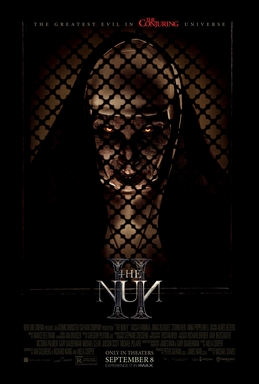
Following a horror franchise from the beginning is a rarity.  At least it is for me.  Now that I’ve seen The Nun II, I’m caught up on the Conjuring universe, for now.  I’ve written an article, still awaiting publication, on the Catholicism in this cinematic universe, and The Nun II has me wondering: how hard is it to find out the basics about Catholicism?  The movie is okay for big-budget horror, but not great.  The Catholicism in it feels like it’s imagined by writers who speculate on what it might be without ever, say, attending a mass to find out.  And the demon Valak isn’t exactly rank and file either.  The idea of using St. Lucy’s eyes as a relic was, however, pretty creepy.

So, after The Nun, Sr. Irene has gone to a convent in Italy.  A series of bizarre clerical deaths sweeps across Europe and all the Vatican can think to do is send the one young nun who’s faced this demon before.  No priest this time because Fr. Burke is dead, rather laconically stated.  Sister Debra sneaks along and the two nuns find themselves facing a demon that immolates priests because it can’t find a relic it wants that will make it even more powerful—the eyes of St. Lucy.  Said eyes are buried in a ruined chapel in a Catholic girls’ school in Aix-en-Provence.  This is the school where Frenchie (from The Nun) now works as a handyman.  We all know he was somehow possessed at the end of that film.  The girls’ school used to be a winery and Valak is defeated when the nuns consecrate a pool of wine that banishes the demon.

At this point in time, the Conjuring universe has grossed over two billion dollars.  All of the films are explicitly religion-based horror.  Putatively in a Catholic setting, they feel like Protestants trying to guess what Catholicism must be like.  At least they feel that way to me.  The Nun sequence in particular, has demons responding to defenses that would not, in a Catholic world, work.  As much as I may disagree on the theology, nuns can’t consecrate wine.  And it turns out that Sr. Irene is a descendant of St. Lucy, one of the virgin martyrs.  Although that title is sometimes given as an honorific, it does generally mean that such saints had no progeny.  Death by thurible is fairly clever, though.  Like all the films of the franchise, The Nun II is worth watching, but it fails to convince on the religion front.  It just doesn’t feel Catholic.


Don’t You Sleep

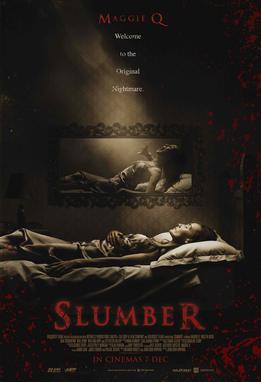
Sleep is pleasant but it’s such a vulnerable time.  Something deep in our animal DNA tells us to find a sheltered place to do it.  That vulnerability is compounded by demons.  So claims Slumber.  While not the most original story, it’s pretty effective for a while, but then holes begin to appear in the plot and you find it difficult not to keep asking why the problems weren’t addressed.  Let’s take a step back.  Doctor Alice Arnolds lost her younger brother to a demon when they were children.  This demon, called Mare, causes, well, nightmares.  These nightmares lead to sleepwalking and ultimately death.  As a doctor specializing in sleep disorders, Arnolds helps others scientifically.  She’s come to believe that her brother’s death was because of natural causes—the supernatural doesn’t exist.

Okay, so sleepwalking is creepy, and the idea isn’t a bad hook.  Then Arnolds meets a family of four, all of whom sleepwalk with nightmares.  The demon’s target here is their young son, who reminds Arnolds of her lost brother.  At the sleep clinic the monitors show something odd, but circumstantial evidence points to the father as the guilty party.  But here’s where the big hole appears.  Once Arnolds becomes convinced something supernatural is happening, she decides to handle it herself, at the family’s home.  Even when it’s clear they’re out of their league, nobody calls the police or even an ambulance, let alone a priest.  Instead they rely on a janitor’s father whom they’ve just met.  They try to keep the boy awake until they’re endangering his life, then they fight the demon in their dreams.  There is a kind of twist ending, and the production values are good.  

The demon, which Arnolds researches on Wikipedia, is a notsnitsa.  Why this Slavic demon targeted both her brother and the family under distress isn’t explored.  The connection is made with “the night hag”—a folkloric demon that attacks in your sleep and is generally explained as sleep paralysis.  This is not a possessing demon.  In the film it’s said to be parasitic, and the sleeping victim acts out what the demon tells it to do.  The lack of any religious tension hurts this movie.  As does that lingering question—why not call in some kind of expert?  Either sacred or secular will do!  I won’t ruin the ending of the movie, but I’ll warn those tempted to watch to come armed with a great deal of suspension of disbelief.  You’re gonna need it.


Sequel Pondering

Of course I’m working on another book.  I can’t say what it is at the moment, but one of the projects I’ve long been contemplating is a kind of sequel to Holy Horror.  The problem is that if the first book didn’t sell very well (the premise is perhaps too academic), a sequel couldn’t be expected to do any better.  I’m still working on sloughing that academy skin.  But I keep watching what we insist on calling “horror” and the more I do, the more I find the Bible in it.  Others have taken up the gauntlet—mostly academics who have jobs that encourage such behavior—of connecting horror and religion.  The Bible’s role, while a subset of the larger field, has its own particular parameters.  In one of my notebooks I have a list of 23 movies to add to my analysis.  I know that there is a twenty-fourth, but it’s only streaming on an exclusive service and still costs a bit too much for something that doesn’t come with a plastic case.

In any case, Holy Horror just scratched the surface.  One of the factors I’ve mentioned before is that there is no database of the Bible’s appearances in film.  It would be an extensive list altogether, and a substantial number of horror films would be on it.  In general, it seems, people really aren’t too interested or intrigued by this fact.  I certainly am.  Our society is a curious mix of sweet and salty.  We want to think we’re too sophisticated for religion, but religion undergirds just about everything we do.  Otherwise it’s pretty difficult to explain how the Bible keeps showing up in horror.  Usually as a mysterious artifact.

I recently saw myself referred to as a biblical scholar.  There’s no doubt that I taught biblical studies for many years.  I even wrote a book interpreting one aspect of the Good Book.  My degree, and my interest, however, has always been historical.  I follow this history of ideas.  Although many people don’t understand my current horror fascination, it’s clear this is another jog down a trail of history.  How did we get to the point that a totemic (the scholarly phrase is “iconic”) Bible became a stand-in for God in movies?  I’m not sure I’ll ever be able to write Holy Sequel, although, if my profession ever permitted it, I’d certainly have the interest in doing so.  There’s a lot to be learned from such explorations.  That’s true even if the books containing the information only appear on a few dusty library shelves.


Sinful Thoughts

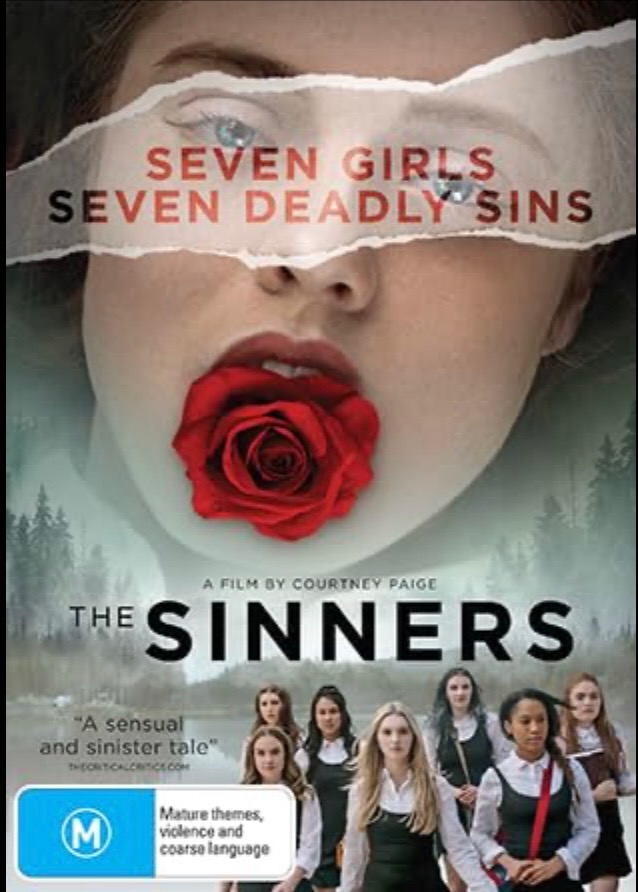
The driving force behind Holy Horror is the fact that the Bible appears in lots of horror movies.  More than might be expected.  Although I’ve moved on to other projects, I still keep an eye out.  There may not be time or opportunity in my life to write a sequel, but you can’t unnotice the Bible in The Sinners.  The title drew me in, as did its free status on Amazon Prime.  It’s a Bible-based flick, for sure, but even the basic description gets religion wrong.  I generally like movies by female directors, and this one was a project of Courtney Paige whose name, for some reason, sounds strangely familiar.  In any case, one of the biggest blunders movies like this make is that the religion doesn’t hang together.  Of course, it doesn’t say what variety of Christianity it is, but it’s of the literalist stripe.

Seven alpha females at a Christian school in a Christian community form a clique in which they’re each characterized by one of the seven deadly sins.  They’re lead by the pastor’s daughter, of course.  One of the girls keeps a journal in which she confides that she confessed their activities to the pastor.  The betrayed girls decide to scare the offender but she escapes when they’re intimidating her.  She’s found dead but then the other sinners start being murdered.  The police aren’t really effective and the girls try to figure out who’s behind this.  I won’t say who but I will say that it doesn’t really make much sense.  Scenes jump around and characters appear with little or no introduction—it’s disorienting.  But that religion…

I know enough PKs (preacher’s kids) to know they often aren’t as innocent as dad thinks (and it’s generally dad).  I also know that forced conformity of religion builds resentment and resistance.  But there’s something wrong here.  The pastor drinks wine.  Even the truly religious girls drop f-bombs.  One even attends a Satanist meeting with no explanation.  The pastor’s wife is having an affair.  The school librarian has sex with her husband at the school between classes.  They can all quote scripture, and often do.  What religion is this?  I couldn’t really engage with the movie because there were too many distracting religious gaffs.  Hey, I don’t mind when movies show the problems with religions—they’re fair game for commentary, after all.  But if you’re going to do it, try to understand the mindset of the religion you’re criticizing.  There’s a lot to think about in this movie, and it really isn’t that bad.  But for those who know religion there’ll be some question of which it is that’s under fire.  If I ever get back to Holy Horror I’ll say more.


Ushering In the New

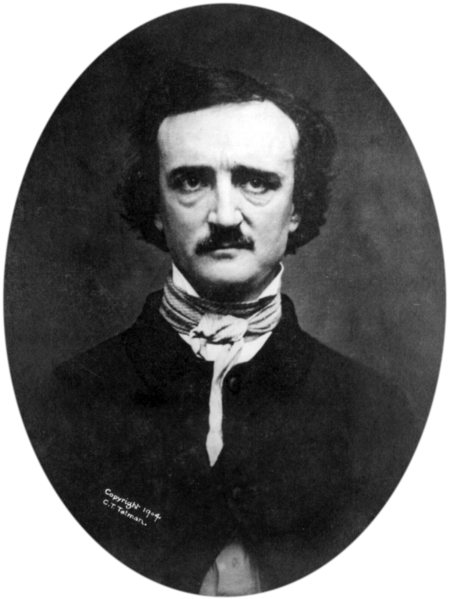
I’m not at all certain I’ll finish it, but at my daughter’s suggestion I watched the first episode of Netflix’s new series, The Fall of the House of Usher.  This isn’t set in Poe’s day.  The action is in the present and it opens with a funeral for three of Roderick Usher’s children.  What’s particularly striking about this funeral is that the priest’s homily is composed of lines from Poe.  I think we all know that Poe is undergoing a great surge of popularity these days, but this series seems not content just to name characters and companies after Poe’s names, but it also weaves his thought deeply into the fabric.  It uses his images in literal ways that add depth to the plot.  I’m not sure that I can spare the time to watch it the whole way through, but I’m sorely tempted to do so.

With C. August Dupin as the Assistant District Attorney, the series ties Poe’s ratiocination stories in with his horror tales.  Like most recent media efforts, the cast reflects diversity in many ways.  This diversity isn’t the reason the house of Usher is falling, but it’s because of disloyalty.  The family owns an unscrupulous company that has shown disregard for the suffering it causes, buying its way out of legal difficulties.  (This part is quite realistic and one can’t help but to think of Trump and others like him who simply buy injustice.)  But someone in the Usher family has decided to speak out.  Dupin won’t reveal who it is, so Roderick and Madeline Usher put the family up to the task of rooting out, and killing, the informant.

Perhaps with some time off over the holidays I’ll be able to catch more of the series.  It intrigues me, however, that Poe is being used essentially as scripture.  Literally.  The priest’s homily fades into the background as the surviving family members check in on each other, but his words are drawn from a variety of Poe’s writings.  I’ve long felt that our canon of scripture is too small.  Inspired literature did not cease to be written in the second century.  As someone who has listened, and still listens to sermons, it’s clear that the Bible alone isn’t a source for knowledge.  I haven’t read all of Poe—he left a massive paper trail through his life—but what I’ve read sticks with me and hearing him as sermon material makes me think I need to try to find time in coming weeks to pick up another episode or two.


Gateway Horror

I’m in two minds about The Gate.  Part of me says “bad movie” while another part says, “Yeah, I’d watch it again.”  A third part of me knows I probably will.  It came out in 1987 as family-friendly horror.  There’s far too much going on for the run-time and the acting is lackluster (child actors who can really pull horror off are rare; perhaps those with more life experience make it believable).  It does have some Poltergeist vibes, though.  So, Glen (12) and his sister Al (15) are allowed to stay home without a babysitter for three days.  A couple nights before, a storm blew over a tree in the backyard, and Glen, with his friend Terry, accidentally open the eponymous gate at the hole by breaking open a geode, allowing demons to come into the world.  And, of course, the parents are gone.

Glen fears he is losing his sister to, well, growing up.  They used to do model rockets, but now she’s interested in boys.  Terry listens to heavy metal and discovers in an insert to an album of a European band, Sacrifyx, that they’ve opened the gate.  As night falls, the stop-motion demons attack.  They’re little and can be blocked by doors.  Al, Glen, and Terry have to figure out how to stop the demons and seal the gate without the Dark Book insert from the Sacrifyx album.  What to do?  They grab a Bible and try reading a bit.  When it doesn’t seem to be working, Terry utters an expletive and throws the Bible into the hole.  It works!  But, ah, this is only the false resolution.  The really big demon bursts through a hole in the living room floor after Terry and Al are both taken.  Glen, left to his own devices, launches a model rocket at the demon, destroying it.

Okay, sounds bad, right?  The reason, it seems to me, is that it doesn’t put religion to work for itself.  The instincts seem good—use the Bible—but the demons are too corporeal and too physical.  There’s no possession here.  In fact, the demons are the old gods (we’re in Lovecraft territory now) who want to take over the world once again.  There’s some good material to work with in The Gate, and if I ever get around to a sequel to Holy Horror I’ll have to include this one.  Overall, the message seems to be that if the Bible doesn’t work, use a rocket.  Oh, and don’t give up on your sister.


The Good Lurid

It takes a lifetime to make a reputation.  In high school my teachers and classmates knew mine well: religious and full of integrity.  Going on to do three degrees in religious studies confirmed all that (at least the former).  Something that nobody seemed to pick up on was that I liked watching monster movies.  I did less of it in college, but still watched some heavy-duty fare (including David Cronenberg) when I was in seminary.  Once I married life looked more optimistic and I really didn’t feel the need to watch what is called “horror” any more.  Sure, we occasionally saw films everyone was talking about, but in general I moved away from the genre.  It took Nashotah House and its aftermath to bring me back.  In any case, my reputation seems to be such that now when people who know me see religion and horror together they think of me.  I’m touched.

A regular reader of my blog sent me an article from The Guardian titled, “Schlock horror! Meet the family who made lurid movies for the Lord.”  It should be pretty clear, if my integrity is intact, that what I’m trying to do is figure out how these things fit together, religion and horror.  That they do is obvious, but how?  In any case, this article plugs a book by journalist Jimmy McDonough, The Exotic Ones.  The book explores the Ormond family and their odd filmmaking.  The father, mother, and son triad, made a living producing cheap, questionable films.  After a plane crash, which they survived, they became religious only to find their minister wanted them to keep making their bad movies for evangelistic purposes.  The films they produced for the church had religious themes, but used well recognized horror tropes, anticipating, if you will, Left Behind and its ilk.  Like a Thief in the Night scarred many of my generation.

I’m probably not alone in not recognizing any of the movies the article discusses.  If I’m reading correctly, Tim Ormond, the son and sole surviving family member, stopped making these films after the death of his parents.  In any case, I have been developing a fascination with bad movies.  The fact that they’re even made and released is incredible to me (mostly the released part).  Many of us end up reacting to life rather than following the plans we had for it.  Fate—call it what you will—has a way to stepping in.  For one family, however, fate led them to a church that paid them for what they wanted to do.  Many of the rest of us find just the opposite and we end up watching horror to try to understand.


Not Grant

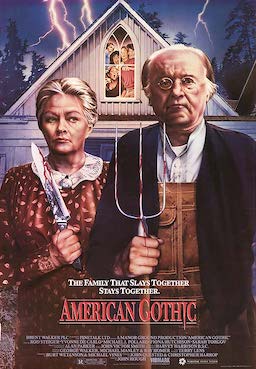
Grant Wood’s painting, “American Gothic,” is undoubtedly his most famous work.  The image is so evocative and suggestive that countless interpretations have been offered for it.  The idea of debilitating isolation suggests itself.  An unhappy self-reliance that has taken its toll on an aging couple (some say the woman is his daughter) often comes to mind.  For some it suggests a movie.  Normally I like horror films from the seventies and eighties.  There’s almost an innocence to them that gets lost in the new millennium.  On a rainy weekend afternoon when I couldn’t be mowing the lawn I found American Gothic on Amazon Prime and it had received four stars and even IMDb showed it as better than average.  The longer I watched the more I was inching toward “bad movie” territory, but I had to see how it ended.

Six young people, four of whom are distinctly unlikeable, have plane trouble and get stranded on a lonely island in the Pacific northwest.  They discover a house furnished from the twenties and it turns out there’s an older couple there who don’t really cotton onto strangers.  As the plot unfolds it turns out they have three adult children who think they’re still adolescents.  And—this is the good part—they are a very religious family (in part.  Again, as often happens in such films, the writers really don’t understand religion).  In any case, the predictable killing off of the kids starts to happen when they continue to be rude and insult the family.  Since we’re in slasher territory here, there’s a final girl—one of the two sympathetic women—who ultimately takes over the house.

Part of the problem with the film is the utter paranoia with which it treats mental illness.  The family clearly has problems and, in a way typical for the genre, they turn toward killing.  Ironically, Pa, when he finds his family has been killed by the one mentally ill visitor (everyone with psychological problems in this movie turns to murder), renounces God and sells himself to Satan.  Interestingly, he doesn’t survive long enough to do anything about it.  Reading about this movie after watching it I came across a new word: hixploitation.  Exploitation movies are familiar to anyone who watches much in this genre, but I’d never considered that Deliverance and company exploit “hicks.”  It’s all about how others look at you.  And, as a movie made in Canada and the UK, it shows us what others see when they look at us.  There’s some ground to explore here in a sequel to Holy Horror


Gods and Crafts

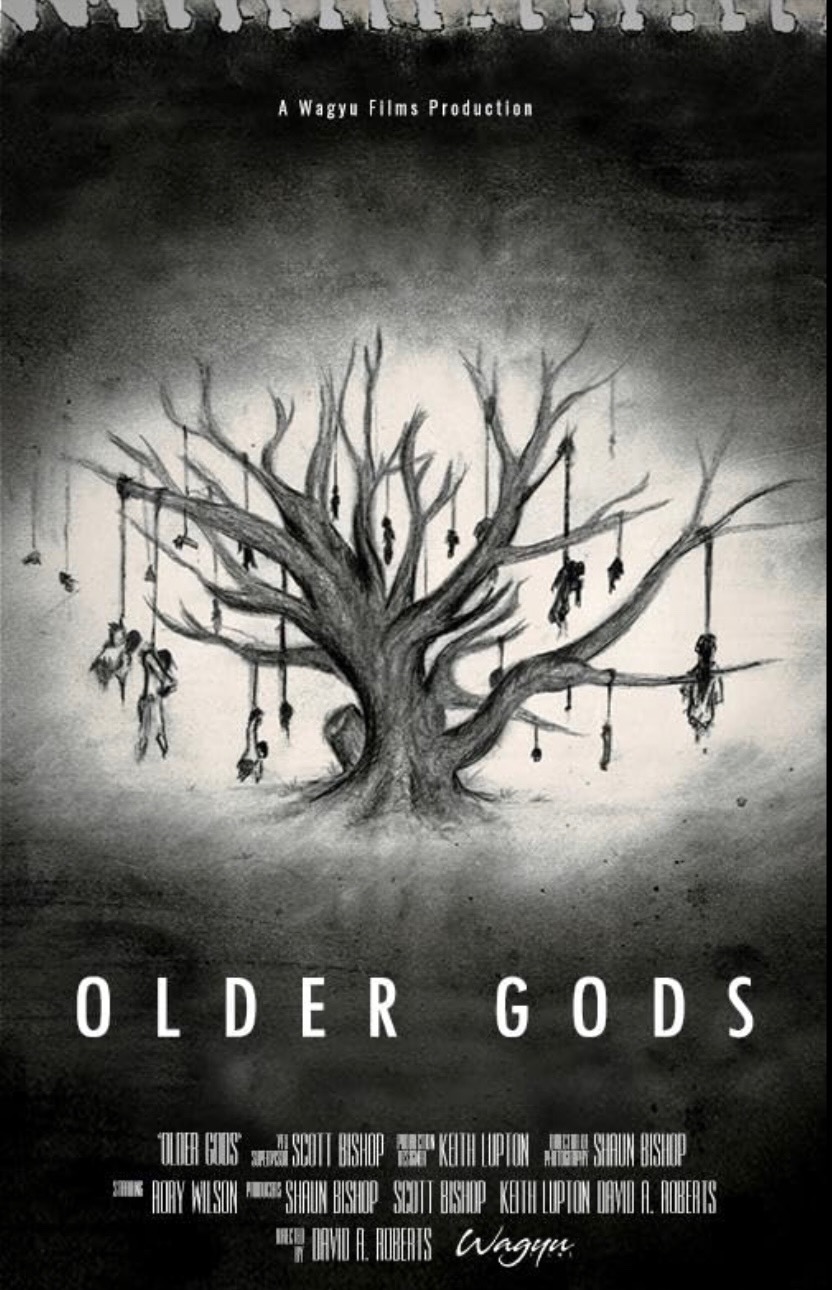
Those of us who write fiction, I suppose, often ponder what it would be like having a kind of writing named after us.  Knowing that’s not likely to happen we might cast an envious eye toward, say Lovecraftian horror, which has become a sub-genre in its own right.  When a friend pointed me to Older Gods, an independent Lovecraftian horror film shot in Wales, I was glad to see it already out on a free streaming site (with commercials, of course).  Winner of several accolades, the movie isn’t easily understood although the plot is fairly simple.  A man has gone to Wales to find answers regarding a lifelong friend’s suicide there.  A recorded message tries to explain what this friend had stumbled upon that led him to his extreme act.  A world-wide underground religion is attempting to awake one of the older gods to bring about the end of the world.

The problem is these devotees of the older gods—one deity in particular, called “The Origin”—hunt down anyone who learns about them.  They give them the choice to join or to have their families killed, followed by themselves.  If they do join, it hastens the end of the world.  In other words, the engine driving this movie is religion.  Shot with a very low budget over a very short span of time, it manages not to fall into the “bad movie” category, and actually edges into the “good” category.  The film crew, reportedly, numbered only seven (no extensive credit roll here), and the story is based on a premise introduced by H. P. Lovecraft.  The older gods, who care nothing for humans, are asleep beneath the sea, awaiting the signal to awake.

Since this movie was only recently released, not much in the way of online summaries is yet available.  The reason this might be important is that Lovecraftian narrators not infrequently go insane.  In other words, is our protagonist a reliable narrator or not?  Did he, like his deceased best friend, go insane?  This is never resolved.  Those devoted to the religion of the older gods are unrelenting.  Lovecraft, famously an atheist, knew the power of religious belief.  His nihilistic universe included a scary place for believers.  When these themes come together, with or without tentacles, we seem to be in territory named after its creator.  Older Gods is a slower paced, thoughtful film that leaves you unsettled.  And there’s no doubt regarding its true origin.


Banned Monk

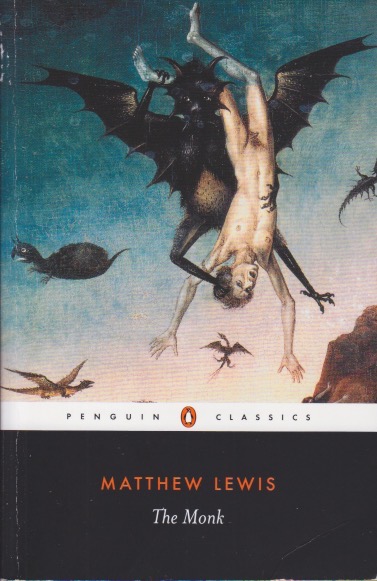
One of the strange things about gothic fiction is that, although often set on the continent, the early practitioners—inventors, if you will—were English.  Three names among them stand out in many treatments of the genre: Horace Walpole, Ann Radcliffe, and Matthew Lewis.  I’ve read the former two and have long supposed I should read the latter’s The Monk.  This 1796 novel made the author famous, but it is long.  And written in the often florid style of the age.  Still, there are plenty of swoons and thunder-plagued nights.  Set in Madrid with a cast of closely related characters, the novel has a twist ending that I did not see coming, which is pretty amazing considering that the book has been out for over two centuries.  (I may have read about the ending before, but had forgotten, if that was the case.)

The novel intertwines two stories that revolve around Antonio, the eponymous monk.  A paragon of righteousness, he heads an abbey in Spain and all are in awe of his piety.  Until sex breaks through his vanity (so we are told; his piety was based on too high a self-regard).  Once seduced, he can no longer maintain his status as chaste, and this sets in motion a tragedy that will leave innocent people dead and lives ruined.  Lewis, it’s famously known, used the novel to critique excesses of the church.  Its power, the novel demonstrates, corrupts.  Still, at the end I was left feeling sorry for Antonio.  He was set up by the Devil and his chances of winning were quite slim from the beginning.

Although PG-13 by today’s standards, the novel scandalized English society when it came out.  The sex scenes were too explicit for the day, especially since they involved the clergy.  The story has quite a leisurely layout, and only after 200 pages (in the edition I read) does the supernatural enter the picture.  Once it does the pace begins to pick up.  The weird thing is, despite its length, this story works.  It’s considered a classic—although often dismissed because gothic literature generally is—it nevertheless delivers.  Antonio is shown to be subject to weakness, and while vain, not inherently evil.  He’s a victim of human vulnerability.  Readers in the late eighteenth century couldn’t see beyond the sex, but there is a tragic human story here.  Castles, abbeys, ghosts, and subterranean passages, murder and torture, it’s gothic through and through.  Although it took most of September to get through it, it feels like I accomplished something worthwhile.  And I finished just in time for Banned Book Week.


Thoughtful Transformation

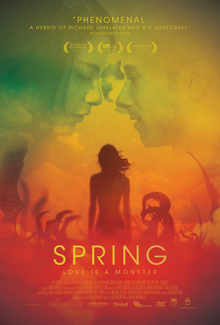
Philosophical horror’s a thing.  A friend introduced me to Moorhead and Benson films—these aren’t major studio productions—and I’ve been watching them as I can find time.  They’re intelligent and tend away from heavy gore, which is fine by me.  And they leave you with plenty to ponder.  I recently sat down with Spring, an unusual movie that sometimes gets classified as science fiction, probably because the lead actress plays a science student.  There will be spoilers here, so if you have plans to watch, please stop and do so now.  Here goes:  The story follows an aimless young man who’d given up college to take care of his dying mother.  To get away, he heads to Italy with no particular destination in mind.  He ends up in Polignano where he meets and is smitten with a young woman.  At least he thinks she’s young.

From the privileged point of view of watchers, voyeurs perhaps, we come to see that Louise isn’t who Evan thinks she is.  She’s a two-millennia-old woman who has to regenerate herself every twenty years to maintain her immortality.  When the twenty years wind down, she transforms into other creatures on the evolutionary scale on the way to humans.  Since she lives on she’s not really seeking a long-term relationship.  This leads to some discussions of religion, which I find intriguing.  Louise is a scientist, however, and even when she transforms into a monster, she refuses to call it supernatural.  Rather, she claims it’s just something that science can’t yet explain.

This perspective really does get at the heart of the debates between science and religion.  Are there things science simply can’t explain?  I.e., are there things beyond science?  Or is science really the panacea for all things?  The problem is that the human mind cannot sense or detect all things.  We don’t even have a clue as to how many things there actually are to detect.  How can one method be used to encompass everything?  Not a bad set of questions to be raised by a somewhat Lovecraftian movie.  Lovecraftian, by the way, due to its focus on the sea and some of Louise’s atavistic transformations.  Spring is an unusual and thoughtful movie.  It’s a love story as well, about willingness to face the unknown for love, and trusting evolution.  The characters are likable and you want them to thrive, which you don’t always get in this genre.  It’s one of the reasons I keep coming back to Moorhead and Benson, and always being glad I came.


Cabin Stories

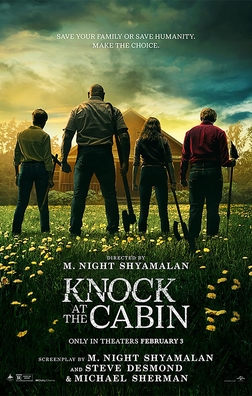
Almost always I come out on the same side of the debate.  The book is better than the movie.  The book allows things to be explained more fully and is the way the story is “supposed to go.”  Maybe it’s because I found the novel open-ended and I like closure, but M. Night Shyamalan’s Knock at the Cabin, in my humble opinion, is better than The Cabin at the End of the World by Paul Tremblay.  Now, the author’s title is better, but Shyamalan’s explanation is clearer.  In short, I think the movie works better.  If you’re not familiar with the story, four apocalypticists, responding to visions they’ve had, break into an isolated cabin occupied by a vacationing family of two daddies and an adopted daughter.  Shyamalan characteristically shifts the cabin’s location to Pennsylvania and, yes, before you think it’s all Philadelphia, there are some very isolated places in my home state.

These weaponized apocalypticists subdue the family and inform them that unless they decide which one will be sacrificed, and then carry out the deed, the world will end the next day.  The adult couple tries to explain rationally how crazy this all is.  How could four people be given this hidden knowledge and be tasked with saving the entire world?  It seems more likely that they’ve targeted a gay couple and are trying to break up their family.  One of the things the movie makes explicit that the book doesn’t is that the intruders are correct.  This is the end of the world.  In order to achieve this, Shyamalan had to rewrite the ending to remove the ambiguity.  For some of us, that really helps.

The movie, in a way that a brief blog post can’t replicate, includes quite a bit of dialogue about religion.  Religion and horror are often bedfellows, and this is one of those movies that relies on religion to fuel the fear.  Interestingly, the cabin invaders aren’t stereotypical conservative Christians.  In fact, they appear to be mostly secular everyday people who have come together around a vision that they all had in common.  In the novel there’s always some question whether this is an elaborate hoax whereas the movie makes it clear that the death of each individual apocalypticist unleashes a plague.  Indeed, they are, as the couple finally realizes, the four horsemen of the apocalypse.  Since I’m still here to tell you about it, the end of the world has obviously been avoided.  This movie is worth seeing, even if the novel has a better title.


Christian Horror

Following the lead of a friend (I don’t regularly read Christianity Today on my own), I found “How Horror Uncovers Our ‘Holy’ Hypocrisy,” by Sara Kyoungah White.  It seems that some evangelical Christians have begun to notice the popularity of horror movies.  This isn’t the same as condoning, of course, and this article took me back to the writing of Holy Horror.  One of the reasons for the book was that, at the time, few people (very few) were exploring religion and horror.  Web searches inevitably brought up the question “is it okay for Christians [subtext, “evangelicals”] to watch horror?”.  Since that time I’ve been exploring why the connection of horror and religion is so appealing.  If you’re a daily reader here, no doubt you’ve noticed it before.  I read on, noting that White has a difficult time finding anything redeeming in horror, apart from trying to stretch it to cover the usual evangelical concerns.

Photo by Stefano Pollio on Unsplash

Some of us, however, are seeking a kind of holy grail—an articulation of how horror contributes positively to spirituality.  That it does is beyond question.  The real puzzle is why.  It might help if we had a better definition of spirituality.  What exactly do we mean by that?  Even some of my Unitarian friends are put off by the word.  Still, it’s part of the human make-up.  You might call it “mind,” “psyche,” “personality,” “spirit,” “consciousness,” or “soul”—or any of a host of other words—but there’s something about people that makes us reflect on realities outside ourselves.  Some of do it with a great deal of awareness that we are undertaking such a quest.  Others may seldom or never think of it consciously.  We all do it, however.  We don’t all use horror to help us think through, or experience it.

I have long used movies for therapy.  It’s only been in the last several years that I’ve begun to notice that horror puts me into a spiritual frame of mind more than other movies tend to.  White notes “nearly every one of the top horror movies of all time deal with some kind of Christian theme or portray a Christian character.”  Some of us have noticed that in the course of our exploration of the genre.  Of course, that depends on how we decide on “the top horror movies of all time.”  The list she cites is the ever-shifting IMDb “Top 50 Horror Movies” list, which has far too many recent films on it.  Still, her claim holds if you go back to the classics and move forward.  There’s definitely a connection there, and, I suspect, it has nothing to do with the showcasing of our sins.


Fear and Reviewing

I have a confession to make.  I don’t always read reviews of my books.  I’m always a little scared, even though they made it through the review process and were accepted for publication, there will be those who don’t like them.  I’ve only seen three full reviews of Nightmares with the Bible and two of them were negative.  Eventually, however, I generally come around to taking a look.  Yesterday I found the first review of The Wicker Man on FilmJuice.  It took some time before I could settle down to read it, and to my great relief it was a positive review.  You see, I knew I was taking a chance by writing this book because I was approaching the movie from an unexpected angle.  That often makes fans uncomfortable.  I’m glad that at least one reader found it worth his time. (By the way, I tried to leave a thank you but WordPress, ironically, wouldn’t let me log in—hey guys, I’ve been blogging here for 14 years!)

I’ve watched horror movies since I was a kid.  I started writing about them in 2009, back when I started this blog.  It was tentative at first, being trained as a religion scholar as I was.  I think many of my early readers didn’t know what to make of it when I wrote about horror—wasn’t this a blog about religion?  Well, actually it’s a blog in the old sense of the word, a log.  Ship logs and diaries both depend on what’s going on at the time.  I still work with religion for a job, but I rely on horror films to help me make sense of life.  Since I watch them, I write about them.  Holy Horror was a bit of an experiment for me.  It didn’t exactly become a best seller, but it brought me into the conversation.

Holy Horror was the first book where I discussed The Wicker Man.  I’d discussed it many times on this blog, of course, but having a book published means that somebody’s invested in your thoughts, or at least thinks they can make a buck or two from them.  (This blog is entirely non-profit.)  I knew the Devil’s Advocates series was lacking a volume on The Wicker Man so I asked the series editor if he’d be interested in a new angle.  That set the direction for the next couple years of my life.  Despite my skittishness, I’m delighted to have a positive review on my reading of the film.  If negative reviews come (and they likely will) I’ll at least have the satisfaction of knowing one reader gets what I’m trying to do here.  And I confess that it feels good.