The Call of Madness

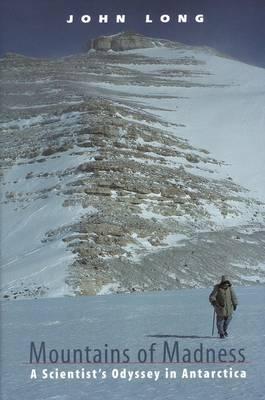
mountainsofmadnessPicture this: the wind is howling outside your tent, violently snapping the fabric. The temperature outside is well below freezing, and you are camping at the base of a mountain nobody has ever explored. You are hundreds of miles from any possible help, in the midst of Antarctica. What do you do? Read H. P. Lovecraft’s “At the Mountains of Madness.” At least that was the decision John Long made on his journey to collect fossil fish in the most inhospitable continent on the planet. Mountains of Madness: A Scientist’s Odyssey in Antarctica is one of those rare books where a rational, educated man of empirical approaches allows the creative, emotional aspect of life speak. I picked the book up at a library sale, based solely on the title. I recognized the Lovecraft in it, and wondered whether it was accidental or not. Besides, reading about polar regions has always fascinated me. Indeed, according to the records of those who’ve trespassed into those regions, madness is not a rare consequence.

Long’s book is not religious, but it is filled with wonder. The mechanistic science that’s often fed to the public is frequently technical and lacks those mysteries we’ve evolved to love. Nowhere in this book is the compelling aspect more relevant than in Long’s accounts of Christmas. The population of Antarctica—a select group by anyone’s standards—is mostly scientists and technicians. Deep field expeditions, it stands to reason, take place in December, which is the summer of Antarctica. In the case of those in the field, they are far removed from their home base, and even the earliest explorers noted in their diaries that Christmas was celebrated, in however minuscule a manner rations and perilous conditions allow. Nobody bulking here that it’s all just a myth.

Lovecraft’s story places explorers far from help in the mountains of Antarctica where they discover they’re not alone. The story inspired such movies as The Thing from Another World, and therefore John Carpenter’s The Thing. Lovecraft, like Long, was a disciple of science and yet, even in his atheistic world deities break in. It’s like Lewis’s Narnia where endless winter with no Christmas is unbearable. Long makes it clear in his account that Antarctica changes a person. Transcendence, those of us who linger over religions know, can express itself in many different ways. For some it is the grandeur of barrenness and inhospitable weather of an unfeeling environment where both macro and micro-predators have trouble surviving and penguins gather to struggle through weather humans can barely tolerate. For others it is camping below the very mountains of madness. Without some wonder, we just don’t survive.

Engineering Meaning

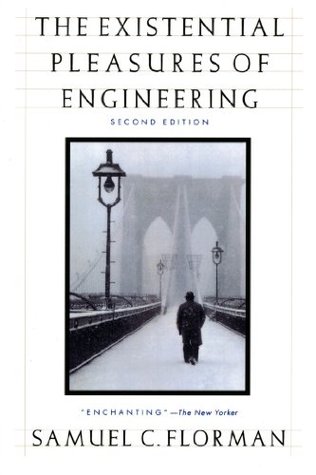
ExistentialPleasuresofEngineeringEngineers have been a part of my life in many ways. My mother’s father was an engineer. Although she did not know it, my grandmother’s grandfather was also an engineer. My wife’s father is an engineer, and grandparents on both sides of her family were either scientists or engineers. My daughter is studying engineering, and other relatives have made it their profession. In fact, had the peril of my everlasting soul not caught my early concern, I would likely have headed into the sciences myself. Not that I would have made it in the profession, but the interest is certainly there. Many years ago my wife bought me a copy of Samuel C. Florman’s The Existential Pleasures of Engineering. Unlike my claims about engineering, I can boldly declare myself an existentialist. The moment I found out what existentialism was, I knew it was my outlook. Now that I am firmly settled in a profession about as far from science and engineering as I can be, I decided to read the book.

Quite surprisingly, I found Florman turning to religion from time to time. Existentialism isn’t inherently religious, but engineering is inherently empirical. Florman notes that the New Testament, with its spiritual values over the physical, often presents serious problems to engineers, enmeshed, as they are, in this universe. That made sense, even if it surprised me a little. A few pages later, however, I was astonished that Florman praises the “Old Testament” for its more earthy viewpoint that has a great appreciation for the physical world its god has created. Perhaps there was a reason my life took this track after all. Although I’m not Jewish, I always felt an attraction to the Hebraic outlook. Maybe I should’ve been an engineer.

Toward the end of his extended essay, Florman once again turns his thoughts toward the spiritual. Noting that massive works of engineering tend to evoke the divine—the most obvious, but by no means only, example being cathedrals—we glimpse a sense of the sublimity in the greatest of human edifices, sacred or secular. The engineer still has recourse to the spirit which is, to a frustrated scientist, a cause for great hope. When I pulled a book on engineering off the shelf, I certainly did not expect to find any religion in it at all. Of course, the book was written before science and religion had become entrenched in such a shrill standoff as they seem to be today. There is balance here, and an appreciation of beauty. And when the engineer does the impossible, it is indeed a work of human divinity.


Vive la différence

Scientists, those to whom society has passed the responsibility for knowing, have an increasingly difficult time defining humans as opposed to other animals. Still, we know a person when we see one. That’s when the crucial ethical issues arise: how should we treat others? Two unrelated articles about human rights recently came across my virtual desk: one about Disney’s Beauty and the Beast and another about how religious rights sometimes/often hamper human rights. There’s so much to sort out here, and I’m not even one of those that society deems fit to do such sorting. Well, I am human, so perhaps I can give it a shot anyway. In an article in Friday’s The Guardian, Deborah Orr points out that for progress in human rights to move forward, rights for the freedom of religion have to take second place. Clearly she’s onto something because, historically, one of the greatest enemies of human rights has been religion. Labeling suffering as virtue, it’s relatively simple for religions to suggest that the lot of the oppressed is to bear suffering so that the faith can continue untainted. After all, those religions with an afterlife, in any case, declare that it all gets sorted in the hereafter.

Orr makes a very good point: we are all human, but we may not all share religion. Isn’t the need of the whole greater than even the need of the many? Utilitarianism would declare it so. So would common sense. (Science warns us not to trust common sense, however.) Some of the harshest violators of human rights continue to be religious traditions. Others are heathens, pagans, infidels, heretics, beasts—take your choice—and therefore displeasing to some divine being, generally male and either hetero- or asexual. Oh, and he’s from the Middle East, ethnically. Over on PhotoBlip.com, a piece about Beauty and the Beast makes the point that Gaston, the strapping, über-masculine antagonist of Belle’s provincial town, is frightening because the people so easily follow him. He whips the crowd into a frenzy because, as a thoughtless but handsome (and ripped) figure, people naturally do what he tells them to. He is a dangerous, selfish bully, and many politicians have learned their tactics from him. Belle, a bookish girl, is considered odd and in need of domesticating. The beast is deformed and in need of killing.

We could learn a lot.  (Photo credit: Brian Forbes, WikiCommons)

We could learn a lot. (Photo credit: Brian Forbes, WikiCommons)

These two stories, from very different sources, point in the same direction: tolerance is the only humane response to a complex world where lots of different types of people live. Still, the problem isn’t wholly a religious one. Human rights insist that all people have access to the basic necessities of life, and, ideally, the possibility of flourishing into what they desire to be. Some, however, desire to dominate. With or without religious backing, this Gaston-esque drive to bully is all too real since might does seem to make right, and even some political darlings get their way by being bullies. One of the most poignant points that religion has ever made is that you can identify the divine by its willingness to lay down power and identify with the weak. We are seldom presented with that side of the gospel truth, for there is a paradox at the heart of it, and people want clear answers, not puzzles. Even science, however, when pushed far enough must answer with a paradox. Is light a wave or a particle? Some religions would say that light is a gift of the divine.


Reach Out and

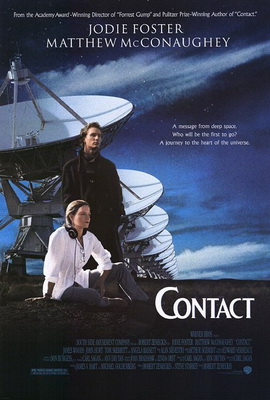
Contact_ver2Carl Sagan, one of the great proponents of the idea that earthlings have never been visited by aliens, wrote a novel entitled Contact. I haven’t finished reading it yet, but many years ago, on a long plane ride, I caught part of the movie version—most of it without the sound on, as I recall. While the ideas have been brewing for about a decade, I’ve been meaning to get around to watching the film. It is a bit of a slow-starter, but I finally sat down to watch it, with sound. While the movie ultimately remains agnostic—with a Twilight Zonish twist at the end—about whether the contact is truly alien or not, one aspect leaves no room for doubt: the movie is really about the relationship between religion and science. Eleanor Arroway cannot raise faith in anything but science, especially since her father’s premature death. Although she has a brief affair with Palmer Joss, a theological journalist, she just can’t believe what her senses don’t confirm.

Once the alien signal is announced, the response of the populace is overwhelmingly religious. One sect in particular seems to channel its faith into the hatred of science, and even Palmer, now an advisor to the president, questions whether science alone can really help humanity to progress. He is the one who nails shut the coffin of Dr. Arroway’s hopes of going to Vega to see the aliens. The reason: she doesn’t believe in God, and therefore is not qualified to represent the human race. Ah, the cruel irony of it all. When she finally does get a chance to visit space, the results are both Freudian and religious. She finds her father in a place like heaven, but her beloved science makes no record of her journey. At a congressional hearing she is made to admit that she believes in what happened without proof. Science is now standing on faith while the religious look smugly on.

Despite the pacing, Contact is an enjoyable movie. In many ways it hasn’t aged much since its 1997 release. Science and religion are still at loggerheads in some camps, and we are no closer to the stars than we were a decade and three-quarters ago. Reading books on the nexus of religion and science, one often gets the impression that the two are inevitably foes. Much of it goes back to a principle that recurs throughout Contact—Occam’s razor. The idea that the simplest explanation is the best does not seem to serve science (or religion) well. Although it works most of the time, it is because, as a friend recently said, we are willing to sweep the stuff that doesn’t fit off the table. Contact showed Occam’s razor with its indiscriminate cutting. Both the religious and the scientific end up bloody when it’s all over (metaphorically speaking, of course). It seems what religion and science really need is indeed contact.


No Singing Matter

Canticle for LeibowitzA Canticle for Leibowitz, by Walter M. Miller, Jr., is one of those books that I read years ago, and when I picked it up again found that I remembered very little of it. I suppose this is one of the hazards of extensive reading—some important things get lost in the noise. I recall having read A Canticle for Leibowitz when I was a grad student at Boston University, and I remembered the detail of a grocery list being taken for holy writ in a post-apocalyptic world where, in a strange reincarnation, monks have once again become the guardians of knowledge. Little else remained. Perhaps part of the reason is that the book requires more experience with the church than I had in those days. One might suppose a seminarian would have about as much ecclesiastical experience as one might need. Not so. It did teach me, however, to read provocative books.

Like most dystopias, there is a deep bleakness to A Canticle for Leibowitz. In the light of recent developments in the papacy, the book is remarkably prescient. In the final pages of the final section, a radiation-sick woman and her young child, in constant pain, seek the government sponsored euthanasia camp. Abbot Zerchi, however, condemns this as a sin against God. Doctrine takes the place of compassion, and only moments later the final atomic strikes wipe the abbot and his monks off the earth forever. Yet there are monks on a spaceship, ensuring that any future planets will have the same uncompromising doctrine planted there as well. For a book published in 1959, it sounded incredibly contemporary. Miller’s anger still echoes throughout. The church builds societies that destroy themselves. A cycle of futility.

I wonder what the result would be if more people read such stories. It is, of course, easy enough to shut out any implications we don’t like and claim it is all a silly piece of fiction. The problem is that Miller is not too far off base. Our civilization does own much to its religious institutions. Those institutions sometimes have considerable trouble relinquishing control when society finds its grounding in science and technology. It is difficult to believe divine proclamations from above in the age of the space telescope. Yet, even so, we still elect to power politicians who look back millennia for the instructions on how to treat those of other genders or races. To do so, as Miller recognized, is to begin building bombs all over again. And even old Ecclesiastes declared that there is, in a Leibowitzian twist, nothing new under the sun.


Tempting Truth

Recently I was discussing the internet with friends. Real ones, I mean, physically in the room with me. One asked if the internet made conspiracy theories more believable. My response was that the internet has changed truth. That probably seems like a bold statement, I know. Truth, however, is an abstract very difficult to pin down. Science, for starters, does not deliver truth. Science is theoretical, and since it is falsifiable, a scientific theory, while based on facts, is always contingent; it is the best explanation that we have at the moment. Scientists generally know not to conflate this with truth, deferring the latter to the realm of philosophy. The average person probably conceives of truth as that which is literally real. Reality itself is, however, a very slippery concept—quantum physics reveals realities where many are not comfortable going, and which very few truly understand. Truth is a philosophical concept that reflects what humanity collectively accepts to be reality. It is in this sense that the internet has changed truth. It is the Wikipedification of the mind.

People, for as long as they’ve had the luxury to consider abstracts, have struggled with the question of truth. For a few centuries—almost a couple of millennia—in much of the western world, the Bible was considered a source of truth. If it was in there, it was true. The source of authority here was that of a deity who oversaw the writing of the Bible, word by sacred word. When science began to demonstrate that this Weltanschuung was untenable, people realized that truth was a bit more complex. When westerners came into contact with other religions, the complexity grew. Large swaths of humanity believed things completely different from the rest of us. What was the truth? A rear-guard action was often the result. Those who had the Bible had the truth already, and since truth doesn’t change, what more was there to be said.

Truth or dare?

Truth or dare?

The internet is not yet a mature adult, but an entire generation has now grown to a kind of maturity with it. It is the first line of recourse for true information. Who has a phonebook in their house anymore? When is the last time you opened a physical dictionary? Some of us routinely look up Bible verses online, since the internet is the ultimate concordance. Instead of turning to the Bible, or any other source, we turn to the collective “wisdom” of humanity as the measure of what is true. Snopes aside, we plow ahead with what we read online, confident that with all those millions of users, we just can’t be wrong. How strange a concept to unplug and look at the actual reality behind the screen. We might be surprised to learn that there are great and terrible wizards back there after all.


To Be, Or

Science and Nonbelief

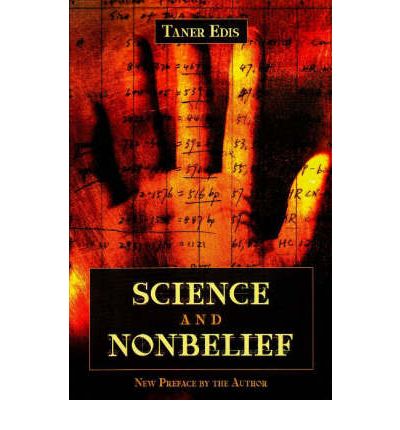
Science is, according to Taner Edis, ambitious. While Science and Nonbelief is somewhat sympathetic to the religiously minded, Edis demonstrates how science aggressively tackles the issues steadfastly claimed by religions, and ultimately triumphs. Interestingly enough, early on in the book Edis notes that “truth” is a philosophical concept, and science operates on the principle of the best explanatory theory of the moment. So far I am in complete agreement. I guess the part that gives me the most trouble is the assumption that reason is the only way of knowing. Perhaps I’m just not enough of a scientist to know such things, but it appears to me that all “lower” animals appear to get along very well in the world without great doses of “reason” that supposedly catapult humanity far above the other species. Scientific observation would seem to confirm that many animals feel emotion—after all, what is fight or flight if not an emotional response? And since we are animals, I reason, have we lost something when we leave feeling aside as a way of knowing?

Edis is quite fair-minded. He notes that science has no way to prove or disprove the existence of a deity, or deities, but he also states that the empirical method is so successful that a spiritual world is no longer required. He may be correct. The vast majority of the people in the world feel he is wrong, however. I may state this since we know, statistically, that most people in the world believe in some form of religion. Rational or not, here they come! It would seem that evolution has endowed us with religion, or an awareness of something we feel rather than reasoning out. And yet, we are told, science takes no prisoners.

I often ponder the fact that no one person has all the answers. Part of the human condition involves possessing limited resources for specializing in too many fields. Polymaths become rarer each year as specialists grow more and more precise. In this great mix of human learning, science often steps in and claims all the marbles belong to it. The rest of us have lost ours, apparently. There’s no denying that applied science has been very successful in bettering our understanding of our universe and our lot in the world. That doesn’t mean that all will believe in it. The title of Edis’ book is apt; belief is the real issue in attempting to fit religion and science into the same world. It is quite clear that religion doesn’t explain much in the way of the natural world. I wonder, however, if science is really capable of encapsulating all of what it means to be human.


Continental Religion

In the course of my duties as an editor of religious studies, I was pondering the origins of the world’s major religions. Now, agreeing on what the major religions are is an exercise fraught with political incorrectness. What does “major” mean, after all? In any case, when we count in terms of numbers, there are more Christians, at the moment, than any other single religion. They are followed by Muslims and Hindus. So far there is little upon which to disagree, at least according to self-professed affiliations. Buddhists are usually counted as the next largest group, followed by Sikhs. When religionists mention “the big five,” however, they usually mean Judaism, Christianity, Islam, Hinduism and Buddhism. There are likely far more followers of traditional Chinese folk religion, perhaps mixed with Confucianism and Taoism, than most accountings record—such beliefs aren’t neatly categorized. Jains make up a sizable population, and Shinto is often classed in with all those religions of the far east. Many of the more modern religions, such as Mormonism and Jehovah’s Witnesses, sprang from Christianity, and so can safely be classed as a form of that faith.

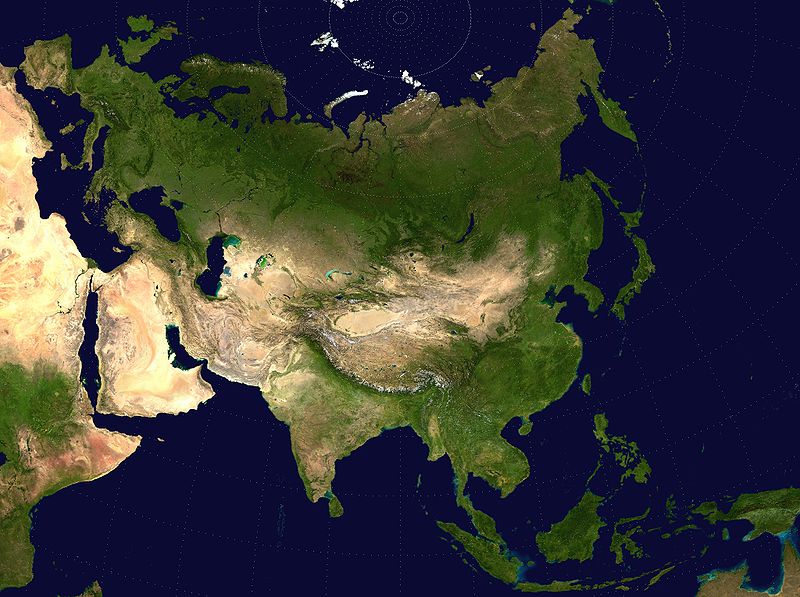
What occurred to me that day was that all the major religions of the present world began in Asia. Judaism and Christianity, with all their numerous progeny, started in Israel or Palestine. Islam, as we all know, began in Arabia. Hinduism, Buddhism, Sikhism, and Jainism all have their origins in India, the big winner for the seed-bed of religions. Traditional Chinese religions and Shinto trace themselves to the far east. Yes, there are indigenous religions throughout the world. Native American and African religions are not to be discounted, yet they never quite attain the level of public awareness to be qualified as “major” religions. In this spiritual accounting, “major” has nothing to do with importance. For the religions with the largest followings we must turn our eyes to the one-stop continent, Asia.

Where major religions begin

Where major religions begin

Considering this, the obvious question is why. Why Asia? Civilization itself began in Asia, and one of the marks of a civilized society, at least until the day of the New Atheists, has been religion. Religion may be abused, as might any human innovation, but it has also been a harbinger of a more civil world. Not only fear of the divine, but also a sense of gratitude toward whatever forces might be greater than humanity, allowing us to survive for another season, or through another storm. Even in the world of science, religion has been a motivator. Gregor Mendel, the scientist who gave us genetics, was a monk experimenting in a monastery. Sir Isaac Newton was an occultist. Francis Collins is an evangelical Christian. Religion is at least as old as civilization. Its forms may be morphing, but, I suspect something our Asian forebears knew: religion will never truly go away.


Bridge over Troubled

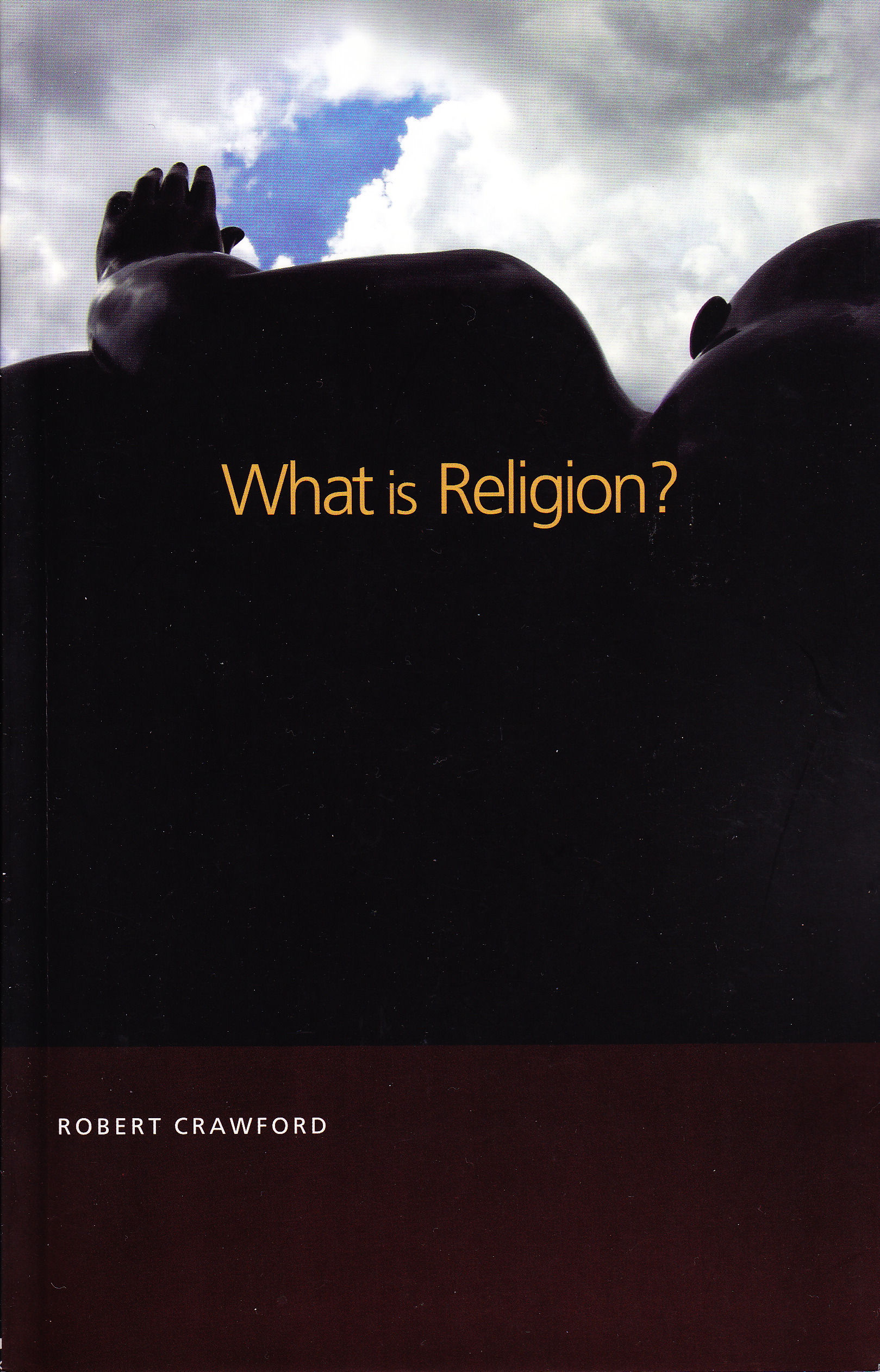
ReligionThe fundamental question of what counts as religion remains elusive. I read Robert Crawford’s What is Religion? hoping to find out. Crawford begins with the admirable assertion that in a pluralistic world all religions must learn to get along. Unfortunately, learning hasn’t always been one of religion’s strong suits. And we still don’t even know what religion is. As becomes clear within minutes of starting the book, consensus will be a stranger in this room. Nevertheless Crawford plows on, hoping against hope that comparison will reveal conformity. Religions aren’t really team players in that way.

Crawford keeps his focus on the “big six”: Judaism, Christianity, Islam, Hinduism, Buddhism, and Sikhism. Although these faiths contain the lion’s share of numbers, they in no way corner the market on religion. I wonder if Crawford’s net is really large enough. When trying to define religion, cutting corners gets you into trouble every time. No matter how we count it, religion is more than a matter of belief and broader than prescribed rituals. It must take seriously the attempts of even small knots of seekers in its preternatural accounting. Crawford sometimes gets bogged down in the details. Science plays a key role in his discussion but then the scope shifts to Christianity, a religion with more than its share of scientific troubles. Islam, for a while anyway, led the world in scientific thinking. What of Sikhs and science?

The more I read of What is Religion?, the more I got the feeling that all of these pieces don’t go to the same puzzle. Religions develop out of historical circumstances and needs. They, with a few exceptions, are not consciously devised by a bunch of eggheads shut up in ivory towers. Religions develop from people in difficult situations, whether physical or psychological. Think about it. If the Bible is to be believed Judaism grew out of slavery in Egypt (either that or Abraham’s childlessness). Christianity out of Roman oppression. Islam from Muhammad’s conviction that polytheism didn’t add up. Hinduism’s old enough to have lost its origins in deep antiquity, but Buddhism is clearly a reaction to pervasive suffering. Sikhism tried to steer between the clashes of Hinduism and Islam. We could go on, but I don’t wish to try your patience. I’m not suggesting I’ve finally done the impossible and defined religion. In fact, I may be suggesting the opposite. Religion encompasses many ways of being in the world. Crawford maybe got a start on the discussion, but it will go on as long as people have troubles.


Monkey’s Uncle

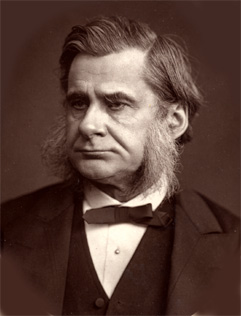
T.H.Huxley(Woodburytype)

An opinion piece in Saturday’s New Jersey Star-Ledger highlights the 150th anniversary of T. H. Huxley’s Man’s Place in Nature this month. Well, Huxley may be forgiven for writing in the idiom of his day—he was Darwin’s contemporary after all—when he really meant humanity’s place in nature. The article, by Brian Regal, points out the common fallacy that evolution, as propounded by Darwin, says that we descended from monkeys. Quite apart from the insult to monkeys, Huxley was the one, as Regal notes, who made explicit something about which On the Origin of Species kept decidedly mum: the evolution of humans. People did not descend from monkeys. Nobody except religious opponents ever suggested that they (we) did. Evolution is a biological fact, and monkeys are evolved just as we are evolved. We had a common ancestor somewhere back a few millions of years ago.

This neverending story of religion (of some sorts) fighting evolution should capture the fascination of anthropologists, sociologists, and psychologists. It shouldn’t be ignored. Darwin wasn’t trying to start any fights. Huxley, well, he may have been, but with good cause. The facts, even in the 1850s, were definitely pointing to descent with modification. In fact, breeders of dogs and pigeons and other animals had known this for centuries. All that Darwin and Huxley attempted was to be intellectually honest with the evidence. It was religious believers who, reading between the lines, picked this fight. The Bible, after all, seemed to say we’d been created on day six (or day one, if you read Genesis 2 literally), and that meant science had to be wrong. Religion is used to setting its own terms. The debate is in the cathedral, not in the academy. Although by the end of the nineteenth century nearly all major branches of the church had come to some kind of understanding of the facts, the issue flared up with again around the time of the First World War with the advent of “social Darwinism.” Then, the religious objectors claimed, we did not descend from monkeys.

Funny thing is, Darwin and Huxley would’ve agreed. Instead, insidious motivation was attributed to some of the greatest minds in science. Accusations were made that everything in the lives of both Darwin and Huxley gainsaid. Natural selection made Darwin ill with its implications, but he could not shy away from the evidence. He believed in truth. Although Huxley coined the term “agnostic” to define his position, he had good reason. The biographies of these scientists are well worth reading before making accusations. So as we stand (or more likely, sit) on the sesquicentennial of Man’s Place in Nature, it might be a good opportunity to assess whence the friction is arising. We claim, in our still limited understanding, that monkeys can’t speak. (I’ve seen the movies and I know differently, nevertheless…) If they could, I imagine the debate would go something like this: “those hairless creatures who say that we are less important than they, they have the audacity to claim a common ancestor with us? Maybe evolution is a myth after all.”


Two Ways

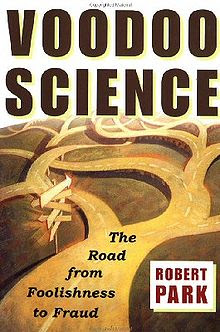
In my own attempt at balance, I turned from reading about the world of literary possibilities to a book on the inevitability of the scientific method. Robert Park’s Voodoo Science: The Road from Foolishness to Fraud is an enjoyable jaunt through the distressing world of pseudo-science. The reader quickly discovers, however, that Park shares in the same scientific orthodoxy as Richard Dawkins (and many others) that claims since science works it is obviously the only way of demystifying our world. I admit that when I read of our government spending billions of dollars on projects put forward because our elected leaders know less about science than I do as a specialist in religion, I grow quite upset. More money than most of us will ever earn in a lifetime has been poured into projects that defy laws such as First and Second Thermodynamics. I learned those laws in Junior High physics and have never attempted to violate them. Even when scientists explain to elected officials in congressional hearings why these proposals simply can’t work, the pork barrels, once opened, are difficult to close.

Like many scientists, Park envisions a world where religion (same as superstition) is slowly losing its explanatory power and people will eventually have to admit that we are just acting out the role pre-determined by the laws of physics. We are fleshy machines, sometimes pretty flabby, but still machines. Ironically, when Park wants to express the seriousness of scientific review, he resorts to religious language. In explaining how peer review for scientific journals works, he notes that objectivity is a “sacred obligation.” Now, of course, one can argue that this is just a metaphor, language that non-scientists can understand. I wonder if it goes deeper than that. Reality, whether sought by scientists or religious believers, rests on the idea that there is only one truth. This, and not the incidental differences between theologies, is the reason for nearly all religious conflict and the “war on science.” There is, we are told in our Aristotelean world, only one possible Truth. Why?

Scientific theory, no less that superstitious theology, finds a unity of truth sensible and comforting. I wonder if the truth (and I use that word advisedly) is more complicated than that. No strict necessity exists for a single truth. (I am awake of Occam’s razor, but I don’t shave.) In fact, truth is a philosophical, not a scientific, concept. The problem is that societies tend to break down if they don’t share a view of the truth. There can be no doubt that science, done properly, works. The existence of the very internet where these virtual words reside is proof of that. That does not mean, however, that other truth can’t exist side-by-side, simultaneously with it. Scientists are duty-bound to declare a singular, physical universe because of the sacred trust of seeking the Truth. My bi-cameral mind just can’t see the necessity in that. But then again, I prefer a world with some mystery left in it. No thanks, I don’t shave.


Supernaturally Selected

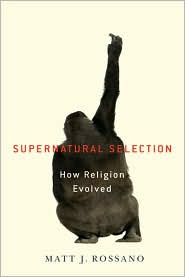
Things are seldom as simple as they seem. Religion, for example, is frequently cast as the villain or the hero of human society, when, in truth, like most human institutions, it is a little of each. I’ve read many theories on the origin of religion, and none has been completely convincing but most contain persuasive aspects while I’m reading them. After having read several books proclaiming the end of religion in the last several months, I just finished Matt J. Rossano’s Supernatural Selection: How Religion Evolved. Many books with a similar goal begin with the suggestion that religion may have had some biological utility for people at one time, but that we’ve outgrown our need for it and we should classify it with other obsolete, arcane concepts that have no further purpose. Rossano suggest that religion grew out of the need for social bonding and that we could not have become human without it.

Basing his ideas on genetics and anthropology, Rossano notes that even with our genetic similarity to chimpanzees there remain striking differences. Mostly they are social in nature. Many of the differences are reflected dimly in our primate cousins, but the human penchant for gathering in groups with ritual behavior to offset overwrought emotions applies only to us. That ritual behavior includes healing rites, something that Rossano suggests might be the earliest, shamanistic, religion. Back in my teaching days I’d been telling students that the earliest evidence for religious behavior dated to the paleolithic period. This is something I’d reasoned from the artifacts found in pre-historic communities. I was happy to find confirmation in a more competent scholar than myself.

While I’ll no doubt revisit some of the fascinating hypotheses of Supernatural Selection over the coming days, one point especially stood out on my initial reading. Religion is a communal phenomenon in what is a largely individualistic society. In other words, religion itself continues to evolve. Even the hermit in his or her cave is only considered religious in comparison with his or her less dedicated, secular compatriots living la vida de fe. Since religion is communal, Rossano suggests, it is impossible to argue someone out of their religion—based on perceived relationships as they are. Indeed, it seems that his hypothesis predicts a behavior we find only too evident when we prepare to line up at the polling booths, but which will immediately fall into the background again once the level is pulled.


Liberating Science

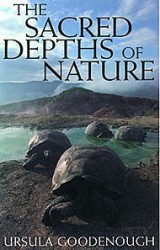
The fact that prominent scientists occasionally take time from their busy schedules to fire off a broadside against religion and religious believers freely bare their fangs at science shows that we need some efforts at reconciliation. I am reminded of schoolyard bullies when specialists in either realm make claims of exclusivity. Religion and science are both here to stay, and they’d better learn to get along. I just finished reading the remarkable little book The Sacred Depths of Nature by biologist Ursula Goodenough. While declaring herself a non-theist, Goodenough, the child of a Methodist minister, preserves a profound respect for the sacred in a concept she calls “religious naturalism.” Her brief book, which a colleague compared to a daily devotional, contains more good sense than all the enraged professionals bellowing at each other from either side of an unbreechable gulf. Uncompromising in her science, Goodenough is not suspicious of the human religious impulse, but embraces it in the expressions of nature. It is an approach I found liberating and amazingly conciliatory. It lacks the territoriality of Stephen Jay Gould’s Non-Overlapping Magisteria (NOMA) and preserves the integrity of the human person in all its complexity.

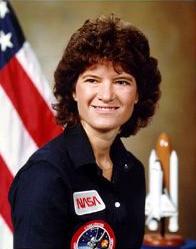
The day I finished the book the headlines of the paper announced the premature death of Sally Ride, another woman who moved science in the right direction. Ride’s sister is a Presbyterian minister, while Ride herself was a physicist as well as the first American woman in space. Aboard the space shuttle Challenger, she made history also as the youngest American in space. Typical of the imperialist national attitude that unfortunately still reigns supreme, space had been tacitly declared a man’s world. Sally Ride shattered that glass ceiling at 17,500 miles per hour. Even so, change seems to have decelerated once again to far below sub-orbital speed. Religion is partly to blame. A deep component in our culture, religions in the western world have traditionally asserted male superiority. Even those who claim God to be sexless can’t really conceive of a big person without some gender. The day after her death and the headlines had shifted from mourning to astonishment that she was gay.

The loss of Sally Ride is a loss to science, for she was in the heaven formerly occupied by God, showing women the way. I am, however, comforted by the efforts of Ursula Goodenough to keep the dialogue open. Too often, it seems, that conflict is the cost of disagreement. One of the observations of astronauts is that long periods confined with the same small coterie of people lead to inevitable disagreements. The question facing us all—for our planet is not so large after all—is how we will choose to deal with differing worldviews. It was declared that science would eventually bury religion, once reason had taken hold and superstition had run its course. Although the grave was dug, it has never been filled. Maybe we should all read the sensible approach of Goodenough and just be glad that we’ve all had a chance to be here at all. And remember Sally Ride as a fearless explorer, a hero rather than a spectacle.


Holy Hypothesis

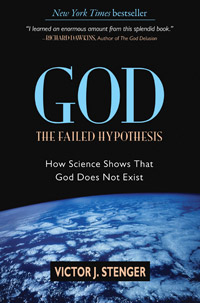
The angry atheists have been center stage in the God debates over the last few years. Many of them have become household names. Often giving sweeping generalizations about what God is, they tear apart this highly improbable image with aplomb. Not that I like to get in the way of somebody’s innocent fun, but their approach to the question only antagonizes the opposition without converting them. I just finished Victor J. Stenger’s God: The Failed Hypothesis. Like many who argue for atheism, Stenger is a highly regarded scientist. Unlike many, he offers a systematic, even-keeled account of his reasons for rejecting the divine. Indeed, the sub-title is straightforward—prosaic even—How Science Shows That God Does Not Exist. As befits a physicist, Stenger is careful to define his terms and is cordial enough to state that his book doesn’t cover the non-existence of deities per se, but the interventionist God of yore in particular.

Although I can’t agree on every single point Stenger makes, he does a compelling job of laying out logically how, if God is taken as an hypothesis (theory is a little too strong a category, implying substantial scientific concurrence), there should be some measurable result in the universe that God created. Choosing to differ from many theologians and scientists, Stenger argues that science can say something about God, given that God reputedly acts in a physical world. Outside these parameters something one may choose to call God may exist, but that kind of God does not answer prayers or oversee evolution.

Like many scientists, Stenger feels compelled to undertake this argumentation at least partially because of the weary insistence that evolution is “just a theory.” Creationists have tried to distort science for nearly a century now and have been successful really only in the United States. As Stenger shows, their method is often science, but wrong science. Just because an idea is scientific does not made it valid science. Stenger also points out that the premises of creationism, no matter how measured, are just plain wrong. Throughout, however, there is no belittling of those who believe in God. What is offered in this little volume is a rational, non-hysterical account of why a physicist who follows the law of the kingdom finds there is no God above it. And like a true scientist, Stenger leaves open the possibility that new evidence could overturn his verdict. Nevertheless, if his work is taken seriously, such a turn of events appears highly improbable.


Battle Billboards

Perhaps the oddest intangible accompanying democracy is the concept that all things are negotiable. Add to that a capitalist sensibility that everything has its price and even truth itself feels like a matter of debate. We see this all the time with Creationists so desperately wanting the Bible to the “true” that they twist science into a fairy tale noose from which to hang their literalist god. The tendency, however, does not stop with them.

Surely one of the most tense stretches of pavement in the country is NJ 495 leading into the Lincoln Tunnel. The aorta pumping countless metallic cells into the heart of Manhattan, drivers and passengers often sit motionless in it for seemingly endless periods to crawl forward like an inchworm entering the Olympics. It is there that Battle Billboards takes place.

I have followed the Atheist billboard development with some interest. In my limited experience with the Lincoln Tunnel, I have noted the digital billboard on the Jersey side bears the message of atheist.org near the major Christian holidays, so as Easter approaches the newest one reads “Celebrate Living Without God” to promote a rally on the Mall in DC. Both religion and science make claims of how to know the truth. Truth with a capital T should be non-negotiable by definition. The problem is that nobody has the Truth. We’re still trying to figure it out. Atheist.org holds a firm conviction that life would be better without religion. Clearly not everyone agrees. Clarity, it seems, is the chimera of debates over Truth.

A few seconds after the atheist.org ad flashes off the big screen, an ad for Wrath of the Titans (coming soon to theaters) flashes on. Irony can be sweeter than honey and as bitter as the Dead Sea. The most recent Clash of the Titans (2010) borrowed little from classical mythology beyond the names and large plot lines. An atheistic Perseus just doesn’t fit the classical taste. In the new film, Zeus—surely one of the prototypes for modern conceptions of God—is captured by Hades and has to be rescued by his unbelieving son. Could any movie be a more thinly disguised Easter story? Atheists? Wrath of the Titans? Which way to jump? Fortunately for me, traffic going into the Lincoln Tunnel in these lanes is one way. That’s the kind of certainty we all can live with.

Light from above or hopeless ambiguity?