Secular Family Values

Fear of social disruption runs deep. Things may not be perfect, but people would rather keep things the way they’re used to them being rather than to face radical change. This is natural enough. During the dark days of the Cold War, when nuclear annihilation constantly hung over our heads, atheism was a mark of the Soviet threat. “Godless communism.” Intellectually, however, a kind of atheism was already part of American society as well, although few people talked of it. With our national history of encouraging Bible reading and prayer in public schools, our self-presentation was of the faithful. Those who hold to “old time religion.” In fact, many had moved on, but those of us growing up in small towns or rural settings had no way of knowing that. Life before the internet was primitive in that way.

A recent Op-Ed in the Los Angeles Times asks “How secular family values stack up.” In this age of Nones many are worried that the social fabric has already begun to unweave and that our ethical clothes have become threadbare and see-through. The statistics, however, don’t really bear that up. Written by Phil Zuckerman, it is no surprise that the piece takes a positive view of a faith-free value system. The fact is, the social disruption that has been widely hyped, especially by Neo-Con pundits, has simply not occurred because of secularism. As Zuckerman points out, the largely secular European society has handled ethical situations admirably well. Even in the United States, non-believers in jail populations are an astonishingly small demographic, and divorce rates run lower than those who report being more religious. Those who don’t believe tend to be more empathetic and to have closer family ties than many religious families do.

Tolerance of those with different outlooks is important. In a nation that was at one time considered a melting pot, such difference of opinion is only to be expected. In practical terms, people in the United States knew nothing of Buddhism or Hinduism until late in the nineteenth century. Other religions were simply outside of the experience of most. And those who lived in different religious traditions were also moral. Biologists who study the development of moral sentiments find that apes, certainly not religious by any standard, are often inclined toward positive social values (although clearly not always so—there are dangers in extremism). It is time that we overcame our distrust of those who, for whatever reason, cannot believe. Being human is sufficiently religious to make us concerned about our fellow person. It is only the drive and insatiable hunger, ironically, of godly capitalism that leads to unfeeling disregard of human need.

FullSizeRender-2


Life as we Know it

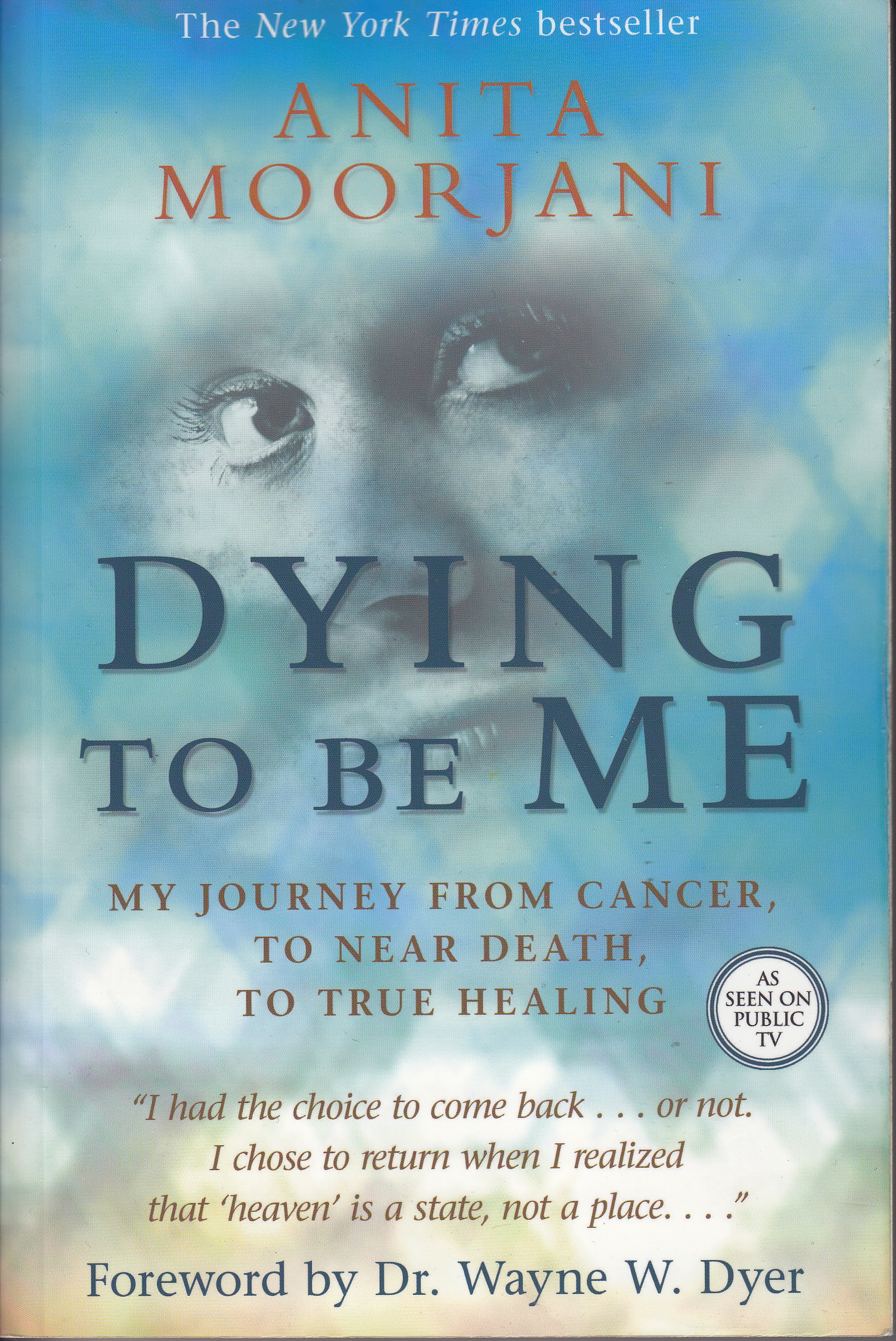
Dying2BMeA friend asked me for a book. Since my life has mostly been about books, I’m generally happy to supply what I can. This friend is a cancer survivor and wanted to read Anita Moorjani’s Dying To Be Me. The last time I saw this friend, she handed me the book, saying she didn’t care for it. Although the author tells of her dramatic Near Death Experience, and is very optimistic about all that we can improve by loving ourselves and others, she isn’t a Christian. Raised as an Indian living in Hong Kong and sometimes attending a Catholic school, Moorjani is conversant with several religions but doesn’t favor one above the others. Her experience of being in a coma with very advanced cancer and having a prognosis of days, at most, to live, yet coming out of the coma and being completely healed of disease within weeks could be overlooked on the basis of a belief system. I decided to read her account myself.

Ironically, Moorjani directly describes why she can’t accept any single religion in her book. Her reason is because religions tend to block being open to possibilities that fall outside of doctrine. Her Near Death Experience, described in great detail, doesn’t fit any particular religion very well, including her native Hinduism. It led her to believe in a kind of universalism with everyone ending up realizing their own divinity and loving all others unconditionally. Even though many of her interpretations of her experience are a bit too New Agey for me, I have a deep appreciation for her advocacy of trying to understand others and loving everyone. I saw nothing incompatible with Christianity there. Or any other ethical religion.

Religion can divide as much as, if not more than, plain common sense. Those who think deeply about it realize that religion should make life better for all. That seems to be its evolutionary purpose, apart from personal survival. Of course, some religions also reject evolution as well. When missionaries reached far shores and found good people living ethical lives, they feared for their souls, thinking only one religion could fit all. Many of us are heirs of such missionaries, being taught from our youngest days that living in fear and self-abasement is the loving, Christian way. It may be that a Hindu who learned to trust herself by nearly crossing the brink of death has something to teach the missionaries as well. If only they could listen.


Driving the Point

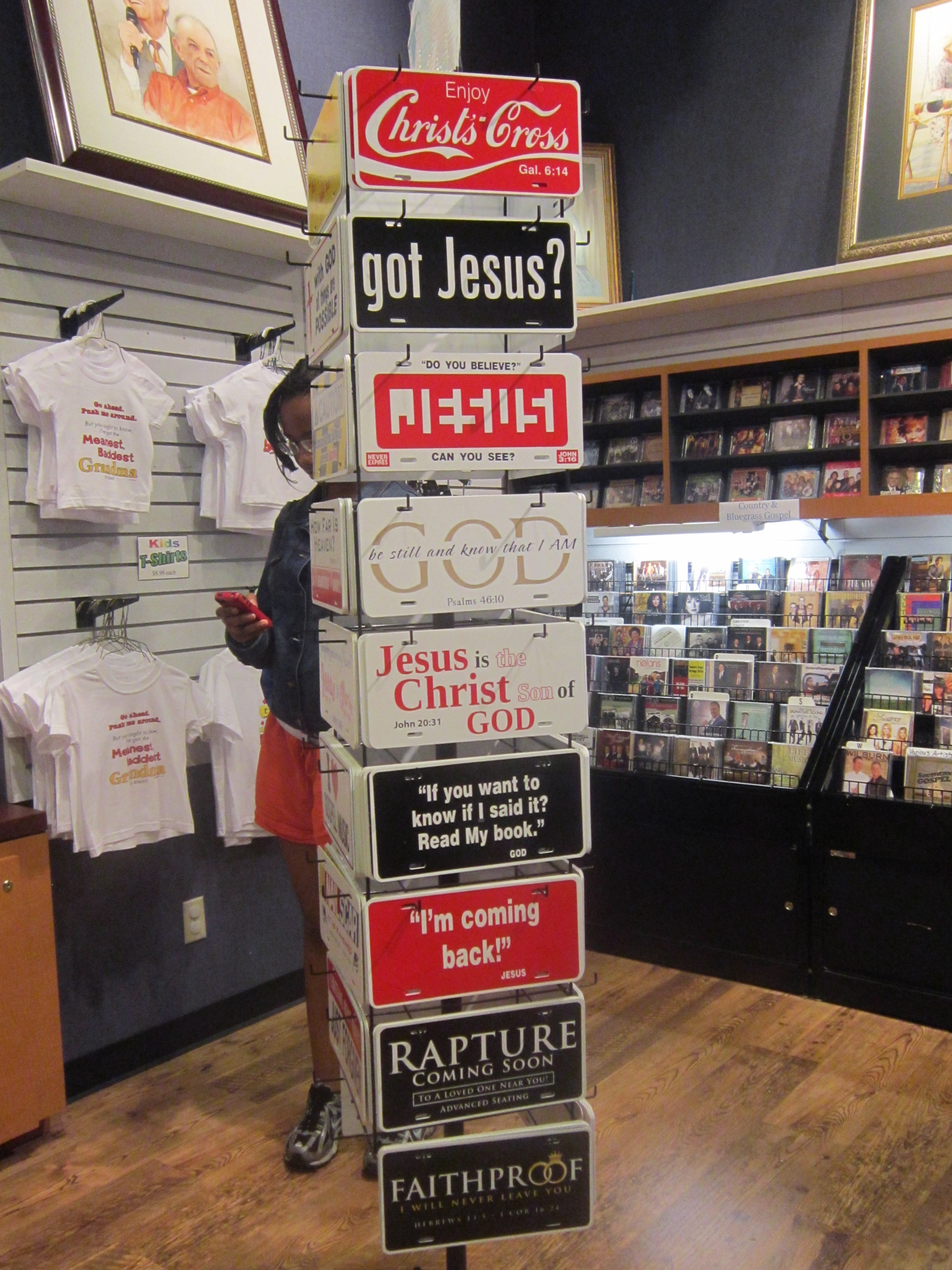
“I drive my car, it is a witness. My license plate, it states my business.” The words are from a song by one of the most creative Christian Rock groups ever, Daniel Amos. While I don’t listen to Christian Rock much anymore, I’ve always appreciated the fresh outlook of this particular band, which was, at least in the ‘80s, ahead of the curve. The lyrics came back to me when reading about a legal suit in New Jersey concerning vanity plates. Like many states, New Jersey has rules against offensive words being spelled out on license plates. When a woman applied for a license reading “8THEIST” it was rejected as “offensive to good taste and decency,” according to a story in NJ.com by Thomas Zambito. Trying the application with “BAPTIST” led to no objections. Others have tried other variations on the word “atheist” and have come up with rejections as well. In a country that prides itself on religious freedom, this is ironic, to say the least.

I’m a bit too pragmatic for vanity plates, or even bumper stickers. Having had to commute long distances after being dismissed from my post at Nashotah House, I often thought that I didn’t want people to know too much about me by the decoration of my car. The culture wars, played out a few years ago by Jesus fish, Darwin fish, Jesus sharks eating Darwin fish, and so on, seemed an opportunity for aggression to me. Already when I’m driving and someone cuts me off or does some dangerous maneuver in traffic, they frequently bear some paraphernalia advertising Jesus on their bumper. Maybe it’s a prayer for protection that allows for stupid driving. It certainly isn’t a witness to the “others first” theology that characterized Jesus’ teaching.

IMG_1216

Is it an affront to decency to be an atheist, or only to advertise being one? The culture wars that plague the United States are based on instant prejudices that make decisions about a person without bothering to witness their behavior. Behavior, after all, is the true measure of goodness. Even higher education is not immune to this system, especially in religion departments. We only want to be surrounded by those who believe like us. Somewhere in this unholy mix is the neglected idea of doing the right thing. Ours is a culture in love with appearances. We object when Muslims want to build a mosque. We object when Roman Catholics run for President. Weren’t not even sure that we really trust the Presbyterian next door. Our differences, one of the historic strengths of this country, have become a liability. Especially when behind the wheel. How different driving would be if we’d just assume that no what the vehicle says, it is piloted by a human being just like us, no matter who they believe the co-pilot might be.


Accept Cookies

You have probably noticed it. As expected as the warmer days of spring are also the Girl Scout cookies. A symbol of wholesome fundraising, Girl Scout cookies have some dedicated buyers, and many imitators. Like any human organization, the Girl Scouts have their troubles, but I can’t help but compare them with the Boy Scouts in which I grew up. Well, at least for a few years. We’ve watched as the media have declared on the excluding of various demographics from the Boy Scouts. To rise to the top you must not deviate from the mythic model of the perfect man. Meanwhile, as an article in Tablet notes, Girl Scouts have been tolerant of difference from the beginning. In a day when being Jewish was still suspect in the wider community, Girl Scouts were founded with early troop leaders who were Jewish, and this was in the days before the First World War and the ensuing tragedy of the Holocaust during the Second. From those early days, Girl Scouts have continued to have a policy of acceptance of those who differ in religious outlook. It erects no barrier.

The success of social progress depends on how we train our young. Prejudice has to be learned. Children are accepting of those with differences until they learn not to be. Radical groups have to recruit constantly. Fear of strangers is natural, but when it becomes a paradigm it is a pathology. One of my professors once claimed that early Christianity thrived because it was exclusive. Only true members could join, like a country club, making it desirable among hoi polloi. Further research has demonstrated the falsity of this view. There were many varieties of Christianities in antiquity. Only by declaring itself uniquely correct, and convincing Constantine of the same, did one sect become dominant. And dominance was what it was about.

Society is all about getting along. We have come together around money to build the tallest structures on the planet. The tallest buildings used to be in the United States. Then China, Malaysia, Taiwan, Saudi Arabia, the United Arab Emirates. A tower serves no purpose without a collective to take pride in it. Religions, unfortunately, often measure themselves by those who stand outside. Taking the view that it only feels good to be right if others are wrong, it is easy for such thinking to slip into a prejudice that promotes and rewards exclusivity. One percent, anyone? Many aspire to such menial goals as getting more money. For me, a life that has a box of Girl Scout cookies available is enough. And I’ll take a tall glass of tolerance with that, and hope that others will feel free to share.

DSCN5045


Middle Eastern Idol

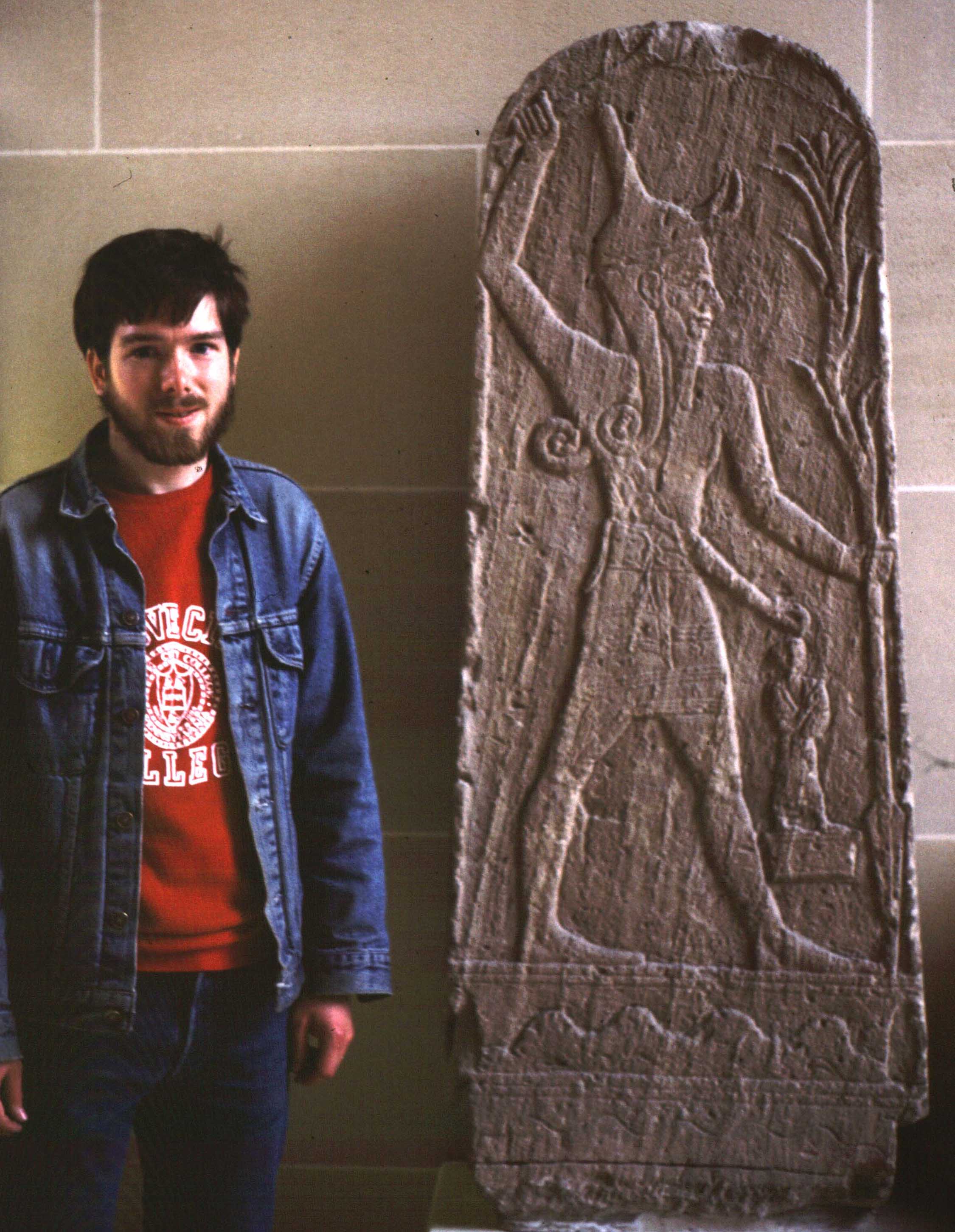
As the Passover-Easter complex of holidays approaches, our stern, scientific face turns toward the more human sensibilities of religion and its impact on our lives. PBS recently aired the Nova special The Bible’s Buried Secrets (originally aired in 2008) and when a colleague began asking me about it I figured I’d better watch it. As an erstwhile biblical scholar there wasn’t much here that was new to me, but one aspect of the program bothered me. Well, to be honest several things bothered me, but I’ll focus on one. When referring to the gods of the Canaanites, among whom the program readily admitted the Israelites should be counted, they were invariably referred to as “idols.” The problem with this terminology goes back to an issue I frequently addressed with my students—the term “idol” is a way of demeaning the gods of a different religion. Implicit in the word is the assumption of the monotheistic worldview and its attendant problems.

The Bible’s Buried Secrets seemed to adopt an overly optimistic view of the monotheistic religions sharing the same god while everyone else worshipped idols. The view is as fraught as it is simplistic. Historically Judaism, Christianity, and Islam are certainly connected. Each recognizes in the others a glimmer of its own theology and outlook, but the concept of deity has shifted somewhat at each development. Judaism and Islam are rather aniconic, especially compared to many varieties of Christianity where images are allowed, or even encouraged. It is difficult to grab the attention of the magazine-reading public with an image of invisibility on the cover. It should come as no surprise that some Jews and Muslims believe Christian images to be, well, idols.

An idol moment?

An idol moment?

The word “idol” is by nature pejorative. Ancient people were sophisticated polytheists. That statue that represented a deity was not thought to be that deity in any absolute sense. Rituals assured the ancients that they were instilling some aspect of divinity into the statues they used, making them sacred in the same way a Christian consecrates a church building. What’s more, it is natural for people to seek a visual focus for its devotion. It is difficult to conceptualize the Almighty as a person without giving it (often him) a body. Islam, especially, has been adamant that this can’t be done, and looking back at Christian practice it is sure to see idols abounding. As the holy days begin for our vernal celebrations, we should perhaps use the opportunity to rethink such religious vocabulary since every orthodoxy is someone else’s paganism.


Huge or Not?

The word “refugee,” I recently learned, was originally coined to refer to the Huguenots. As the Reformation began to take hold in Europe, although mostly associated with Germany and Switzerland, many French believers left Catholicism and became known as Huguenots. Early modernity was a time when religious persecution was rather openly practiced (as it still is in parts of the world) and many Huguenots were forced out of their homeland where Catholicism was the state religion. The word used to describe these unfortunates was “refugee.” For whatever reason, the plight of the Huguenots has never really captured the public imagination the way that many groups of displaced individuals has. We seldom hear of Huguenots any more, but generic refugees are daily in our news.

800px-Print_entitled_Horribles_cruautes_des_Huguenot_en_France_16th_century

While it is hardly a mark of pride or accomplishment to have Christians persecuting Christians as the origin of the term “refugee,” the fact that refugees are becoming more common rather than less so should be worrying. Borders, all of which are artificial, no matter how high we build our walls, lead to closed opportunities. Every once in a while, I ponder the phenomenon that none of us has any control over where we’re born. We might be fortunate enough to find ourselves in an affluent democracy (so I’m told) or equally beyond our control in a repressive totalitarian military state. The ability to see things from another’s point of view is essential to the concept of the refugee. Can we imagine what it is like to be persecuted for religious belief? For being born female in a chauvinistic society? For being poor when money seems to be everywhere for those who know how to extort it? Have we no sympathy for those who find themselves conceived under trying circumstances? If it were me, I’m sure I would think differently about it.

Historically, and by the numbers, the Catholic Church has been by far the most successful form of Christianity that the world has known. Claims to the title of “Christianity” are hotly contested, but the continuity, in some form or other, has hung together for a couple of millennia. In times past, those who differed, such as the Puritans in England and Huguenots in France, were encouraged to leave. The world was plenty big enough. Were the borders of today erected in early modernity, the plight of the Huguenots, like that of many untolerated religious groups, might have been far more dramatic. Largely assimilated today, the Huguenots are not much on most people’s minds and yet refugees still regularly approach the borders beyond which a more humane life awaits. Religious persecution gave the world the word; could its opposite provide the solution?


Order of Melchizedek

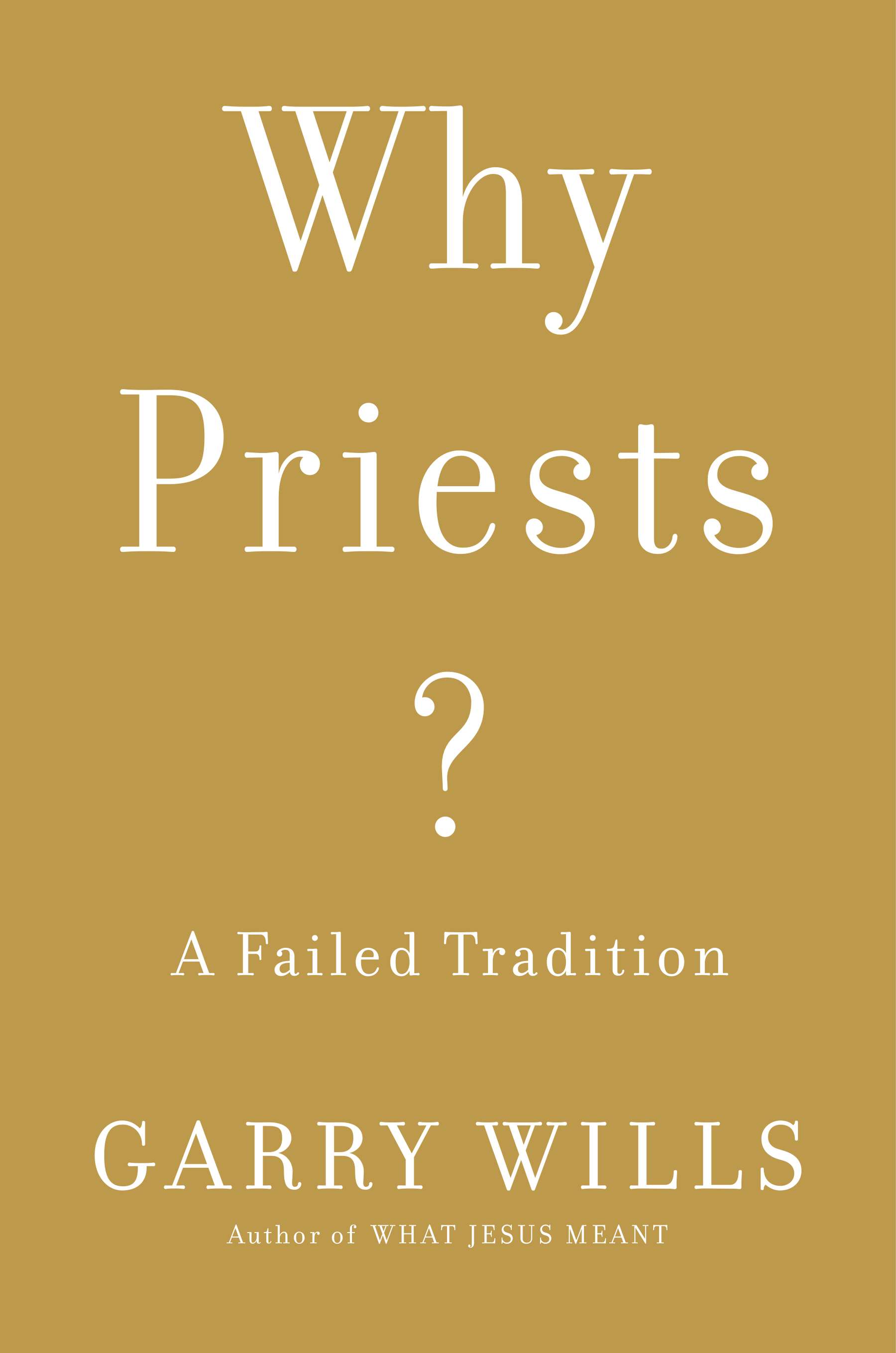
WhyPriests?A considered reflection from a long-time believer is a force never to be taken lightly. Garry Wills is a lifelong Catholic and an intellectual. His book, Why Priests? A Failed Tradition, was recommended to me by a friend and it is indeed a book that raises most profound questions. To someone born Protestant, such as the current writer, many of the arguments Wills marshals are strangely familiar. Many were lobbed in Fundamentalist harangues where clergy that believe in a literal six-day creation proved surprisingly adroit at finding the chinks in Catholic armor. The New Testament says nothing about the Christian movement having its own priests. And even the explicit command that seems to have come from Jesus—call no man father—is immediately reversed once priests become a fixture in a priestless faith. Wills explores the origins of these practices not to tear apart the religion of which he remains a loyal part, but to suggest that religious tolerance is the only proper solution. It is amazing how much of Catholic thought goes back to the disputed book of Hebrews with its mysterious Melchizedek.

While I have never been a Catholic, I have always been haunted by the idea that my religion was some kind of innovation. After all, the stakes were beyond stratospheric. If you pick the wrong one, at least according to what I was taught, Hell awaits at the end of the day. Then I discovered that my own Fundamentalism also had a history. We were called Protestants because we protested Catholicism. As I moved into the Methodist tradition, at least there seemed to be a continuity—John Wesley was an Anglican and Anglicans were really kind of English Catholics. Or so it seemed. Naturally, I became an Episcopalian since going Roman seemed like it came with exceptional amounts of accretions that were clearly not biblical. Such accretions are much of what Wills explores. Traditions that become doctrine. And exclusive. Those on the outside can hope for Purgatory at best, and the very Hell I was trying to avoid remained a distinct possibility. Who was right?

Religions suffer with time. The faith that Jesus seems to have proclaimed had already altered by the time Paul put pen to parchment. Ask any Gnostic. Already, within just three decades, the question became “now what did he say again?” And what exactly did he mean? The core of that message seemed to be love above all else, but that doesn’t make for sexy doctrine. Exclusivity achieves what love could never accomplish. Wills explores how sacraments evolved, and how Scripture became a sword dividing believer from believer. His most sensible solution? Its time to get beyond priests. He doesn’t actually suggest doing away with them, but asks Catholics why they don’t consider closely the implications of their roots. Melchizedek takes on a stature greater than anyone seems to have imagined for an imaginary figure. And a lifelong believer here asks the most basic of questions: what is Christianity truly about?


Greece Lightning Rod

Eds and op-eds are popping over the Supreme Court decision to allow sectarian prayer at Greece, New York town council meetings. Some citizens complained that the prayers made them feel disrespected and excluded. Who hasn’t from time to time? I’m no advocate of government-sponsored religion, but I do wonder how we can live in a society in which the mere mention of God offends some as much as the “f word” offends others. Are we, perchance, getting a little thin-skinned? After several long years of neo-con rule, we have learned that opposition is a form of treason, and that conflicting opinions cannot coexist. As an erstwhile teacher of religion, the implications make me shiver. Isn’t the point of learning about religion to train people in toleration? If I sued every time I was offended, I’d be the richest man in the country.

Ironically, the United States is one of the rare cases of a developed, “first world” nation where skirmishes over religion often and vocally take center stage. We have, as a society, dismantled the apparatus of dispassionate, scholarly discussion of religion (“no need for it,” “budget can’t afford it,” “superstition and nonsense”) and wonder why it always brings us to verbal blows. Religion is that which we can’t define, but we can surely fight about. We’re offended by public prayers, the wearing of hijab, and idols to the Ten Commandments on the courthouse lawn. Religion, like sex, is relegated to private places only, but for diametrically opposed reasons. What are we so afraid of?

Lost in the clutter.

Lost in the clutter.

We have no trouble when someone with private money spends it to introduce religion into the public sphere. You can walk down the street in Manhattan and see crosses outside churches and “Jesus saves” scrawled in the cement of well-trod sidewalks. Nobody seems to be offended. Finding practitioners of the “exotic” religions of Hinduism, Buddhism, Sikhism, Vodou, Theosophy, and Scientology is hardly a challenge in a city of millions. Over what is there anything to be offended? I’m offended by those with too much money keeping everyone else below them because the law says that they can. I’m offended by those who pollute our common environment because they can afford lawyers to find loopholes. I’m offended by those who use their religion to oppress women and non-believers. Those who want to pray to a god, any god, before a civil meeting, as long as that god demands nothing from non-believers, aren’t hurting anyone but those who never learned to agree to disagree.


Heavenly Beings

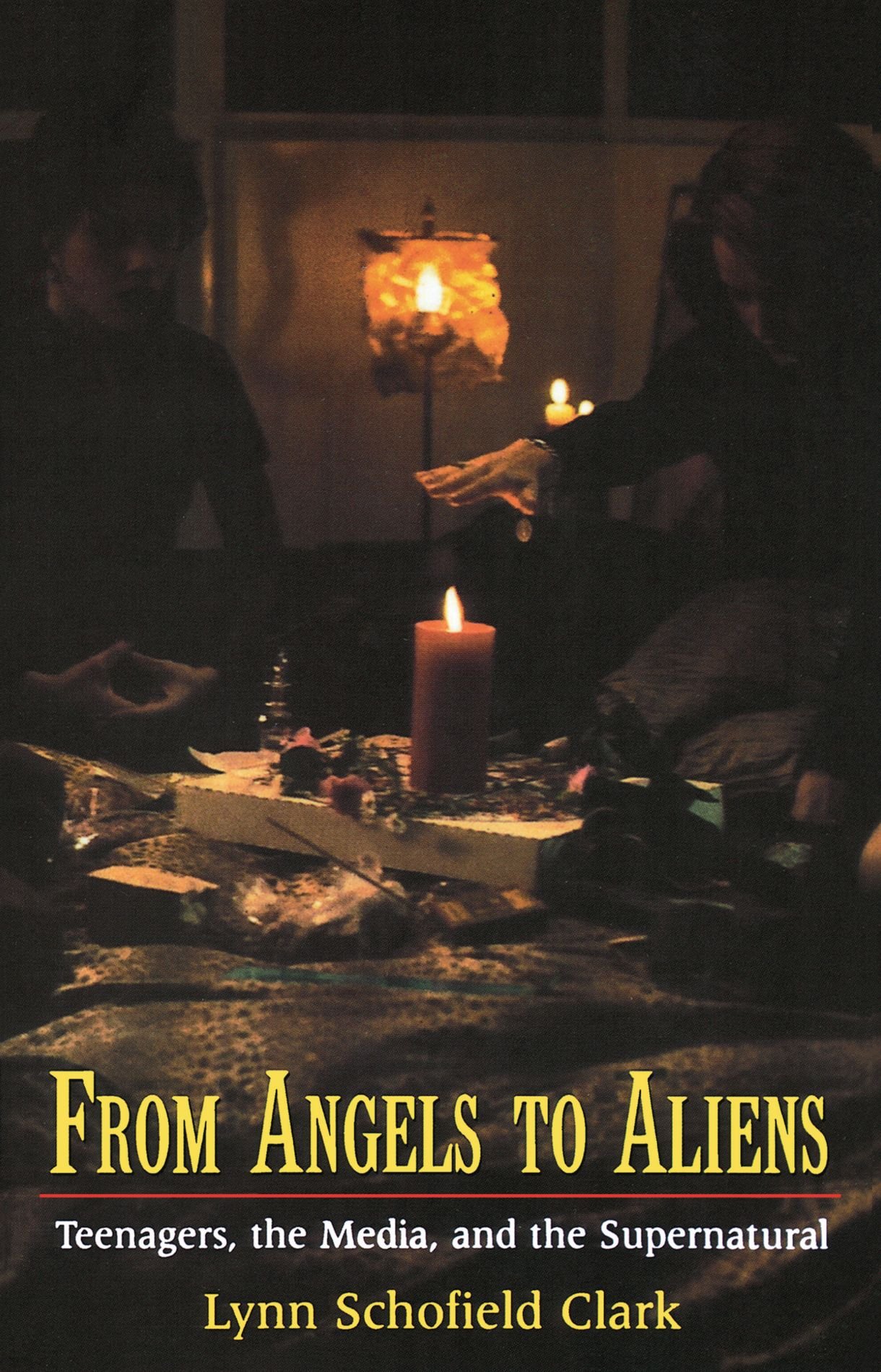
FromAngelsToAliens Religious tolerance suggests that it’s less important what you believe than it is that you believe. After all, where you are born—socioeconomically as well as geographically—determines which options are open to you. And now that the world is virtually inter-connected, the media must play into the idea of what we believe as concepts mix and brew and distill. Lynn Schofield Clark’s From Angels to Aliens: Teenagers, the Media, and the Supernatural, is a study that takes all of this seriously. We know teens as the ultimate disenfranchised demographic. For those of us who were once there, no doubt concerning that status exists. But what of teens in an age where God seems to be effacing and angels and aliens invading? At least according to the media. Clark interviews several teens and their families about their belief in the supernatural, and, in keeping with what the statistics of national surveys continually show, belief in some world beyond ours is indeed deeply rooted. Many youth, however, have trouble distinguishing angels from aliens.

Not literally, of course. Rather, supernatural entities are so much a part of our media experience, and church attendance so little, that clear ideas of how these things all fit together, if they do, are lacking. Scientists are looking for life in space while denying that if it exists it ever could have intentionally travelled here. We are, after all, the most intelligent species in an infinite universe. (Did I say that belief in God was effacing?) Socially, however, angels are much more acceptable than aliens. Belief in aliens is easily equated with mental instability, while belief in angels is normal, if not a little naive. To the average person, it seems that we’re not alone. As many popular media portray, however, God remains silent and we have to wonder if there’s anyone really driving a universe with no real up or down and with an exploding singularity at its center. It’s all a little disorienting—rather like being a teenager.

Clark remains wonderfully open-minded as she asks her questions to the younger generation. I felt a bit of recognition when she mentioned her church experiences in theologically conservative western Pennsylvania, the area in which I grew up, and where neither aliens nor angels were particularly uncommon. And we were in a media black hole in those days. Stations from Pittsburgh or Erie didn’t boost their signal to reach those of us in the boondocks with much reception beyond the big three. Of course, there was nothing beyond ABC, CBS, and NBC. Well, there was PBS in the background, but this was a universe still awaiting its big bang. Angels were good, aliens were evil, and God never remained silent for very long. And nobody really cared what teenagers thought. We have evolved since then, but we still look to the sky and wonder who, if anyone, is out there.


Make Light

Despite the war on Christmas, it came. To be honest, I haven’t yet gone to the window this morning to see if smoky remains litter the street of my small town, but there is something decidedly positive inside me that tells me that it’s Christmas. Religious holiday or not, any celebration that can make people feel at peace for even just a day is worth it. Christmas has always been a time of sharing. Not to exclude our southern hemispheric and equatorial companions, but the darkest time of year requires something to lift the human spirits. I wonder if even the Romans back in their salubrious Mediterranean climate felt a bit of a pinch at this time of year as they planned the festivity that marked the shortest day of the year. Without precise timekeeping, it is difficult to know exactly when the solstice is—to me for about a fortnight is looks dark pretty much all the time. I catch the bus to work in the dark, arrive at work before sunrise, leave work in the dusk and by the time I’m on the bus home it is dark. These few days around the solstice I know that I could use a little break.

SolsticeLights

How like human nature to take such a wonderful concept and turn it into something to fight over. I don’t know the religious preferences of everyone at work. I suspect a large number might be Jewish, and some are likely Muslims. Many, I suspect, have no religious leanings at all. Yet today they all have a gift, tree or not. They are paid for not working. The gift might be extra sleep, or it might be the light that neighbors shed in the darkness with gaudy displays of Christmas lights, or holiday lights, or just colorful lights—what is the difference, really?

The whole concept of a war on Christmas has to do with feelings of superiority. Those who take up the war cry feel proprietary rights to a holiday their religion did not invent. We don’t know when Jesus was born. The best guess scholars have is that it was in April, around about the time we celebrate Easter, I suppose. Christmas was despised and scorned by many Christians until the nineteenth century, the very ancestors of the conservative factions that claim Christmas as their own banned the holiday for its papist trappings and pagan undertones. Now they wish to claim Christmas as uniquely theirs. Like the Grinch up on Mount Crumpit, I put a hand to my ear and learn something new. Christmas is for everyone. Any holiday that can bring peace to this troubled mind for a few hours is a day to be shared.


The Four “R”s

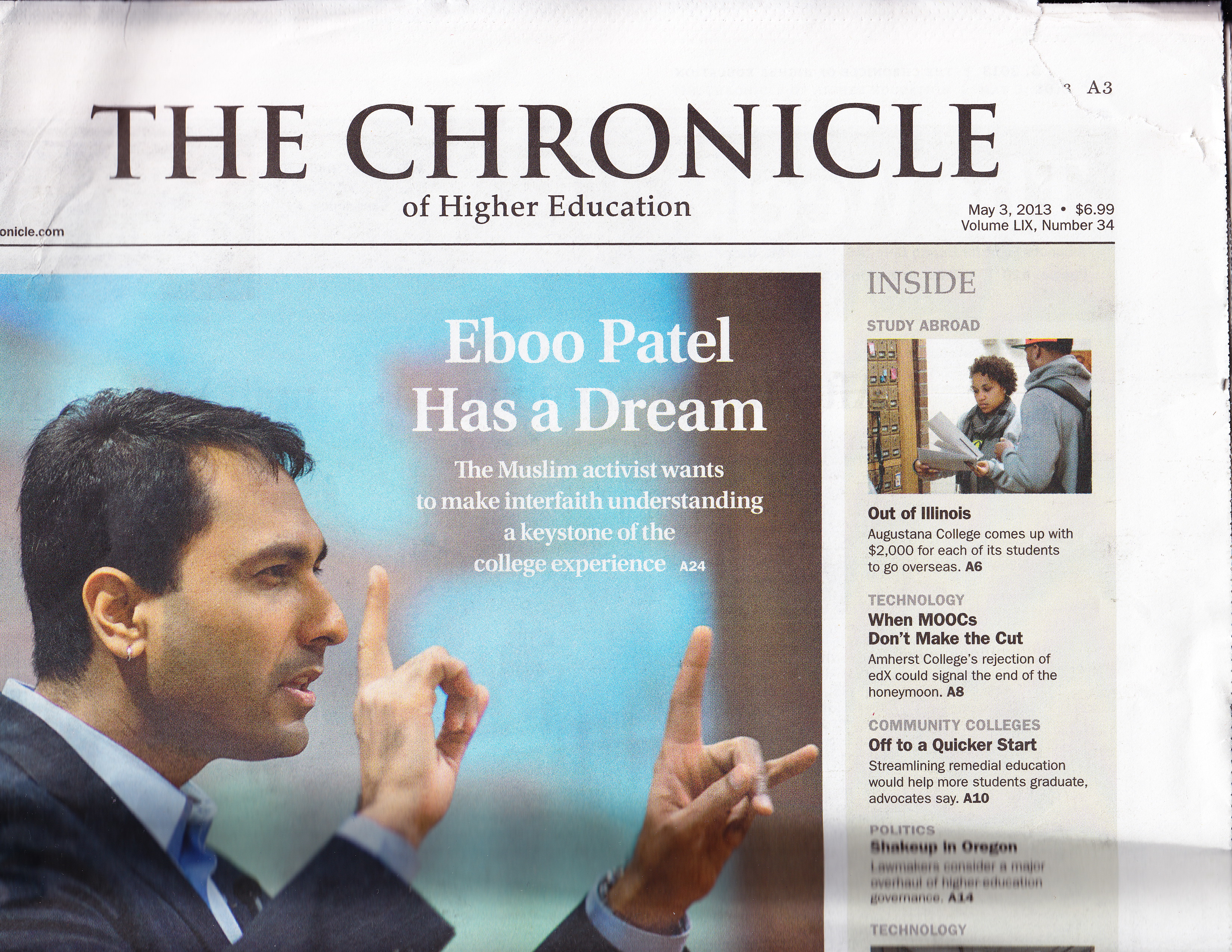
Last week the Chronicle of Higher Education feted Eboo Patel. As someone who has been on the receiving end of subtle religious violence, I appreciate what Patel is trying to do. He is a Muslim activist, the kind of which the world needs more. His last two books have been advocating for religious understanding to be considered a keystone of a college education. He’s right; religious understanding should stand right up there with the other three “r”s of education. The problem Patel faces is one I have personally faced, however; there is no money in religious studies.

Chronicle

That seems odd, even as I write it. We see lavish treasures owned by the Vatican. We see televangelists living in mansions that make Graceland seem tawdry. No huckster is more able than a skilled preacher at wheedling money out of people. Religious terrorist groups, our society conveniently ignores, are often well funded. We just don’t want to pay those professors of religion! We glory in our enlightened status and wonder why America consistently ranks among the most religious nations of the world. What department is first to receive the chop when the budget tightens? Well, it begins with an R.

What Eboo Patel is saying is what I’ve been preaching for all my adult life. We all think we know what religion is, but we actually have no idea. Universities, with rare exceptions, will do what they can to hide the study of religion like a zip on prom night. Patel is a Muslim and has good cause for wanting people to understand that his religion is not evil. He has written a couple of books advocating teaching our young about religious tolerance. It is a message America, especially, should be eager to embrace. Paradoxically, we don’t give a damn. We will cast caskets full of money into business and law departments. We will fund the research of medical and science students. Don’t ask for permission to hire a religion specialist of any description, however. Don’t you know that religion is dying out?

No doubt the electronic revolution has forever changed the way our young think about reading, writing, and yes, even arithmetic. If we had it the way our universities suggest, they would know as little as possible about the fourth, forgotten “r” that leads to much misery and meaning in our little world.


Backyard Wisdom

From where I was sitting, the robin appeared to be asleep. It was an overcast and chilly spring morning, so I had to admit that I was a little envious. Our back yard is divided from the neighboring landlord’s property by a kind of picket fence with square-topped stanchions every ten feet or so. The robin was sleeping on the stanchion closest to an old maple tree. A wiggle of movement caught my eye. Further down the fence, maybe seven or eight pickets back, sat an impatient gray squirrel. It was sitting up on its haunches, and flashing its bushy tail in an obvious attempt to draw attention to itself. The robin sat, implacable. The squirrel looked around like a nervous commuter who will be late for work. It hoped a picket or two closer. Up on its haunches, looked around, jiggled its tail. Still the robin sat. The squirrel turned toward the maple tree and reared back, preparing to jump. It was too far. The squirrel turned back to look at the bird. The robin, flapping its wings a time or two, hopped into the air and landed on a picket two further down beyond the stanchion. The squirrel climbed onto the now vacant spot and leapt into the tree. The robin flew back to its original post.

This little exchange brought home to me once again the intelligence of animals. I don’t know what was going through the minds of these two different species, but they obviously both wanted to be at the same place at the same time. Perhaps some moral imperative passed in unspoken form between them. The squirrel needed to be close enough to make the leap into the tree, and the robin was clearly comfortable where it was sitting. Something had to give. I don’t know if robins peck on squirrels when nobody’s looking, but the rodent, larger than the bird, was obviously cautious. In the end, a compromise was reached and each ended up where they wanted to be.

More than a show of intelligence, I also saw this as a parable. I imagined how differently it might have worked out if the robin were a Christian and the squirrel a Muslim. Would there be any giving way? Any acknowledgement of the need of the other? A few wing flaps, a little leap to the left, and the squirrel found its sanctuary. The robin simply returned to where it was. They both wanted the same sacred space. They didn’t raise voices or argue—the whole exchange was terribly polite. Behavioral biologists often suggest that we can learn much by watching animals. As I watched what must have been only a minor incident in the backyard world of robins and squirrels, I felt as if two of the great teachers of our many religions were enacting a parable for humankind. If only we would pay attention.

IMG_0675


On Dasher, On Dancer

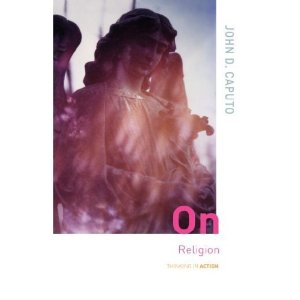
CaputoOnReligion It’s a little embarrassing to admit that after having pondered religion for all of my life, I still have no clear idea what it is. In my case pondering includes three degrees in the study of religion and almost two decades in teaching it. I still read books that introduce religion, hoping to catch some distilled essence that I might label the core of the phenomena that go by the name. Some least common denominator. But that’s not how life works. Even the most basic of things can be complex, so I recently turned to John D. Caputo’s On Religion to find out what a philosopher thinks it might be. From the start this little book is jarring. Caputo, while staunchly refusing to tip his hand, defines the religious as those who love God. Or god. Or not really god, but something that might be as impersonal as the Force. Of course, love is as slippery a term as “God,” so Caputo suggests that it is caring for more than one’s own self. If many of our religious politicians and televangelists could get even that far perhaps we’d be closer to the religious idea of heaven itself. Then when Caputo turned philosophical, he started to lose me a little.

The big problem, and one of which Caputo is well aware, is that loving God is a western religious ideal. There are those who claim that some “Eastern religions,” such as Buddhism, Taoism, and that of Confucius’ followers, are actually philosophies and not religions. But if we’re trying to define religion, excluding a very large portion of the world’s belief structures seems to tilt the balance a bit dangerously westward. Come to think about it, the idea that all people have to have some kind of religion is a western conceit as well. Who are we to define the terms of another’s existence? That, it seems to me, is one of the problems of reductionism. Assuming that all people accept the premise that an empirical system can explain everything will not rid the world of religious martyrs. So what is to be done?

Caputo has thought about this as well. He concludes his short manifesto with a chapter entitled “On Religion—Without Religion.” Here the true root of the problem is exposed—religions that claim they alone can be true. For Caputo’s purposes western religions work best here because the three major monotheistic faiths share so much in common. Put crassly, the real question is where does the line of final revelation end. Is it Moses? Jesus? Mohammad? We could go on—Joseph Smith? Raël? Philosophically, at least, Caputo suggests that all religions could co-exist if they were willing to admit that they are all right. It boggles the reductionist mind. How can they all be right? How can they not be? After all, despite the millennia spent on the topic, we still don’t know what religion is.


Chronicle Illness

In a completely innocent blog post on the Chronicle of Higher Education, Geoffrey Pullum wrote about the use of singular “they.” I won’t try to summarize his work here—it is quite fine the way he writes it. What I would like to note, however, is what was likely an unintentional grammatical association that is quite profound. In two consecutive paragraphs, Pullum requires a synonym for someone who is unwilling to listen because they’ve already made up their mind. His choices are those who believe in “unquestioned dogma” and those who hold a “resolutely and hermetically theological view.” Both phrases indicate those who unswervingly accept religious belief. The article is lightheartedly written, and quite witty, but there is something serious here. Religion has built itself into the great bastion of intolerance.

The more I contemplated this correlation, the more it became clear—when we need to express someone’s complete devotion to unquestioned propositions, even when reason dictates conclusively that they are wrong, we are in the realm of religion. Religions may accept one another, but as long as truth is at stake, and as long as truth is one, there will always abide that smug satisfaction of knowing that my religion is at least a smidgeon closer to that truth than yours. Such thoughts, when matured and fully-grown, are bound to cast the seeds of intolerance abroad. Religions don’t take prisoners. Having spent a lifetime studying religions I’m not so crass as to put them all in the same cage together (that would be cruel), but history has demonstrated that when properly provoked any religion will turn intolerant. The provocation is mostly just daily life.

Literary folks have thousands of tomes full of words and ideas from which to draw. One of the joys of reading is finding so many ways of expressing that which we experience in fresh and insightful ways. With all these words and concepts from which to choose, the most immediately recognized to express unwillingness to listen belong to religion. Listening to Pat Robertson or Pope Benedict XVI, it is not hard to see why. Religions give the world much more than reasons to fear, distrust, and hate others. But they do include these components as well. The only way to change this image is replacing the arrogance of dogma with the willingness to listen with humility. If religions would do this, there would be room for everyone in this conversation; they’d like that, wouldn’t they?


Jew Want Some Jesus with That?

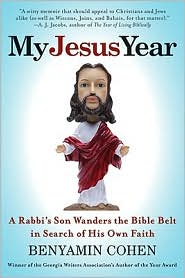
There’s been a trend in the last few years of journalists following a religious lifestyle not their own to learn something of another faith. This often leads to whimsical—occasionally funny—books that generally sell well. I appreciate the effort of those who try to open their minds to other belief systems, but the truly funny thing about religions is that they are very difficult to study objectively. There is a universe of difference between studying the papacy and being a Pope (I am only guessing here). This aspect of the religious explorer came through quite clearly in Benyamin Cohen’s My Jesus Year. Cohen, an Orthodox Jew, without compromising his faith, spent a year of Sundays attending various churches with two goals in mind: to learn more about Christianity and to appreciate his own Judaism more. The result is, for someone raised in the Christian tradition, a little disorienting.

We seldom tell children about other religions since such information would imply that religion is a choice, a marketplace. We prefer to tell our children that our brand is the right one—the only right one—because that is what we believe. By the time most children encounter those of other faiths, the indoctrination of their childhood has congealed. Many Christians will send their children to Christian daycare, often followed by parochial schools. Where would they expect to meet their first Muslim? Unfortunately, it is often on the battlefield. By protecting our children from the dangers of foreign faiths, we endanger everyone involved. So, reading a book written by a Jew, I felt a little strange—as if maybe Christianity wasn’t the majority faith after all. Given the wide diversity of Christianities Cohen cites, this is not so strange after all. Am I more like the evangelical Ultimate Christian Wrestling crowd or the Roman Catholic doing crossword puzzles during mass? Or none of the above?

Cohen notes that evangelical pastors (or laypersons, Christian or not) will sometimes share their secrets of success with those of other religions. Tellingly, he quotes Bernie Marcus, co-founder of Home Depot, explaining to rabbis how they might drum up more excitement: “You’re in the marketing business; you’re selling a product. You’re selling religion. It happens to be something that’s good for people. But you can’t get to them to sell them the religion because you’re in the marketing business and you don’t realize you’re in the marketing business.” Is that what it really comes down to? Religion is frequently described as a marketplace; it is the only paradigm available for the true capitalist. We’ve seen it take over higher education, and now those who give advice to religious leaders are the captains of industry. We have become victims of our own success. There was a time when religion stood outside the ordinary, but now it can be packaged and marketed and sold. An excellent exercise on your way to the store, however, is to stand back and listen to the other customers. If you are lucky, one of them will be Benyamin Cohen.