Oz Undone

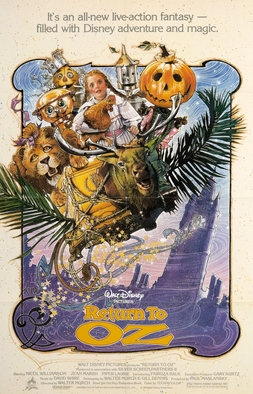
Horror is notoriously difficult to define.  Two friends recently suggested that I watch Return to Oz, which, for them, was horror.  Although rated PG, it does shade into horror at several points.  It begins with an eerie soundtrack and a disturbing idea: Dorothy hasn’t been sleeping and really believes in Oz, so she’s to receive electroshock therapy.  She escapes the gothic hospital during a storm and after almost drowning, lands in an Oz gone wrong.  Any number of scary things happen there, and the story is one of constant tension.  First Dorothy encounters the “wheelers,” which equal blue-faced, flying chimps for terror.  She is taken to the residence of a wicked princess who has a collection of heads and changes them at will.  At one point she chases Dorothy with no head on at all, perhaps referencing the headless horseman.  People turn to stone or sand, depending on whether the Gnome King or the deadly desert gets them first.

Dorothy tries to find the Scarecrow but he’s been captured and imprisoned by the Gnome King, who turns people into objects.  When she frees the Scarecrow the gnomes—scary monsters, not bearded little people—attack.  Dorothy and friends are chased to a point that they’re about to be eaten by the Gnome King.  This is dark Disney.  There’s a minor Halloween theme and a living jack-o-lantern.  Fairuza Balk, who plays Dorothy, would go on to play horror and gothic roles.  Even Pumpkinhead, the jack-o-lantern, would be used as the title of a legitimately scary horror movie.  All in all I was impressed with how well this fits into PG horror.  It’s scarier than some other intentional horror with the same rating.

I missed Return to Oz when it came out in 1985.  I’d graduated from college and began seminary that year, so I was a bit distracted.  The movie has gathered a cult following and was praised by Neil Gaiman.  Interestingly, the writer/director Walter Murch noted in an interview that he’d used the book Wisconsin Death Trip, a nonfiction book of unusual events and deaths in a small section of, well, Wisconsin, to get ideas for the script.  This seems a strange inspiration for a Disney film, and indeed, Murch had a rocky time as the director.  The end result is strangely affecting and fits what might be considered horror for children.  The squeaky clean image that Disney has cultivated in recent decades hides a history of films that can legitimately scare the young.  Return to Oz is one of them.  And it has a fascinating back story.


If You Do

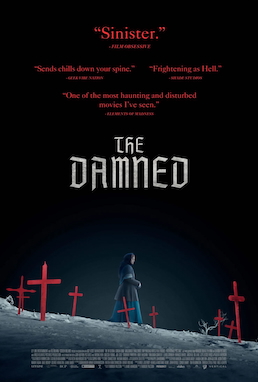
Folk horror is particularly open to religion.  The powerful Euro-horror film, The Damned, is nearly worthy of Robert Egger status.  Indeed, the movie reminded me of Egger’s work, so perhaps Thordur Palsson is his Icelandic incarnation.  Set in a fishing station in a remote arctic bay in the 1870s, the owner’s widow oversees the operations of six fishermen and the woman who cooks and keeps the house.  Her husband died at sea the previous year, and the fishing has been very poor, threatening their existence.  They need to eat their catches, as well as their bait, trying to stay alive until spring.  Eva, the young widow, sees a ship foundering on the distant, jagged rocks.  The men insist that if she orders them to help, their food supplies will quickly be depleted, and the rescue operation would put them all at risk.  Lured to the wreck by a food barrel that has washed ashore, they encounter more men than they can keep and have to fight them off of their small fishing boat, killing one in the process.

The helmsman of the boat falls overboard and drowns as the survivors try to climb aboard.  The small boat manages to escape, however.  Helga, the housekeeper, warns Eva of the draugr, a monster of Nordic folklore that is a kind of zombie.  If it gets into your head, she warns, it will led to death.  Skeptical of folktales, Eva begins to change her mind as her small group of companions begins dying off.  Helga disappears.  One of the men dies after being stopped from killing a companion.  Eva is now left with only four men.  One of the men insists they are paying for their sin, and begins erecting a large cross as an act of penitence.  After seeing a man in the mist, the new helmsman dies by suicide.  Now convinced the draugr is real, Eva leads an expedition to find and destroy it.  This leads to the death of yet another crew member.  The three remaining people decide to flee by night in the boat.  Eva, however, encounters the draugr in the cabin and destroys him by fire.  A spoiler follows.

The shocking end reveals that the draugr was actually a survivor of the shipwreck and his presence explains the “supernatural” events they believed the monster caused.  Eva, delusional, kills the man.  The story plays heavily on both the isolation of the fishing station and the guilt the characters all undergo after leaving their fellow sailors to die on the jagged rocks.  Their fear transforms fevers into deadly paranoia as they kill one another and themselves off.  This is set against the stunning arctic scenery of the fjord that houses the station in a stark winter landscape.  And the conflict between religious systems is right there on the surface and deep within the minds of those isolated, far from civilization.


Hunting Season

Back when it came out in 1997, I’d heard that it wasn’t a particularly happy movie.  It was a good movie but it dealt with two damaged men.  I was frightened off from seeing Good Will Hunting until it became associated with dark academia.  Will Hunting is a genius but he was born in a bad part of town and earned himself a police record.  He works as a janitor at MIT, but he also solves proofs instantly that professors labor over for years.  The only way he can keep out of jail, however, is with the help of a therapist.  Sean Maguire, who teaches at Bunker Hill Community College, is a psychologist who shares the background of Will’s rough neighborhood, but who recently lost his wife to cancer.  He’s been traumatized by his life and the two come to realize, once Will learns to trust, that they have helped heal each other.

The darkness in this academia is mostly social.  Even today, those of us who grew up in rougher locations don’t easily fit in academia.  We’re blithely ejected from it in favor of those with more proper backgrounds.  And connections.  There were a few personal triggers for me watching this movie, but I had been wanting to see it for some time.  Robin Williams, who plays Maguire, had starred in what may be the epitome of dark academia movies, Dead Poets Society.  In both he plays his part convincingly.  The term “dark academia” wouldn’t be coined, however, until the year after he died.  Education is supposed to lead us out of darkness, but given what humans are, it creates its own form of gloominess.  That’s probably why some of us find the category of dark academia so intriguing.  Compelling enough to get us to watch films that will perhaps come with their own brand of trauma.

Children born into similar, or nearly identical situations may react to it quite differently.  Although both in academic settings, Will and Sean have different experiences of it.  With his life experience as a war veteran, and an educated world traveler, Sean invested his life in love and helping others.  Will struggles with his fear of rejection to finally try to love someone more than upholding his own walls of self-protection.  There’s some real depth here.  It’s no wonder that the screenplay won more than a couple awards.  It would take another couple decades, however, until the category of dark academia would be named.  And if it hadn’t, I wouldn’t have risked watching this amazing movie.


Old Horror

One of the early horror movies not in the Universal lineup was Doctor X.  It deals with themes that are perhaps surprising to modern viewers of old movies since the Motion Picture Production Code had not yet taken effect.  The story itself is slow paced, as is typical for the time, and not very scary according to modern standards.  Police are investigating a series of full moon killings and have traced them near to Dr. Xavier’s institution, the Academy of Surgical Research.  There he, along with four other scientists, are conducting advanced, but unorthodox medicine.  Dr. X convinces the police that he will investigate thoroughly and if the killer is among his colleagues, which he does not believe he is, he’ll learn which one.  There’s quite a bit of screwball humor introduced by the investigative reporter and even the butler and maid.  Hooking everyone up to a machine that indicates excitement, Dr. X has the murder reenacted to determine guilt among the watching scientists.  This is an early form of polygraph, apparently.

One of the colleagues, Dr. Wells, is excused because he is missing a hand and the murderer clearly used two.  The lights go out during the experiment and the “guilty” doctor is found murdered.  The solution Dr. X proposes is to do the experiment again, using his daughter (with whom the reporter has fallen in love) as the “victim.”  In order to prevent anyone from moving around, all but Wells are handcuffed to their chairs that are bolted to the floor.  Wells is then shown transforming himself into a monster by using “synthetic flesh” that he’s developed, allowing himself to animate a second hand and also, to disguise his face, freeing him from being identified.  He attacks Dr. X’s daughter, but the scientists are all handcuffed to their chairs.  The comic reporter saves the day by destroying the monster.

These early horror films blazed trails for later monster movies.  The science is a mix of plausible sounding theory and mumbo-jumbo.  I wasn’t sure what to expect since I knew the movie by name only.  Dr. X is a kind of mad scientist, but he’s not evil.  There’s a theme of cannibalism that runs through the story as well, since this is where Wells gets the material for his synthetic flesh.  The themes are scarier than what’s shown on the screen, of course.  These were the days when Boris Karloff in Frankenstein monster makeup could cause viewers to faint.  Doctor X was never as popular as the Universal lineup and although Wells is grotesque enough, he’s no Frankenstein creature.  He is, however, part of cinematic monster history.


Don’t Stop Moving

Stopmotion is a strangely affecting horror movie.  Body horror as well as Euro-horror, it follows the dream-like world of Ella, a stop motion animator.  She learned the trade from her mother who, suffering from arthritis, has Ella do the work for her.  After her mother has a stroke, Ella continues working on her final film but in a new location.  Tom, her boyfriend, gets her an apartment in a run-down building where Ella meets a precocious and odd little girl who tells her she should film a different movie and proceeds to tell Ella how it should go.  To her chagrin, Ella has to admit that the little girl’s story is better than her mother’s.  With the girl’s help, Ella animates a monster, the Ash Man, who is pursuing a girl lost in the woods.  Then Ella starts receiving visits from the Ash Man, or at least she believes so.  She ends up in the hospital. Spoilers follow.

Tom, who visits her there, is worried that Ella has let this go too far.  He threatens to delete the film while she’s immobile in the hospital.  Ella’s mother dies and with the little girl’s help, Ella gets back to her apartment to finish the film.  When Tom, and his plagiarizing sister, come to return Ella to the hospital, she kills them both.  She then, with the girl’s help, finishes the film.  The film results in her own death, or at least that’s the way she sees it.  The film features quite a lot of stop motion animation although the movie itself is live action.  It’s a very artful, if gross, film.  The little girl is never seen by anyone else, nor explained, suggesting that she’s a younger Ella following her own creativity.  And paying the price for it.

I can’t claim to understand everything that happens in this movie.  That doesn’t make it bad, but worth pondering.  Those of us who live creative lives experience dry patches, and often, self-doubt.  I know that when I compare my writing to that of others, I suffer in the very comparison.  When Stopmotion first ended, I felt both confused and intrigued.  Euro-horror of recent years, to generalize, emphasizes the art of the craft.  There was a lot of symbolism in this movie, some of which I couldn’t connect to the action.  I suspect repeated viewing might bring some of this to light.  My family has often told me that with my focus and interests, I would’ve been a good stop motion animator.  I certainly have the creating monsters part down pat.  It’s just a matter of deciding which narrative to follow.


Mirroring Reality

I watched Oculus for two reasons: it kept coming up as a “freebie” on a service I use, and I’d been thinking about haunted mirrors.  Well, three reasons—I also liked the sound of the title.  (Not all decisions are a matter of science.). I was pleasantly surprised that it turned out to be pretty good.  I’ll probably throw in a spoiler or two, so if it’s on your list, you’ve been warned.  Kaylie and her brother Tim were attacked by their parents, but Tim was being framed by the mirror.  Both parents attempt to kill the children, but end up dead instead.  Tim is sent to an institution since he pulled the trigger, and Kaylie has spent eleven years researching the mirror.  When her brother is released she convinces him that they have to keep their promise to destroy the mirror.

The problem is, the mirror messes with perceptions of reality.  The two go back to their childhood home where Kaylie has set up a device to drop an anchor onto mirror.  This is set to happen with a wind-up timer since the mirror can control electronics.  She’s also set up the room so that everything is being recorded.  If she can prove the mirror is what she believes it to be, her father will be exonerated and her brother proven innocent.  The movie gets a little tricky to follow since their current story is intercut with flashbacks as to what happened when they were children.  Also, the mirror records events on the cameras that didn’t really happen.  Add to this the fact that Tim has undergone therapy for eleven years and he’s convinced that his sister is delusional.  It’s one of those movies that messes with your perception of reality.

When Tim doesn’t see his sister in front of the device meant to destroy the mirror, he accidentally kills her.  The police arrive, believing he has repeated his murderous attack from eleven years before.  The ending is rather nihilistic, but the scares are effective.  There are a few gross-out scenes and some jump startles, but overall it is the story that conveys the fear.  For me, the mental issues were almost triggers.  But then again, I watched it on a day when I was a bit fuzzy-headed because of waking up too soon.  I really didn’t know what to expect when I hit “play.”  I’ve done that enough times and ended up with films that were wastes of time, so I was glad to have found a competent one this time.  These are my reflections, in any case.


Hungry Madness

It’s been on my wishlist of movies to watch for a few years, In the Mouth of Madness.  A tribute to Lovecraftian horror, as well as a probing of insanity, it is a heady mix.  In keeping with my usual rules for movie watching, I hadn’t pre-read anything about it that would give away the plot.  Coming to it fresh, a number of things stood out.  There were some very good scenes and parts of the movie made me want to like it a lot.  It is a great movie for religion and horror analysis, and in that regard it’s much better than Prince of Darkness (despite Alice Cooper).  In fact, had I been able to see it years ago, it would’ve been included in Holy Horror.  That itself is noteworthy since two of John Carpenter’s other movies were in it: The Fog and the aforementioned Prince.  I suppose I should provide a little summary (if possible) in case you haven’t seen.

Trent is an insurance investigator, and a hardened skeptic.  A horror writer who outsells Stephen King, Sutter Cane, has gone missing and Trent’s sent to investigate.  He discovers that Cane is in a town that doesn’t exist (Hobb’s End) and that his books are not fiction.  In fact, Trent is a character in one of his novels.  When people read his latest book, In the Mouth of Madness (a title adapted from Lovecraft), they go insane and begin killing others.  The plot gets a bit busy because people are starting to transform into slimy, Lovecraftian monsters and this reality, if the book is read, or movie watched, will spread to all of humanity, leading to our extinction.  A bit too ambitious, the plot can’t hold all this weight, but it really isn’t bad.  There’s just too much going on.

The religion elements come in because Cane has holed himself up in an unholy church.  He refers to his latest novel as the “new Bible.”  “More people,” he says, “believe in my work than believe in the Bible.”  He later refers to himself as God.  I haven’t seen all of Carpenter’s films, but there seems to be a trajectory of his earliest major films being his best.  Halloween and The Thing are classics.  The Fog isn’t bad.  When he brings religion into his stories, as in The Fog, things begin to cloud over a bit.  Prince of Darkness doesn’t deliver a believable Devil.  In the Mouth of Madness doesn’t quite hang together well enough.  It’s not a bad movie, though.  It has given me some ideas for another book, if I can stay sane long enough to write it.


Reptile Puppet

I read about Reptilicus, but I can’t remember where.  A monster movie shot simultaneously in English and Danish in 1960, with two different directors, it was universally panned.  Some times you just have to see a bad movie.  This one qualifies.  I actually laughed out loud a time or two.  The idea behind the story holds promise: some animals can regenerate lost limbs, or even entire bodies from a severed piece.  What if a giant reptile could do the same?  The film’s problem is in the execution.  So, a team drilling for copper above the arctic circle—they’re sweating and working with their sleeves rolled up in a temperate forest—hits a frozen animal in the permafrost under the tundra.  Taken to an aquarium in Copenhagen, the animal’s tail is kept frozen until someone leaves the door open overnight.  When it thaws it begins to regenerate.

Once fully formed—and nobody could see this coming—it breaks out and terrorizes Denmark.  There are some scenes thrown in to show off Copenhagen, and the film makes liberal use of stock footage from military exercises.  The dialogue, poorly written, is delivered with wooden earnestness by actors who struggle to be convincing in their roles.  The monster, Reptilicus, is so obviously a puppet that it could scare no-one.  But it’s a monster movie!  Those of us who grew up on such fare sometimes feel a need to go back to the well.  To appreciate a bad movie, I always approach it with a certain hopefulness.  Here I am, over six decades later, watching the film.  If that can happen, perhaps someone will see that publishing my novels isn’t the worst you could do?  It makes for a crooked kind of logic.  

The main thing Reptilicus has going for it is its near indestructibility and its ability to regenerate.  How is it finally destroyed?  We’re not shown.  In one scene the general asks the head scientist, something like, “If we can knock it out, you can kill it?”  Receiving an affirmative answer, they drug the monster and send the scientist off to do his work (after he’s suffered a heart attack).  I’ve read novels where it seems pretty clear that the author was unsure how the resolution actually goes—I’ve painted myself into that corner a time or two, so I know how it feels.  If you’ve got a budget and backers, however, you have to deliver something.  The movie performed reasonably well at the box office, which shows just how indestructible some monsters can be.


In the Water

On a list of hard-to-watch horror, I found the South Korean offering The Isle.  I was feeling particularly brave that day, I guess.  I was unfamiliar with Kim Ki-duk’s work, and looking for something that wouldn’t cost me any money to watch.  I found out this was one of those vomit or faint body horrors, but it is otherwise filmed so beautifully and gently that the contrast is downright shocking.  It all takes place at a low budget fishing platform rental business where the proprietor is a mute woman.  She ferries customers to their platforms, delivers food, and female companions, and occasionally takes revenge when customers treat her badly.  One day a fugitive arrives.  She doesn’t immediately know that he’s on the run, but she’s intrigued by him.  She prevents a suicide attempt and the two begin to bond.

Wanting to make sure her customer is satisfied, she starts bringing him a prostitute, but she gets jealous when they start to bond.  When the police come to find potential fugitives, he again tries to kill himself in a particularly gruesome way.  (Probably one on the vomit scenes.)  The proprietor again saves him and hides him from the police.  Apparently drawn to that type, she gets close to him and sees the prostitute as a threat.  She kidnaps the woman and when the prostitute falls in the water, hands and feet tied, she drowns.  The proprietor sinks her body and when the pimp comes looking for her, she drowns him.  The fugitive now realizes that they both have murder in common, but he feels trapped and escapes with her boat until she uses a reverse method of his suicide (another vomit scene) and he rescues her.  The police discover the bodies of their victims and the two take the platform house to a hidden location.  Apparently Kim Ki-duk likes enigmatic endings because the final scene is the proprietor drowned in a partially sunken boat.

I’m not quite sure what to make of this one.  I would agree with the hard-to-watch assessment.  Not only are there gruesome, self-destructive acts, I’m pretty sure that some animals were harmed in the making of the film—particularly fish.  I’m not often in the mood for body horror, but sometimes when I’m trying to save money, I’ll settle.  I very much doubt I’ll ever watch The Isle again.  K-horror is sometimes compelling, though.  This one manages to be emotional, and of art-house quality, but the only monsters are humans and they seem more to be misunderstood than anything else.  And I didn’t vomit or faint.


Nostalgic Shadows

Nostalgia is a funny thing.  Although it can strike at any age, somehow after the half-century mark it’s particularly easy to get swept into it.  As I written about many, many times, I was drawn into the Marilyn Ross Dark Shadows novels as a tween.  In my mid-to-late forties, when the internet made it possible, I started to collect all the volumes from 1 through 32.  It took several years.  I had to find them via BookFinder.com and our level of income didn’t support buying more than one every few months.  Then in 2022, having difficulty locating the last of the original series, I found a seller on eBay offering up the whole set.  The price for that set was less than the least expensive final volume I could find.  I did what any nostalgic guy would do.

We don’t really buy antiques, but I’d been looking for an office desk (this was before the scam).  I’d been using a craft table for a desk for years and it seemed that I really needed something with a better organizational range.  This led me to stop into a local antique shop.  They ended up not having much furniture, but they did have aisles of nostalgia.  A few weeks later when it was too hot and humid to be outdoors, I revisited the shop.  This time, relieved of the burden of seeking a desk, I was able to browse at leisure.  It’s like going to a museum but not having to pay admission.  I turned a corner and I saw something I’d never seen before.  A collection of Marilyn Ross Dark Shadows books.

It wasn’t a full set, but I had, prior to finishing my own collection, never seen more than one or two together in any single place.  As a child I’d buy them at Goodwill.  As an adult, on BookFinder.  All those years in-between, I always looked for them when visiting used bookstores.  I visit said shops whenever possible.  In decades of looking I’d only found one in the wild once or twice, and always by its lonesome.  This was a completely new experience for me.  It was also quite odd to be seeing them and not having any need to buy them.  I have a full set.  The nostalgia was almost overpowering.  I couldn’t help but think of how even a few years ago I’d been pawing through to see if there were any I hadn’t yet found.  All for reliving a bit of my childhood.


Dark History

I wouldn’t have watched The History Boys had my current interest in dark academia not emerged.  A comedy-drama based on a play by Alan Bennett, it’s set in a British boys’ school where the seniors who’ve made record-breaking A-levels, are set to try to get into Oxford and Cambridge.  The movie revolves around two teachers, “Hector,” who is unorthodox but full of humanistic spirit and Irwin, who urges the boys to stand out in originality, even if it means bending the truth, or outright lying.  The darkness, although played lightly, is that Hector gropes the boys.  This has led to some criticism of the film since Hector is presented in a positive light.  Bennett, who also wrote the screenplay, pointed out that the “boys” are actually consenting age, and know that Hector does nothing more than fondle them when fully clothed.  This hasn’t protected the film from the furor of those who find the idea offensive.

Beside the divergent approaches of Hector and Irwin’s completely opposite angles, although understated, remains the middle voice of Mrs. Lintott, the history teacher.  She does make the point as the boys prep for their entrance exams, that women have been silenced in history and they should never forget this.  The Cutler’s Grammar School boys all win entry to Oxford, and the movie ends by each of them saying what has become of them.  There’s really too much going on in the movie to chase down every plot line.  For example, the very religious physical education instructor’s story.  He’s brought up short while using Jesus to urge the boys on when one of his students is Jewish and another Muslim.  Of course, school life is all-encompassing, and vignettes are the most that movies might offer.

The History Boys is a film that would bear rewatching for the words alone.  Since the movie is based on a play and the playwright wrote the script, it is naturally very well written.  The dialogue contains many potentially quotable bits.  Dark academia tends to be that way.  At least some of it is.  Often set in educational locations, it recalls how we came to understand our world.  It really is a fraught journey.  Here the coda showing what happened to the boys is a reminder that our fates choose us rather than the other way around.  And that’s what dark academia explores—we may set out to do one thing, becoming an expert, only to find ourselves scratching out a living doing something else.  I know I’d see this again, to continue my own education.


More Curtis

Dan Curtis was the mind behind Dark Shadows, an important part of my childhood.  Reading about his work in film and television, I learned that he produced a lot more than Barnabas Collins, and was an influence in horror in his own right.  A friend recommended that I find The Norliss Tapes, which I did.  This made for television movie was cut from the same cloth as The Night Stalker, which Curtis also produced.  The ending of the movie makes clear that The Norliss Tapes was a pilot for an intended series that never materialized and is a good representation of religion and horror, which is likely why it was recommended to me.  Here’s the story.   David Norliss was given a large advance by a publisher to write a book debunking the supernatural.  Before he can, he goes missing, leaving behind a set of tapes explaining what happened.  The first tape is the pilot episode.

Norliss is contacted by Ellen Sterns Cort, a widow who claims to have had a supernatural episode.  Upon following her dog to her late husband’s studio one night, she encounters her undead husband.  She shoots him, but the police can find no evidence of any body.  It’s revealed that he purchased an occult scarab ring that permits him to return to life to raise a demon who will, in turn, bring him back to real life.  To get the raw materials he needs (such as blood) he has to kill a few people and this again alerts the authorities but they insist on covering it all up.  Removing the ring from his finger will stop him, but that’s easier said than done.  At the end the demon is stopped but this is just the end of the first tape.  His publisher starts to play the second tape.

Dan Curtis productions have a certain feel to them.  I’m not sure how directors and producers do that—I’m not sure of all the tools they have in their box.  What is obvious is that watching The Norliss Tapes brings back echoes of Dark Shadows.  That’s not surprising since Dark Shadows wound down just two years before the Norliss Tapes came out.  The Night Stalker was sandwiched between them, but Kolchak: The Night Stalker was not a Curtis production and doesn’t have a Curtis feel to it.  Even though I’d never seen Norliss before, it was nostalgic watching the movie for the first time.  There’s a trick to it, I just don’t know what it is.


Play Time

Of course I’ve seen Child’s Play before—what kind of poser do you think I am?  But that was back before I started blogging.  After writing a post about Puppet Master, I thought I should watch it again because it didn’t really strike me as memorable the first time around.  Probably the reason for that is I knew the basics of the story before I saw the movie and, like zombies, possessed dolls are a little hard to buy into.  Still, on this second viewing I was a bit more impressed.  The idea of the monster that won’t stop coming is a scary one, and I’d forgotten just how much Chucky had to be dismembered before being stopped.  And there are some legitimately scary scenes, despite unanswered questions.  In case you’re not familiar: criminal Charles Lee Ray is shot to death in a toy store, but not before transferring his soul, through voodoo, into a Good Guy doll.  This doll is bought on the black market by a widow who can’t afford one, for her son’s birthday.

Chucky befriends the boy but starts taking revenge on those who’ve wronged him, including the police officer called to investigate his first murder.  The officer happens to be the one that shot Ray at the beginning of the film.  Nobody believes that the doll is alive until it attacks them personally.  Nobody, that is, except Andy, the six-year-old owner of Chucky.  (Although it isn’t cited as such, I have to wonder if Toy Story’s Andy wasn’t actually based on this one; that’s not the official story, but still…)  Child’s Play wasn’t the first horror film to portray an animated doll, but it was perhaps the most influential.  Chucky went on to become a repeat slasher villain with wide recognition.

I’d completely forgotten the appropriation of voodoo as the animating force behind Chucky.  Of course, that leads to the very obvious weirdness of a doll using a voodoo doll to kill someone.  To modern sensitivities, the use of Vodou feels inappropriate, but this was in the eighties, and other religions were fair game for horror.  In fact, religion was fair game.  Without it, no animated Chucky, and no threat to Andy and his mother.  Religion and horror have played together from the very beginning.  The possession aspect also ties into religion and there have been no end of possessed dolls since Chucky first lunged out the screen with his knife.  It was a good play date, it turns out.


City Children

Some movies are very difficult, if not impossible to classify.  City of Lost Children is one.  One label that seems to have stuck is steampunk, and I think that’s accurate.  A touch confusing, not least because it’s in French, it is visually stunning.  So, the lost children are kidnapped by a kind of mad scientist who cannot dream.  He takes the children’s dreams (with pre-echoes of Inception).  The initial dream sequence of multiple Santa Clauses could be horror—much of the film is unnerving, as well as disorienting.  This mad scientist is attended by a set of clones, a tiny wife, and a brain in a fish-tank.  Meanwhile, thieving orphans, controlled by women who are conjoined twins, steal valuables.  A circus strongman, One, sets out to find his kidnapped “little brother,” and finds the orphans.  He helps them on one job but one of the lead orphans, Miette, takes pity on him and tries to assist in finding his brother.

The brother is in the hands of the mad scientist.  Miette is nearly drowned but saved by an amnesiac submarine pilot.  She leaves to fine One, whom the twins tried to kidnap.  One and Miette team up once again to rescue “little brother.”  They find the mad scientist’s lair, but the submarine pilot is about to blow it up.  One and the children escape, but at the last minute the submarine pilot regains his memory and realizes that he was the creator of the mad scientist and clones, but he is blown up along with the lab.  Accompanying this there are striking visuals in a world that is a cross between Existenz and The Matrix, but with steampunk overtones.  I suspect multiple viewings may be needed to get it, but the cinematography would make that a pleasure.

The cyclopses (did I mention them?) are the religious part of this world.  They believe in the plucking out of eyes in order to see.  This they do with eyes from the scientist and the cyclopses, in turn, capture the children for him.  Their religion is violent but somewhat biblical.  Although this is an alternate universe, it’s one where such features as religion might cross over.  Often religion is neglected in world-building, even though it comes naturally to our species.  It’s easy to get lost in this kaleidoscopic world.  Even so, you come to care for One and Miette and the value of loyalty.  Funny, creepy, confusing, and emotional, City of Lost Children is a movie that has to be seen to be believed.


Another Picnic

It’s curious, the desire to see a movie based on a novel you’ve already read.  I was intrigued to see how Peter Weir might handle Picnic at Hanging Rock.  As my post about the novel points out, the book, as it stands, is ambiguous about what happens to the missing girls.  It was only as I saw the film that I realized just how complex a story was crammed into a relatively brief novel.  Film directors have to make choices and although this one follows the book to quite a large extent, some elements were more clearly implied in the cinematic version.  The suspicion on Michael Fitzhubert was clearer, as was the fear that the girls had been molested.  The character of Mrs. Appleyard, although not exactly kind, is treated somewhat sympathetically.  It’s not implied that she might’ve killed Sara, for example.  Her treatment of the orphan, however, does lead to suicide.

This story isn’t simple to untangle even in the book.  Being literature, it isn’t clear exactly what is happening throughout.  It allows for ambiguity.  The novel never explains how the girls went missing or what happened to them.  Hanging Rock is presented as mysterious, almost a portal.  One way the movie deals with this is by invoking Poe.  It begins with a voiceover reading “Dream within a Dream.”  Indeed, the movie is shot with a dream-like quality.  The roles of the male characters is, appropriately, understated.  The story is about women and coming of age.  It’s often considered an example of dark academia.  Appleyard College isn’t a school at which fair treatment is doled out and Miranda, the most accomplished student, is compared to an angel, adding to the dreamlike quality of it all.

Using Poe to frame a film may not be entirely fair.  It does signal the viewer that what follows may or may not be reality.  Although Wikipedia can’t be considered the final authority—anyone can edit it—it lists (as of this writing) the movie Picnic at Hanging Rock as an adaptation of Poe’s famous poem.  Maybe by implication, but the story is clearly that of Joan Lindsay’s novel.  She presented this, in the sixties, as an account of an actual event, which it is not.  I found it interesting that dialogue was added to the film that doesn’t appear in the novel.  Overall, however, this seems to work as an art film.  The movie has been hailed as the greatest Australian movie of all time, and just this year was rereleased in theaters.  I’m glad to have seen it, but remain curious.