Not Yet Illegal

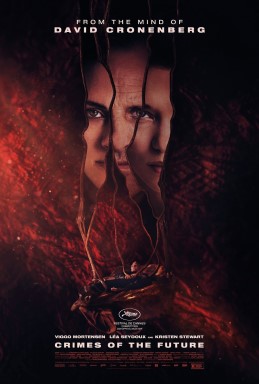
David Cronenberg’s name suggests a certain kind of body horror as unique as it is unsettling.  Crimes of the Future (2022) immediately reminded me of Existenz, which I watched many years ago.  Crimes of the Future is more difficult to understand, however, in part because it is shot dark and quite a lot of the dialogue is indistinct.  I happen to be reading a hard-to-follow book and my overwhelmed brain was hoping for a more straightforward narrative.  In any case, in the eponymous future, human evolution is such that it has to be regulated.  A performance artist couple puts on shows of surgery since he (Tenser) is constantly growing new organs.  They’re harvested as part of the performance.  Humans have evolved out of pain by this point, so surgery is done as art.

Meanwhile, a group has evolved to the point that they can eat plastic and toxic waste.  They demonstrate that physical modifications can be inherited, which puts them on the government’s wanted list.  Tenser and his partner, Caprice, own an automated autopsy table (who doesn’t?) that performs the autopsy while letting others watch.  The radical group wants to use this device to autopsy, as art, the child born with the ability to eat plastic (he’s killed at the beginning of the movie).  Also in the mix are a couple of crooked bureaucrats and a detective who seems sincere, but who has been working with an insider among the criminal group.  Eventually the autopsy occurs but it seems the boy’s insides had been surgically altered.  The leader of the radical group is assassinated and Tenser eats a toxic waste bar and dies.

If you’re saying “How’s that make sense?” you’re not alone.  Body horror isn’t my favorite.  Many of Cronenberg’s favorite themes are present here, but the film lacks a strong narrative.  Or at least one that I could follow.  Art house cinema often requires quite a bit of work from the viewer.  The atmosphere of this film, like Existenz, isn’t really horror, but it breezes into that territory.  Just when the horror—the surgeries—appears the social commentary kicks in.  That’s often true of body horror, a genre Cronenberg is credited with developing.  But I watch for the story as well as the mood.  Some movies are more about the images, I know.  And the future orientation makes some classify the film as science fiction.  It has more of a Blade Runner, dystopian feeling atmosphere, but without replicants.  Crimes of the Future, it seems, may require a better detective than yours truly to solve them.


A Different Village

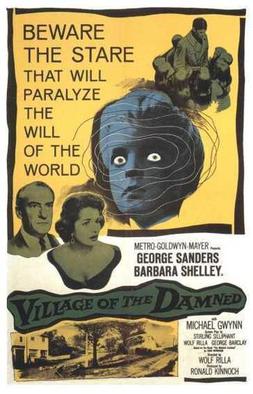
If I’m honest I’ll admit that I first found out about John Wyndham’s The Midwich Cuckoos from The Simpsons.  In one of the episodes, “Wild Barts Can’t Be Broken,” a “clip” is shown of a horror movie called The Bloodening.  A spoof on Village of the Damned, the scene caught my imagination and I was able to learn that it’d been taken from this movie.  This was many years ago, of course.  In any case, I went out and found a DVD of Village and found it less frightening than anticipated, but it left me curious.  It was easy enough to find out the book it was based on (it’s in the credits).  Now, well over a decade later I finally read it, but I’d forgotten nearly everything about the movie but the glowing eyes.  Having read the novel, I had to see the movie again.

Interestingly, the book is generally considered science fiction and the movie horror.  The two genres are closely related, of course.  The explanation for the children in the movie is a little sci-fi, but the framing is horror.  So much so that in Britain in 1960 it was nearly given an X rating (the censors didn’t like the glowing eyes).  As typical, when compared to today’s fare this is a tame little piece about some unruly children.  Of course they do get blown up at the end.  That may have been a spoiler.  I guess I can be unruly too.  In any case, sequences of self-harm, and even suicide, make this a reasonably scary movie.  The film has the same stiff upper lip that the book does, but otherwise it’s a modern horror classic.  I haven’t seen the 1995 remake, but it didn’t get very good reviews.

The movie doesn’t have as much moralizing as the novel does, but it raises the very real issue of how we socialize children.  I do suspect, however, that blowing them up when they’re all together is probably not the message they wanted us to take home.  Although far from a flawless film, this is quite intelligent for horror of the period.  Consensus is that horror “grew up” in 1968, but there were some premies, it seems.  Night of the Demon is another one from the period.  Horror has, I would argue, been intelligent from the start.  Dracula, although not a perfect story, has become a bona fide classic, and Frankenstein before it, had already been a literary touchstone for decades by the time the former was published.  Not bad for watching an episode of The Simpsons.


Special Delivery

Deliver Us is a horror movie intentionally built around religion.  It hasn’t been discussed much on the sites I frequent, but I suspect that it should be more.  Yes, it gets aspects of religion wrong, but then most religious horror does.  And it leaves a lot unexplained.   Again, most religious horror also does.  The cinematography is bleak and beautiful, evoking a winter chill.  The story is built around a made up prophecy, but do I really need to say it a third time?  Fr. Fox is a Catholic priest in Russia and a former exorcist.  Like Fr. Karras, he doesn’t believe in demons, but his bishop really wants him to go to a convent to check out a possible genuine miracle.  Fr. Fox is about to become Mr. so he can marry his pregnant girlfriend.  Since she has to go to Estonia for a while, she encourages him to do this one last thing for the church.

Meanwhile, signs are occurring that the end times are arriving.  In the convent a secret society called Vox Dei is harvesting prophecies from people’s backs.  What sways Fox to go is that a renowned cuneiformist, Cardinal Russo, is there.  Fox wrote his dissertation on “alphabetic cuneiform”—that’d be Ugaritic, folks.  Not explaining where they got the human-skin scrolls, Russo needs Fox’s help in figuring out the language (it turns out to be cuneiform Zoroastrian).  The miracle is a weeping Madonna statue, but there’s also an immaculately pregnant nun.  She has twins in her, one the Messiah and the other the Antichrist.  Fox doesn’t believe any of this but when he learns that the Cardinal is going to kill the babies to prevent the end of the world, Fox convinces him to give up the wicked plan and they escape with the nun.

This is enough to give you a flavor of the movie.  I won’t give up the resolution but I will say it ends up revolving around the end of the world.  In general this is a pretty intelligent movie.  It borrows quite a lot from other films, including The Omen and The Shining, but it is fun to watch (if you don’t mind a bit of gore).  The tension mounts as Vox Dei tries to find the escaped priest, Cardinal, and nun and there are some legitimately scary scenes.  It was written and directed by Lee Roy Kunz, who also plays Fox.  I do think this deserves more in-depth consideration and had it been out in time, and had I known of it, I would’ve included it in Holy Horror.


Bad Taste

There is a reason for watching bad movies, apart from the fact that they’re often found streaming for free.  Sometimes that reason is that they’re so bizarre that they’re almost surreal.  And sometimes the circumstances surrounding them are equally strange.  Michael Findlay’s Shriek of the Mutilated was included in the set of movies I bought for Zontar: Thing from Venus.  Not one to be wasteful, I’m finally dutifully watching these before allowing myself to purchase new fare.  Given the fact that this had a theatrical release, I’m surprised that it’s not compared more often with Ed Wood’s oeuvre.  In any case, this is a very convoluted story and spoilers will follow.  You’ve been warned.

An international group of demon worshipping cannibals have a member who’s a professor that takes students on a “yeti hunting” expedition every few years.  The students are all killed but one, so that the yeti story can continue.  Viewers (if any) aren’t clued in to this until the last few minutes of the film but early on you can spot the cannibal theme.  So four students in the professor’s Mystery-Machine-like van, go on a hunt while staying with a “colleague.”  Naturally the students start getting killed.

Using some of the worst dialogue ever written, the clueless coeds keep allowing themselves to be led into situations no sane person would.  The chosen “survivor” discovers the plot and is amazed that the creature was (blindingly obviously) a guy in a suit trying to scare them to death.  The cannibals prefer their meat with no bruises.  Much more could be said about the ineptitude of the movie but it ends up having an interesting, if tragic, coda.

Michael Findlay, who made exploitation films with his wife Roberta, was actually sliced to death in a helicopter accident on top of the (then) Pan Am Building in Manhattan.  This happened three years after this movie was released.  In those three years he’d directed eight more films, so his last movie before being mutilated was not the one in my Beast collection.  Quite often when I watch bad movies I have trouble finding any discussion of them at all.  Shriek of the Mutilated is discussed at some length in two books—not surprisingly published by McFarland (they have great pop culture titles).  Until I discovered this movie, in with ten others in a collection, I’d never heard about it.  Of course, the theatrical release was for drive-ins and was limited to Texas, Florida and California.  There can be a lot of information to dig out when people stoop to talking about bad movies.


Late Night

If you lived through the seventies, Late Night with the Devil will take you back a bit.  It’s one of the more creative possession movies I’ve seen, but what really makes it stand out is the insider winks plentifully on offer.  Jack Delroy is a late-night variety show host wanting to top Carson.  His ratings have been up and down, and he decides to make his 1977 Halloween episode his ticket back into the game.  His guests that night include a psychic, a James Randi-like debunker, and a parapsychologist and her demonically possessed charge, Lilly.  A character resembling Anton LaVey, Lilly’s father, had raised her to be a child sacrifice to the demon Abraxas.  The broadcast even mentions Ed and Lorraine Warren, as well as The Exorcist.  Someone knows what the paranormal scene was like in the seventies.

The psychic has authentic contact with what he believes is Delroy’s deceased wife and while the debunker, well, debunks him, the psychic nevertheless dies after a mysterious attack.  Delroy insists that the parapsychologist summon Lilly’s demon, while on stage.  The debunker claims that what the audience saw was a case of group hypnosis, but the demon finally attacks, killing everyone but Delroy and Lilly.  Toward the end the layers of claimed deception become so deep that it’s difficult to know, at first, how to interpret the ending.  Or whether you are supposed to “believe” the climatic demonic attack, of if you’re supposed to conclude that it was part of the mass hypnosis.  What is certain is that religion is front and center in this horror, but the demon ensures that in any case.

The taped pieces between segments of the show make it clear that this is all about ratings.  Indeed, Delroy sacrificed his wife’s health and life to try to break into the lead.  The real demon here is capitalism.  The desire to be on top has outweighed every other and hints are given throughout that Delroy isn’t as innocent as he pretends to be.  Still, the main thing is that the movie gets the paranormal seventies in America just about right.  The disturbing implication is that people are suggestible to the point of not being able to distinguish reality from manipulation.  That pall hangs over the entire movie plot as well as the ending.  This kind of meta critique isn’t intended to detract from what is really quite a good horror movie.  It is believable in the context of the world it devises, and that world includes demons.


Non-Demon

The psychological horror film The Neon Demon isn’t about a literal demon.  It’s a movie about rivalry between runway models in Los Angeles, but there isn’t a great deal of story.  And what story is told doesn’t really make sense.  Sixteen-year-old Jesse, who should probably technically be an orphan, has made her way to LA because all she has is her prettiness.  Some photos get to an agency that agrees to hire her.  The other young women become jealous of the attention Jesse receives.  Only one, Ruby, a make-up artist, befriends her.  The jealous models confront her, and the creepy hotel manager where she stays seems to prey on the women who are trying to break into the dream of the city of angels.  Jesse escapes to Ruby but Ruby’s interested in a sexual relationship that Jesse doesn’t want.  Ruby and two rival models kill Jesse and eat her.  This leads to the death of Ruby and one of the models.

Some of what I describe here is speculative since there are abstract, dream sequences thrown in and it’s not always clear what is going on.  I kept finding myself wondering if this was horror, as presented in the list where I found it.  The unrelenting male gaze could be considered horror for women, but the movie doesn’t take up that narrative.  There are a few male characters, and one of them actually seems to be a good guy, but the threat comes from the other women.  Reviews for the movie were deeply polarized.  Some declared it one of the best movies of the year (2016) while others gave it abysmal ratings.  At the box office it earned about half its budget back, and that budget was a respectful seven figures.

Horror is a difficult genre to define.  I keep coming back to the fact that it’s artificial.  The history of the term began with monster movies but eventually other films with dark themes were included.  Some have no monsters unless a human acting aberrantly counts (and some do count such as monsters).  Slashers have their serial killers and gothic tales have their haunted houses.  Well over seventy sub-genres of horror have been defined.  Casting about for freebies on the weekend leads to some that you just can’t pin down.  Neon Demon does, ultimately seem to fit the label, but many viewers will probably wonder exactly how.  Being out on your own can be frightening, and cannibalism is creepy, so I’ll go with that.


The Search Continues

This movie’s so bad there’s a backstory.  Years ago I was really wanting to see Zontar: Thing from Venus.  This was before streaming, and I found it as part of the “Beast Collection,” a set of 11 movies for less than the price of one regular first-run DVD.  I watched a few other movies in the collection, but before long it got shoved to the back of a shelf and forgotten.  I remembered it recently because another collection I have was missing a movie, Snow Beast.  I wondered if it might be part of this otherwise forgotten set.  It was (this really encouraged me because maybe my memory is still much better than I sometimes suppose).  In any case, one of the other movies—one I’d never seen—was Search for the Beast.  I figured, why not?  This is a film that fails on every level.  And I mean every single one.  It really should merit a Wikipedia page, just for being so bad.

So, a professor in Alabama goes in search of the beast in the Okaloosa mountains.  The budget for the movie must’ve been a matter of pocket change.  Anyway, the beast has been “killing” anyone who ventures into the mountains and the professor wants to prove it exists.  He’s backed by a guy with money, who isn’t explained at all, and his university office is less well equipped than an average undergrad’s dorm room.  He takes a female grad student with him but his financier, unbeknownst to the benighted professor, hires a bunch of beefy guys with assault rifles to go along, although they’re only going to take pictures.  Of course the professor sleeps with the grad student but then the head of the tough guys kidnaps her as the beast kills off the tough guys’ heavily armed posse.  Turns out the local hillbillies are, apparently, trying to mate the beast with the women who come into the woods.  It’s worse than I’m describing it.

There is some chatter on the internet about this groaner, so I’m sure that I’m not the only one who’s seen it.  Someone recently asked me how such movies even get made.  Well, anyone with a camera can shoot a movie.  Of course, getting paid screen time (or video distribution) is another story.  I doubt the makers of this film made much money off of it, but since other suckers like myself have discussed it online, the producer, director, writer, and actor Richard Arledge, has the last laugh.  His work is being talked about, no matter if nobody has a good thing to say about it.  Of course, I wouldn’t have ever seen it at all, if I hadn’t had a hankering for Zontar: Thing from Venus all those years ago. 


Dusk’s Early Dark

It may be the strangest vampire movie ever, and that’s saying something.  To understand this, you have to realize that I read as little as possible about a movie before seeing it.  I try to avoid trailers, and recommendations from well-wishers play a big part in my choices.  I came across From Dusk till Dawn in a couple of online lists and when I saw it was Quentin Tarantino and George Clooney, I doubted the vampire part.  Indeed, for the first twenty minutes to half hour I was convinced I’d stepped into Pulp Fiction 2.  (Tarantino wrote it, after all.)  Those kinds of movies unnerve me, and just when I was wondering if I’d made a mistake, it became a monster movie.  An action horror film.  Lots of vampires and, surprisingly lots of talk about God.

In case you haven’t seen it, Clooney and Tarantino are brothers out on a crime spree.  Harvey Keitel is an ex-minister out on a road trip with his teenage kids.  After his wife’s death, he lost his faith although he still believes in God.  (Classic theodicy.)  The criminals abduct the family to get them into Mexico where they’ve made a deal with a guy.  They meet at about the most salacious strip club you can imagine, one that caters only to truckers and bikers.  It turns out that the staff and strippers are all vampires and they prey on the patrons.  Okay, so the story doesn’t hold together.  Clooney’s character, which is hardly the sort you’d want anywhere near you, tells Keitel’s that unless he re-finds his faith none of them will make it out alive.

There’s quite a bit of humor packed into the over-the-top fight scene, including dialogue about how to defeat vampires.  A couple of the patrons, it turns out, are pretty adept at that sort of thing, but the human holdouts keep getting bitten and have to be killed.  Finally, the titular dawn arrives, leaving just Clooney and the minister’s daughter alive.  I couldn’t help but to be reminded of Willy’s Wonderworld, in overall story arc, but the two are completely different in tone.  The fact that the movie is 28 years old and that I’d only heard of it recently really surprised me.  Especially since religion is so heavily involved in the story.  Not only that, but the message about religion, in service of the story, is that belief is good.  And this from a murderer and a thief.  Strange indeed, but not easily forgotten.


Sowing Seeds

The Bad Seed is one of the scariest movies Stephen King lists from about 1950 to 1980.  Like many movies from before my time, I was unaware of it.  Projecting it back to 1956, when it was released, it’s pretty clear why it had trouble making it through the Production Code Administration.  Showing no blood or gore, this two-hour feature may seem to drag a little but it ends up in a very dark place.  I’ve never read the novel upon which it was based, but I’ve learned that the ending had to be changed because evil doers, according to the PCA, cannot go unpunished.  In fact, the ending is so dark that the director, Mervyn LeRoy, had the cast do a walk-on introduction when the movie was over, assuring the audience that this was just fiction after all.

The shock comes from a child psychopath.  So much so that Rhoda Penmark has become a character in her own right.  A sweet, innocent eight-year-old girl, she lies nearly as well as Trump and has skeletons in her closet.  Skeletons an adult shouldn’t have, let alone an eight-year-old.  Not only is she a sociopath, she’s convinced all the adults that she’s just as innocent as she acts.  The movie moves into psychological territory quite a lot, including a discussion of “nature or nurture” as the source of human evil.  The title of the film gives away the conclusion on that front.  Some children are born bad.  What’s more, this is the result of genetics, according to the story.  Rhoda is the child of an adopted woman—her adoption has been kept secret from her.  Eventually her father confesses that she was the child of a notorious serial killer, abandoned and adopted by loving parents.  Rhoda herself is raised in a loving, stable home, but she is her grandmother’s daughter.

I won’t spoil the ending, but I will say that if they had ended it at the hospital scene it would’ve been scarier.  The book, apparently, ends the scarier way.  I do have to wonder if Alfred Hitchcock was familiar with the tale in some form.  The movie was released four years before Psycho, but then again, that was based on Robert Bloch’s book.  Maybe he’d read the original.  In any case, I’d been watching King’s list of scary movies and mostly finding myself unbothered.  A couple of his choices: Night of the Hunter, and now The Bad Seed, have managed to rattle me a bit.  Even with its nearly seventy-year-old sensibilities, the latter still scares.


Victorian Inspiration

Some stereotypes hold the truth.  Since we couldn’t afford a vacation this summer, we arranged a couple of our versions of “staycations.”  For us that means driving some place a couple hours away, staying in a hotel for a night or two, and exploring a new place for the weekend.  We’ve done that to explore the Lancaster area and a couple of times to the Poconos.  When possible, and affordable, we like to stay in unusual places rather than the typical hotel.  For example, around Lancaster we try to book a caboose at the Red Caboose.  Since those are expensive over the weekend, typically we have to take a vacation day or two to do them before the weekend proper sets in.  On a trip to the Endless Mountains region, we stayed at the Victorian Charm Inn in Towanda.  This is a converted ten-bedroom house from the late Victorian era.  Not a typical hotel, it’s an inspiring place to stay.

What I mean by stereotypes is that such places inspire me to write in their genres.  After staying in the Red Caboose, I typically write fiction about trains.  I’d been on a gothic kick when we stayed at Victorian Charm and indeed, it inspired gothic writing.  Not that we could’ve afforded it, but when we were looking for a house, I really wanted to buy a Victorian.  We looked at a couple but neither one had been well kept up.  I thought they would inspire my writing.  Perhaps it would get old, living in such a house and reading Poe and other Victorian writers, but I wonder if it might have led to more gothic stories.  The fiction I do write tends to draw from my experience of living in various places.  Victorian mansions have a feel to them.

Writing is mostly a matter of discipline, rather than inspiration.  All writers, I suspect, crave inspiration.  I know that I do.  When I awoke to a thunderstorm in a Victorian mansion I experienced something that had never happened to me before in real life.  It made me wonder what it would’ve been like to have been able to live in such a place.  The cracked plaster, the faded elegance.  The nooks and alcoves.  An honest-to-goodness fainting couch.  And who knows?  Perhaps a ghost or two.  Our house was built in the Victorian Era, but by those of much more modest means.  It is an inspirational place to write, but it’s also the place associated with work.  That’s why, in stereotypical behavior, we need to get away on the occasional staycation.


Burial Zone

I don’t always believe the statistics.  Numerically, the number of horror films—depending on how the term is defined—declined into men (and sometimes women) in rubbery suits in the 1950s.  Indeed, it’s often opined that had not Hammer joined the horror business in the mid fifties that the genre born only twenty-something years earlier might’ve died out.  There seem to have been some good horror films made then, though, even if overlooked because of their B status.  A friend recently directed me to I Bury the Living, after reading my post about Carnival of Souls.  I have to confess to having never heard of I Bury the Living.  (Stephen King mentions it in Danse Macabre.)  Produced as a B movie it was itself buried among the various other efforts of the late fifties.  It’s not a bad movie, however.  In fact, it’s better than the title might lead you to believe.

The plot is something of a period piece—a well-respected department store supports a cemetery committee for Immortal Hills, the town’s graveyard.  Robert’s turn as chairman of the committee arises and he tries unsuccessfully to get out of the duty.  The caretaker, Andy, doesn’t want to retire, but he’s aging out.  The movie, however, revolves around the map.  The sold plots are marked with white pins while the plots already occupied have black.  When Robert accidentally puts black pins into newly purchased plots and the couple dies, he believes he’s cursed with an ability to kill those he black pins.  He substitutes a black pin for a white one at random.  The person dies.  In all, seven people succumb.  Convinced he’s murdered them, Robert decides to bring them back to life but putting the white pins back.  Only at this point does Andy confess that he’s been killing the victims in retaliation for being forcefully retired.

The ending is a little weak, but the psychological tension as it builds up is believable.  One critic compared it to an extended episode of The Twilight Zone, a comparison that has also been made for Carnival of Souls.  I would concur with that observation.  Although Twilight Zone wouldn’t air for another year, that kind of unsettling tale was already in the air.  No zombies appear, but the palpable belief that they might is what really makes the horror work in this instance.  The first half is an eerie story, but when Robert sticks in that first white pin a shift takes place.  Of course, modern viewers have been primed by Night of the Living Dead, so we know the possibilities.  Perhaps the power of Night gives life to older movies.  After all, anything can happen in the Twilight Zone.


Stupid Burnt Lizard

The kaiju monster film has evolved significantly, as my post on Godzilla Minus One may indicate.  Monster boomers grew up with Saturday afternoon kaiju, although we never heard that word.  (Or at least I didn’t.)  Godzilla was the most famous, but some people trace the origins of the idea to King Kong.  The kaiju, or “strange beast,” genre features outsized monsters that, when they come in contact with civilization, wreak havoc.  Many are primarily symbols of atomic fear, and after watching Godzilla again, I settled down one uncomfortably hot summer afternoon to watch Monster from a Prehistoric Planet, a wildly misleading title for a movie also called Gappa, which is more accurate but less eye-catching.  A gappa is a “triphibian beast” that does equally well on land, water, or in the air.  I do have to wonder if Michael Crichton saw this film before coming up with the idea for Jurassic Park.

A wealthy publisher wants to open a tropical island resort in Japan.  (You see?)  He wants to fill it with exotic animals, and among those in the model are dinosaurs.  His expedition to collect specimens leads a Japanese crew to discover a newly hatched gappa, which they take back to Japan.  (The publisher, concerned that their find has been exaggerated, utters the title of this post.)  Meanwhile, back on Obelisk Island, the gappa parents return and aren’t pleased to find their baby gone.  They head to Japan to stomp around, Godzilla style.  It takes the sole survivor from Obelisk Island, a young boy, to figure out that the parents really only want their baby back.  The publisher, scientist, and journalist (all male) don’t want to give it up.  The female lead, also a journalist, convinces them that they must.  Japan is saved.

Kaiju have more recently become somewhat believable, and even a bit scary.  The monsters themselves seem to be metaphors.  It’s no accident that these early movies, such as Gappa, expend much of their screen time on explosions.  From the artificial volcano on Obelisk Island to the model tanks and missiles, to the plumes rising as the gappa lead to destruction, things are always blowing up.  The Japanese think at first that “Gappa” is a god, but the local boy who survives is emphatic that “Gappa” is “no god.”  Yet the locals are careful not to raise their wrath.  These movies aren’t great in any traditional sense, but they are imbued with reminders of war—no god—and the lasting damage it causes.  And the wealthy can lead to the destruction of many cities for the sake of making money off of a stupid burnt lizard.


Television

Television has lost its prominence in the internet age.  Those of us entering the “senior” category of life’s grades were raised on television.  I know I watched far too much as a kid.  Now I consider the wasted opportunity to grow minds, and sensibilities, through television.  Mostly I blame the sit-com.  There’s not much learning going on when someone else contrives scenarios to make you laugh on a weekly schedule.  They are beguiling and I watched more than my fair share of them when I was younger.  Now, as an adult, I value the more profound examples of early viewing.  We didn’t watch The Twilight Zone with the devotion of Gilligan’s Island, but those episodes I did see had a profound effect.  The same is true of Dark Shadows.  One thing these shows had in common was that they were quite literate, eschewing the mindless competition.

College led to me no longer watching television regularly.  That hiatus lasted until my wife and I began watching a couple of weeklies after I’d return from Nashotah House.  While at the seminary full-time, television reception was quite poor and we tended toward rented movies on VHS.  By the time we moved to New Jersey television had changed so that you needed some kind of magic box to watch even commercial channels.  We relied on DVDs of shows we wanted to see.  That’s how Lost came into our lives.  Now, however, facing senior issues (health, people dying, wondering if retirement might ever happen) I’ve started to revisit television I missed.  The X-Files is pretty prominent.  Being an historian at heart, I’ve been exploring the inspirations for The X-Files, picking up Kolchak: The Night Stalker, and Twin Peaks.  I have to balance this with time for writing since work still claims the lion’s share of my waking hours.

Photo credit: Smithsonian Institution, via Flickr’s The Commons

I’ve lost track of what’s on the tube.  Now we spend workday evening hours watching intelligent television that we missed back when it aired.  We can’t afford it all, of course.  Dark Shadows, for example, has over 1200 episodes and “complete sets” are pricey.  Lost was either a birthday or Christmas present years ago.  I bought The Twilight Zone over a decade ago for a week that I knew I was going to be home alone.  We accumulated The X-Files over a number of years.  Twin Peaks, since it was only two seasons, wasn’t too expensive.  Kolchak is on Amazon Prime.  Many of these shows are a kind of therapeutic watching for me.  Some might call it escapism, but it runs deeper than that.  It becomes part of who we are.


Fun Homework

I recently discussed the two Kolchak movies: The Night Stalker and The Night Strangler.  In those posts I noted that I’d not grown up with Kolchak.  My reason for watching them was part of a self-assigned homework project.  You see, I’d begun watching the series online.  I realized backstory was missing, and, despite what literary critics are fond of saying, I like backstory.  After a couple of episodes I decided I needed to see the movies before moving through the rest of the series.  As it turns out, you can do the movies without the series or the series without the movie.  Regardless, I soldiered on through all twenty episodes.  This series was terribly influential for the kinds of things I eventually cottoned onto.  Kolchak was formative for the X-Files and many “monster of the week”-formatted series.  I felt like a poser having never had watched it.  This telinematic experience was good homework.

Originally a television movie produced by Dan Curtis, of Dark Shadows fame, the first film was successful enough (very successful, in fact) to cause a second one.  The second film also performed well, but instead of a planned third, ABC decided on a weekly series instead.  Only twenty episodes were aired and the run was cancelled before all the ordered episodes were filmed, or even scripted.  Still, this small franchise had a solid following and led to a number of other successful franchises in its wake.  The monsters are definitely fun, but Darren McGavin’s Kolchak does tend to get on your nerves after a while.  Even McGavin was reputedly ready to leave the show as things started to get pretty silly near the end—an animated suit of armor, a very cheap humanoid-alligator, and Helen of Troy hardly seemed conventional monsters.  

In fact, the Helen episode (“The Youth Killer”), although it had a solid premise, didn’t convince that Helen was a monster.  She prays to Hecate to steal the youth of “perfect” young people around Chicago and rejuvenates herself as the twenty-somethings age and die in a matter of minutes.  And a Greek cab driver (former Classics teacher) is the one who helps Carl crack the case.  Famous for its quirky humor, this one just seemed to have all engines fail.  Of course, the series lived on as a cult classic and can be found in a variety of media today.  I’m glad to have had this particular homework assignment.  Television had a number of influential shows in the seventies, and it feels like coming home to have caught up on one that I initially missed.  Even with Cathy Lee Crosby and a monster I just couldn’t buy.


Two-Eyed Cyclops

You can probably tell, if you read me regularly, that I’ve been going through an older movie kick.  A lot of these are easier to find for free on streaming services, so that’s been the path of least resistance.  So it was that I came to watch Doctor Cyclops.  I’d completely forgotten that I’d watched it about fourteen years ago.  In any case, a kind of precursor to The Incredible Shrinking Man, it’s the story of the deliberate shrinking of five people by a mad scientist with an endless supply of radium at hand.  The movie made a splash because of the use of Technicolor in a horror film (with no blood, however).  The story is a touch dull and the shrunken people (three scientists among them) spend most of their down time running around and saying very little.  They do face an alligator, which is kind of fun, and the big hand that holds the pompous Dr. Bulfinch is distinctly unnerving.  The movie received an Oscar nomination for visual effects.

There’s something distinctly enjoyable about these early sci-fi horror films that don’t explain much but nevertheless manage to employ some impressive cinematography.  The use of oversized props and forced perspective make much of this possible, perhaps making up for the simplicity of the tale.  Even by 1940 the “scientist goes mad and must be stopped” narrative was getting old.  The Second World War was underway but nuclear power wasn’t yet harnessed either for bombs or energy.  Interestingly, the source of the mad doctor’s radium is pitchblende, which one of the characters notes, is a source of uranium.  Of course, many movies were to follow where radiation mutated life forms in various ways, including shrinking them.

Coincidentally—it was a rainy Sunday afternoon—I watched the Twilight Zone episode “The Little People” later in the day.  Here was another story about the large oppressing the small.  This one, however, has a stranded astronaut who discovers the little people thinking that he is their god because he has the power to harm them.  The message here is much more profound, even if told with more brevity.  No clear motive is given for Dr. Cyclops’ work beyond his interest in pure science.  By the way, his real name isn’t “Cyclops.”  That refers to his being a giant with one eye—the latter because one of his glasses lenses gets broken.  Don’t worry, the shrunken people learn that the effect is temporary—their brush with radioactivity leaves no lasting harm.  There is, however, a decided danger to desiring to return to a “simpler time,” as Mr. Serling steps in to remind us.