Whose Story?

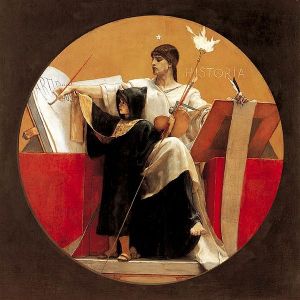
nikolaos_gyzis_-_%ce%b7istoria

What really happened? I grew up thinking that reading history gave the answer to that question. In fact, it is a viewpoint that I still struggle against. You see, historians try to marshal as many facts as they can to support their reconstruction of events in the past. Somethings, clearly, “really happened.” What those things are, however, depends on your point of view. For example we know that the twentieth century was dominated by wars and economic crises. Apart from a few periods when things seemed largely okay, it was a century of leapfrogging crisis after crisis. Historians pick a set of circumstances in this mix—let’s say the Second World War—and try to explain what led to certain results. But what if we stop to think about such events from another point of view? What if we think about it from the perspective that “nations” are purely fictional inventions? Who wins such a conflict?

This is more than an idle thought-experiment. We, as people, base our self-perception on how we view our personal histories. It can be quite jarring to have someone contradict our own personal narrative of “what really happened.” I’ve run into that from time to time—my reconstruction of events is not the same as someone else’s reconstruction. Who’s right? There’s no objective history. There are only events viewed from multiple angles. Turn the clock back a few centuries—was Jesus of Nazareth a political criminal (the Roman point of view), or a great sage out to save the world (a Christian point of view)? And these are only two out of many possible views of a political execution.

As we enter an era of post-truth politics, we’re going to find more and more historical events questioned. Facts have lost the anchoring functions they used to have. Historians built narratives by stepping from fact to fact, like using a series of stones to cross a river. They can’t tell us what really happened, but they can make sense out of an otherwise confusing stream of chaotic events. The thing about history, however, is that you have to read it to understand. Certain things we’ve pretty much all come to agree upon are now being questioned by those who see everything through the lens of capitalism. Money changes history. It is a narrative of great power as long as everyone agrees it’s true. What really happened? I think we may have all been too quick to accept what economists have told us and we have fabricated a fictional story that we can all believe.

Revisionist History

I recently came across a website with academic papers available on it.  Although the internet has yet to achieve its promise as a locus of solid academic material, such sites are becoming more common.  I’ve been uploading my own papers onto Academia.edu since they seem to be old enough not to impact anyone’s sales aspirations.  In any case, this particular website I found noted that a paper had been updated at such-and-such a time, and that anyone who had downloaded the previous version should delete it and use the new one instead.  This is a dilemma.  I know of publishers who make corrections without issuing new editions.  When I buy a book, what it actually says will depend on the printing rather than on the edition.  I wonder if such retractions are really fair.  How does one know when she’s reading something outdated?
 
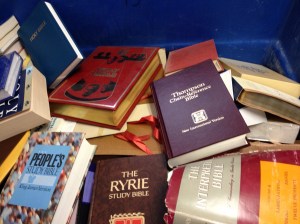
Picture this: a young kid, perhaps an unknowing fundamentalist, reading his Bible.  Then he gets a newer copy of the same translation.  But soon he notices that there are differences.  Although the example may sound overly Talmudic, it is factual.  Bibles, being printed in large quantities, are especially susceptible to error.  When did the printed word become something that’s negotiable?  I’ve been pondering clay tablets and their apparent immutability.  Contrary to popular belief, most clay tablets weren’t fired—it was a lot of effort for something that had limited value.  Some tablets show signs of erasure or additional words being added.  In the case of clay, this is often very clear.  Besides, the readers were few and specialists.  They knew what they had.  But for a modern person staking the salvation of her soul on a document, is it not problematic to change a jot or tittle (of which not the least shall pass away)?  Has technology made us immune to fixed texts?
 
Back to the website I found.  What if I downloaded the faulty paper and wrote my own paper based on it?  How would I know to go back and check to see if a new version had been uploaded?  Am I to spend all my time revisiting web pages to see what has changed?  Knowledge itself seems now to have become whimsical.  What is true depends on the date and time you accessed it.  Perhaps I’m just a dreamer, but there was a time, it seems to me, before post-modernism, when you might purchase a book and be fairly certain of what you had.  Errata sheets (or the more fancy addenda et corrigenda) didn’t intrude into the typeset page.  You could still read correctly, assured that someone had spotted and acknowledged the mistake.  We have, I fear, outlived the need for sic.  And it is only a small step from siclessness to truth that changes second by second. Is this the siclessness unto death?

IMG_1363