
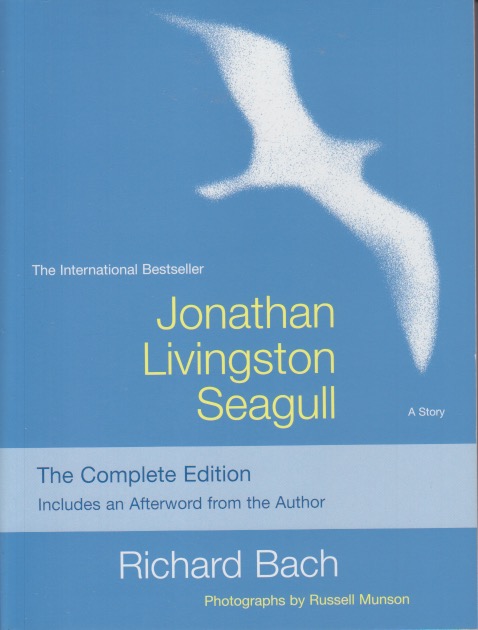
It was a seventies thing. Even though I lived in a small town, even I had heard about Jonathan Livingston Seagull. At first I didn’t know it was a book. (A similar thing happened to me in the nineties with a character named Harry Potter.) It was probably in college that I learned this was a book I should read. I did, and I followed it up with Illusions, also by Richard Bach. Now, this was unorthodox stuff. These novels consider what some would call superhumanities and others self-deification. The two are related. In any case, Jonathan Livingston Seagull is a story about a seagull that overcomes limitations. An inspirational book. The publisher had no great expectations for it but it ended up becoming a number-one bestseller without any real marketing support, largely through word of mouth. You’d have had to have been living in a cave in the seventies not to have heard people mentioning Jonathan Livingston Seagull, whether bird or book.
I got a hankering to read it again but alas, it was one of the books destroyed in the flood. I went to a local bookstore and was disappointed to see that it was out in a new edition—larger, and, of course, more expensive. Longing eventually overcame reluctance and I bit the bullet. I’m glad I did. The story is still as empowering as I remembered it, but the fourth part, the new one, strikes me as very necessary. In it, rumors of the disappeared Jonathan Livingston Seagull have turned him into a god. A god, moreover, whose followers are more interested in the orthodoxy of ritual than what he taught. This was published before Trump’s first election, but it accurately describes what “Christianity” has become under his two-pronged reign of terror.
The idea of Christianity itself has become deified to the point that Jesus—what he did and taught—have become completely irrelevant. Now, you don’t have to walk all the way with Richard Bach (I read the two books after Illusions as well, The Bridge Across Forever and One), but this book has a message that still rings true after all these years. The book is over half-a-century old now and I am glad that it’s having a small resurgence. The message, when the book ended at part three, was perhaps a little lighter. We still, however, have to learn to overcome limitations. And there’s a fair amount of wisdom in this little book. Even though it was a seventies thing, it remains a good thing.
 Steve A. Wiggins