
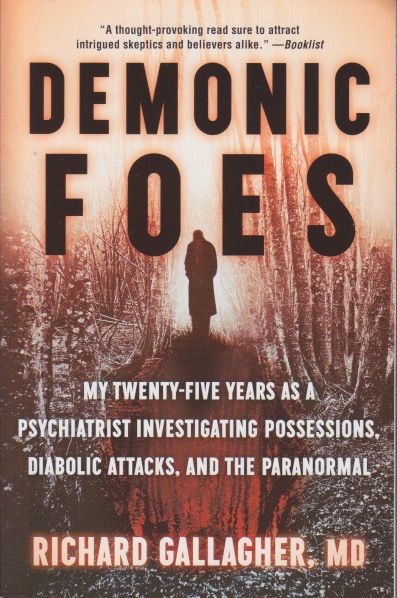
Exorcism is sexy these days. I fully understand why $100 books on it escape attention, but I’d been looking for Richard Gallagher’s treatment since 2016 when I learned that he was writing it. Demonic Foes is, however, a little disappointing. As I am wont to do, I tried to find information on the author only to discover that he appears on many webpages but really has no online presence himself. He teaches as Columbia but his page there is minimal as they come. The book, which I suspect easily caught an agent’s eye (see my opening sentence), is a rambling tour—very roughly chronological—through the author’s experiences with and thoughts about demons. I’m left puzzled, however, about why he maintains the secrecy around his priest mentors, although they are dead. Believe me, I understand withholding names, but if you’re trying to convince people, we need something to go on.
There are some interesting, and scary cases here. But Gallagher also gives nods (somewhat skeptically) to Malachi Martin, but also to Lorraine Warren, and Fr. Gabriele Amorth. At times he easily moves between movies and actual events. His writing style at times obfuscates, unintentionally, I expect. Before too long it becomes clear that, as a Catholic, the author distrusts anything occult, paranormal, or parapsychological. At one point he suggests assuming spirits are demonic until you can prove otherwise. At the same time, he suggests possessions are rare. I’m left wondering about a number of things. There’s no bibliography and his knowledge of the ancient world isn’t that of a specialist. Even his history of demons doesn’t address the nuanced issue of how Christianity came to understand demons as the New Testament seems to. He gets some facts wrong about other religions.
I’m no stranger to cobbling books together while working full-time and trying to hold daily life together. You can hire book coaches (if you afford them) and not all editors are willing to tamper with money. (Trade publishers do what they do for lucre, don’t you know.) Demons are a controversial subject. The tired orthodoxy of demonizing other religions still holds for some, and it seems to here as well. This rambling book raises more questions than it answers: which exorcisms did the author witness? Why are non-Catholics said to have rosaries? Why are verifying names kept secret? If wanting to convince people, why are so few dates or precise places given? I appreciate what Gallagher is trying to do and I agree with him that we need to avoid dismissing demons because they don’t fit a scientific worldview. As he admits in the epilogue, he holds a traditional view of what demons are. I’m left wondering what we might find if science would take the paranormal seriously.
 Steve A. Wiggins